Bachelor of Health Science in USA: Universities, Fees & Scholarships

Jun 05, 2026
The United States is home to some of the most advanced health education systems in the world, and a Bachelor of Health Science from a US university opens doors across clinical practice, public health, research, and healthcare administration simultaneously.
For Nepalese students who want a healthcare career with a broad scope, strong earning potential, and genuine flexibility in terms of specialization and further study, a Bachelor of Health Science in the USA offers a uniquely versatile foundation. Nepalese students who are still exploring their destination options can start by looking at studying in the USA before committing to a specific program.
In this guide, we cover everything a Nepalese student needs to know about pursuing a Bachelor of Health Science in the USA, from top universities and admission requirements to tuition costs, scholarships, career roles, salary expectations, and work authorization pathways.
In this blog
What Is a Bachelor of Health Science in the USA?
A Bachelor of Health Science (BHS) in the USA is a four-year undergraduate degree that provides students with a broad, interdisciplinary foundation in the biological, social, and administrative dimensions of health and healthcare. It sits at the intersection of clinical science, public health, and healthcare management, making it one of the most versatile health degrees available at the undergraduate level.
It is important to understand how a Bachelor of Health Science differs from other health degrees. Medicine and nursing are clinically focused professional degrees that train students for direct patient care. Public health focuses specifically on population-level disease prevention and health promotion. A Bachelor of Health Science, by contrast, is a broader degree that spans multiple health disciplines, giving students enough depth in each area to pursue a wide range of careers or to use the degree as a stepping stone into more specialized postgraduate study.
This dual purpose is one of the most important things Nepalese students need to understand before applying. Many BHS graduates in the USA use the degree as a direct entry point into careers in healthcare administration, clinical research, health education, and public health analysis. Others use it as a pre-professional pathway into medical school, physician assistant programs, master of public health degrees, or healthcare management master's programs. The degree works both ways, and this flexibility is one of its greatest strengths.
Why Study Bachelor of Health Science in the USA?
Study a Bachelor of Health Science in the USA because it offers globally recognized degrees, access to world-class research and medical facilities, strong career demand across multiple health sectors, a clear pathway into graduate study in medicine and public health, and work authorization through OPT and H-1B after graduation. For Nepalese students who want a health career with broad scope and strong long-term growth potential, the USA provides an education that is difficult to match anywhere else. This is a key part of why Nepalese students choose the USA for health and science programs.
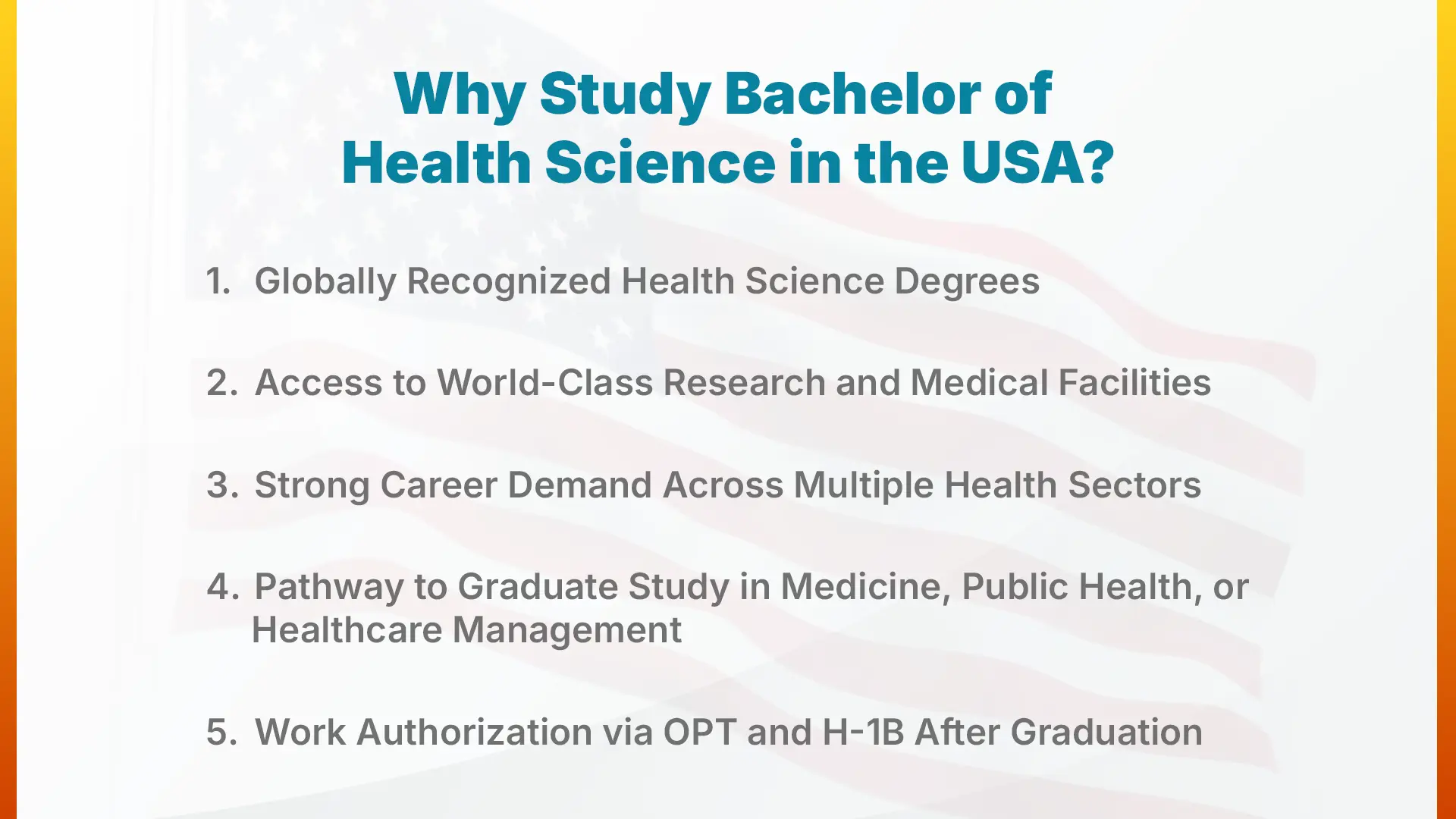
1. Globally Recognized Health Science Degrees
A BHS from a US-accredited university is recognized by healthcare employers, graduate schools, and professional bodies across North America, the UK, Australia, and beyond. For Nepalese graduates, a US health science degree creates genuine international career flexibility and is a respected credential across multiple health sectors worldwide.
2. Access to World-Class Research and Medical Facilities
US universities invest heavily in health research infrastructure, simulation laboratories, and clinical partnerships with leading academic medical centers. Students at institutions like Johns Hopkins, George Washington University, and the University of Florida have access to research programs and clinical environments that are at the forefront of global health science, giving them a depth of exposure that significantly enhances their graduate school and career prospects.
3. Strong Career Demand Across Multiple Health Sectors
The US healthcare sector is the largest in the world by expenditure and employs more people than any other industry in the country. Health science graduates are actively recruited across hospitals, public health agencies, pharmaceutical companies, insurance organizations, research institutions, and government health departments. The Bureau of Labor Statistics projects strong and sustained growth in health-related occupations over the coming decade, making this one of the most employment-secure degrees available in the USA.
4. Pathway to Graduate Study in Medicine and Public Health
A Bachelor of Health Science is one of the strongest pre-professional platforms available in the US education system. Graduates with strong GPAs and research experience are competitive applicants for medical school, physician assistant programs, Master of Public Health degrees, Doctor of Physical Therapy programs, and healthcare administration master's degrees. For Nepalese students with long-term ambitions in medicine or advanced health practice, a BHS provides the right academic foundation.
5. Work Authorization via OPT and H-1B
International students who complete a BHS in the USA are eligible for Optional Practical Training (OPT), which allows up to 12 months of full-time work in a health-related role after graduation. Health science qualifies as a STEM-adjacent field at many institutions, and graduates who move into data-driven health roles may be eligible for the 24-month STEM OPT extension, providing up to 36 months of authorized work experience before needing employer sponsorship for an H-1B visa.
Top Universities Offering Bachelor of Health Science in USA
The top universities offering a Bachelor of Health Science in the USA include Johns Hopkins University, University of Florida, Arizona State University, George Washington University, University of South Florida, and Drexel University, each offering strong programs with research integration, clinical exposure, and dedicated support for international students.
Choosing the right university depends on your academic profile, career goals, preferred location, and budget. Nepalese students who want a broader view before shortlisting can explore the best universities in the USA for international students.
1. Johns Hopkins University
Johns Hopkins in Baltimore is consistently ranked as the number one public health and health science university in the world. Its undergraduate health science programs are deeply research-integrated and benefit from the university's extraordinary clinical and research infrastructure, including the Johns Hopkins Hospital and Bloomberg School of Public Health. For Nepalese students with exceptional academic profiles, Johns Hopkins represents the gold standard for health science education in the USA.
2. University of Florida
The University of Florida's College of Public Health and Health Professions in Gainesville offers a well-regarded Bachelor of Health Science program with strong concentrations in health services administration, rehabilitation science, and public health. UF is a large public research university with affordable tuition relative to private institutions and excellent graduate school placement rates for health science students.
3. Arizona State University
Arizona State University offers one of the most accessible and well-structured Bachelor of Health Science programs in the USA, with flexible online and on-campus options and a strong emphasis on health promotion, community health, and healthcare systems. ASU is particularly popular among international students for its welcoming campus environment, large international student support infrastructure, and its location in Phoenix, one of the USA's fastest-growing healthcare markets.
4. George Washington University
George Washington University's Milken Institute School of Public Health in Washington DC offers a strong undergraduate health science program with unique access to federal health agencies, international organizations, and policy institutions located in the US capital. GWU students benefit from internship and research opportunities that are simply not available at universities outside Washington, making it an exceptional choice for students interested in health policy and global health.
5. University of South Florida
The University of South Florida in Tampa offers a Bachelor of Science in Public Health with strong concentrations in epidemiology, environmental health, and community health practice. USF is a large research university with a well-established College of Public Health and strong clinical partnerships across the Tampa Bay healthcare system. It is also one of the more affordable options for international health science students among major US research universities.
6. Drexel University
Drexel University in Philadelphia offers a Bachelor of Science in Health Sciences with a distinctive cooperative education model that integrates paid work terms with academic study throughout the degree. Drexel's co-op program gives health science students real professional experience in healthcare settings before they graduate, building a portfolio and professional network that significantly strengthens their graduate school and career applications.
Eligibility and Admission Requirements for Bachelor of Health Science in USA
The eligibility and admission requirements for a Bachelor of Health Science in the USA include completion of Grade 12 or Plus Two with a strong background in biology and science, English language proficiency through IELTS or TOEFL, a personal statement, letters of recommendation, and medical and financial documentation. Meeting these requirements thoroughly is essential for securing admission at a reputable US university for health science.
1. Academic Requirements
Applicants must have completed Grade 12 or Plus Two with strong results, particularly in biology, chemistry, and mathematics. Most US universities require a minimum GPA equivalent of 3.0 on a 4.0 scale, though competitive programs at Johns Hopkins and GWU require significantly higher academic profiles. A background in science subjects is strongly preferred, and students with distinctions in biology and chemistry are at a clear advantage during the admissions process.
2. English Language Requirements
All BHS programs in the USA are taught in English, and international applicants must demonstrate proficiency through an approved language test. Standard requirements are:
IELTS Academic: minimum overall score of 6.0 to 6.5, with no individual band below 6.0
TOEFL iBT: minimum score of 79 to 95, depending on the university
PTE Academic: minimum score of 53 to 65
Nepalese students who need to improve their score before applying can enroll in IELTS preparation classes to reach their target band.
3. Personal Statement and Letters of Recommendation
Most universities require a personal statement explaining your motivation for studying health science, your academic background, any healthcare or volunteer experience, and your long-term career or graduate study goals. Two to three letters of recommendation from science teachers or healthcare supervisors are typically required. Nepalese students can follow the SOP format for USA universities to understand exactly what US admissions panels look for.
4. Medical Fitness and Financial Proof
Some programs require incoming students to submit immunization records before beginning any clinical observation components. For the F-1 student visa application, students must provide financial documentation demonstrating they can cover the full cost of tuition and living expenses for at least the first year. The documents required for an F-1 visa cover the full checklist so you can prepare well in advance.
How to Apply for a Bachelor of Health Science in the USA?
The admission process for a Bachelor of Health Science in the USA involves six steps: researching and shortlisting universities, preparing your documents, submitting your application, writing your SOP and reference letters, receiving your offer letter, and applying for the F-1 student visa. Approaching each step with proper preparation well in advance of deadlines gives Nepalese students the best possible chance of a successful outcome.
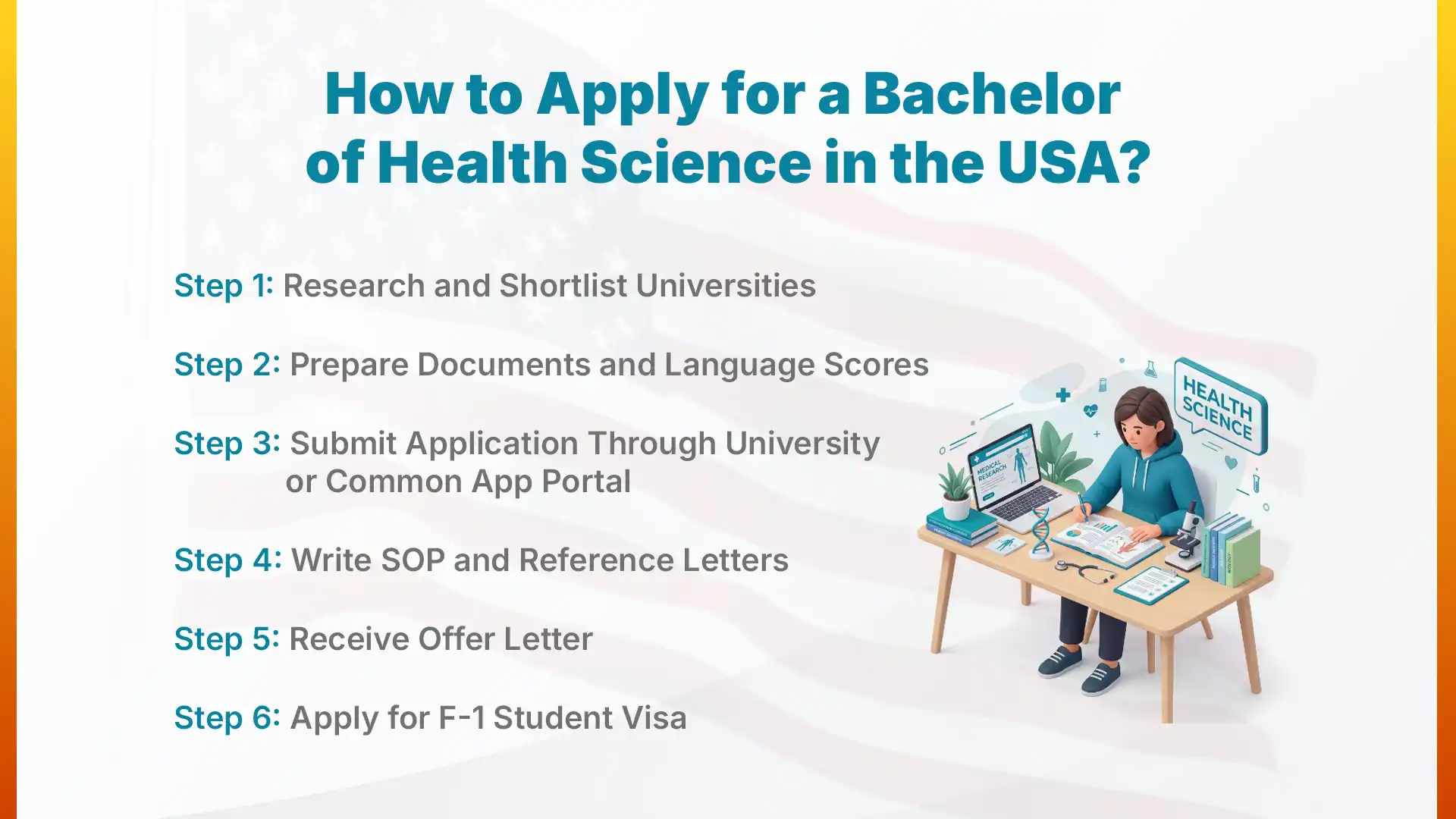
Step 1: Research and Shortlist Universities
Compare BHS programs based on your academic profile, program concentrations, research opportunities, tuition fees, and scholarship availability. Shortlist three to five universities to give yourself the best chance of receiving at least one offer.
Step 2: Prepare Documents and Language Scores
Gather your Plus Two transcripts, mark sheets, school leaving certificate, and character certificate. Book your IELTS or TOEFL exam early so your scores are ready before application deadlines, which typically fall between November and January for September intake.
Step 3: Submit Application Through University or Common App Portal
Most US universities accept applications through their own online portals or through the Common App platform. Pay close attention to individual program deadlines as health science programs at competitive universities fill quickly.
Step 4: Write SOP and Reference Letters
Your Statement of Purpose should clearly explain why you want to study health science, what healthcare or community experiences have shaped that decision, and whether your long-term goal is direct employment or graduate study. It is also worth understanding what makes a strong letter of recommendation before approaching your referees.
Step 5: Receive Offer Letter
The university will issue a conditional or unconditional offer after reviewing your application. A conditional offer typically requires you to complete your Plus Two with a specified minimum score before your place is confirmed.
Step 6: Apply for F-1 Student Visa
Once you have accepted your offer and received your I-20 form, apply for the F-1 student visa through the US embassy. This involves paying the SEVIS fee, completing the DS-160 application form, and attending a visa interview.
Cost of Studying Bachelor of Health Science in USA
The cost of studying a Bachelor of Health Science in the USA generally ranges from USD 18,000 to USD 50,000 (approximately NPR 2,430,000 to NPR 6,750,000) per year in tuition fees, depending on whether the university is public or private.
When combined with accommodation, food, health insurance, and other living expenses, Nepalese students should budget approximately USD 35,000 to USD 70,000 (approximately NPR 4,725,000 to NPR 9,450,000) per year in total. While the cost to study in the USA is higher than Canada or Australia, the career and graduate study outcomes for health science graduates justify the investment for students who plan strategically.
1. Tuition Fees
Tuition fees vary significantly between public and private universities. Public universities offer lower tuition rates even for international students due to state government funding, while private universities charge higher fees that reflect their research investment and smaller class sizes.
University Type | Annual Tuition (USD) | Annual Tuition (NPR approx.) |
|---|---|---|
| Public Universities (e.g., USF, ASU, UF) | USD 18,000 – USD 32,000 | NPR 2,430,000 – NPR 4,320,000 |
| Private Universities (e.g., GWU, Drexel) | USD 35,000 – USD 50,000 | NPR 4,725,000 – NPR 6,750,000 |
2. Living Expenses
Monthly living expenses vary significantly by city. In Washington DC and Philadelphia, students should budget USD 2,000 to USD 3,000 per month. In more affordable university cities such as Gainesville, Tampa, or Phoenix, monthly costs typically range from USD 1,200 to USD 2,000. On-campus accommodation and shared housing are the most cost-effective options for international students.
3. Total Estimated Cost
Taking tuition, accommodation, food, transportation, health insurance, and miscellaneous expenses into account, Nepalese students should budget approximately USD 35,000 to USD 70,000 per year. For a four-year BHS degree, the total estimated cost ranges from USD 140,000 to USD 280,000 (approximately NPR 18,900,000 to NPR 37,800,000), making early scholarship applications and financial planning essential for most Nepalese students.
Scholarships for Bachelor of Health Science in USA
Scholarships for a Bachelor of Health Science in the USA include US government and federal awards, university-specific merit scholarships for international health science students, and external healthcare foundation grants. While fully funded scholarships for international undergraduate students in the USA are limited, partial scholarships and tuition waivers from universities can meaningfully reduce the overall cost for high-achieving Nepalese students.
1. US Government and Federal Scholarships
The most relevant government-level funding for international health science students comes through the Health Resources and Services Administration (HRSA), which supports students who commit to working in underserved communities after graduation. The Fulbright Foreign Student Program is also available for postgraduate study and is worth planning for as a next step after completing the BHS.
2. University-Specific Health Science Scholarships
Most universities offer merit-based scholarships to high-achieving international applicants. These include:
ASU New American University Scholarship up to USD 10,000 per year for eligible international students
Drexel University International Student Scholarship: merit-based partial tuition award
University of Florida International Student Scholarship available to strong academic applicants
GWU Presidential Academic Scholarship: merit-based award for exceptional incoming students
3. External Healthcare Scholarships
Several professional organizations and foundations offer scholarships for health science students in the USA, including awards from the American Public Health Association (APHA) and various state health foundations. Students are encouraged to research current offerings through their university's financial aid office.
4. Tips to Increase Scholarship Chances
Apply as early as possible before scholarship deadlines
Maintain the highest possible Plus Two GPA in biology and science subjects
Include any healthcare volunteer or community health experience in your application
Write a focused personal statement connecting your background to your health science goals
Apply to multiple scholarships simultaneously
Career Opportunities After Bachelor of Health Science in USA
Graduates with a Bachelor of Health Science from the USA can pursue careers as healthcare administrators, public health analysts, clinical research coordinators, health educators, and medical and health services managers across hospitals, government agencies, research institutions, and NGOs. The USA's large and growing healthcare sector means that BHS graduates have immediate and consistent demand across multiple career pathways.
1. Healthcare Administrator
A healthcare administrator manages the operations of hospitals, clinics, and health departments, overseeing budgets, staffing, compliance, and service delivery. This is one of the most common and well-compensated career pathways for BHS graduates in the USA.
2. Public Health Analyst
A public health analyst collects and interprets health data to identify disease trends, evaluate health programs, and support evidence-based policy decisions for government agencies and research institutions.
3. Clinical Research Coordinator
A clinical research coordinator manages and oversees clinical trials and health research studies, coordinating between patients, physicians, and research teams. This is a highly in-demand role across the USA's large pharmaceutical and academic research sectors.
4. Health Educator
A health educator develops and delivers programs that promote healthy behaviors and prevent disease within communities, schools, workplaces, and healthcare settings. This role is available across public health departments, NGOs, and corporate wellness programs throughout the USA.
5. Medical and Health Services Manager
A medical and health services manager oversees specific departments or programs within healthcare organizations, managing staff, budgets, and quality improvement initiatives. This is one of the fastest-growing and best-paid roles available to BHS graduates with some work experience.
6. Physician Assistant (With Further Study)
BHS graduates with strong GPAs and clinical observation hours are competitive applicants for physician assistant (PA) programs, one of the most in-demand and highest-paid healthcare professions in the USA. A PA master's degree after a BHS typically takes a further two to three years.
Scope and Salary After Bachelor of Health Science in USA
The scope and salary after a Bachelor of Health Science in the USA are strong and growing, with consistent demand for health professionals across all states, competitive starting salaries, OPT and H-1B work authorization after graduation, and a clear pathway into graduate study for students who want to advance into medicine, public health, or healthcare management.
For Nepalese students, a BHS in the USA offers not just immediate career opportunities but one of the strongest platforms for long-term health career growth available at the undergraduate level. This makes health science one of the best courses to study in the USA for students who want both direct employment and postgraduate study options.
1. Average Salary After Bachelor of Health Science in USA
The salary after a Bachelor of Health Science in the USA depends on the career role, state of practice, and level of experience. Graduates who move into healthcare administration or clinical research roles earn at the higher end of the range, while those who pursue advanced study in medicine or physician assistant programs can earn significantly more over time. The table below reflects typical annual salary ranges across experience levels in USD and NPR equivalent.
Experience Level | Annual Salary (USD) | Annual Salary (NPR approx.) |
|---|---|---|
| Entry-Level (0–2 years) | USD 45,000 – USD 65,000 | NPR 6,075,000 – NPR 8,775,000 |
| Mid-Level (2–5 years) | USD 65,000 – USD 90,000 | NPR 8,775,000 – NPR 12,150,000 |
| Senior / Specialist | USD 90,000 – USD 130,000+ | NPR 12,150,000 – NPR 17,550,000+ |
Healthcare administrators and medical services managers consistently earn at the higher end of these ranges. Graduates who pursue PA or advanced practice routes after their BHS can earn USD 115,000 or more annually.
2. OPT and H-1B Work Pathways
After completing their BHS, international graduates can apply for OPT, allowing up to 12 months of full-time work in a health-related role. Many Nepalese students also take up part-time jobs in the USA during their studies to manage living expenses and gain early US healthcare experience before graduating.
3. Pathway to Graduate Study and Advanced Health Careers
One of the most distinctive features of a BHS in the USA is its versatility as a platform for graduate study. Strong BHS graduates regularly gain admission to medical school, physician assistant programs, Master of Public Health degrees, Doctor of Physical Therapy programs, and healthcare MBA programs. For Nepalese students with long-term ambitions in medicine or advanced health leadership, a BHS from a strong US university is one of the most strategically powerful undergraduate qualifications available.
Conclusion
The USA offers Nepalese students an exceptional combination of academic breadth, research exposure, career flexibility, and graduate study opportunity through a Bachelor of Health Science. With strong universities, consistent job demand, competitive salaries, and a degree that functions both as a direct career qualification and a gateway to advanced health professions, a BHS from the USA is one of the most versatile and future-proof health degrees available at the undergraduate level.
The demand for health science professionals in the USA is growing, the pathways are clear, and the degree opens doors across clinical, administrative, research, and policy sectors simultaneously. For Nepalese students who want a health career with a broad scope and long-term growth potential, a Bachelor of Health Science from the USA is a qualification worth serious consideration.
Interested in studying health science in the USA? Contact SAS Education Consultancy for a free counseling session and let us help you find the right university, apply for the best scholarships, and navigate the F-1 visa process with confidence.