Bachelor of Public Health in South Korea: Universities, Fees, Scope & Admission

Jun 04, 2026
Have you ever wondered how South Korea managed to keep its cities running smoothly during major global health crises while the rest of the world stood still?
It was not magic. It was the power of their high-tech public health system.
If you are a plus-two science student in Nepal who wants a prestigious medical career but feels overwhelmed by the fierce competition of MBBS or the hectic life of clinical nursing, you are in the right place.
Choosing to study a Bachelor of Public Health (BPH) in South Korea is a smart, modern alternative that puts you at the intersection of medical science, big data, and life-saving technology. This ultimate guide will walk you through how you can study in this safe, high-tech nation and build a highly respected global career.
In this blog
What Is a Bachelor of Public Health?
A Bachelor of Public Health (BPH) is a practical science degree that teaches you how to protect and improve the health of entire populations. If clinical medicine is about putting out a fire in a single house, public health is about designing fireproof cities so the fire never starts in the first place. Instead of treating patients one-by-one in a clinic, you will work on a much larger canvas to stop diseases, design wellness programs, and build better health systems.
During this four-year journey, you will study how infections spread, how data helps us predict outbreaks, and how social habits shape our physical well-being. You will also learn how to run community health programs and influence health laws. These skills are highly valued because they help governments and organizations keep millions of people safe.
The key difference between public health and hospital medicine is prevention versus treatment. Medicine focuses on diagnosing and curing individual sicknesses using drugs or surgery. Public health, on the other hand, focuses on education, policy, and systemic prevention. It is the absolute best career choice if you want to make a massive, positive impact on society without working in a traditional hospital ward.
Why Is South Korea a Popular Destination for Public Health Students?
Studying public health in South Korea is highly popular due to its world-class health technology, affordable tuition rates, and prestigious scholarships. Students get hands-on experience inside a globally admired epidemic response network while building high-demand clinical data skills. This modern degree provides an incredible global launchpad for your career.
Here are the top reasons why you must consider South Korea for your healthcare career in 2026:
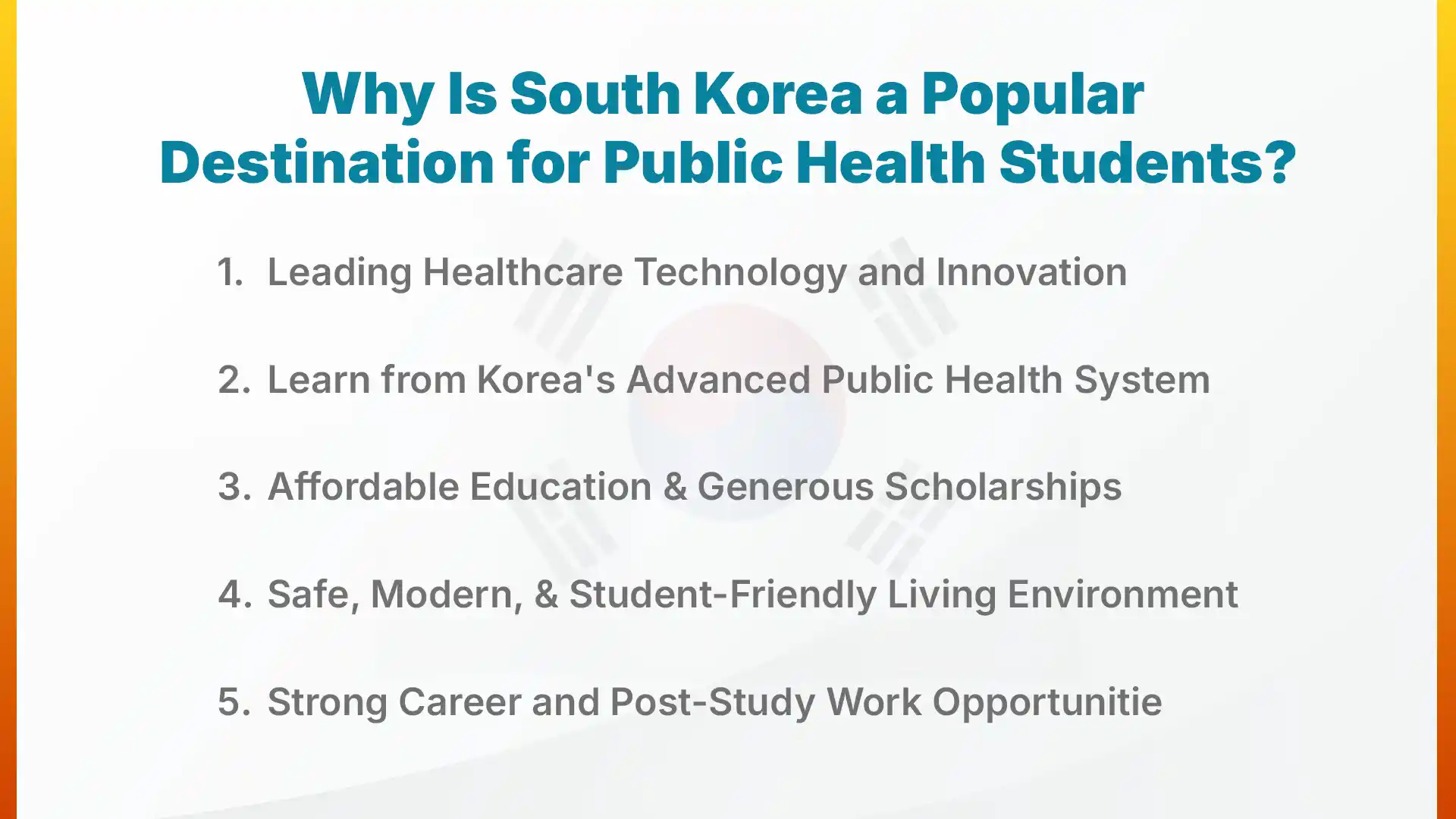
1. Leading the World in Healthcare Technology and Innovation
South Korea is famous for integrating advanced technology like Artificial Intelligence (AI) and big data into its medical systems. As a student, you will not just study old-school health policies; you will learn how smart apps, wearable devices, and digital tracking are used to monitor community wellness. This tech-heavy training gives you a massive advantage in the modern job market, making you a highly attractive candidate for international organizations.
2. Learn Directly from the Legendary "K-Quarantine" Model
When the COVID-19 pandemic hit, South Korea’s quick, data-driven response became a global gold standard, famously known as the "K-Quarantine" model. Studying public health here means you get to learn directly from the policy directors, scientists, and researchers who designed this world-class response. This first-hand, practical knowledge is something you simply cannot get from textbooks in Western classrooms.
3. Affordability and Achievable Scholarships
Studying abroad can feel like a heavy financial burden for Nepalese families, but South Korea offers incredible financial relief. The government-funded scholarships cover up to 100% of your tuition, airfare, and monthly allowance. Even if you miss out on these competitive full scholarships, almost all South Korean universities offer generous grade-based tuition discounts to international students.
4. High-Tech, Safe, and Culturally Exciting Living
South Korea is consistently ranked as one of the safest and most advanced countries in the world for international students. You will experience ultra-fast public Wi-Fi, incredibly clean subways, and a peaceful environment where you can safely walk home late at night. Plus, living in the land of K-pop, delicious street food, and gorgeous four-season landscapes makes your college life unforgettable.
5. High-Demand Careers via D-10 and E-7 Visa Pathways
Graduating from a Korean university makes transitioning into the professional local workforce incredibly smooth. The government grants you a D-10 Job Seeking Visa right after graduation, giving you up to two years to secure a professional position. Once you land a job in health management or data research, you can transition to an E-7 professional work visa, allowing you to build an amazing international career.
Public Health Course Structure & Subjects for Undergraduate Level
The Bachelor of Public Health in South Korea is a structured four-year program that covers core topics in infectious disease control, health statistics, and policy design. Students spend the first two years mastering basic biological sciences before moving to advanced health research and community internships. This system ensures you are fully prepared to join the workforce.
Year 1
Your first year is all about laying a solid foundation in human biology and social health patterns. You will get used to the university environment while learning how basic human systems work.
- Introduction to Public Health: Explore the history, core values, and major achievements of community health campaigns.
- Human Anatomy and Physiology: Study the structure of the human body and how different organs function.
- Social Determinants of Health: Discover how factors like income, environment, and education impact a community's wellness.
- Basic Biostatistics: Learn the fundamental math skills needed to collect and organize medical research data.
Year 2
In the second year, you will shift your focus to tracking diseases and understanding how governments create health regulations.
- Principles of Epidemiology: Master the science of tracking how, why, and where infectious diseases spread in a community.
- Environmental Health Science: Learn how clean water, air quality, and waste management protect public safety.
- Health Education and Promotion: Learn how to design engaging public campaigns that motivate people to live healthier lives.
- Healthcare Systems and Policies: Study how different countries organize and fund their medical services.
Year 3
Your third year is highly practical, focusing on using computer software to analyze data and managing health projects.
- Health Data Analysis: Learn to use modern statistical software to interpret complex medical and disease trends.
- Epidemiology of Chronic Diseases: Focus on long-term health challenges like diabetes, heart disease, and mental health.
- Public Health Administration: Study the business side of healthcare, including budgeting, leadership, and staff management.
- Research Methodology: Design your own research proposal and learn how to collect data ethically in the field.
Year 4
Your final year is dedicated to real-world experience, research writing, and preparing for your future career.
- Professional Internship: Spend a full semester working inside a research lab, community health clinic, or international NGO.
- Global Health Challenges: Examine complex cross-border issues like climate change, migration, and global pandemics.
- Graduation Thesis: Write and present a detailed, independent research paper on a public health topic you are passionate about.
- Public Health Seminar: Collaborate with industry experts to discuss current issues and practice interview skills for your job hunt.
Top South Korean Universities for Bachelor of Public Health
Top South Korean institutions like Seoul National University, Yonsei University, Korea University, and Kyungpook National University offer elite public health programs. These universities combine state-of-the-art laboratory research with affordable tuition fees and generous support systems for international students. They are highly respected by global employers.
University Name | Approximate Annual Tuition Fees | Course Duration |
|---|---|---|
| Seoul National University (SNU) | 4,500,000 KRW to 6,000,000 KRW | 4 Years |
| Yonsei University | 7,000,000 KRW to 9,500,000 KRW | 4 Years |
| Korea University | 6,500,000 KRW to 8,500,000 KRW | 4 Years |
| Kyungpook National University | 3,500,000 KRW to 5,000,000 KRW | 4 Years |
| Pusan National University | 3,800,000 KRW to 5,200,000 KRW | 4 Years |
| Hanyang University | 6,000,000 KRW to 8,000,000 KRW | 4 Years |
Note: 1,000 South Korean Won (KRW) is roughly equal to 100 Nepalese Rupees (NPR), making budgeting super easy to calculate for Nepalese families!
Eligibility Requirements for the Bachelor of Public Health in South Korea
Nepali students need a minimum GPA of 2.8 in plus-two exams and proof of English or Korean language proficiency to study public health. Universities accept IELTS scores of 5.5 to 6.0 or TOPIK Level 3 depending on the teaching language of your course. Meeting these criteria ensures a smooth university admission process.
1. Academic Requirements
To get accepted into a Korean public health program, you must have completed your plus-two (10+2) or equivalent high school education. Most universities look for an average GPA of 2.8 or higher. While having a science background with biology is highly preferred, some universities also accept humanities or management students if they have strong grades in social sciences.
2. Language Proficiency Requirements
Your language requirements to study in Korea will depend entirely on whether your chosen course is taught in English or Korean. If you choose an English-track program, you will need a minimum IELTS score of 5.5 to 6.0 (or equivalent PTE score). If you opt for a Korean-track program, you must pass the official TOPIK test and score at least Level 3 or 4.
Join the Best IELTS Classes in Kathmandu!
3. Documents Required for Admission
Gathering your paperwork early is the secret to a stress-free application. Here are the main documents you need to prepare:
Academic transcripts and certificates (SEE and Plus Two)
Valid passport copy
English language test results (IELTS or PTE) or TOPIK certificate
Study Plan and Self-Introduction (highlighting your passion for public health)
Two letters of recommendation from your previous school teachers
Family relation certificate (to prove your relationship with your financial sponsors)
Bank balance certificate (usually showing $20,000 USD to satisfy student visa rules)
How to Apply for a Bachelor of Public Health in South Korea?
To apply for a public health degree in South Korea, you must select your university, submit academic transcripts and TOPIK/IELTS scores, pay the application fee, and secure a D-2 student visa. Carefully following these step-by-step procedures prevents processing delays and secures your university seat. Here is the exact application timeline.
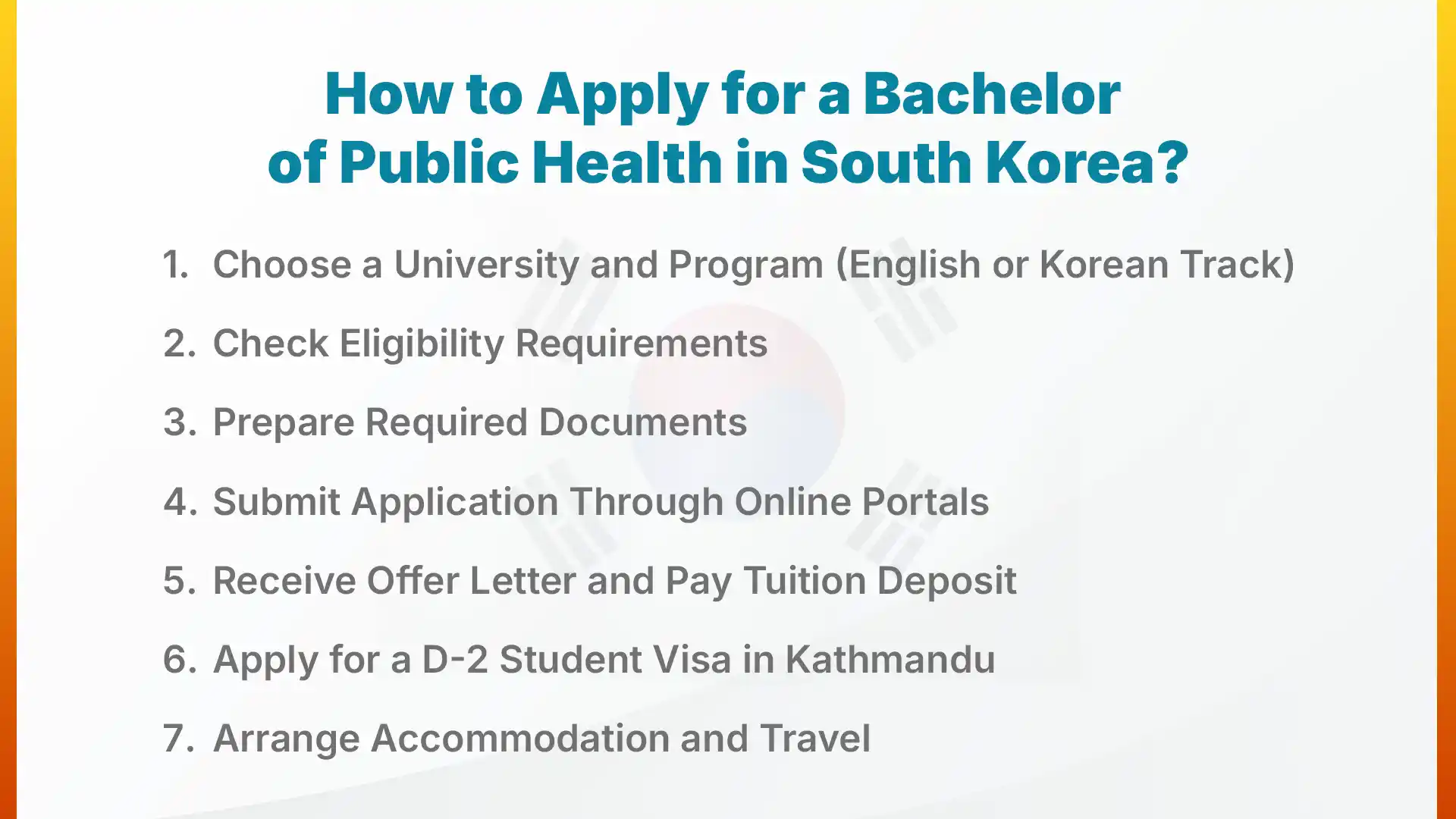
1. Choose a University and Program (English or Korean Track)
Your first step is to research and shortlist universities that offer a BPH program matching your budget and career goals. You must decide early on whether you want to study in English or take the Korean language route. Take some time to look at the campus locations, as living outside Seoul can be much cheaper.
2. Check Eligibility Requirements
Once you have your list, carefully double-check each university's specific GPA and language requirements. Some competitive universities might require higher TOPIK or IELTS scores than the national average. Making sure you meet these cut-offs prevents your application from being rejected immediately.
3. Prepare Required Documents
Next, collect all your academic papers and get them notarized or apostilled according to Korean embassy rules. Spend quality time writing your Self-Introduction essay and Study Plan, explaining why you chose South Korea. These essays are highly valued by admissions teams and can even win you scholarships in Korea.
4. Submit Application Through Online Portals
Most Korean universities process their applications through specialized online portals like Jinhak Apply or Uway Apply. Fill out the forms carefully, upload your scans, and pay the non-refundable application fee. After completing the online step, you must mail your physical, certified documents to the university's office in Korea.
5. Receive Offer Letter and Pay Tuition Deposit
If the admissions committee is impressed with your profile, they will send you an official acceptance letter. You will also receive an invoice for your first semester's tuition deposit. Once you make this payment, the university will issue your Certificate of Admission (CoA).
6. Apply for a D-2 Student Visa in Kathmandu
Take your Certificate of Admission (CoA) and a No Objection Certificate (NOC) from the Ministry of Education in Nepal to start your visa process. You will submit your visa application to the VFS Global center or directly to the Korean Embassy in Kathmandu. Make sure your financial documents are perfectly prepared to avoid visa delays.
7. Arrange Accommodation and Travel
As soon as you get your visa stamped, start looking for a place to stay in South Korea. Most first-year students prefer living in university dormitories because they are affordable and convenient. Finally, book your flight to Incheon, pack your warm clothes, and get ready for a life-changing adventure!
Cost of Studying Bachelor of Public Health in South Korea
The average cost of studying public health in South Korea ranges from 4,000,000 KRW to 9,000,000 KRW per year for tuition, plus modest living expenses. This makes South Korea a highly budget-friendly destination compared to Western countries like the UK or USA.
Here is a breakdown of your major expenses for studying in South Korea:
1. Tuition Fees
On average, tuition fees for a Bachelor of Public Health range from 4,000,000 KRW to 9,000,000 KRW per year. Public universities are run by the government and are significantly cheaper, while private universities in Seoul cost slightly more. Keep in mind that having a strong entrance GPA or a high TOPIK score can easily slash your tuition costs by 30% to 50% from your very first semester.
2. Living Expenses
Your monthly living costs will depend heavily on your personal lifestyle and where you choose to live. Living in university dorms is highly recommended, costing around 250,000 KRW to 400,000 KRW per month, which usually includes utility bills. When you add groceries, local bus fares, and mobile data, you should budget around 600,000 KRW to 900,000 KRW per month.
3. Other Costs
Beyond tuition and rent, you must prepare for a few official government fees. You will need to pay for a student visa application fee in Kathmandu, which is highly affordable. Once you arrive in Korea, you must also pay for the mandatory National Health Insurance (NHI), costing about 60,000 KRW per month, which gives you complete access to Korea's world-class medical clinics.
Scholarships for International Students in South Korea
You can fund your BPH in South Korea through university tuition waivers, and government-funded grants. These financial packages cover up to 100% of your academic fees and even provide monthly living stipends. Let us look at the primary funding options.
1. Government Scholarship
South Korea offers government-funded scholarships for international students, including Nepalese students. Depending on the program, they may cover tuition, airfare, living costs, and Korean language training. These scholarships are highly competitive but can greatly reduce your study costs.
2. University-Specific Tuition Waivers
Almost every university in South Korea offers automatic merit scholarships for international students during the admission process. If you apply with a high IELTS score or TOPIK Level 3 or above, you can get 30% to 100% off your first-semester tuition fee. Maintaining a good GPA inside the university allows you to keep these tuition waivers for all four years.
3. Korean Government Support Programs
The Ministry of Education in South Korea offers special monthly allowances for outstanding self-funded international students. These monthly grants of around 500,000 KRW are designed to help talented students cover their grocery and rental costs. You can easily apply for this support after completing your first semester of university.
4. Professor Research Assistantships
Public health is a heavily research-focused field, and Korean professors manage large research budgets. If you show dedication and strong analytical skills, a professor can hire you as a research assistant. This role provides hands-on laboratory experience and a steady monthly salary that easily covers your living costs.
Career Opportunities After a Bachelor of Public Health
Graduating with a public health degree from South Korea opens up high-paying careers in epidemiology, health administration, and international NGOs. Entry-level salaries start around 28,000,000 KRW per year and rise rapidly with experience. Here is what you can earn in major public health roles.
Job Role | Entry-Level Salary (Annual) | Mid-Level Salary (Annual) | Senior-Level Salary (Annual) |
|---|---|---|---|
| Public Health Officer | 28,000,000 KRW | 45,000,000 KRW | 65,000,000 KRW+ |
| Health Promotion Officer | 26,000,000 KRW | 40,000,000 KRW | 58,000,000 KRW+ |
| Community Health Worker | 24,000,000 KRW | 36,000,000 KRW | 50,000,000 KRW+ |
| Epidemiology Assistant | 30,000,000 KRW | 48,000,000 KRW | 72,000,000 KRW+ |
| Health Research Assistant | 28,000,000 KRW | 42,000,000 KRW | 60,000,000 KRW+ |
| Healthcare Project Coordinator | 32,000,000 KRW | 50,000,000 KRW | 75,000,000 KRW+ |
| NGO Program Officer | 27,000,000 KRW | 41,000,000 KRW | 59,000,000 KRW+ |
Note: 1,000 KRW is roughly equal to 100 NPR. An entry-level salary of 28,000,000 KRW is roughly equal to 28 Lakhs NPR per year!
Further Specialisation Options After Public Health Degree in South Korea
Advance your career after a BPH by specializing in top-tier postgraduate programs like a Master of Public Health (MPH), Epidemiology, Global Health Policy, or Health Data Analytics. These programs open doors to senior advisory roles in international bodies like the World Health Organization (WHO) and global health consultancies. Let us explore the best postgraduate pathways.
1. Master of Public Health (MPH)
An MPH is the absolute gold standard for public health professionals worldwide. This postgraduate program sharpens your administrative skills, teaches you health economics, and prepares you for senior managerial roles. It is highly valued by global health organizations and local ministries alike.
2. Global Health
If you want to travel and work on a global stage, this is your perfect path. This exciting track focuses on healthcare issues that cross international borders, like refugee medical aid, climate change impacts, and global vaccine distribution. It is highly suited for future United Nations (UN) and NGO career seekers.
3. Epidemiology
If you love solving medical mysteries and working with statistics, epidemiology is the ideal specialty for you. You will focus entirely on tracing how diseases emerge, spread, and can be stopped using scientific models. This path relies heavily on research and is highly demanded by disease control centers worldwide.
4. Health Policy and Management
This specialized area focuses on the administrative and political side of healthcare systems. You will learn how healthcare laws are made, how hospital budgets are planned, and how to improve medical accessibility for the public. It prepares you to become an influential policy advisor or hospital administrator.
5. Public Health Research
This pathway is designed for students who want to build a career in laboratory settings, universities, or private medical companies. You will learn advanced scientific research methods and run clinical trials to find new health solutions. It serves as a perfect stepping stone toward a PhD.
Is a Bachelor of Public Health in South Korea Worth It?
Pursuing a Bachelor of Public Health in South Korea is absolutely worth it because it combines cheap, world-class education with amazing global career prospects. The opportunity to learn from the world's best disease-control systems gives you a massive advantage in the job market. This degree is a smart, life-changing investment.
Think of studying in South Korea as a powerful, long-term investment that pays off quickly. Thanks to the D-10 Job Seeking Visa, you can stay and work locally right after graduation, allowing you to gain prestigious international work experience. Because the cost of education in Korea is relatively low, you can easily earn back your entire educational investment within just one to two years of working.
Furthermore, the global demand for public health experts is higher than ever before. Choosing this pathway gives you an incredibly stable, highly respected career where you can make a genuine difference in the world. It is the perfect blend of job security, personal satisfaction, and high income potential.
Conclusion
A Bachelor of Public Health in South Korea is an incredible, modern pathway that balances a rewarding life with global success. It is the perfect choice for Nepalese students who want to enter the medical field, gain world-class high-tech training, and build an exciting international career. By choosing South Korea, you are not just getting a respected degree, but also gaining hands-on skills in a nation that leads the world in healthcare innovation.
Your dream of studying in South Korea is much closer than you think, and you do not have to navigate this journey alone. We at SAS Education Consultancy are here to guide you through your university search, document preparation, and the Korean visa process.