Bachelor of Public Health in USA: Admission, Fees & Career Scope

Jun 04, 2026

The United States is home to the world's most advanced public health research infrastructure, the largest network of accredited public health schools, and some of the most influential global health institutions on earth. For Nepalese students who want to build a career that protects and improves the health of communities locally in Nepal or globally across international organizations, a Bachelor of Public Health in the USA offers an unmatched combination of academic depth, research exposure, and professional opportunity.
Public health is one of the fastest-growing fields in the American job market, and graduates from US programs are in demand across government agencies, hospitals, NGOs, international health organizations, and the private healthcare sector. Nepalese students who are still weighing their options can start by reading about studying in the USA from Nepal before committing to a specific program.
In this guide, we cover everything a Nepalese student needs to know about pursuing a Bachelor of Public Health in the USA, from top universities and admission requirements to tuition costs, scholarships, career roles, salary expectations, and work authorization pathways after graduation.
In this blog
What Is a Bachelor of Public Health in the USA?
Before applying, Nepalese students should understand that public health undergraduate degrees in the USA are offered under several different titles across institutions. The most common are the Bachelor of Public Health (BPH) and the Bachelor of Science in Public Health (BSPH), and the Bachelor of Science in Community Health. Some universities also offer public health as a concentration within a broader Bachelor of Science in Health Sciences degree. The degree title varies by institution, but the core curriculum, career outcomes, and professional recognition are consistent across accredited programs.
What matters most when evaluating a program is whether it is accredited by the Council on Education for Public Health (CEPH), which is the recognized accrediting body for public health programs in the United States. A CEPH-accredited undergraduate public health degree is recognized by employers, graduate schools, and international health organizations worldwide and is the standard credential for entry into professional public health practice in the USA and beyond.
A Bachelor of Public Health in the USA is a four-year undergraduate degree that prepares students to understand, analyze, and address the health challenges facing populations and communities. Unlike a pre-medical or nursing degree, which focuses on individual patient care, a public health degree focuses on systems, populations, policy, and prevention of the forces that shape health outcomes at the community and societal level.
The degree blends classroom instruction with fieldwork, community-based research, and structured internship placements, giving graduates both the analytical foundations and the practical community engagement skills that define effective public health practice.
Why Study a Bachelor of Public Health in the USA?
Study a Bachelor of Public Health in the USA because it offers CEPH-accredited degrees recognized worldwide, access to leading public health research centers and faculty, strong internship and fieldwork integration with government and NGO partners, high and growing demand for public health professionals across all sectors, and a clear pathway to work authorization and immigration through health-related occupations.
For Nepalese students who want a career that combines scientific rigor, social purpose, and global relevance, the USA provides the best possible environment for a public health education. This is a key part of why Nepalese students choose to study in the USA for health and science programs.
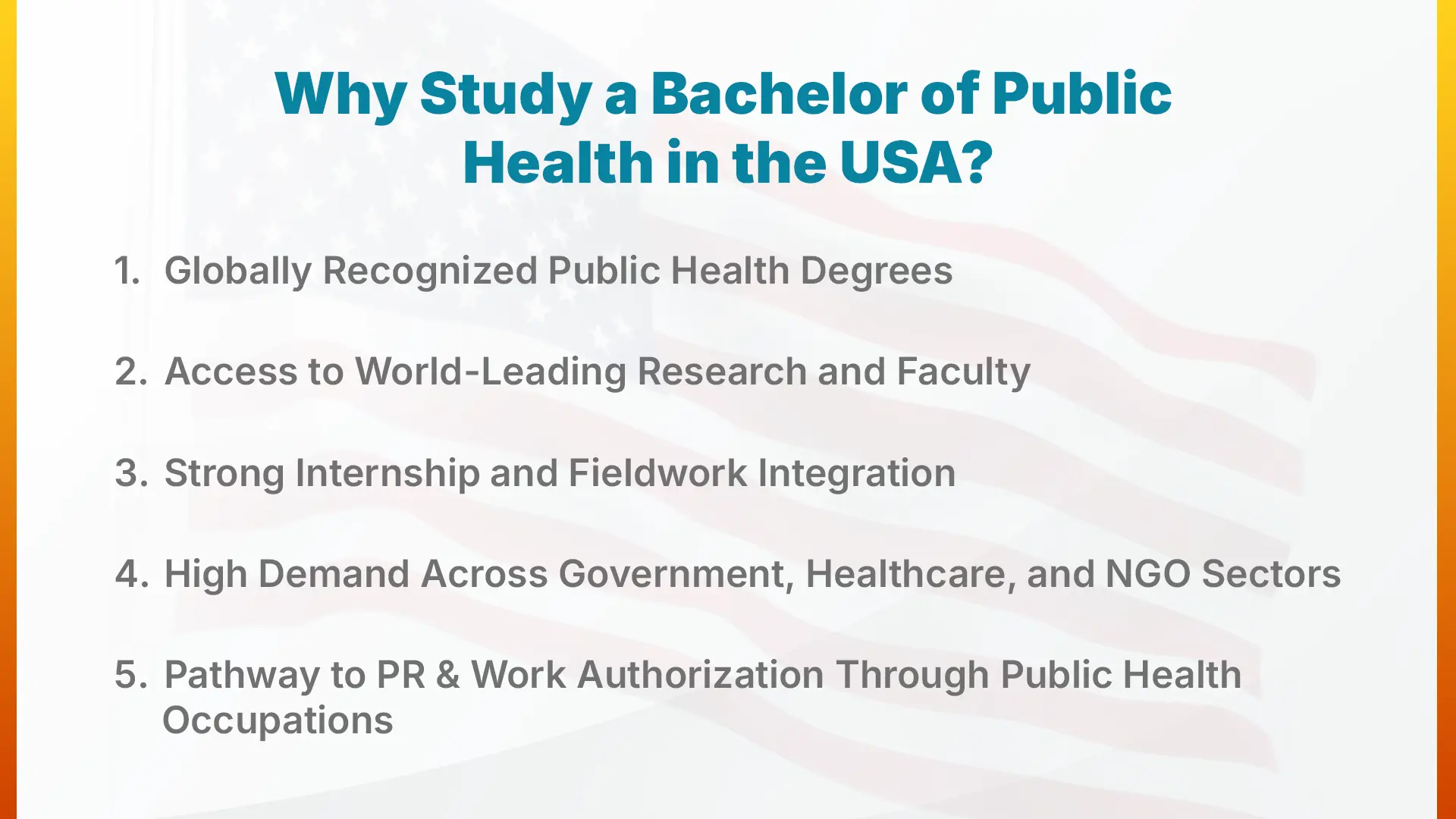
1. Globally Recognized and CEPH-Accredited Degrees
US public health degrees accredited by CEPH are recognized by the World Health Organization, the United Nations, major international NGOs, and public health ministries worldwide. For Nepalese graduates, a US public health credential creates genuine global career flexibility across international development, humanitarian health, and government health sectors in Nepal and beyond.
2. Access to World-Leading Research and Faculty
The USA is home to the world's most cited public health research institutions, including the Johns Hopkins Bloomberg School of Public Health and the CDC in Atlanta. Undergraduate students at major US universities benefit from proximity to this ecosystem, gaining exposure to cutting-edge studies in infectious disease, health policy, and global health that is unavailable at most institutions elsewhere.
3. Strong Internship and Fieldwork Integration
Most US undergraduate public health programs include mandatory internship or community practicum placements as a degree requirement, placing students in health departments, hospitals, NGOs, and international health organizations. This applied learning is one of the most important features of a US public health education and gives graduates a professional readiness that employers consistently value.
4. High Demand Across Government, Healthcare, and NGO Sectors
The US Bureau of Labor Statistics projects strong growth in health-related occupations through 2032, with public health roles among the fastest-growing categories. The COVID-19 pandemic significantly increased institutional investment in public health infrastructure, translating into sustained hiring across federal agencies such as the CDC and NIH, state health departments, hospitals, and international organizations.
5. OPT, STEM OPT, and Work Authorization Pathways
After completing a Bachelor of Public Health in the USA, international graduates are eligible for Optional Practical Training (OPT), allowing up to 12 months of full-time work in a public health-related role. Graduates from programs with a quantitative focus such as epidemiology or biostatistics may qualify for a 24-month STEM OPT extension, giving Nepalese graduates up to three years of US work experience before needing employer-sponsored visa sponsorship.
Top Universities Offering Bachelor of Public Health in USA
The top universities offering a Bachelor of Public Health in the USA include Johns Hopkins University, the University of Michigan, the University of North Carolina at Chapel Hill, Boston University, Tulane University, and George Washington University, each offering CEPH-accredited programs with strong research affiliations, internship networks, and global health connections.
Choosing the right university depends on your academic profile, preferred location, budget, research interests, and career goals. Nepalese students can also explore the best universities in the USA for Nepalese students for a broader comparison across all disciplines.
1. Johns Hopkins University
Johns Hopkins University in Baltimore, Maryland, is consistently ranked as the number one public health university in the world. Its undergraduate public health program, offered through the Bloomberg School of Public Health and the Krieger School of Arts and Sciences, gives students access to world-class faculty, pioneering research centers, and an unmatched professional network in global health, epidemiology, and health policy.
2. University of Michigan
The University of Michigan's School of Public Health in Ann Arbor offers a rigorous and well-rounded undergraduate public health program with particular strengths in environmental health, health behavior, and health management. Michigan's large and active research infrastructure, strong connections to the Michigan Department of Health and Human Services, and a vibrant campus culture make it an outstanding environment for public health students who want both academic depth and community engagement.
3. University of North Carolina at Chapel Hill
UNC Chapel Hill's Gillings School of Global Public Health is one of the most highly ranked and CEPH-accredited public health schools in the United States. Its undergraduate programs emphasize community health, epidemiology, and global health, and students benefit from close proximity to the Research Triangle, one of the USA's most active biomedical and public health research corridors. UNC's relatively lower tuition compared to private peers makes it a strong value option for international students.
4. Boston University
Boston University's School of Public Health in Boston, Massachusetts, offers undergraduate programs in public health with a strong emphasis on health policy, community health, and global health. Boston's extraordinary concentration of hospitals, research institutions, and global health organizations, including Harvard Medical School, Massachusetts General Hospital, and multiple global health NGOs, gives BU public health students an exceptional professional environment that extends well beyond the campus.
5. Tulane University
Tulane University's School of Public Health and Tropical Medicine in New Orleans, Louisiana, is one of the oldest and most distinctive public health schools in the USA, with particular strengths in tropical medicine, global health, and community health rooted in its unique Gulf South context. Tulane's location in New Orleans, a city with deep public health challenges and a rich community health tradition, gives students a genuinely distinctive fieldwork and research environment that prepares them for public health practice in complex, resource-limited settings.
6. George Washington University
George Washington University's Milken Institute School of Public Health in Washington, D.C., benefits from an unparalleled location in the heart of the US federal government. GWU public health students have direct access to federal health agencies, including the CDC Washington office, NIH, USAID, the World Bank health division, and hundreds of global health NGOs headquartered in the capital.
Eligibility and Admission Requirements for Bachelor of Public Health in USA
The eligibility and admission requirements for a Bachelor of Public Health in the USA include completion of Grade 12 or Plus Two with strong results, particularly in science subjects; English language proficiency through IELTS or TOEFL; SAT or ACT scores where required; a personal statement; letters of recommendation; and financial documentation for the F-1 student visa. Preparing each component thoroughly and well in advance of deadlines is essential for a competitive application to a US public health program.
1. Academic Requirements
Applicants must have completed Grade 12 or Plus Two with strong overall results. A background in biology, chemistry, or mathematics is advantageous for public health programs due to the quantitative and scientific demands of epidemiology and biostatistics components. Most universities require a minimum overall academic score of 75% to 85%, with competitive programs at Johns Hopkins, UNC, and Boston University requiring stronger academic profiles. Students with outstanding results and a demonstrated interest in health and community service are prioritized by admissions panels.
2. English Language Requirements
All Bachelor of Public Health programs in the USA are taught in English, and international applicants must demonstrate proficiency through an approved language test. Standard requirements are the following:
IELTS Academic: minimum overall score of 6.5, with no individual band below 6.0
TOEFL iBT: minimum score of 80 to 100, depending on the university
PTE Academic: minimum score of 58 to 65
Nepalese students who need to build their score before applying can enroll in IELTS preparation classes to reach their target band well before application deadlines.
3. SAT/ACT Requirements
Several US universities, including Johns Hopkins and Boston University, require or recommend SAT or ACT scores from international undergraduate applicants, though a growing number of institutions have adopted test-optional policies. Students should check the current admissions policy of each university on their shortlist before deciding whether to sit the SAT or ACT.
4. Personal Statement and Letters of Recommendation
A compelling personal statement is one of the most important components of a US university application. For public health programs, your statement should explain your motivation for studying public health, any relevant health, community, or research experiences that have shaped your interest, your understanding of the field, and your long-term career goals in public health.
Two to three letters of recommendation from science teachers, health mentors, or community organization supervisors who can speak to your academic ability and commitment to public service are typically required. Nepalese students can follow the SOP format for the USA to structure their personal statement effectively for American admissions panels.
5. Financial Proof and F-1 Visa Documentation
For the US F-1 student visa application, students must demonstrate financial capacity to cover the full cost of tuition and living expenses for at least the first year of study. A full checklist of the documents required for an F-1 visa is essential reading before beginning the visa application process.
How to Apply for a Bachelor of Public Health in USA
The admission process for a Bachelor of Public Health in the USA involves six steps: researching and shortlisting universities; preparing documents and language scores; submitting your application; writing your personal statement and reference letters; receiving your offer letter and I-20; and applying for the US F-1 Student Visa. Beginning this process at least 12 to 18 months before your intended start date gives Nepalese students the best possible chance of a successful outcome. It is also worth reviewing the intakes in the USA to understand the application calendar before you begin.
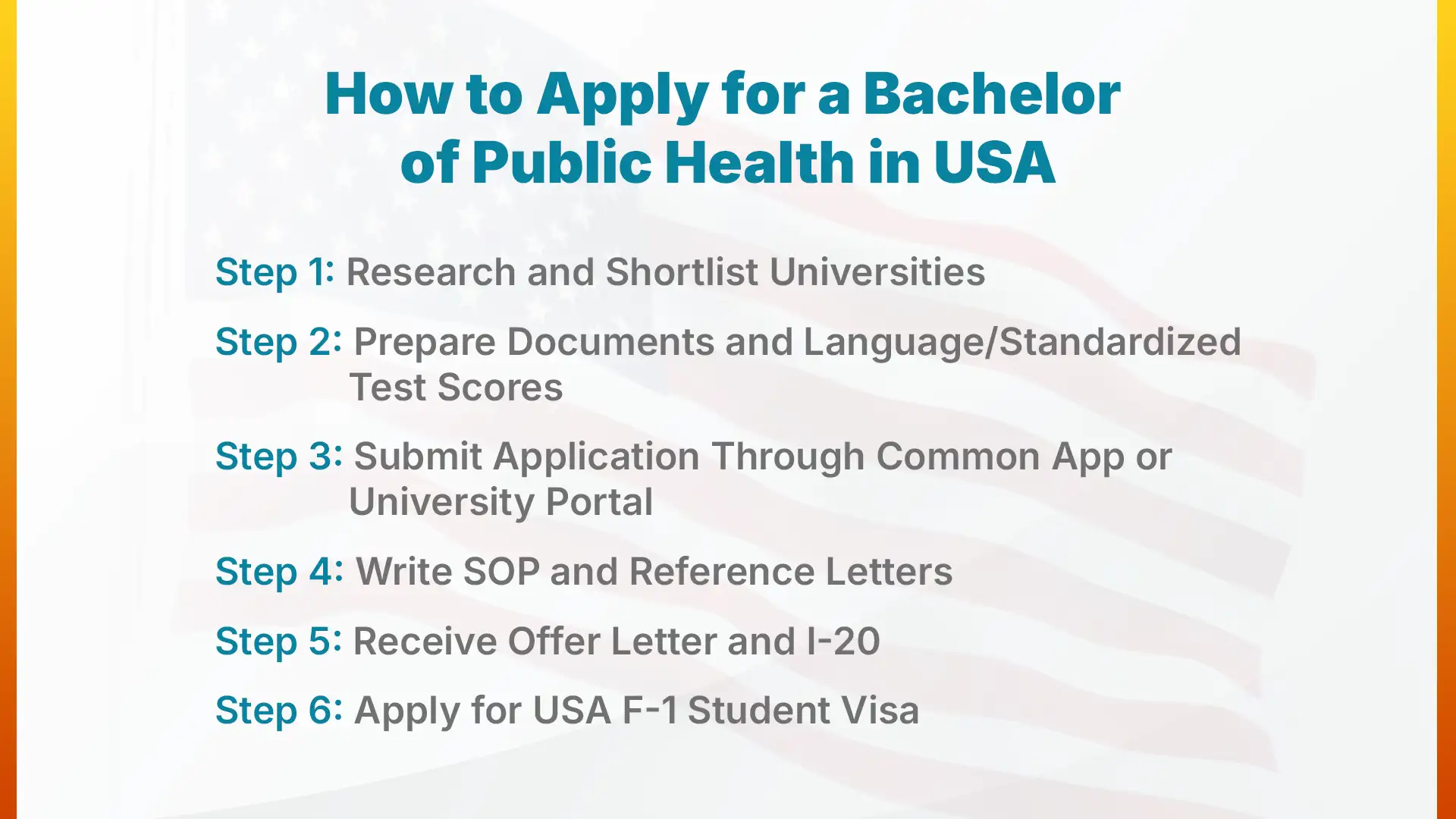
Step 1: Research and Shortlist Universities
Compare public health programs based on CEPH accreditation status, your academic profile, location, research strengths, internship opportunities, tuition fees, and scholarship availability. Shortlist four to six universities to maximize your chances of receiving at least one strong offer.
Step 2: Prepare Documents and Test Scores
Gather your Plus Two transcripts, mark sheets, and all supporting academic documents. Book your IELTS or TOEFL exam and, where required, your SAT or ACT early so all scores are ready before application deadlines. Begin drafting your personal statement and identifying your referees well in advance.
Step 3: Submit Application Through Common App or University Portal
Most US universities accept applications through the Common Application platform. Some, including certain state universities, use their own portals. Public health programs at competitive universities are among the more selective undergraduate admissions in the health sciences, so submitting early, particularly for Early Decision or Early Action rounds, is strongly recommended.
Step 4: Write Personal Statement and Reference Letters
Your personal statement should be specific, authentic, and focused on your genuine interest in public health as a field. Generic statements about "wanting to help people" are less effective than specific accounts of health experiences, research interests, or community work that have shaped your public health ambitions. Understanding what makes a strong letter of recommendation is equally important before approaching your referees.
Step 5: Receive Offer Letter and I-20
The university will issue an admission decision and, upon acceptance and payment of your enrollment deposit, will issue a Form I-20, which is the official document certifying your enrollment in a SEVP-approved program and is required for your F-1 visa application.
Step 6: Apply for USA F-1 Student Visa
Once you have received your I-20, pay your SEVIS fee and complete your DS-160 visa application form. Book your visa interview at the US Embassy in Kathmandu and prepare your financial documentation, academic records, and supporting materials thoroughly.
Cost of Studying Bachelor of Public Health in USA
The cost of studying for a Bachelor of Public Health in the USA ranges from USD 18,000 to USD 62,000 (approximately NPR 2,430,000 to NPR 8,370,000) per year in tuition fees for international students, depending on whether the institution is a public or private university.
When combined with accommodation, food, transportation, health insurance, and other living expenses, Nepalese students should budget approximately USD 30,000 to USD 80,000 (approximately NPR 4,050,000 to NPR 10,800,000) per year in total. For a full picture of what studying in the USA costs; the total cost to study in the USA is a helpful reference when planning your finances.
1. Tuition Fees
Tuition fees for a Master of Public Health (MPH) in the USA range from USD 18,000 to USD 62,000 (approximately NPR 2,430,000 to NPR 8,370,000) per year for international students, varying significantly by university and program structure. More affordable options include the University of North Carolina at Chapel Hill, while prestigious institutions such as Johns Hopkins University sit at the higher end of the spectrum.
University | Annual Tuition (USD) | Annual Tuition (NPR approx.) |
|---|---|---|
| University of North Carolina at Chapel Hill | USD 18,000 – USD 24,000 | NPR 2,430,000 – NPR 3,240,000 |
| Tulane University | USD 28,000 – USD 36,000 | NPR 3,780,000 – NPR 4,860,000 |
| University of Michigan | USD 32,000 – USD 42,000 | NPR 4,320,000 – NPR 5,670,000 |
| George Washington University | USD 38,000 – USD 48,000 | NPR 5,130,000 – NPR 6,480,000 |
| Boston University | USD 40,000 – USD 52,000 | NPR 5,400,000 – NPR 7,020,000 |
| Johns Hopkins University | USD 52,000 – USD 62,000 | NPR 7,020,000 – NPR 8,370,000 |
2. Living Expenses
Monthly living expenses in the USA vary significantly by city. In high-cost cities such as Boston and Washington, D.C., students should budget USD 2,000 to USD 3,500 per month for accommodation, food, and transportation. In more affordable cities such as Chapel Hill or New Orleans, monthly costs typically range from USD 1,200 to USD 2,000. Since your choice of city has a major impact on your total budget, it is worth reading about the best cities in the USA for international students before finalizing your university shortlist.
3. Total Estimated Cost
Taking tuition, accommodation, food, transportation, health insurance, and miscellaneous expenses into account, Nepalese students should budget approximately USD 30,000 to USD 80,000 per year. For a four-year Bachelor of Public Health degree, the total estimated cost ranges from USD 120,000 to USD 320,000 (approximately NPR 16,200,000 to NPR 43,200,000), depending on the university and city chosen.
Scholarships for Bachelor of Public Health in USA
Scholarships for a Bachelor of Public Health in the USA include US institutional merit awards, need-based financial aid, global health and public service fellowships, and external funding programs specifically for international students in health-related fields. Preparing a strong application early and demonstrating both academic excellence and genuine commitment to public health significantly improves a Nepalese student's chances of securing financial support. Students can also explore the full range of scholarships in the USA for Nepalese students as a starting point.
1. University Merit and Need-Based Scholarships
Most US universities offer both merit-based and need-based financial aid to international undergraduate students, though the availability and generosity of these awards varies significantly by institution. Private universities such as Johns Hopkins, Boston University, and Tulane tend to have larger endowments and therefore more institutional aid available for international students. State universities such as UNC Chapel Hill offer lower base tuition but more limited international student aid. Key awards include:
Johns Hopkins University Merit Scholarships: competitive merit awards for exceptional international applicants
Boston University Presidential Scholarship up to full tuition for the highest-achieving incoming students
Tulane University Stamps Scholarship: a prestigious full-cost merit award available to outstanding applicants
GWU Presidential Academic Scholarship merit-based partial tuition awards for strong international students
University of Michigan Regents Merit Scholarship competitive merit award for high-achieving incoming students
2. Global Health and Public Service Fellowships
Several foundations and international organizations offer fellowships and scholarships specifically for students pursuing public health and global health education at US universities. These include awards from the Gates Foundation, the Fulbright Program, the CDC Foundation, and various United Nations health agency scholarship programs. Students with a demonstrated commitment to public health in developing countries, including Nepal, are frequently prioritized for these globally focused awards.
3. Tips to Increase Scholarship Chances
Apply as early as possible, particularly for Early Decision rounds where merit aid is most generous
Maintain the highest possible Plus Two GPA with strong results in science subjects
Write a personal statement that specifically connects your public health interests to concrete experiences and future goals
Highlight any community health, research, or volunteer work in your application
Career Opportunities After Bachelor of Public Health in USA
Graduates with a Bachelor of Public Health from a US university can pursue careers as epidemiologists, health policy analysts, community health workers, environmental health specialists, global health program managers, and healthcare administrators across government, hospital, NGO, and private sector environments. The breadth of career pathways available to public health graduates is one of the most attractive features of the degree, and the USA's large and diverse health sector means that employment opportunities span every state, every level of government, and dozens of industries.
1. Epidemiologist / Public Health Officer
An epidemiologist investigates the patterns, causes, and effects of health and disease conditions in populations. Entry-level epidemiology roles are available at local and state health departments, the CDC, and international health organizations for graduates with strong quantitative and data analysis skills. Many epidemiologists pursue a Master of Public Health (MPH) after their undergraduate degree to advance into senior research and leadership roles.
2. Health Policy Analyst
A health policy analyst researches, evaluates, and develops policies that shape how health services are designed, funded, and delivered at the local, national, and international levels. This is a high-impact role that suits graduates with strong research, writing, and analytical skills and is particularly well-matched to students who studied at institutions with direct government access, such as GWU or Johns Hopkins.
3. Community Health Worker / Health Educator
A community health worker or health educator works directly with communities to promote healthy behaviors, provide health information, and connect people to health services. This is one of the most in-demand entry-level roles in the US public health workforce and is increasingly recognized as a critical bridge between clinical health systems and underserved populations.
4. Environmental Health Specialist
An environmental health specialist identifies and manages environmental factors that affect human health, including air and water quality, food safety, hazardous materials, and occupational health risks. This is a technically demanding and growing specialization, particularly as climate change elevates the health impacts of environmental hazards across the USA and globally.
5. Global Health Program Manager
A global health program manager designs, implements, and evaluates health programs in low- and middle-income countries on behalf of international NGOs, bilateral aid agencies, or multilateral health organizations. For Nepalese graduates, this career pathway offers the possibility of contributing directly to health development efforts in Nepal and the broader South Asian region while building on a US public health education.
6. Healthcare Administrator
A healthcare administrator manages the operational, financial, and strategic functions of hospitals, clinics, public health agencies, and health insurance organizations. Public health graduates with strong business and management skills are well-positioned for healthcare administration roles, particularly in community health centers, federally qualified health centers, and non-profit hospital systems.
Scope and Salary After Bachelor of Public Health in USA
The scope and salary after a Bachelor of Public Health in the USA are strong and growing, with the US Bureau of Labor Statistics projecting faster-than-average employment growth for health-related occupations through 2032; competitive starting salaries; OPT and STEM OPT work authorization allowing up to three years of US work experience after graduation; and pathways to H-1B sponsorship and eventual green card eligibility through public health occupations.
For Nepalese students, a US public health degree is not just a career investment but a qualification with genuine global reach and long-term professional value. This is consistently recognized as one of the best courses to study in the USA for students who want to combine scientific knowledge with social impact.
1. Growing Demand for Public Health Professionals in USA
The COVID-19 pandemic fundamentally reshaped public awareness and institutional investment in public health infrastructure across the United States. Federal, state, and local governments significantly expanded their public health workforces, and this investment has been sustained through ongoing appropriations and public health emergency preparedness programs. The CDC, NIH, and state health departments continue to grow their analytical and program management workforces, and demand for public health professionals in the NGO, hospital, and private insurance sectors has grown alongside government hiring.
2. Average Salary After Bachelor of Public Health in USA
Graduates with an MPH from the USA can expect competitive salaries that grow steadily with experience, ranging from USD 45,000–USD 60,000 (approximately NPR 6,075,000–NPR 8,100,000) at the entry level to USD 85,000–USD 130,000+ (approximately NPR 11,475,000–NPR 17,550,000+) at the senior level, depending on specialization and employer.
Experience Level | Annual Salary (USD) | Annual Salary (NPR approx.) |
|---|---|---|
| Entry-Level (0–2 years) | USD 45,000 – USD 60,000 | NPR 6,075,000 – NPR 8,100,000 |
| Mid-Level (2–5 years) | USD 60,000 – USD 85,000 | NPR 8,100,000 – NPR 11,475,000 |
| Senior Level (5+ years) | USD 85,000 – USD 130,000+ | NPR 11,475,000 – NPR 17,550,000+ |
Salaries vary by specialization, with epidemiologists and health policy analysts at federal agencies typically earning at the higher end of these ranges. Public health professionals working in the private healthcare and pharmaceutical sectors often earn above the government pay scales at equivalent experience levels.
3. OPT, STEM OPT, and Work Pathways After Graduation
After completing a Bachelor of Public Health in the USA, international graduates can apply for OPT, which provides up to 12 months of authorized full-time work in a public health-related role. Graduates from programs with a qualifying STEM component, typically those with strong epidemiology, biostatistics, or data science tracks, may be eligible for a 24-month STEM OPT extension, giving Nepalese graduates up to three years of US work experience.
During this period, many graduates secure H-1B employer sponsorship, which is the primary long-term work visa pathway for skilled foreign nationals in the USA. Many Nepalese students also take up part-time jobs in the USA during their studies to manage living costs and gain early professional experience.
Conclusion
The United States offers Nepalese students an exceptional combination of academic excellence, research exposure, professional opportunity, and global career reach through a Bachelor of Public Health. With CEPH-accredited programs at world-leading institutions, strong internship and fieldwork integration, growing demand for public health professionals across every sector, competitive salary outcomes, and a clear work authorization pathway after graduation, the USA stands apart as the most strategically compelling destination for Nepalese students who are serious about building a long-term career in public health.
The health challenges facing the world today, from pandemic preparedness to climate-driven disease burden to health equity, require a generation of trained, motivated, and globally minded public health professionals. For Nepalese students who are ready to invest in that mission, a Bachelor of Public Health from the USA is a degree that will matter for the rest of their careers and for the communities they serve.
Interested in studying public health in the USA? Contact SAS Education Consultancy for a free counseling session and let us help you find the right university, prepare a strong application, identify the best scholarships, and navigate the F-1 visa process with confidence.