Bachelor of Health Science in South Korea: Tuition & Admission Guide

Jun 05, 2026
Are you a high school science student in Nepal trying to figure out your future? You might want a meaningful career in healthcare, but the intense competition of MBBS or the sleepless shifts of bedside nursing feel overwhelming.
If that sounds like you, do not worry! There is an exciting, modern alternative that most students in Kathmandu miss out on.
Studying a Bachelor of Health Science (BHS) in South Korea is the perfect way to enter the medical world. It puts you at the crossroads of human biology, smart technology, and healthcare management.
This complete guide will show you how you can study in this safe, high-tech country and build a highly respected global career.
In this blog
What Is a Bachelor of Health Science?
A Bachelor of Health Science (BHS) is a four-year academic degree that studies the human body, health systems, and technology to improve medical services without requiring a traditional clinical license. It combines life sciences, business administration, and data systems to prepare students for the modern digital healthcare economy.
1. Program Overview
The BHS is designed to give you a broad, flexible understanding of the medical industry. Instead of training you to perform surgeries, it teaches you how to manage the systems that make surgeries possible. You will study how diseases behave in a community, how health organizations are run, and how technology makes patient care safer. It is the ideal degree for students who love medical science but prefer working in management, research, or policy roles.
2. Course Curriculum and Subjects
The BHS curriculum blends fundamental biological sciences, healthcare technology, statistics, and administrative policies across its four-year course map. This dual focus ensures you are competent in both the laboratory setting and the modern hospital business office. Let us review the primary subjects you will master throughout your studies in South Korea.
Academic Year | Core Course Subjects | Key Learning Focus & Skills Developed |
|---|---|---|
| Year 1 (Foundation) | • Human Anatomy and Physiology • Public Health Fundamentals | You will study how the human body works and what makes people sick. You will also learn how factors like poverty, water, and schooling impact a society's physical wellness. |
| Year 2 (Core Science) | • Epidemiology • Health Promotion and Education | You will do the "detective work" of healthcare by tracking how outbreaks spread. You will also learn to design engaging social media flyers and community health campaigns. |
| Year 3 (Tech & Admin) | • Healthcare Management • Biostatistics | This focuses on the business side of medicine. You will master medical budgeting, hospital scheduling, and learn to analyze research data using professional statistics software. |
| Year 4 (Practical Focus) | • Community Health • Research Methods in Health Science | You will organize local health programs with local leaders. You will also learn to write scientific reports, design research papers, and complete your professional internship. |
3. Skills You Will Develop
This practical program focuses heavily on building real-world skills that employers look for. You will learn how to analyze complex medical data using modern computer software. You will also develop strong leadership, project management, and public communication skills. These abilities will help you design successful health campaigns and run medical offices smoothly.
4. Difference Between Health Science and Medicine
The main difference comes down to clinical treatment versus system management. Medicine focuses on diagnosing and treating individual patients in a clinic using surgery or medication. Health science, on the other hand, focuses on improving the entire healthcare system through research, technology, and policy. It is a fantastic option if you want to make a massive, positive impact on society without working in a traditional, high-stress hospital ward.
Why Study a Bachelor of Health Science in South Korea?
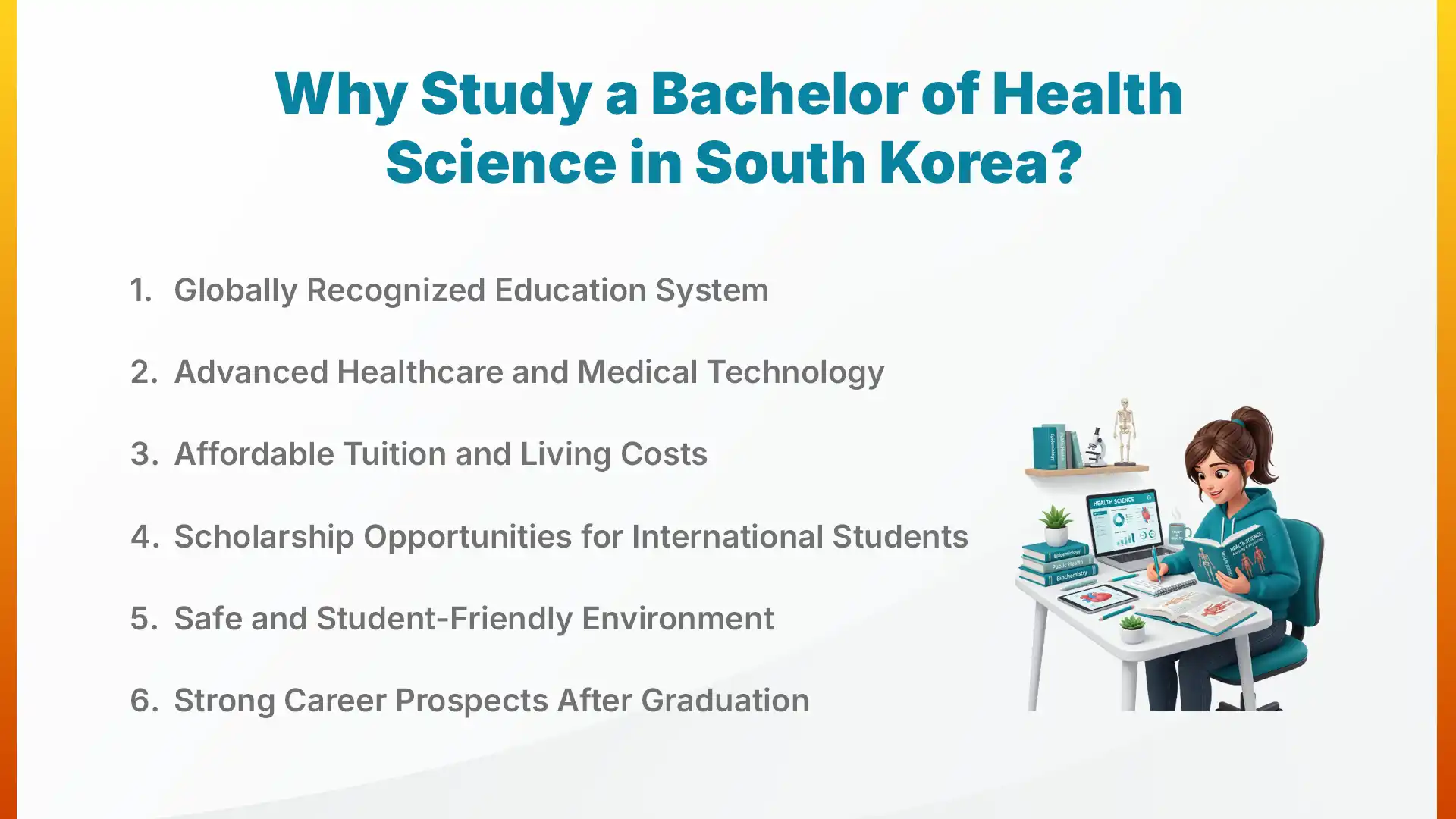
Studying a Bachelor of Health Science in South Korea is highly rewarding due to its cutting-edge medical technology, affordable tuition, and prestigious fully funded and merit-based scholarships. This modern education gives Nepalese students hands-on training inside world-class smart hospitals without the heavy financial burden of Western universities. Let us look closely at the key benefits of starting your healthcare journey in this high-tech nation.
1. Globally Recognized Education System
South Korea's advanced universities rank among the absolute best in Asia and the world. Earning your health science degree here means your qualification is respected by global employers and elite graduate schools wherever you work.
2. Advanced Healthcare and Medical Technology
South Korea is a clear global leader in digital medical innovation. You will get hands-on experience with modern healthcare systems, patient databases, and smart hospital tracking programs that traditional courses simply cannot offer.
3. Affordable Tuition and Living Costs
Unlike expensive fees in Western nations like the US or UK, South Korean degrees are very pocket-friendly. You get a world-class degree at a fraction of the cost, making calculations in Nepalese Rupees incredibly simple.
4. Scholarship Opportunities for International Students
Fully funded packages, often covered by Government or top universities, cover your entire tuition, flights, and monthly living allowance. Even standard university entries offer automatic tuition discounts of up to 50% based on your high school marks. Affordable tuition fees and generous scholarships in South Korea make it an attractive study destination.
5. Safe and Student-Friendly Environment
South Korea is consistently ranked as one of the safest countries on Earth. You can study peacefully, walk around safely at night, and travel using clean, highly advanced, and super cheap public transport networks.
6. Strong Career Prospects After Graduation
The Korean government offers a simple two-year D-10 Job Seeking Visa right after graduation. This gives you plenty of time to secure a professional healthcare job, gain international experience, and transition to residency.
Bachelor of Health Science in South Korea at a Glance
Pursuing a health science degree in South Korea offers international students a highly versatile, technology-oriented curriculum with affordable entry options and excellent employment pathways. The program prepares you to navigate advanced digital systems, smart hospitals, and health research frameworks across East Asia and beyond.
The table below outlines the core features of the BHS program to help you plan your next steps.
Feature | Details |
|---|---|
| Degree Duration | 4 Years (Full-time) |
| Academic Intakes | March (Spring) and September (Fall) |
| Study Mode | On-campus (Lectures, laboratory sessions, and internships) |
| Average Tuition Fees | 3,500,000 KRW to 7,000,000 KRW per semester |
| Language of Instruction | Dual tracks available (English-taught and Korean-taught) |
| Scholarship Availability | High (government funded, university merit discounts, and research grants) |
| Career Outcomes | Healthcare Administrator, Health Data Analyst, Research Coordinator |
Top Universities for Bachelor of Health Science in South Korea
Top South Korean institutions like Seoul National University, Yonsei University, and Korea University offer elite, highly respected health science programs. These campuses provide access to cutting-edge research laboratories, massive university hospital networks, and generous tuition scholarships for Nepalese students. Let us look at the top universities and their main highlights.
University Name | Key Health Science Highlights |
|---|---|
| Seoul National University (SNU) | Offers world-class research facilities with a heavy focus on global health policies and direct connections to government policy makers. |
| Yonsei University | Renowned for its state-of-the-art Severance Hospital network, offering practical training in digital health technology. |
| Korea University | Features a respected College of Health Science with excellent programs in biomedical engineering and environmental health. |
| Kyung Hee University | Famous for blending traditional Eastern medicine with modern health sciences, sports medicine, and community nutrition. |
| Hanyang University | Known as a powerhouse for healthcare informatics, biostatistics, and smart hospital database systems. |
| Sungkyunkwan University (SKKU) | Backed by the world-class Samsung Medical Center, providing elite training in modern health technology. |
| Ewha Womans University | Offers outstanding health science and global health programs with a highly supportive international student environment. |
| Pusan National University | A top-tier public university offering affordable tuition and strong community health research initiatives outside of Seoul. |
Eligibility Requirements for a Bachelor of Health Science in South Korea
Securing admission requires Nepalese students to complete their 10+2 examinations with a GPA of 2.5 or above alongside proving English or Korean language proficiency. Depending on your track, you must submit standardized test scores to demonstrate you can handle the science curriculum. Let us break down the exact academic, language, and university-specific requirements you need to meet.
1. Academic Requirements
To apply, you must have completed your high school education (Plus Two / 10+2 or equivalent) under a recognized board like NEB. Most universities look for a minimum GPA of 2.5 or higher, though top schools like SNU or Yonsei prefer GPAs above 3.2. While a science background with biology is highly preferred, some universities accept humanities or management students if they have strong social science grades.
2. English Language Requirements (IELTS/PTE/TOEFL)
If you apply for an English-taught program, you must prove your language skills. Most universities accept an IELTS score of 5.5 to 6.0, a PTE Academic score of 50 or above, or an equivalent TOEFL score. Having a higher score not only makes your admission easier but also increases your chances of winning a university scholarship.
Join IELTS Preparation Classes Today!
3. Korean Language Requirements (TOPIK)
If you choose a Korean-taught track, you must take the official Test of Proficiency in Korean (TOPIK). Most schools require a minimum of TOPIK Level 3 for admission, though you will need to reach Level 4 to graduate. Learning Korean is highly recommended, as it makes your daily life, part-time jobs, and local career networking much smoother.
4. Age Requirements
To apply for an undergraduate student visa (D-2) in South Korea, you generally need to be between 18 and 25 years old. If you have a gap year after high school, you can still apply easily. You will just need to write a simple explanation in your study plan showing how you used that time productively.
5. Additional University-Specific Requirements
Some competitive universities may conduct a short online interview via Zoom to test your communication skills and motivation. They might also ask you to write a brief essay on a basic scientific topic. Be sure to check each school’s official website early to see if they require these extra steps.
6. Documents Required for Admission
To apply successfully, you must compile certified academic transcripts, language score sheets, a Statement of Purpose (SOP), recommendation letters, and financial proofs. Here is the comprehensive document requirements for your South Korean education:
Academic Transcripts and Certificates
Passport Copy
Statement of Purpose (SOP for South Korea)
Language Test Scores
Passport-Sized Photographs
Financial Proof Documents
How Much Does It Cost to Study Bachelor of Health Science in South Korea?
The average total cost of studying health science in South Korea ranges from 4,000,000 KRW to 7,500,000 KRW per semester for tuition alongside modest local living costs. When converted to Nepalese Rupees (NPR), these rates are highly competitive compared to self-funded medical programs in Western countries.
The sections below offer a realistic breakdown of your semesters, housing, and food budgets:
1. Average Tuition Fees
Tuition fees vary depending on whether you study at a public or private university. Public universities like SNU or Kyungpook National University are much cheaper, ranging from 3,500,000 KRW to 5,000,000 KRW per semester. Private universities like Yonsei or Korea University cost slightly more, usually between 6,000,000 KRW and 7,500,000 KRW per semester.
2. Accommodation Costs
Living in university dormitories is highly recommended for your first year. On-campus dorms are very convenient and cost around 250,000 KRW to 450,000 KRW per month, which usually includes utility bills. If you choose to rent a small studio apartment (One-room) off-campus, expect to pay around 400,000 KRW to 600,000 KRW per month, plus a security deposit.
3. Food and Transportation Expenses
Eating in university cafeterias is highly affordable, with healthy meals costing around 4,000 KRW to 6,000 KRW. If you cook your own meals and shop at local markets, your monthly grocery budget will be around 250,000 KRW. Public transportation is incredibly clean and cheap; a monthly bus and subway pass will cost you about 60,000 KRW.
4. Health Insurance Costs
As an international student, you are legally required to join South Korea's National Health Insurance (NHI) system. This costs approximately 60,000 KRW per month and gives you access to world-class dental, medical, and emergency care at very cheap rates.
Scholarships for BHS Students in South Korea
Nepalese students can fund their health science studies in South Korea through government scholarships, university scholarships, and other financial aid. Some can cover tuition fees, while others may also provide help with living costs. These options are competitive, so start preparing early.
1. Government Scholarships
South Korea offers government-funded scholarships for international students, including Nepali students. Depending on the program, they may cover tuition fees, living costs, airfare, and language training. These scholarships are highly competitive, so a strong academic record and a well-prepared application can improve your chances.
2. University Merit Scholarships
Almost every university in South Korea offers automatic tuition discounts to incoming international students based on their entrance grades or language test scores. If you apply with TOPIK Level 3 or a high IELTS score, you can easily get a 30% to 50% tuition waiver for your very first semester.
3. International Student Scholarships
Many universities offer special financial aid packages specifically for students from developing nations, including Nepal. These scholarships are designed to promote campus diversity and can cover up to 100% of your tuition fees as long as you maintain a decent GPA (usually above 3.0 out of 4.5) during your studies.
4. Government-Funded Financial Aid
The Ministry of Education in South Korea often runs special monthly support programs for outstanding self-funded international students. Once you are enrolled and finish your first semester with excellent grades, you can apply for a monthly stipend of 500,000 KRW to help cover your living and food costs.
How to Apply for a Bachelor of Health Science in South Korea?
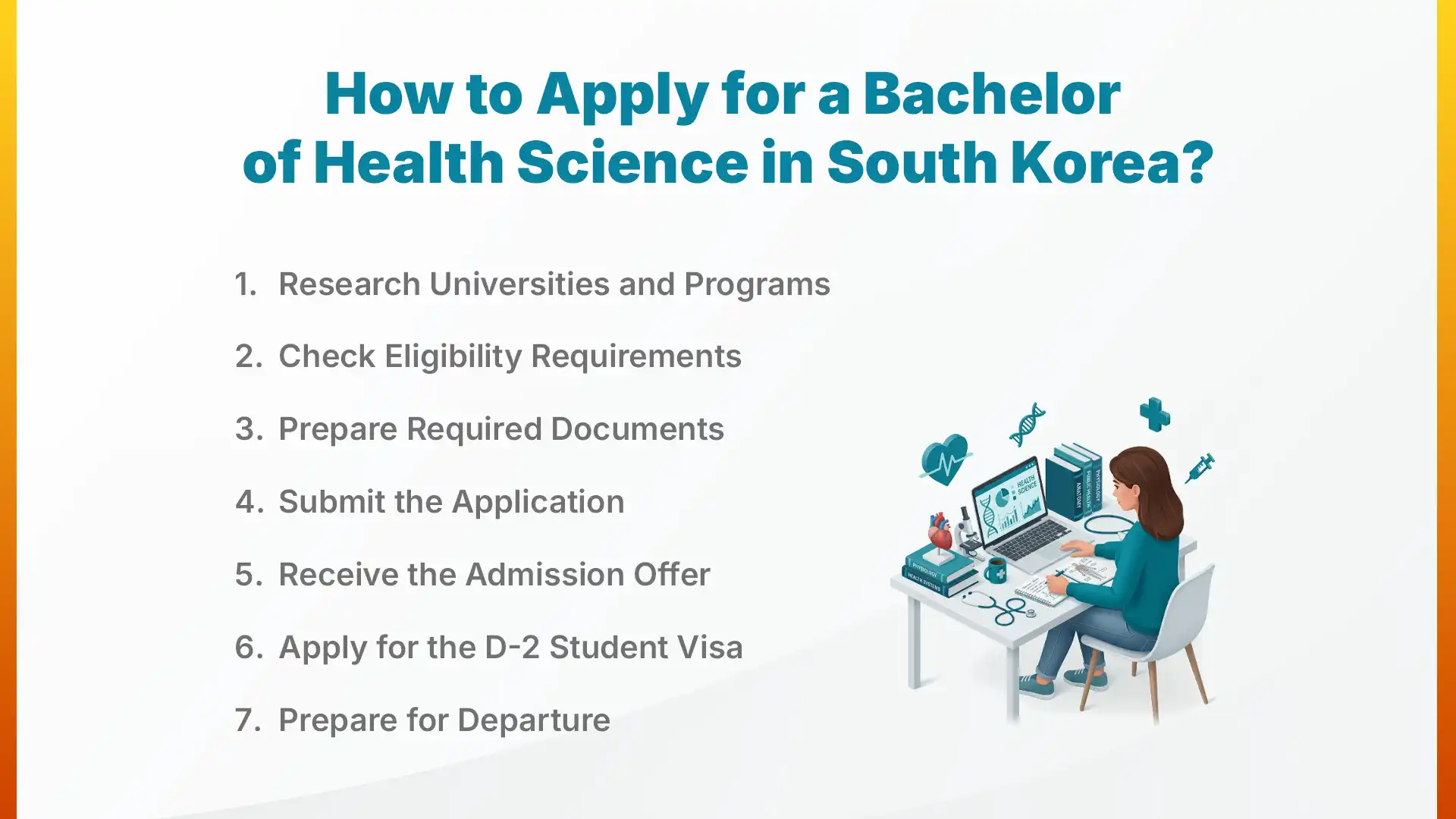
Applying for a Bachelor of Health Science requires choosing your track, submitting transcripts, paying processing fees, receiving a Certificate of Admission (CoA), and applying for your D-2 visa. Navigating these steps methodically prevents unexpected processing errors or missed registration windows. Here is your clear, step-by-step roadmap to successfully secure your place at a top Korean campus.
1. Research Universities and Programs
Start by visiting the official websites of South Korean universities to check which schools offer a Bachelor of Health Science that fits your budget. Decide early on whether you want to study in English or take the Korean language route, as this will shape your preparation.
2. Check Eligibility Requirements
Once you have your shortlist, double-check each university's specific GPA and language requirements. Some highly competitive campuses might require higher IELTS or TOPIK scores than the national average.
3. Prepare Required Documents
Gather all your academic papers, get them translated into English, and have them notarized and apostilled by MoFA in Kathmandu. Take plenty of time to write your Study Plan, SOP for South Korea, and Self-Introduction essays, highlighting your passion for healthcare.
4. Submit the Application
Most Korean universities process undergraduate applications online through specialized portals like Jinhak Apply or Uway Apply. Fill out the forms carefully, upload your scanned files, pay the application fee (usually around 100,000 KRW), and mail your physical papers to the university's office in Korea.
5. Receive the Admission Offer
If the university is impressed with your profile, they will send you an official acceptance letter. You will then receive an invoice to pay your first semester's tuition deposit. After payment, the university will issue your Certificate of Admission (CoA).
6. Apply for the D-2 Student Visa
Take your CoA, school transcripts, financial documents, and all the requirements to study in South Korea. Start your student visa application. You will submit your papers through VFS Global or directly to the Korean Embassy in Kathmandu.
7. Prepare for Departure
As soon as your visa is stamped, start looking for accommodation, such as booking a room in the university dormitory. Buy your flight ticket to Incheon, pack some warm clothes for the Korean winter, and get ready for a life-changing educational adventure!
Career Opportunities After Bachelor of Health Science in South Korea
Graduating with a Health Science degree unlocks various high-demand career pathways in health policy analysis, digital health management, research, and community education. Both regional public offices and multinational medical technology firms actively seek bilingual candidates with strong data analysis backgrounds. Let us evaluate the most rewarding professional roles available to you after graduation.
1. Public Health Officer
In this role, you will work with government health offices or international NGOs to design, run, and evaluate public safety programs. You will focus on large-scale wellness issues, such as tracking vaccination rates, designing clean water programs, or managing local maternal health clinics.
2. Health Educator
As a health educator, your main job is to teach communities how to live healthier lives. You will design engaging workshops, school wellness programs, and social media campaigns about healthy diets, fitness, mental health, and infectious disease prevention.
3. Community Health Worker
This is a highly practical role where you serve as a bridge between professional medical systems and local communities. You will visit families, perform basic health check-ups, and help people access hospital services or government wellness subsidies.
4. Healthcare Administrator
As a healthcare administrator, you will manage the daily business operations of a hospital, clinic, or private medical company. You will handle staff scheduling, health informatics databases, patient relations, and ensure the facility follows local health regulations.
5. Health Research Assistant
In this research-focused role, you will work in university labs, private pharmaceutical companies, or medical device firms. You will help gather laboratory data, run health surveys, and analyze clinical trial results for new medications.
6. Health Policy Analyst
As a policy analyst, you will study how healthcare laws and government budgets impact public wellness. You will gather data and write detailed reports to help government leaders build fairer and more affordable medical systems for the public.
Salary After Bachelor of Health Science in South Korea
Health science graduates in South Korea can expect entry-level salaries starting around 28,000,000 KRW to 35,000,000 KRW annually depending on their role. Over time, gaining professional experience and obtaining master's qualifications will raise your earnings substantially. Here is a breakdown of what you can expect to earn as you build your career.
1. Entry-Level Salary Expectations
For fresh graduates, entry-level salaries in South Korea range from 28,000,000 KRW to 35,000,000 KRW per year (roughly 28 to 35 Lakhs NPR). These starting rates easily cover your living costs and allow you to recover your educational investment within one to two years of working.
2. Factors Affecting Salary
Your salary will depend heavily on your language skills, location, and the type of company you join. Working for multinational pharmaceutical firms or smart hospital networks in Seoul pays much more than smaller, regional clinics. Having a high TOPIK score (Level 5 or 6) is also a massive advantage that can boost your pay.
3. Opportunities for Career Growth
As you gain three to five years of experience, you can move into mid-level and senior management roles. Mid-level professionals in healthcare administration can earn up to 55,000,000 KRW annually. Senior policy advisors or research directors often make over 80,000,000 KRW, making this a highly lucrative career path.
Higher Study Options After Graduating from a Health Science Degree in Korea
Postgraduate pathways for health science alumni include pursuing a Master of Public Health (MPH), healthcare administration, epidemiology, or global health policy degrees. These specialized master's programs are key to unlocking senior administrative positions in world organizations like the World Health Organization (WHO).
Let us explore the most strategic academic tracks for your future specialization.
1. Master of Public Health (MPH)
An MPH is the absolute gold standard for health professionals globally. This course sharpens your leadership skills, teaches you advanced health economics, and prepares you to run large-scale community health campaigns for governments or international organizations.
2. Master's in Health Administration
If you love the business side of medicine, this is your perfect path. This degree focuses entirely on hospital finances, staff management, and healthcare laws, preparing you to become a chief administrator or operations director at a major medical center.
3. Master's in Epidemiology
If you enjoy solving scientific mysteries and working with statistics, specializing in epidemiology is ideal. You will focus entirely on tracing how diseases emerge, spread, and can be stopped using scientific models. This path relies heavily on research and is highly demanded by disease control centers worldwide.
4. Master's in Global Health
This exciting track is designed for future international aid workers. You will study how healthcare issues cross borders and learn to manage cross-border crises like refugee medical aid, climate change impacts, and global medical supply chains.
5. Research and Academic Pathways
If you want to build a career in teaching or scientific innovation, you can opt for a research-heavy Master of Science track. This serves as the perfect stepping stone toward a PhD, allowing you to run clinical trials and design new healthcare technologies.
Conclusion
A Bachelor of Health Science in South Korea is a fantastic, modern pathway that balances personal growth with global career success. It is the perfect choice for Nepalese students who want to enter the medical field, learn to use world-class technologies, and build an exciting, secure life abroad.
By choosing South Korea, you are not just getting a respected degree, but also gaining hands-on skills in a nation that leads the world in medical innovation.
Your dream of studying in South Korea is much closer than you think, and you do not have to walk this path alone. We are here to guide you through your university search, document apostilling, and the Korean student visa process.
Not sure which country is best for your career? Explore the best places to study and work for Nepalese students.