What is the Student Visa Success Rate for South Korea?

Dec 29, 2025
South Korea is becoming an increasingly popular study destination for Nepali students. Thanks to its globally ranked universities, advanced technology programs, affordable tuition, and growing scholarship opportunities. However, along with this interest comes confusion and concern about the student visa process. Questions about approval chances, document requirements, and rejection risks are common, especially when clear official data is limited.
The truth is that South Korea has not closed its doors to international students from Nepal. Student visas are still being approved every year, but the process depends heavily on how well an application is prepared. Visa officers focus on documents, financial clarity, academic fit, and the student’s genuine intent to study. This means success is not about luck or rumours, it’s about how you prepare and present yourself.
In this guide, we break down the real student visa success rate for South Korea from Nepal, explain how decisions are made, and show you what truly improves your chances, so you can apply with clarity and confidence.
In this blog
What Is the Student Visa Success Rate for South Korea from Nepal in 2025?
In 2025, the estimated student visa success rate for South Korea from Nepal is around 85%, based on recent embassy patterns and application outcomes. While South Korea does not publish exact country-wise approval data, trends clearly show that genuine and well-prepared students continue to get approved. At SAS Education Consultancy, 98% of our students applying for South Korean education succeed in receiving their D-2 student visa for Bachelor’s and Master’s courses.
In most cases, refusals happen due to weak documents, unclear finances, or poor course justification rather than strict country rules. Because of this, students who submit complete financial proof and choose a course that matches their academic background see much better results. Moreover, visa officers focus more on clarity and consistency than on perfect scores or profiles. In short, getting a South Korean student visa is not about luck; it is about how well prepared and honest your application is.
What Are the Factors Affecting Student Visa Approvals in South Korea?
Student visa approvals in South Korea mainly depend on your financial proof, study plan, academic background, document consistency, and intent to return to Nepal. When these elements are clear, logical, and well-connected, visa officers see you as a genuine student and approval becomes more likely. In the next section, we’ll break down each of these factors in detail so you know exactly how to prepare.
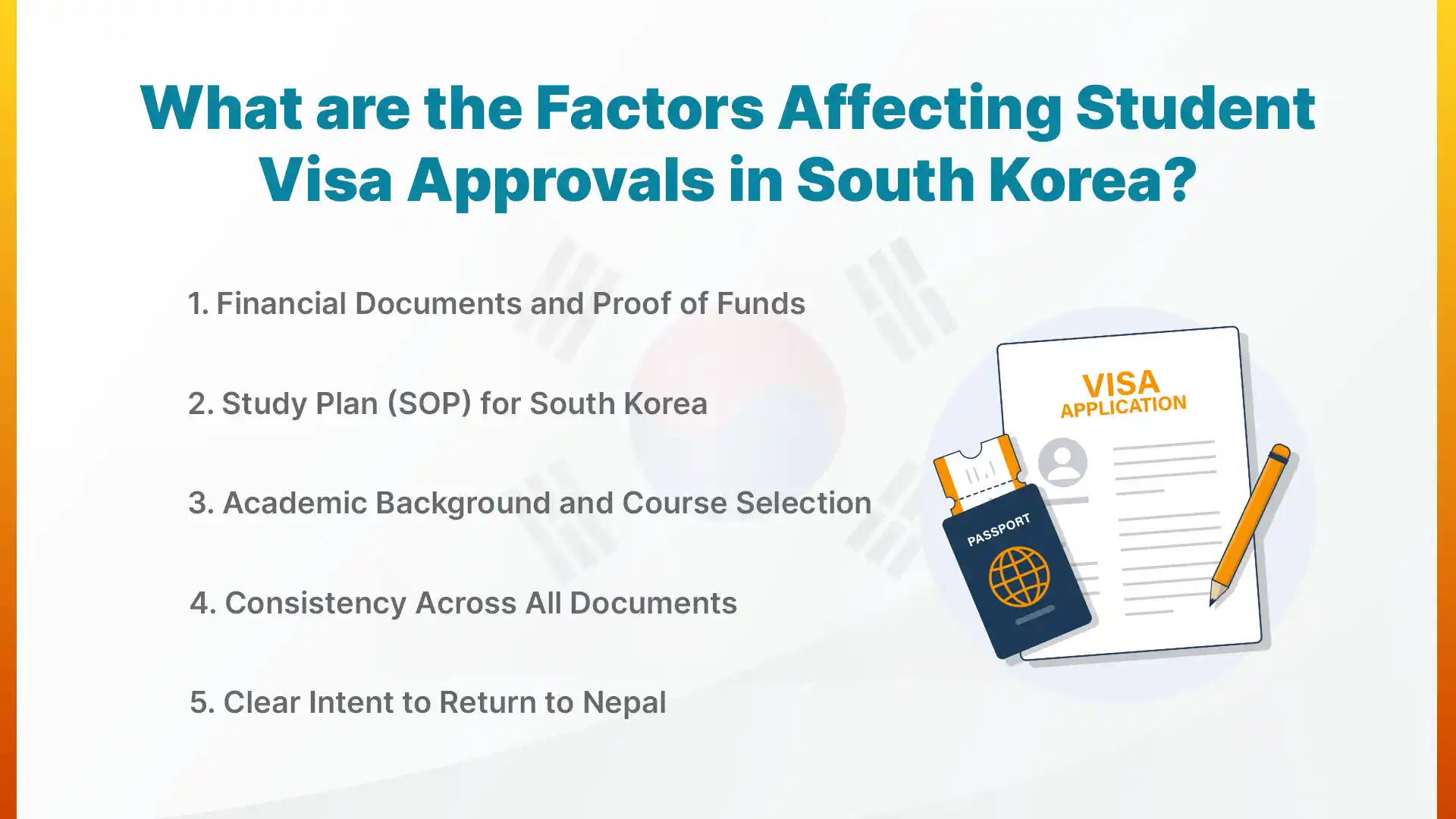
1. Financial Documents and Proof of Funds
Financial clarity is one of the most important requirements of a South Korean student visa application. Visa officers want to clearly see that you can pay your tuition fees and manage your living expenses without stress. This usually includes bank statements, sponsor details, and proof of paid or planned tuition. If funds look borrowed, unclear, or recently deposited without explanation, it can raise doubts. Therefore, simple, well-documented, and stable finances strongly improve your approval chances.
2. Study Plan (SOP) for South Korea
A study plan or SOP for South Korea explains why you chose the country, your course, and your university in a clear and practical way. Unlike Western countries, South Korea expects a more direct and goal-focused study plan, not emotional or story-based writing. Officers want to understand how this course fits your academic path and future goals. Copy-paste or vague SOPs are a common reason for refusal. A clear, honest study plan builds trust and shows genuine intent to study.
3. Academic Background and Course Selection
Your previous education should logically match the course you plan to study in South Korea. For example, language programs are suitable for beginners, while degrees require relevant academic preparation. Sudden changes to unrelated fields often create confusion for visa officers. When your academic history supports your chosen program, your application looks realistic and well planned. This alignment helps officers believe that you are applying for study, not for other reasons.
4. Consistency Across All Documents
All your documents should tell the same story about your study purpose. Your SOP, academic records, financial papers, and application forms must support each other clearly. Even small mismatches, such as different course goals or unclear funding sources, can raise red flags. Because applications are reviewed on paper, consistency plays a big role in decision-making. A clean and matching application shows seriousness and careful preparation.
5. Clear Intent to Return to Nepal
South Korea issues student visas as temporary permits, so officers need to see that you plan to return after your studies. This can be shown through future career plans, family ties, or goals linked to Nepal. You do not need to guarantee anything, but your plan should sound realistic and practical. When officers see a clear reason for returning home, they feel more confident approving the visa. This final step often strengthens an otherwise strong application.
In summary, South Korean student visa approvals rely on strong financial proof, a clear study plan, relevant academic background, consistent documents, and a realistic intent to return to Nepal. The verdict is that genuine and well-prepared students still have a very good chance of success when these factors are carefully addressed. For additional guidance and support, connecting with consultancies with the highest visa success rate can help you polish your documents and plan your application effectively.
New D-2 Student Visa Rules & Changes in 2025
South Korea’s student visa landscape has shifted significantly between 2020 and 2025, focusing on attracting quality international students while supporting their academic and career growth. The new updates bring clear steps and requirements for students from Nepal who want to study there. These changes focus on academics, language, finances, post-study work, and document preparation. Understanding these updates helps students from Nepal plan better and increase their chances of approval.
1. Lower Financial Requirements Make Study Easier
Previously, students had to show around $20,000 USD for tuition and living expenses. In 2025, this requirement was reduced to roughly $15,400 USD, making it easier for students to demonstrate financial readiness. Visa officers now focus on clarity and authenticity rather than large deposits, so well-documented and consistent finances remain essential. This change lowers the entry barrier while still ensuring that students can support themselves.
2. Work Opportunities Are More Flexible
Undergraduates can work up to 25 hours per week and postgraduates up to 35 hours, starting after their first semester. This allows students to earn extra income legally while studying, helping cover living expenses and gaining work experience. Clear adherence to university approval and weekly limits is still necessary to avoid visa issues.
4. Extended Post-Study Job Search
Earlier, students had only 6 months to find work after graduation. In 2025, this was extended to 3 years through the D-10 Job Seeker visa, a post-study work visa. Graduates, especially from STEM fields, can now explore career opportunities in Korea for a longer period and even convert to work visas or apply for permanent residency. This change makes South Korea an attractive option for students planning their careers alongside their studies.
5. New Pathways for Talent Retention
South Korea introduced STEM-focused pathways and wide-area visas to attract high-quality students and retain skilled talent. These visas prioritize students in fields critical to Korea’s economy and innovation goals. Compared to previous years, this ensures that international students with strong potential have faster and more direct routes to work and residency. Students should consider STEM programs or other priority fields if they want maximum career benefits.
6. Shift from Quantity to Quality
While student numbers surged, the government and universities now focus on quality over quantity. This means stricter checks on GPA, language proficiency (IELTS or TOPIK), and genuine intent to study. Universities also emphasize practical skills and competitiveness rather than just filling seats. For students, this shift highlights the importance of preparing strong applications with consistent academic records, a clear study plan, and financial clarity.
Overall, South Korea’s student visa changes in 2025 make studying there more accessible and rewarding for genuine, well-prepared students. Financial requirements are lower, part-time work is easier, post-study opportunities are longer, and STEM or priority pathways open career doors. However, universities still prioritize academic quality and genuine intent, so careful preparation is key. Staying informed with these updates makes it easier for students to plan, prepare, and succeed in South Korea.
How to Increase Your Chances of Getting a Korean Student Visa in 2026?
To increase your chances of getting a Korean student visa, focus on choosing the right university, preparing a strong study plan, providing clear financial proof, showing ties to Nepal, and submitting unique, well-organised documents. When these steps are done carefully, visa officers can easily see your genuine intent and readiness to study.
1. Choose the Right University or Language Institute
Your choice of institution plays a big role in visa approval. Public universities and well-known language institutes are generally trusted more by visa officers because they have clear academic standards. Choosing a school that matches your academic level and future goals requires proper research. Avoid selecting institutions only because they are easy to get into. A logical and well-justified choice makes your application look serious and genuine.
2. Write a Strong Study Plan in English or Korean
Your study plan should clearly explain why you chose South Korea, your course, and your institution. Keep it simple, factual, and focused on your academic and career goals. South Korean visas prefer clear direction over emotional storytelling. If your plan sounds realistic and well thought out, officers are more likely to trust your intent. Writing it in English or Korean, when possible, also adds clarity and professionalism.
3. Prepare Financial Proof Carefully
Clear financial proof helps officers quickly understand how you will support yourself. Use simple and verifiable sources like bank statements, sponsor letters, and tuition receipts. Funds should show a stable history, not sudden large deposits without explanation. When finances are easy to verify, the risk of doubt or delay is much lower. Strong financial clarity often strengthens the entire application.
4. Show Strong Ties to Nepal
Showing ties to Nepal helps prove that your study plan is temporary. This can include family responsibilities, future job plans, or career goals connected to Nepal. Your intention to return does not need to be forced, just realistic. When officers see a clear future plan back home, they feel more confident approving your visa. This step adds balance and trust to your application.
5. Avoid Copy-Paste Applications
Generic applications are one of the most common reasons for rejection. Visa officers review many files and can easily spot copied content. Your study plan and documents should reflect your personal background and goals. Even small personal details help your application stand out. A unique and honest application always creates a stronger impression.
The verdict is clear. Students who carefully choose the right university, prepare a strong study plan, provide clear financial proof, show ties to Nepal, and submit original, well-organized documents have the highest chance of getting a Korean student visa. To make your application even stronger and get expert guidance, you can visit the best consultancy in Nepal for South Korea to review your profile and documents.
Conclusion
The student visa process in South Korea is stricter than it used to be, but “strict” doesn’t mean impossible. The authorities now check financial proof, study plans, academic alignment, and return intent more carefully than before. They want to ensure that only genuine students who can support themselves and follow their study plan get visas.
At the same time, South Korea still approves a majority of well-prepared applications. Students with clear documents, a logical course choice, a solid SOP, and stable finances usually get approved without major issues. So, it’s less about being “too strict” and more about being careful and selective.
In short, if you prepare properly, follow the rules, and show genuine intent, the process is very manageable. The stricter checks actually work in your favour by rewarding thorough and honest applications.
Curious about the Australian Student Visa Success Rate for Nepalese Students? Explore our article featuring year-by-year approval trends, key factors affecting visa approval, & new rules for 2026.