Bachelor of Nursing in Canada: Universities, Fees, Scholarships & Career Guide

May 27, 2026
Nursing is one of the most stable, respected, and globally mobile professions in the world, and Canada has emerged as one of the strongest destinations to earn a nursing degree. With an aging population, a publicly funded healthcare system, and a national shortage of registered nurses, Canada actively recruits internationally trained healthcare professionals, including those who complete their degrees within the country. For Nepalese students who want a career that offers both personal fulfillment and long-term financial security, a Bachelor of Nursing in Canada offers exactly that combination.
In this guide, we cover everything a Nepalese student needs to know about pursuing a Bachelor of Nursing (BScN or BN) in Canada, including why to study in Canada, top universities, admission requirements, tuition costs, scholarships, career outcomes, salary expectations, and the pathway to permanent residency.
In this blog
What Is a Bachelor of Nursing in Canada?
A Bachelor of Nursing is a four-year undergraduate degree that prepares students to become registered nurses through a comprehensive combination of academic study and supervised clinical training. Unlike general health science degrees, a bachelor of nursing is a professional, practice-focused qualification that leads directly to licensure as a registered nurse (RN) upon successful completion.
The curriculum covers core medical and healthcare subjects, including anatomy and physiology, pharmacology, pathophysiology, mental health nursing, community and public health, pediatric nursing, adult medical-surgical care, and evidence-based clinical practice. Students divide their time between classroom and laboratory learning, simulation exercises, and hands-on clinical placements in hospitals, community health centers, and specialized healthcare facilities.
Why Study BSc Nursing in Canada?
Study BSc Nursing in Canada because it offers globally recognized degrees; affordable tuition compared to the UK, USA, and Australia; strong clinical training through hospital placements; immediate job demand due to an active nursing shortage; and a direct pathway to permanent residency after graduation.
For Nepalese students who want a healthcare career that is stable, well-paid, and internationally mobile, Canada provides the right combination of academic quality, professional opportunity, and long-term immigration advantage.
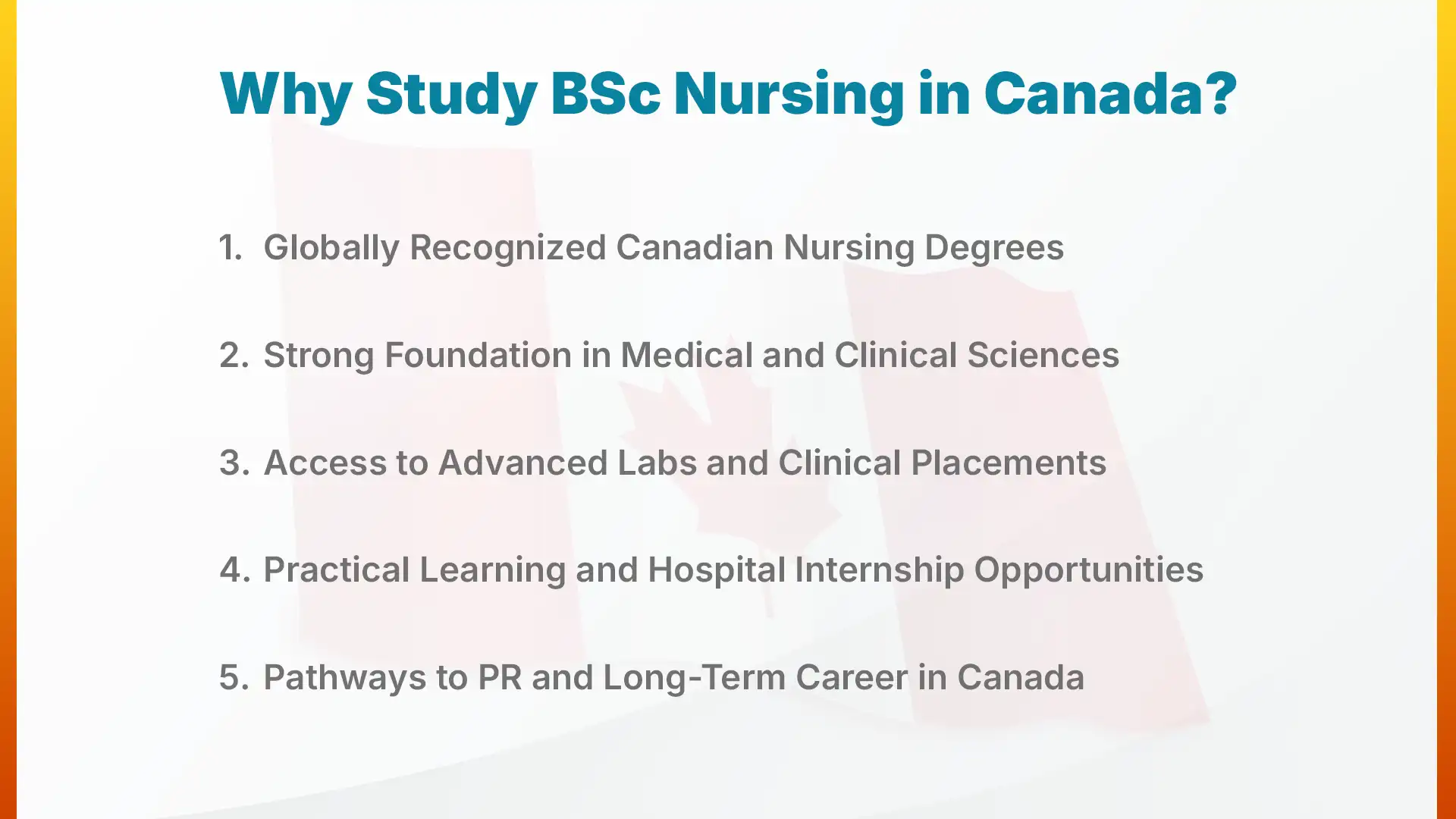
1. Globally Recognized Canadian Nursing Degrees
Canadian nursing degrees are recognized by regulatory bodies in the United Kingdom, Australia, New Zealand, the United States, and across the Gulf region. For Nepalese graduates, this means that a degree earned in Canada creates career flexibility on multiple continents, not just within Canada itself.
2. Strong Foundation in Medical and Clinical Sciences
Canadian nursing programs are designed and regulated by provincial nursing associations and accredited by the Canadian Association of Schools of Nursing (CASN). This ensures that every accredited program delivers a consistently rigorous education that meets international professional standards.
3. Access to Advanced Labs and Clinical Placements
Canadian universities invest heavily in simulation labs that replicate real hospital environments, allowing students to develop clinical competence before entering patient-facing settings. Clinical placements are integrated throughout the degree program, typically beginning in the second year, giving students early and sustained exposure to real healthcare practice.
4. Practical Learning and Hospital Internship Opportunities
Most BSc nursing programs in Canada include structured clinical practicums in major hospitals, long-term care facilities, community health clinics, and mental health services. These placements are not optional add-ons but core components of the degree, ensuring graduates enter the workforce with genuine hands-on experience.
5. Pathways to PR and Long-Term Career in Canada
Canada's immigration system is specifically designed to support internationally educated healthcare workers. After completing a Bachelor of Nursing, international graduates are eligible for the Post-Graduation Work Permit (PGWP), which allows them to work in Canada for up to three years. Registered nurses qualify for Express Entry under the Federal Skilled Worker Program and are also prioritized under several provincial nominee programs, creating a reliable and well-established pathway to permanent residency.
Nepalese students who want a full picture of what it costs and takes to study in Canada before making their decision will find that nursing consistently stands out as one of the most practical and future-proof choices.
Top Universities Offering Bachelor of Nursing in Canada
The top universities offering a bachelor of nursing in Canada include the University of Toronto, University of British Columbia, McMaster University, University of Alberta, University of Ottawa, and Dalhousie University, each offering accredited programs, strong clinical networks, and dedicated support for international students. Choosing the right university depends on your academic profile, preferred location, budget, and career goals.
1. University of Toronto
The University of Toronto's Lawrence S. Bloomberg Faculty of Nursing is consistently ranked among the top nursing schools in the world. The BScN program combines rigorous academic training with extensive clinical placements across Toronto's network of teaching hospitals, including Toronto General Hospital, SickKids, and Mount Sinai. Students benefit from world-class faculty, strong research output, and one of the most diverse and internationally connected student communities in Canada.
2. University of British Columbia (UBC)
UBC's School of Nursing in Vancouver is one of Canada's oldest and most established nursing programs, with a strong emphasis on global health, Indigenous health, and community-centered care. The program integrates theory with practice from the first year and places students in a range of healthcare settings across British Columbia. UBC's location in Vancouver, one of Canada's most liveable cities, also makes it a popular choice for international students.
3. McMaster University
McMaster University in Hamilton, Ontario, is internationally recognized for its problem-based and inquiry-driven approach to health education. The BScN program reflects this philosophy, encouraging students to think critically and adapt to complex clinical situations from an early stage. McMaster's nursing graduates are highly regarded by employers across Ontario and beyond.
4. University of Alberta
The University of Alberta in Edmonton offers a well-structured BScN program with a particular strength in rural, remote, and Indigenous community health. The program provides students with broad clinical exposure across a range of settings, preparing them for nursing practice in both urban and underserved environments. The University of Alberta is also one of the more affordable options for international students among Canada's research-intensive universities.
5. University of Ottawa
The University of Ottawa offers a bilingual nursing program, one of the few in Canada that can be completed in either English or French. This is a unique advantage for students who wish to develop bilingual professional competency, which significantly expands career options across Canada and internationally. Its location in the national capital also provides access to federal health agencies and government-sector healthcare institutions.
6. Dalhousie University
Dalhousie University in Halifax, Nova Scotia, is one of Atlantic Canada's leading universities and offers a highly regarded BScN program with strong community health and coastal health dimensions. Dalhousie's nursing graduates benefit from strong regional employer relationships and the university's active support for international graduates seeking employment and immigration pathways in the Atlantic provinces, where nursing demand is particularly high.
Nepalese students who are still deciding between universities across different disciplines can explore the best universities in Canada for Nepalese students for a broader comparison.
Popular Specialisations in BSc Nursing in Canada
Popular specializations in BSc Nursing in Canada include critical care nursing, mental health and psychiatric nursing, pediatric nursing, community and public health nursing, gerontological nursing, and oncology nursing. Each specialization opens distinct career pathways across hospitals, clinics, and community health settings, and choosing the right focus depends on your personal interests, clinical strengths, and long-term career goals in healthcare.
1. Critical Care Nursing
Critical care nursing focuses on the care of patients with life-threatening conditions in intensive care units, emergency departments, and cardiac care settings. This is one of the highest-demand and highest-paid nursing specializations in Canada.
2. Mental Health and Psychiatric Nursing
Mental Health and Psychiatric Nursing addresses the growing need for qualified mental health nurses across inpatient, outpatient, and community settings. Canada has faced an accelerating demand for mental health services, and nurses with psychiatric training are among the most actively recruited.
3. Pediatric Nursing
Pediatric nursing specializes in the care of infants, children, and adolescents across hospital, clinic, and community settings. Pediatric nurses are in consistent demand at children's hospitals and general healthcare facilities across Canada.
4. Community and Public Health Nursing
Community and Public Health Nursing prepares graduates to work outside hospital environments in schools, community health centers, public health agencies, and outreach programs. This specialization is particularly relevant in rural and remote regions of Canada, where community-based care is essential.
5. Gerontological nursing
Gerontological nursing focuses on the care of older adults, a specialization that is growing rapidly in direct response to Canada's aging population. The demand for nurses in long-term care and aged care settings is expected to continue increasing for the foreseeable future.
6. Oncology Nursing
Oncology nursing involves caring for patients undergoing cancer treatment, including chemotherapy, radiation, and surgical recovery. Oncology nursing requires a high level of technical and emotional competence, and graduates with this specialization are actively recruited by cancer centers across Canada.
Eligibility Criteria for International Students
The eligibility criteria for a bachelor of nursing in Canada include completion of Grade 12 or Plus Two with a strong background in science, along with meeting English language requirements through IELTS, TOEFL, or PTE. Most universities also require a personal statement, letters of recommendation, academic transcripts, a valid passport, and financial documents as part of the application. Meeting these criteria is essential for securing admission to a reputable Canadian university for nursing
1. Academic Requirements
Applicants must have completed Grade 12 or Plus Two with strong academic results. Most universities require a biology or science background, and high marks in biology and chemistry are particularly important for nursing admissions. Some universities may also require or prefer a mathematics qualification at the secondary level.
2. English Language Requirements
Since virtually all nursing programs in Canada are taught in English, international applicants must demonstrate English proficiency. Most universities accept:
IELTS Academic: minimum overall score of 6.5 to 7.0, with no individual band below 6.0 or 6.5 depending on the institution
TOEFL iBT: minimum score of approximately 86 to 100, depending on the university
PTE Academic: minimum score of 58 to 65
Language requirements for nursing programs tend to be higher than for many other undergraduate disciplines, reflecting the critical importance of communication in patient care. Hence, IELTS preparation should be done before applying for a bachelor's.
3. Admission Requirements for BSc Nursing in Canada
The admission requirements for a bachelor of nursing in Canada include a high school diploma or Plus Two equivalent with science subjects, a minimum academic score of 65% to 80%, English language test scores through IELTS or TOEFL, a personal statement, recommendation letters, medical fitness clearance, and financial proof for the study permit. Meeting all these requirements thoroughly is essential for securing admission at a reputable Canadian university for nursing.
Requirement | Details |
|---|---|
| High School Diploma | Grade 12 or Plus Two equivalent with science subjects |
| Minimum Academic Score | Typically 65% to 80% overall, varying by institution |
| IELTS Score | Minimum 6.5 to 7.0 overall |
| TOEFL Score | Minimum 86 to 100 iBT |
| Personal Statement | Required by most universities |
| Reference Letters | Two to three academic or professional references |
| Medical Fitness | Some universities require immunization records and health clearance |
| Financial Proof | Bank statements, scholarship letters, or sponsor documentation |
How to Apply for a Bachelor of Nursing in Canada?
The admission process for a Bachelor of Nursing in Canada involves six key steps: researching and shortlisting universities, preparing your documents, submitting your application through the university portal, writing your personal statement and reference letters, receiving your offer letter, and applying for the Canada Student Visa (Study Permit). The process is straightforward when approached with proper planning and preparation well in advance of application deadlines. Nepalese students typically follow these six steps to successfully secure admission at a Canadian university for nursing.
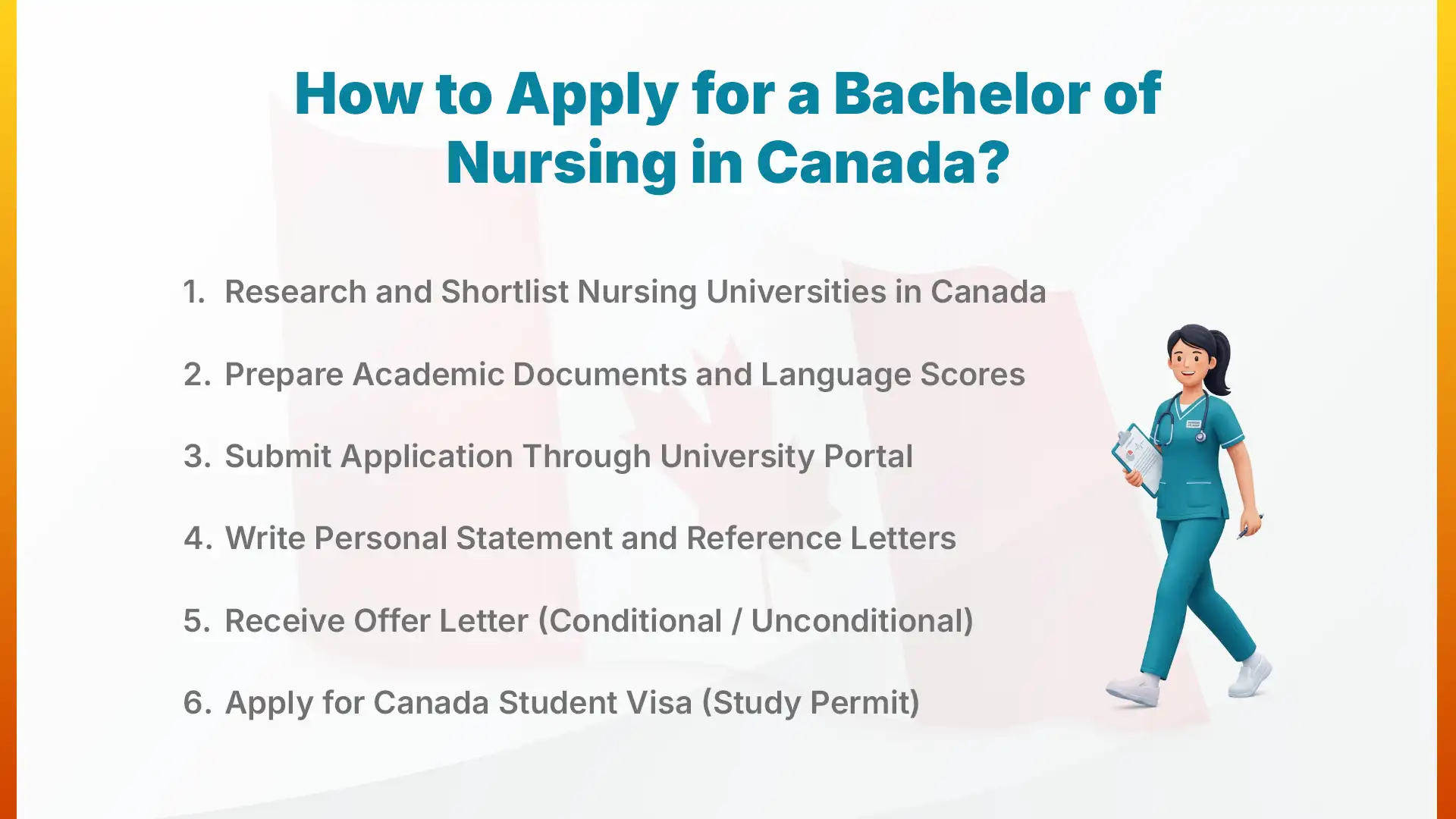
Step 1: Research and Shortlist Nursing Universities in Canada
Compare programs based on your academic profile, preferred location, tuition fees, and scholarship availability. Shortlist three to five universities to give yourself the best chance of receiving at least one offer.
Step 2: Prepare Academic Documents and Language Scores
Gather your Plus Two transcripts, mark sheets, school leaving certificate, character certificate, and migration certificate. Book your IELTS, TOEFL, or PTE exam early to ensure you receive your scores before application deadlines.
Step 3: Submit Application Through University Portal
Most Canadian universities accept direct online applications through their own admissions portals. Some also use centralized application platforms depending on the province. Ontario universities, for example, use the OUAC (Ontario Universities' Application Centre) system.
Most nursing programs in Canada fill up quickly, so it is worth checking the Canada September intake deadlines early to make sure you do not miss the window.
Step 4: Write Personal Statement and Reference Letters
Your personal statement, sometimes called a statement of purpose or letter of intent, should clearly explain your reasons for choosing nursing, your academic and personal background, your clinical or volunteer experience, and your long-term career goals in healthcare. Request reference letters from teachers or supervisors who can speak to your academic ability and character.
Nepalese students who are unsure how to structure this document can follow the SOP format for Canada, which covers what admissions panels at Canadian universities look for. It is also worth understanding what makes a strong Letter of Recommendation before you approach your referees.
Step 5: Receive Offer Letter (Conditional or Unconditional)
The university will issue a conditional or unconditional offer after reviewing your application. A conditional offer typically requires you to complete your Plus Two with a specified minimum score or submit final official transcripts before your place is confirmed.
Step 6: Apply for Canada Student Visa (Study Permit)
Once you have accepted an offer and paid a deposit, you will receive an acceptance letter that you will use to apply for a Canadian study permit. This is done through the Immigration, Refugees, and Citizenship Canada (IRCC) portal. Requirements include your acceptance letter, financial documents, valid passport, photographs, and biometrics.
Cost of Studying Bachelor of Nursing in Canada
The cost of studying a Bachelor of Nursing in Canada generally ranges from CAD 20,000 to CAD 40,000 (approximately NPR 1,800,000 to NPR 3,600,000) per year in tuition fees alone. When combined with accommodation, food, transportation, health insurance, and other living expenses, Nepalese students should budget approximately CAD 35,000 to CAD 55,000 (approximately NPR 3,150,000 to NPR 4,950,000) per year in total. Compared to the UK, USA, and Australia, Canada remains one of the most affordable destinations for a high-quality nursing degree among English-speaking countries.
1. Tuition Fees for International Students
Tuition fees for international students in Bachelor of Nursing programs typically range from CAD 20,000 to CAD 40,000 per academic year (approximately NPR 1,800,000 to NPR 3,600,000), depending on the university and province. National averages place nursing tuition among the higher ranges within undergraduate programs due to the practical, resource-intensive nature of clinical training.
Publicly funded universities such as the University of Alberta and Dalhousie University tend to be at the lower end of this range, while institutions in Ontario such as the University of Toronto and McMaster are typically at the higher end.
2. Living Expenses in Canada
Monthly living expenses in Canada for a student vary significantly by city. In Vancouver and Toronto, students should budget CAD 1,500 to CAD 2,500 per month (approximately NPR 135,000 to NPR 225,000) for accommodation, food, local transportation, and personal expenses. Students in smaller cities such as Halifax or Edmonton will find living costs notably lower, typically CAD 1,000 to CAD 1,800 per month.
On-campus dormitories and shared private housing are the most common and cost-effective accommodation options for international students.
3. Additional Costs
Additional expenses include:
Study Permit (Canadian Student Visa): CAD 150 (approximately NPR 13,500)
Biometrics fee: CAD 85 (approximately NPR 7,700)
Health insurance: CAD 600 to CAD 900 per year, depending on province
Textbooks and study materials: CAD 500 to CAD 1,500 per year
IELTS/TOEFL examination fee: approximately NPR 25,000 to NPR 30,000
4. Total Estimated Cost
Taking tuition, accommodation, food, transportation, health insurance, and miscellaneous expenses into account, the total cost to study in Canada for Nepalese students should be approximately CAD 35,000 to CAD 55,000 per year (approximately NPR 3,150,000 to NPR 4,950,000). For a standard four-year degree, the total estimated cost ranges from CAD 140,000 to CAD 220,000, making financial planning and early scholarship applications essential for most Nepalese students.
Scholarships for Bachelor of Nursing in Canada
Scholarships for a Bachelor of Nursing in Canada include Canadian government scholarships; university-specific merit awards from institutions like the University of Toronto, UBC, and McMaster; international student scholarships; and healthcare and nursing field scholarships designed specifically for students pursuing medical careers. Early preparation, strong Plus Two academic results, and a well-crafted personal statement significantly improve a Nepalese student's chances of securing financial support and reducing the overall cost of their nursing degree in Canada.
1. Canadian Government Scholarships (Vanier and Banting)
The Vanier Canada Graduate Scholarship is one of Canada's most prestigious awards and is primarily aimed at doctoral-level students, though awareness of it helps students plan for postgraduate funding. For undergraduate international students, the most relevant government-level funding comes through provincial immigration programs that offer financial incentives in exchange for post-graduation work commitments, particularly in Atlantic Canada.
2. University-Specific Scholarships
Most Canadian universities offer dedicated international student scholarships for high-achieving undergraduate applicants. These include:
University of Toronto International Scholar Award
UBC International Major Entrance Scholarship
McMaster University International Achievement Award
University of Alberta International Student Scholarship
Dalhousie University International Student Award
These awards are merit-based and typically range from CAD 2,000 to CAD 15,000 per year. Students with strong Plus Two results and a compelling personal statement are the strongest candidates.
3. International Student Scholarships in Canada
Several external organizations and foundations also offer scholarships specifically for international students studying healthcare-related fields in Canada. These vary by year and availability, and students are encouraged to research current offerings through their university's international office and Canada's official scholarship portal.
4. Healthcare and Nursing Field Scholarships
Some provincial healthcare authorities and hospital foundations offer bursaries and awards to nursing students who commit to working in specific regions or healthcare settings after graduation. These are particularly common in provinces with acute nursing shortages, such as Saskatchewan, Manitoba, and New Brunswick.
5. Tips to Increase Scholarship Chances
Apply early; many deadlines fall before the main admissions deadline
Maintain the highest possible Plus Two GPA, particularly in science subjects
Demonstrate volunteer experience in healthcare or community service
Write a specific, honest, and well-structured personal statement
Apply for multiple scholarships simultaneously to maximize your chances
Career Opportunities After BSc Nursing in Canada
Graduates with a bachelor of nursing from Canada can pursue careers as registered nurses, clinical nurse specialists, public health nurses, pediatric nurses, nurse educators, and healthcare administrators across a wide range of hospitals, clinics, and community health settings. Canada's active nursing shortage means that qualified graduates are in immediate demand the moment they complete their degree and pass the NCLEX-RN licensing examination, making BSc Nursing one of the most employment-ready degrees available to Nepalese students today.
1. Registered Nurse (RN)
The core outcome of a Bachelor of Nursing, a Registered Nurse practices in hospitals, clinics, long-term care facilities, schools, and community health settings. RNs assess patient conditions, administer medications, carry out treatments, coordinate care, and support patients and their families across the full spectrum of healthcare delivery.
2. Clinical Nurse Specialist
A Clinical Nurse Specialist (CNS) is an advanced practice nurse who focuses on a specific area of healthcare, such as cardiology, oncology, or critical care. CNS roles typically require additional postgraduate education but are accessible to BSc nursing graduates who develop specialized experience over time.
3. Public Health Nurse
Public health nurses work outside of hospitals in government agencies, community health centers, schools, and outreach programs. They focus on disease prevention, health promotion, and supporting vulnerable populations across urban and rural communities.
4. Pediatric Nurse
Pediatric nurses specialize in the care of children from infancy through adolescence. They work in children's hospitals, pediatric wards, neonatal units, and community pediatric clinics. This is a highly rewarding specialization with strong career demand across Canada.
5. Nurse Educator
Nurse educators teach and train the next generation of nurses in university classrooms, simulation labs, and hospital clinical education departments. This role typically requires several years of clinical experience and, in academic settings, a postgraduate qualification.
6. Healthcare Administrator
Experienced nurses with strong leadership and organizational skills can progress into healthcare administration roles, overseeing nursing teams, managing clinical departments, or leading hospital operations. This pathway offers significant career growth and competitive salaries.
Scope and Job Demand After BSc Nursing in Canada
The scope and job demand after a bachelor of nursing in Canada are exceptionally strong, with growing nurse shortages across all provinces; competitive salaries ranging from CAD 55,000 to CAD 130,000 per year; a Post-Graduation Work Permit (PGWP) allowing up to three years of full-time work after graduation; and a clear pathway to permanent residency through Express Entry and Provincial Nominee Programs. For Nepalese students, nursing in Canada offers not just a stable and well-paid career but one of the most reliable routes to long-term settlement in Canada available today.
1. Growing Demand for Nurses in Canada
Canada is facing a well-documented and significant nursing shortage that is projected to worsen over the coming decade due to an aging population, workforce retirements, and increased demand for healthcare services. According to the Canadian Nurses Association, Canada needs to add tens of thousands of nurses to the workforce in the years ahead.
This makes nursing one of the best courses to study in Canada, consistently ranking alongside IT and engineering as a top-demand profession across every province.
2. Average Salary After BSc Nursing in Canada
Registered Nurses in Canada are well-compensated across all provinces. Entry-level RN salaries typically range from CAD 55,000 to CAD 70,000 per year (approximately NPR 4,950,000 to NPR 6,300,000), with mid-level nurses earning CAD 70,000 to CAD 95,000 per year and experienced nurses or specialists earning CAD 95,000 to CAD 130,000 per year or more. Nurses working in high-demand remote or rural areas often receive additional salary supplements and retention bonuses.
Provinces such as British Columbia, Ontario, and Alberta consistently offer the highest nursing salaries in the country.
3. Post-Graduation Work Permit (PGWP) for International Students
After completing their bachelor of nursing, international graduates from Canadian universities can apply for a Post-Graduation Work Permit (PGWP), which allows them to work full-time in Canada for a period equal to the length of their study program, up to a maximum of three years.
The PGWP is an open work permit, meaning graduates can work for any employer, including hospitals, clinics, and healthcare agencies across Canada. Many Nepalese students also take up part-time jobs in Canada during their studies to cover living expenses and gain local work experience before graduating.
4. Pathway to Permanent Residency (PR) in Canada
Registered nurses are classified as a high-demand occupation under Canada's immigration system. PGWP holders with nursing experience are well-positioned to apply for permanent residency through the following:
Express Entry (Federal Skilled Worker Program or Canadian Experience Class) for those with strong CRS scores
Provincial Nominee Programs (PNPs), particularly in Atlantic Canada, Saskatchewan, and Manitoba, which actively target healthcare workers including nurses
Atlantic Immigration Program, which offers a streamlined PR pathway for healthcare graduates who receive a job offer in Atlantic Canada
For Nepalese students, a Bachelor of Nursing in Canada is not only a path to a rewarding healthcare career but also one of the most reliable routes to Canadian permanent residency available today.
5. Global Career Opportunities with a Canadian Nursing Degree
A Canadian nursing degree and RN registration are recognized in the United States, the United Kingdom, Australia, New Zealand, Ireland, and Gulf Cooperation Council (GCC) countries, including the UAE and Saudi Arabia. For Nepalese graduates who wish to explore opportunities beyond Canada, a Canadian nursing qualification is a genuinely global credential that opens doors across multiple continents.
Conclusion
Canada offers Nepalese students an exceptional combination of academic quality, professional training, career demand, and immigration opportunity through a bachelor of nursing. With world-respected universities, structured clinical placements, strong salary outcomes, and one of the clearest pathways from graduation to permanent residency available anywhere in the world, Canada stands apart as the most compelling destination for Nepalese students who are serious about building a long-term career in nursing.
The nursing shortage in Canada is real, the demand is immediate, and the doors are open. For Nepalese students willing to invest in four years of challenging, rewarding education, a Bachelor of Nursing from Canada is a qualification that will serve them for a lifetime.
Interested in studying nursing in Canada? Contact SAS Education Consultancy for a free counseling session and let us help you identify the right university, apply for the best scholarship opportunities, and navigate the study permit process with confidence.