UK Student Visa Work Rules for Nepali Students: Latest Hour Limits

Aug 19, 2026

For most Nepali students in the UK, a part-time job isn't optional; it's how rent, groceries, and everyday costs actually get covered. But the rules around how much you can work are stricter and more closely monitored than many students realise, and a single misunderstanding about your weekly limit can put your entire visa at risk.
This guide breaks down exactly how the UK's 2026 student visa work rules work, what counts toward your hours, what's banned outright, and how to stay compliant without second-guessing every shift. Because working is often essential for managing the overall cost to study in the UK from Nepal, getting these details right from day one is critical.
In this blog
What Are the UK Student Visa Work Hour Limits in 2026?
UK student visa work hour limits in 2026 allow degree-level students to work up to 20 hours per week during term time and full-time during official vacation periods, while students on below-degree-level courses are limited to 10 hours per week during term time. Not every student visa holder gets even this much; the 20-hour allowance depends on your sponsoring institution being a higher education provider with a strong compliance track record, and some private colleges without that status can carry a full work prohibition instead. Your exact permitted hours are recorded as a condition on your e-visa, so this is the first thing worth checking before you accept any job.
Course Level | Term-Time Limit | Vacation Period |
|---|---|---|
| Degree Level or Above | 20 Hours/Week | Full-Time |
| Below Degree Level | 10 Hours/Week | Full-Time |
| Some Institutions With No Track Record | No Work Permitted | No Work Permitted |
How Is the Weekly Work Limit Actually Calculated?
The weekly work limit is calculated on a fixed Monday-to-Sunday week, not as an average across multiple weeks, meaning working over the limit in even a single week is a visa breach regardless of how few hours were worked in surrounding weeks. This trips up more students than almost any other part of the rule: working 25 hours one week and 15 hours the next doesn't average out to compliance, since each individual week is assessed entirely on its own.
What counts toward this weekly total also catches students off guard: paid work, unpaid or voluntary work, on-call hours, and on-the-job training all count toward your limit, not just hours you're actually paid for. For anyone currently navigating the landscape of part-time jobs in the UK, keeping a strict log is non-negotiable. And if you're juggling two jobs at once, the 20-hour cap applies to your combined hours across all employers. Working 12 hours at one job and 10 at another still adds up to a breach, even though neither job alone crosses the line.
What Types of Work Are Banned on a UK Student Visa?
Types of work banned on a UK student visa include self-employment or freelance work, filling a permanent full-time vacancy, working as a professional sportsperson or coach, paid entertainment work, and most doctor or dentist training roles outside a recognised foundation programme.
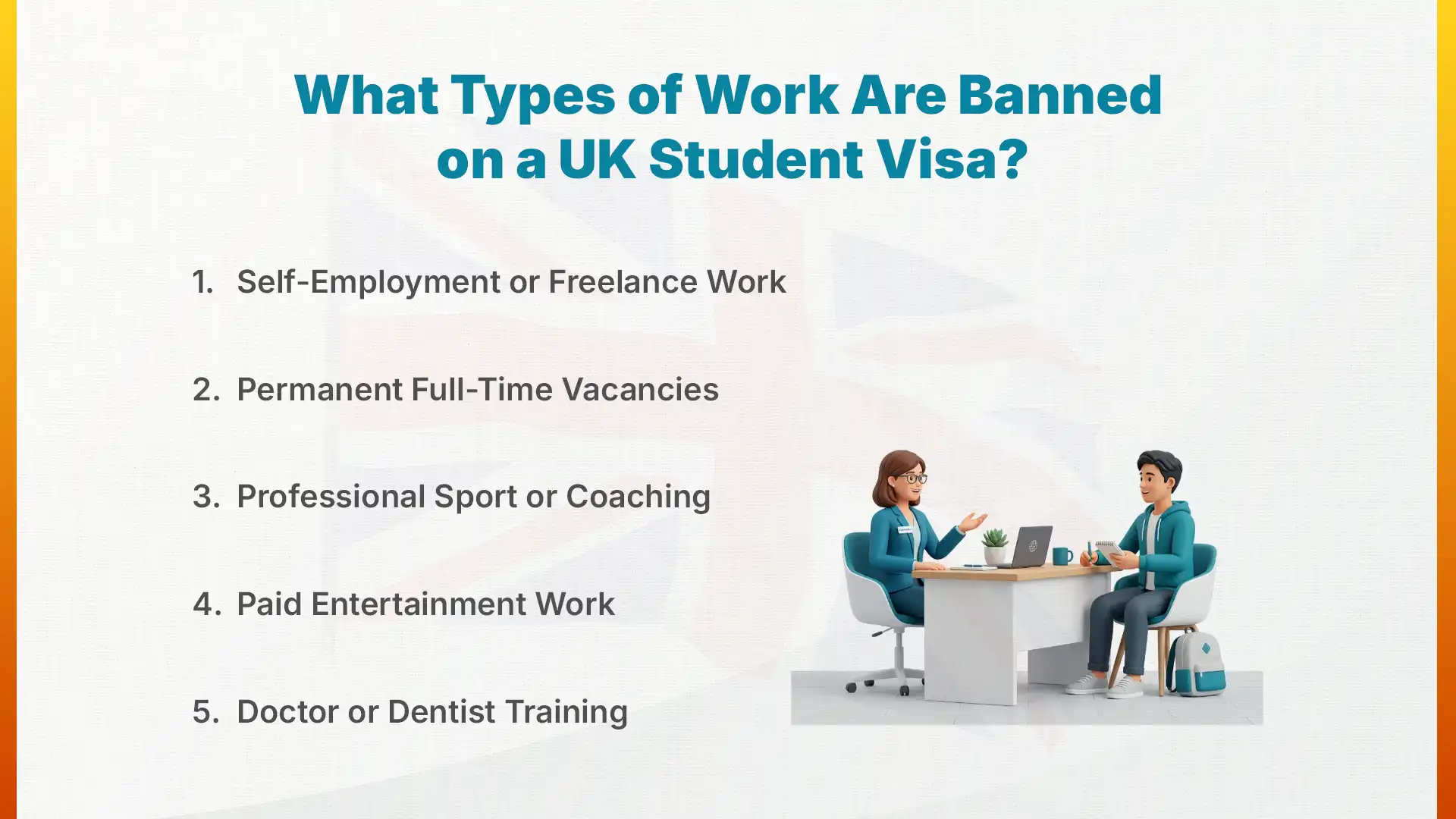
1. Self-Employment Or Freelance Work
Operating as a sole trader, invoicing clients directly, or working through freelance platforms is treated as self-employment and is banned outright, regardless of how few hours it involves. If you're not on an employer's payroll through PAYE, it's safest to assume the work isn't permitted.
2. Permanent Full-Time Vacancies
Taking a genuinely permanent full-time position isn't allowed, even during vacation periods when you can otherwise work full-time hours. A fixed-term vacation job is fine; a permanent role is a different category entirely.
3. Professional Sport or Coaching
Working as a professional sportsperson or sports coach is prohibited regardless of how many hours are involved. This restriction applies even if the role would otherwise fit within your permitted hours.
4. Paid Entertainment Work
Paid performing work, acting, singing, and DJing for a fee are off-limits, with narrow exceptions for assessed performances tied to specific performing arts degrees. This catches some students by surprise if they're pursuing music or performance as a side income.
5. Doctor or Dentist Training (With Limited Exceptions)
Training roles as a doctor or dentist are generally prohibited unless you're working on a recognised foundation programme. This is a narrow, specific exception rather than a general allowance.
When Can Students Work Full-Time on a UK Student Visa?
Students can work full-time on a UK student visa during official vacation periods set by their institution, and in most cases during the post-course "wrap-up" period after finishing their course but before their visa expires, provided their leave hasn't been curtailed. Official vacation periods include Christmas, Easter and summer breaks, which are defined by your institution's academic calendar, not your personal schedule or exam timetable, so it's worth confirming these dates directly rather than assuming.
The wrap-up period, typically around four months for most degree courses, allows full-time work once your course has formally ended but while your visa remains valid, giving students a useful bridge before the official process of transitioning from a student visa to a work visa in the UK. What doesn't change during either of these full-time windows is the underlying category restrictions: self-employment, professional sport, and entertainment work remain banned, and filling a permanent vacancy is still off-limits unless specific visa-switching provisions apply.
What Happens If a Student Breaches the Work Hour Limit?
Breaching the work hour limit on a UK student visa is treated as a serious violation of immigration conditions, which can lead to visa curtailment, difficulty with future visa applications, and reporting obligations for the sponsoring institution and employer. Detection has become significantly more automated in recent years; employers report hours and earnings to HMRC through the Real-Time Information system, and the Home Office cross-checks this data against immigration status, meaning breaches are increasingly caught through digital records rather than manual checks.
For students, the consequences of a confirmed breach can include visa curtailment and complications with future visa applications, while universities are required to report suspected breaches to UKVI within a set window or risk their own sponsor licence. What surprises many students is how little room there is for error: working even one hour over your limit in a single week is treated as a breach, not a minor technicality, so there's no informal buffer built into the rule. Work violations are consistently listed among the common reasons the UK rejects Nepali student visas, making strict compliance essential.
How Can Nepali Students Stay Compliant With Work Hour Rules?
Nepali students can stay compliant with work hour rules by checking their exact permitted hours on their eVisa, tracking hours manually across all jobs, confirming official term dates with their institution, and declaring all employment to every employer they work for.
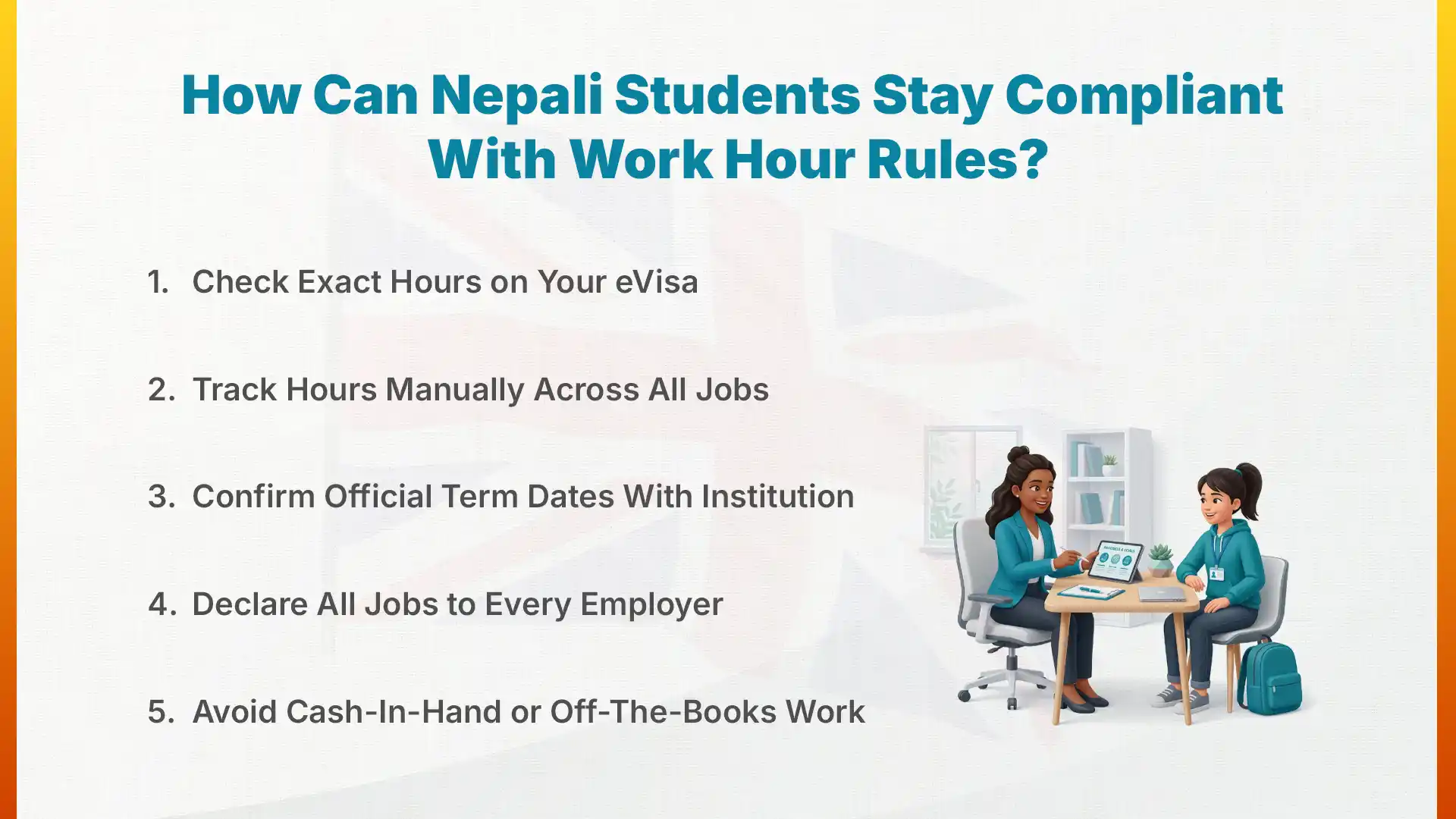
1. Check Exact Hours on Your eVisa
Log into your UKVI account and confirm exactly how many hours you're permitted to work, since this is your definitive record rather than assumptions based on your course level. If something looks incorrect, report it before you start working, not after.
2. Track Hours Manually Across All Jobs
Keep your own simple record of hours worked each Monday-to-Sunday week rather than relying solely on an employer's system. This is especially important if you're working more than one job at a time.
3. Confirm Official Term Dates With Institution
Get your university's official term and vacation dates in writing since these are not your personal class schedule and determine when the 20-hour cap applies. This also helps if an employer needs proof of your vacation periods.
4. Declare All Jobs to Every Employer
If you're working more than one job, make sure each employer knows about the other so your combined hours stay within the legal limit. This transparency protects both you and your employers from an accidental breach.
5. Avoid Cash-In-Hand or Off-The-Books Work
Some employers may offer to pay in cash or ask you to underreport hours worked over the limit. This is illegal for both parties and puts your visa status at serious risk. It's never worth the exposure, regardless of how tempting the extra income might be.
What Should Nepali Students Know About Pay and Minimum Wage?
Nepali students working in the UK are entitled to the National Minimum Wage, which as of April 2026 is £12.71 per hour for those aged 21 and over and £10.85 per hour for those aged 18 to 20, regardless of immigration status. These rates apply to every employer, and any employer paying below them is breaking the law irrespective of a student's visa status.
This is worth knowing, since it protects students from underpayment regardless of their immigration situation. Working the full permitted 20 hours a week at the 21-and-over rate works out to roughly £254 a week, or somewhere around £1,000 to £1,100 a month, giving a realistic baseline for budgeting term-time income. When looking at these numbers, it helps to research how far that income goes in the best cities in the UK for Nepalese students. If a student believes they're being paid below the legal minimum, they can report this directly to HMRC without it affecting their visa status, since wage complaints and immigration status are handled as entirely separate matters.
Conclusion
The UK's student visa work rules leave very little room for error. The 20-hour term-time limit is strict, non-averaged, and increasingly monitored through automated digital records, which means understanding and tracking your hours carefully matters far more than it might seem at first glance. Knowing what counts toward your limit, what's banned outright, and when full-time work is genuinely allowed helps you earn what you need without putting your visa at risk.
If you want to make sure you fully understand your work rights before starting a job, SAS Education Consultancy can help you check your eVisa conditions and navigate your student visa with confidence. Drop an inquiry with our advisors today to get clarity on your work rules.