Australian PR Pathways After Studying in Australia: A Guide for Nepali Graduates

Aug 12, 2026

For a lot of Nepali students, graduation in Australia isn't the finish line; it's the starting point of a much bigger question: how do you actually turn that qualification into permanent residency? The honest answer is that there's no single, guaranteed path. PR in Australia runs through a handful of different visa routes, and which one makes sense for you depends on your occupation, your points score, whether you're willing to work regionally, and how early you start planning.
The honest answer is that there's no single, guaranteed path when you study in Australia. PR in Australia runs through a handful of different visa routes, and which one makes sense for you depends on your occupation, your points score, whether you're willing to work regionally, and how early you start planning. This guide walks through the main pathways available to Nepali graduates and what actually moves the needle toward PR.
In this blog
What Are the Main PR Pathways Available to Graduates in Australia?
The main PR pathways available to graduates in Australia include the Skilled Independent visa (subclass 189), Skilled Nominated visa (subclass 190), and Skilled Work Regional visa (subclass 491), and employer-sponsored visas, each with different eligibility requirements tied to occupation, points score, and location.
Visa | Type | Key Requirement |
|---|---|---|
| Subclass 189 | Points-Tested, No Sponsorship | Occupation on MLTSSL, Points Threshold Met |
| Subclass 190 | State-Nominated | State Nomination, Occupation Demand |
| Subclass 491 | Regional Skilled Visa | Regional Living/Working Commitment |
| Employer-Sponsored | Sponsorship-Based | Job Offer from Approved Employer |
How Does the Graduate Route Fit Into the PR Pathway?
The Graduate visa (subclass 485) fits into the PR pathway as a temporary bridge that allows graduates to gain Australian work experience, build points, and pursue employer sponsorship or a skilled visa invitation before their temporary status expires. The Graduate visa lets you live and work in Australia temporarily after completing your course, without needing sponsorship, but what it doesn't do is lead directly to PR on its own; it's a window of time to build the experience and points needed for a longer-term visa, not a residency pathway in itself.
The most effective use of this period is accumulating skilled work experience in your field, since this directly strengthens your points test score and makes you a more attractive candidate for both state nomination and employer sponsorship. Graduates who treat the graduate visa period as active preparation, targeting relevant roles, tracking points, and researching visa options, tend to move toward PR far more smoothly than those who wait until the visa is close to expiring to start planning.
What Factors Improve a Graduate's Chances of PR in Australia?
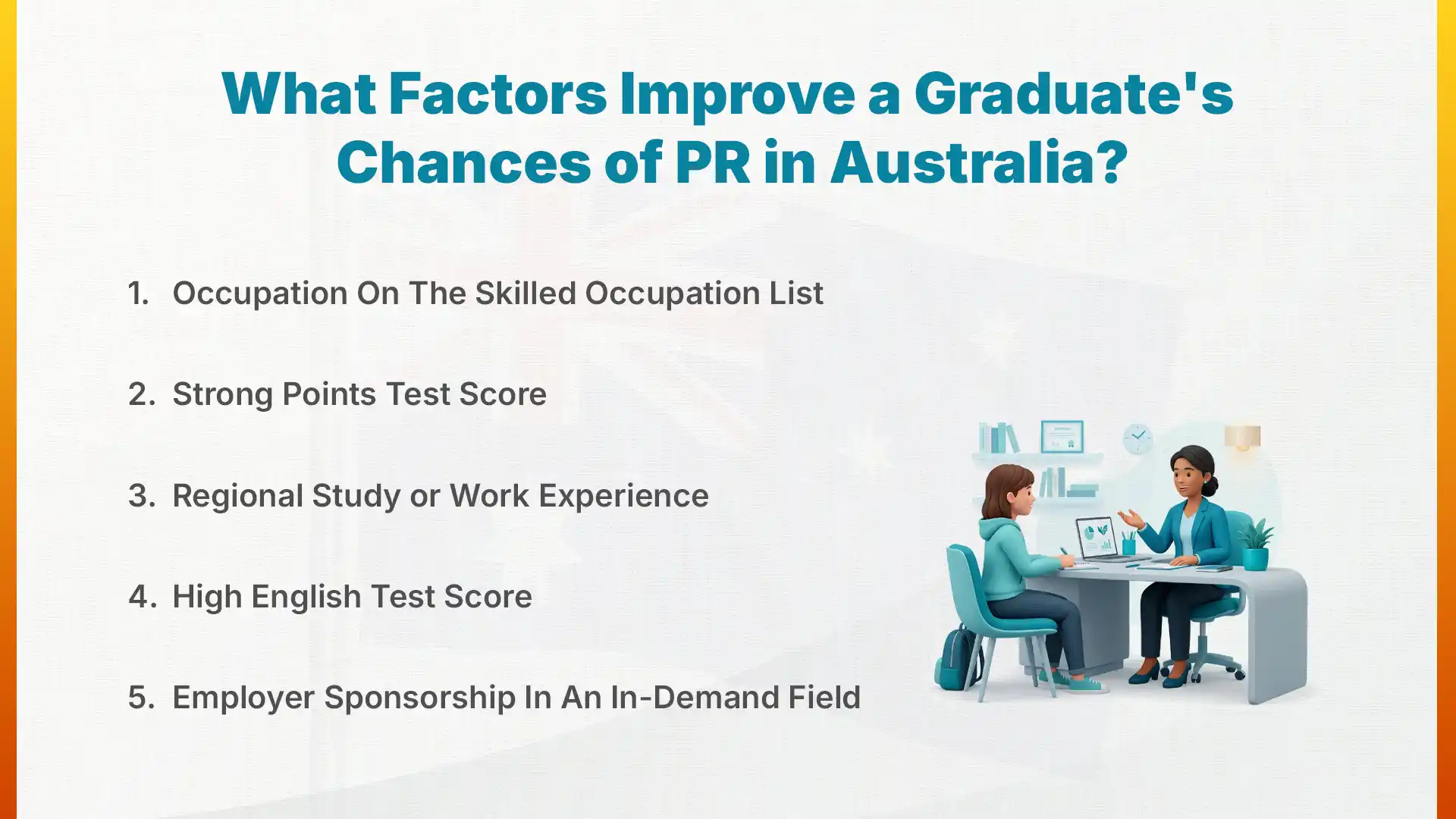
Factors that improve a graduate's chances of PR in Australia include having an occupation on the Skilled Occupation List, a strong points test score, regional study or work experience, a high English test score, and employer sponsorship in an in-demand field.
1. Occupation On The Skilled Occupation List
Having a qualification tied to a listed occupation is the single biggest factor, since it determines whether you're eligible for points-tested or nominated skilled visas at all. This is exactly why checking the best courses in Australia for Nepalese students should ideally be done before enrolling, not after graduating.
2. Strong Points Test Score
A higher points score improves your chances of receiving an invitation under the subclass 189 or 190 visas, particularly during competitive invitation rounds. Age, English proficiency, and work experience all contribute meaningfully to this score.
3. Regional Study or Work Experience
Studying or working in a designated regional area adds extra points and opens access to the subclass 491 visa. Researching the best cities in Australia for regional opportunities is one of the most underused strategic advantages available to graduates.
4. High English Test Score
Scoring well above the minimum English requirement adds additional points toward the skilled visa threshold, on top of meeting basic eligibility. It's one of the more controllable factors in the entire points calculation.
5. Employer Sponsorship In An In-Demand Field
Securing sponsorship from an employer in a shortage occupation can open a more direct route to PR, particularly in sectors like healthcare, trade and vocational courses in Australia, and engineering.
How Does the Points-Tested Skilled Visa System Work?
Australia's points-tested skilled visa system works by awarding points for factors such as age, English proficiency, skilled work experience, and qualifications, with applicants needing to meet a minimum threshold and receive an invitation to apply for a subclass 189 or 190 visa. Points are awarded across several categories, including age (with younger applicants generally scoring higher), English language ability, skilled employment experience both in Australia and overseas, and educational qualifications, with each category carrying its own scoring scale that combines into a single points test result.
Meeting the minimum points threshold doesn't guarantee an invitation; it only makes you eligible to be considered in periodic invitation rounds, where candidates with the highest scores in their occupation category are typically invited first, which makes maximizing your score genuinely important rather than just meeting the bare minimum. Completing your qualification in Australia, particularly at a regional campus, can contribute additional points beyond what an equivalent overseas qualification would offer, making local study itself part of a deliberate PR strategy rather than just an academic choice.
What Role Does Regional Study and Work Play in PR Pathways?
Regional study and work play a significant role in PR pathways because they provide additional points, access to the subclass 491 regional visa, and often less competition for nomination compared to metro-based applicants, making regional areas a genuine strategic advantage.
1. Additional Points for Regional Study
Graduates who complete their studies at a regional campus can access additional points under the skilled migration points test, which can be the difference between meeting and missing the invitation threshold in a competitive round.
2. Subclass 491 and Its Pathway to Permanent Residency
The subclass 491 visa is a provisional regional visa that, after meeting specific work and residency requirements over several years, can lead to permanent residency through a follow-on visa, making it a genuine long-term pathway rather than just a temporary placeholder.
3. Lower Competition in Regional Nomination Programs
Because most international graduates default to metro areas, regional state nomination programs often have less competition and, in some cases, more generous occupation lists than their metro equivalents, giving regional applicants a real edge.
What Should Nepali Graduates Do to Plan Their PR Pathway Early?
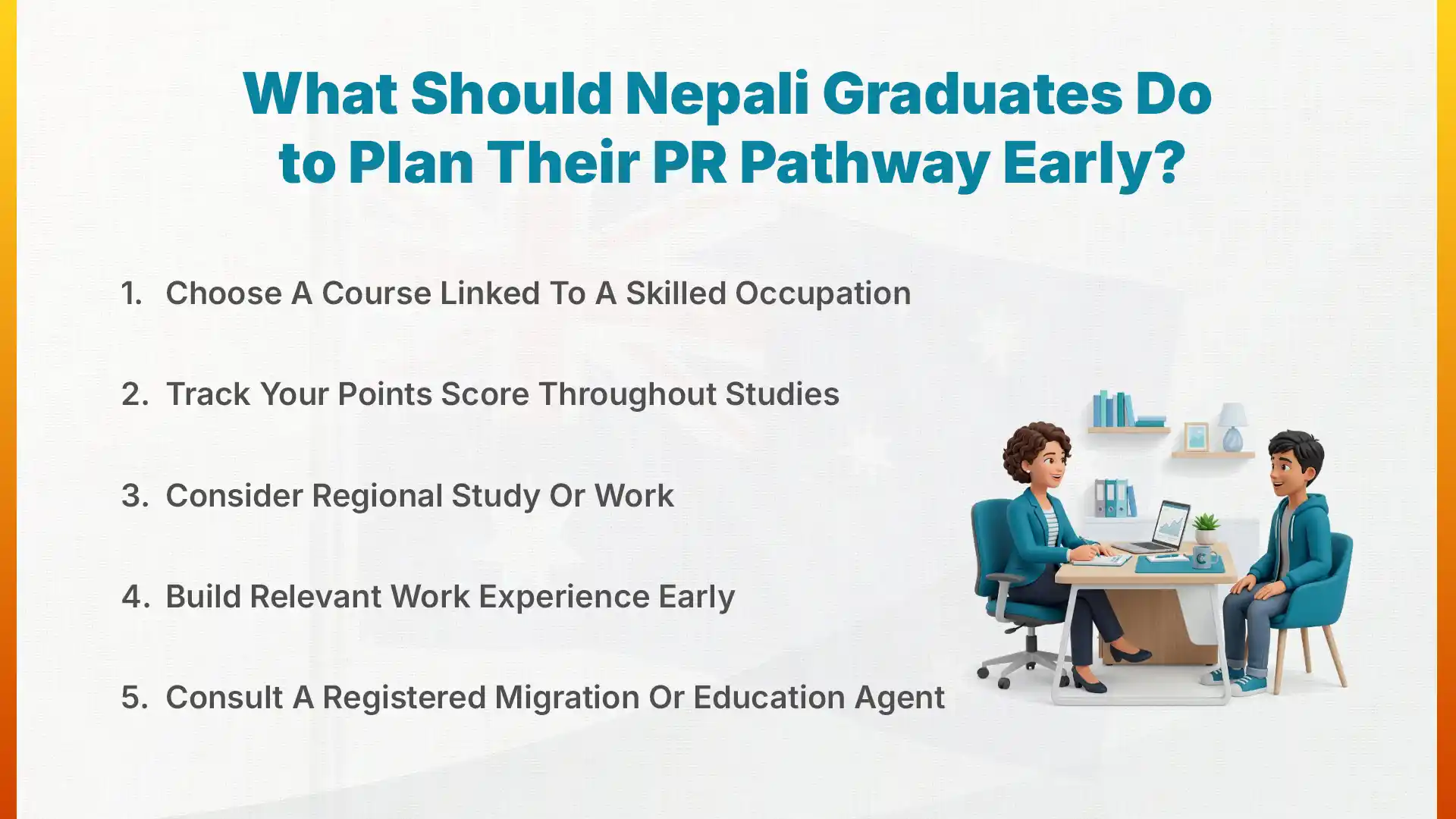
Nepali graduates should plan their PR pathway early by choosing a course linked to a skilled occupation, tracking their points score throughout their studies, considering regional study or work, and consulting a registered migration or education agent well before their graduate visa expires.
1. Choose A Course Linked To A Skilled Occupation
Confirm your intended course leads to an occupation on the current requirements to study in Australia from Nepal and the Skilled Occupation List before enrolling, rather than discovering the mismatch after graduation. This single decision shapes nearly every visa option available afterward.
2. Track Your Points Score Throughout Studies
Keep a running estimate of your points test score as your circumstances change, so you have a realistic picture of where you stand well before you need to apply. This makes it easier to identify and act on gaps early.
3. Consider Regional Study or Work
Weigh the added points and visa access that come with regional study or work against your personal and career preferences, since this can meaningfully change your PR timeline. It's worth evaluating seriously rather than dismissing outright.
4. Build Relevant Work Experience Early
Use your graduate visa period to gain experience directly in your skilled occupation rather than unrelated work, since this experience carries far more weight in both points calculations and sponsorship applications.
5. Consult a Registered Migration or Education Agent
Get professional guidance well before your graduate visa expires, not in the final months, so there's enough time to course-correct if your circumstances or the occupation list change.
How Does Employer Sponsorship Support the PR Pathway?
Employer sponsorship supports the PR pathway by allowing graduates to work in Australia under an approved employer, often leading to nomination for permanent residency once specific work and time requirements are met, particularly in occupations facing ongoing shortages. An employer-sponsored visa requires a job offer from an approved Australian employer willing to sponsor the applicant, typically in an occupation the business genuinely cannot fill locally, and over time, with specific conditions met, this sponsorship can lead toward a pathway to permanent residency.
Sectors experiencing persistent shortages in healthcare, trades, aged care, and certain engineering and IT specializations tend to see the highest rates of genuine employer sponsorship, since businesses in these fields are actively struggling to fill roles locally. For many Nepali students, healthcare courses in Australia offer some of the strongest pathways to employer sponsorship because hospitals, aged care providers, and community health services continue to face workforce shortages across multiple Australian states. Many employer-sponsored visas start as temporary arrangements, with permanent residency becoming available after the sponsored employee meets a minimum period of employment with the same employer, along with other standard requirements.
What Common Mistakes Delay or Derail a Graduate's PR Pathway?
Common mistakes that delay or derail a graduate's PR pathway include choosing a course unrelated to a skilled occupation, waiting too long to plan next steps after the graduate visa is granted, and failing to track changes to occupation lists or points requirements over time.
1. Choosing A Course With No Clear Occupation Link
Enrolling in a course because it sounds interesting or convenient, without checking whether it leads to a listed occupation, is one of the most common and costly mistakes graduates make when it comes to PR planning. Failing to factor in the cost of study in Australia from Nepal for a course that yields no PR benefits is a financial setback.
2. Waiting Too Long To Plan Next Steps
Treating the graduate visa as a two-year break rather than an active planning window often leaves graduates scrambling in their final months, with far fewer options than if they'd started building points and experience from day one.
3. Not Tracking Occupation List or Points Changes
Skilled occupation lists and points requirements are reviewed periodically, and a pathway that looked solid a year ago can shift. Graduates who don't stay informed risk building a strategy around outdated information.
Conclusion
Permanent residency after studying in Australia isn't automatic, and it isn't a single process; it's a set of interconnected decisions that start with course choice and continue through how you use your graduate visa period. Occupation demand, points score, regional experience, and timing all shape which pathway actually works for you, which is exactly why planning early makes such a meaningful difference.
If you're a Nepali graduate trying to map out the right PR pathway, SAS Education Consultancy can help you assess your occupation, calculate your points position, and plan your next steps well before your graduate visa expires. Contact Education Consultancy today to start planning your route to permanent residency.