Why Trade and Vocational Courses Are Gaining Popularity Among Nepali Students in Australia

Aug 03, 2026

For years, the default dream for Nepali students heading to Australia was a bachelor's or master's degree from a well-known university. That script is being rewritten. A growing number of Nepali students are now choosing trade and vocational courses like carpentry, electrotechnology, hospitality, aged care, and automotive mechanics over traditional university programs, and it isn't a compromise decision. It's a calculated one. The reasons are practical and financial: lower costs, shorter study periods, faster entry into paid work, strong job demand across the country, and a clearer road to permanent residency than many oversubscribed degree fields can offer.
This shift reflects a broader rethink happening among Nepali families who plan to study in Australia. Rather than measuring success purely by degree prestige, students and parents are increasingly asking a more direct question: which path leads to a stable job, a visa, and a return on the money invested? For a growing number, the answer is vocational education. This blog breaks down exactly why that is, what courses are trending, and how to choose the right one if you're weighing the same decision.
In this blog
What Are Trade and Vocational Courses in Australia?
Trade and vocational courses in Australia are hands-on training programs under the VET (Vocational Education and Training) system, delivered through TAFE institutes or registered training organizations (RTOs) in fields like carpentry, electrical work, hospitality, aged care, and automotive repair, leading to nationally recognized certificates and diplomas.
Unlike university degrees, which lean heavily on lectures, research assignments, and theoretical assessment, VET courses are built around demonstrable, on-the-job skills. Students typically split their time between structured classroom instruction and supervised practical training, often inside a real workplace, not just a simulated lab. This means that by graduation, a student in a plumbing or hospitality course has usually already logged real hours on tools, in a kitchen, or with clients, giving them a head start that a purely academic graduate doesn't have.
The VET sector is also tightly regulated. Every course is mapped to a national training package, which sets out exactly what skills and knowledge a student must demonstrate to be certified competent, meaning an electrotechnology certificate earned in Perth carries the same recognized standard as one earned in Melbourne.
1. Difference Between VET and University Degrees
University degrees are academic and research-oriented, usually spanning three to four years, with success measured through essays, exams, and theoretical understanding. VET courses are competency-based: students are assessed on whether they can actually perform a task to industry standard, not just explain it. Courses are also considerably shorter, and many are designed in direct consultation with industry bodies, so the curriculum reflects the best courses to study in Australia based on what employers are hiring for right now, not what was relevant a decade ago
2. Common Qualification Levels
Certificate III and IV: Entry-level trade qualifications and the typical starting point for apprenticeships; Certificate III is often considered the minimum standard to be recognized as "trade qualified" in fields like carpentry or electrical work.
Diploma and Advanced Diploma: Higher-level vocational qualifications that go deeper into supervisory, technical, or specialized skills, often opening doors to team-leader or small-business-owner roles.
Nationally Recognized Training: Every VET qualification is recognized Australia-wide under the Australian Qualifications Framework, so graduates aren't restricted to working in the state where they studied.
Why Are Nepali Students Choosing Vocational Courses Over Traditional Degrees?
Nepali students are increasingly choosing vocational courses because they offer lower tuition costs, shorter completion times, stronger job placement rates, and clearer pathways to permanent residency compared to traditional bachelor's or master's degrees.

1. Lower tuition fees compared to university programs
VET courses typically cost a fraction of what a bachelor's degree costs per year, easing the financial pressure on families who are often taking loans or pooling savings to fund overseas education. For many households, this difference is the deciding factor between a course being financially realistic or not.
2. Shorter course duration and faster entry into the workforce
Most certificates and diplomas take between six months and two years, compared to three to four years for a bachelor's degree. That means a student can be earning a trade wage while a peer in a university program is still mid-degree, still paying tuition, and still without an income.
3. Practical, job-ready skills over theoretical study
Employers in trades, hospitality, and aged care consistently prioritize hands-on competency and reliability over academic transcripts. A VET graduate walks into an interview with demonstrable experience, not just a certificate to describe on paper.
4. Better alignment with Australia's in-demand job market
Australia has a well-documented, persistent shortage of skilled tradespeople and care workers. This means VET graduates often face far less competition for jobs than graduates from saturated degree fields like business or IT, where the market is flooded with both local and international graduates chasing the same limited entry-level roles.
What Are the Top Trade Courses Nepali Students Are Enrolling In?
The top trade courses Nepali students are enrolling in include carpentry and construction, electrotechnology, plumbing, automotive mechanics, hospitality and commercial cookery, and aged care/community services, chosen for their strong demand in the Australian job market, reasonable entry requirements, and clear apprenticeship-to-employment pipelines.
Carpentry and construction
Electrotechnology
Plumbing
Automotive mechanics
Hospitality and commercial cookery
Aged care / community services
How Do Vocational Courses Improve Job and PR Prospects in Australia?
Vocational courses improve job and PR prospects because many trade occupations appear on Australia's Skilled Occupation List, qualifying graduates for skilled visas, while the strong national demand for tradespeople means higher employability and faster full-time job placement after graduation.
1. Trade Occupations on the Skilled Occupation List
Trades like electricians, plumbers, chefs, and carpenters regularly appear on Australia's skilled migration lists at both the federal and state levels. This matters because it directly opens up visa pathways, including state-nominated and regional visas that aren't always accessible to graduates from oversubscribed degree fields, where occupation caps and stiff competition can make sponsorship far harder to secure.
2. Visa Pathways Linked to Vocational Qualifications
Many VET courses are structured around formal apprenticeships or traineeships, meaning students often start part-time jobs in Australia with a real employer well before they've finished their qualification. This "earn while you learn" model not only reduces financial strain during study but also means graduates often walk straight into ongoing employment with the same employer who trained them.
3. Employer Demand and Apprenticeship Opportunities
Many VET courses are structured around formal apprenticeships or traineeships, meaning students often start working and earning a wage with a real employer well before they've finished their qualification. This "earn while you learn" model not only reduces financial strain during study but also means graduates often walk straight into ongoing employment with the same employer who trained them.
What Is the Cost Comparison Between Vocational and University Education in Australia?
Vocational courses in Australia generally cost significantly less than university degrees, with total course fees for a certificate or diploma often ranging well below a bachelor's degree's tuition, making them a more affordable option for Nepali students managing Australia study costs.
1. Average Vocational Course Fees vs. University Fees
A Certificate III or IV can often be completed for a fraction of the cost of a single year of university tuition, while diploma-level courses remain considerably cheaper than a full bachelor's program spread over three to four years. Because course fees for international students vary widely by provider and location, it's worth requesting a detailed fee breakdown and comparing multiple RTOs before enrolling.
2. Additional Cost Savings
Because vocational courses take less time to complete, students also save substantially on living expenses, accommodation, health cover, and other costs tied to a longer stay abroad, savings that compound quickly for families supporting a child overseas. Shorter courses also mean less time before a student can begin earning locally, which further eases the financial load on the family back home.
What Career Outcomes Can Nepali Students Expect After Completing a Trade Course?
Nepali students who complete trade courses in Australia can expect career outcomes such as becoming licensed electricians, qualified chefs, aged care workers, construction supervisors, and automotive technicians, with many progressing over time to self-employment, business ownership, or sponsorship-based permanent residency as they build local experience and licensing.
Licensed electrician
Qualified chef or commercial cook
Aged care or community services worker
Construction supervisor
Automotive technician
Progression over time to self-employment or business ownership
Pathway to sponsorship-based permanent residency as local experience and licensing build up
What Challenges Do Nepali Students Face When Choosing Vocational Courses?
Common challenges include limited awareness about VET pathways compared to university options, social perception around trade jobs, difficulty selecting a genuine registered training organization, and navigating visa and compliance requirements without proper guidance.
Lack of awareness and information gaps: Many students and families simply aren't exposed to vocational education as a legitimate, high-outcome alternative to a degree, since most study-abroad conversations in Nepal still center almost entirely around university admissions.
Social stigma around trade professions: In Nepal, white-collar degrees are still often viewed as more prestigious than trade work, even though tradespeople in Australia frequently earn strong, stable incomes and enjoy shorter paths to independence and homeownership.
Choosing a genuine, registered institution (RTO): Not every training provider offers the same course quality, facilities, or industry recognition, and some are far more diligent than others about supporting international students through visa and compliance requirements, making upfront research essential to protect your Australian student visa success rate.
How Can Nepali Students Choose the Right Vocational Course and Institution?
Nepali students should choose a vocational course and institution by checking RTO registration status, verifying industry accreditation, comparing course-to-visa pathway alignment, and consulting a registered education agent to match career goals with the right trade.
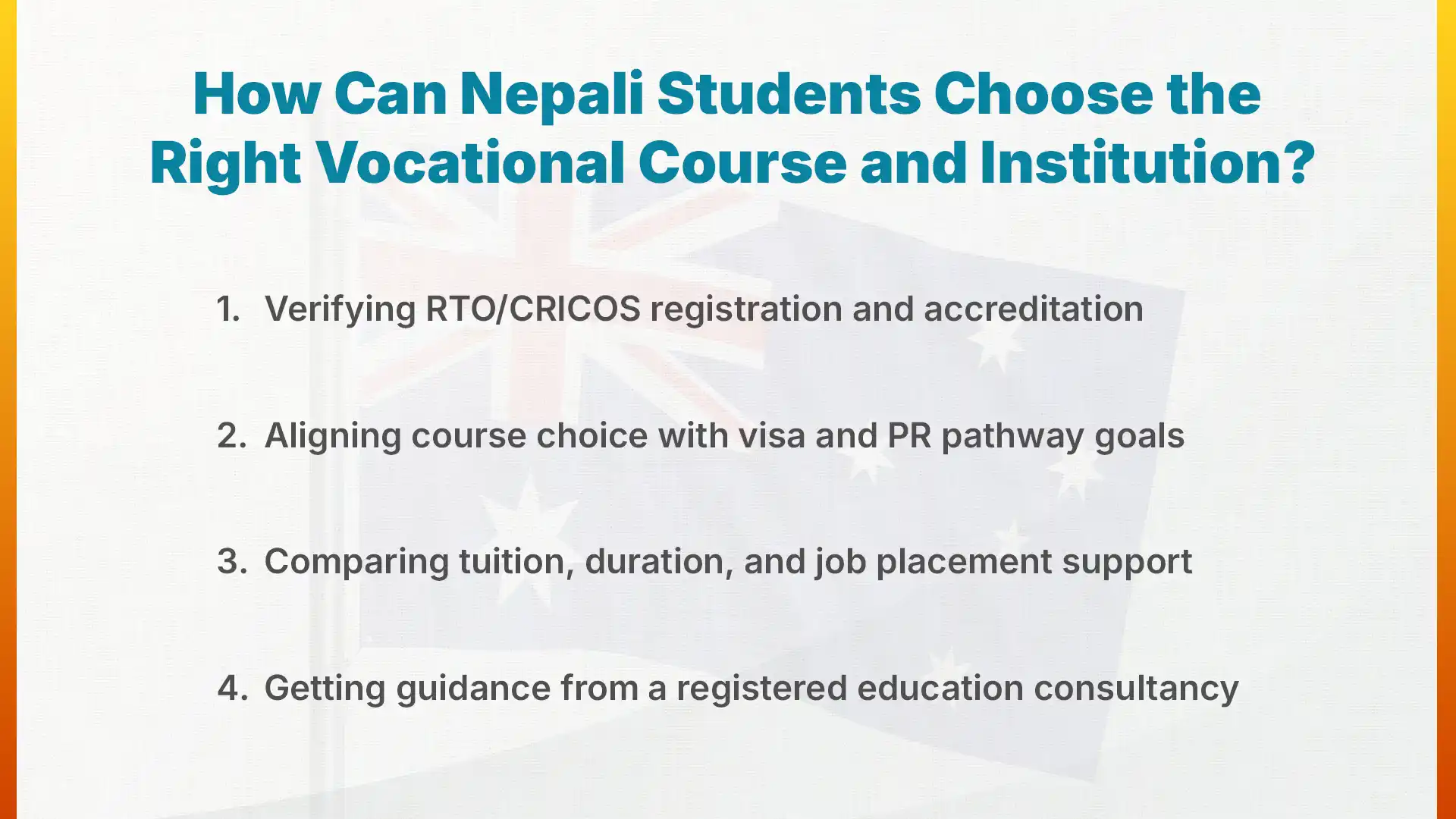
1. Verifying RTO/CRICOS Registration and Accreditation
Always confirm that an institution is a registered training organization listed on CRICOS (Commonwealth Register of Institutions and Courses for Overseas Students), which ensures the qualification is genuine, government-recognized, and eligible for a student visa. Skipping this check is one of the most common and costly mistakes prospective students make.
2. Aligning Course Choice with Visa and PR Pathway Goals
Choosing a trade that appears on the relevant state or federal skilled occupation list can significantly improve long-term visa and residency outcomes, so it's worth researching current occupation lists before settling on a course rather than after enrolling.
3. Comparing Tuition, Duration, and Job Placement Support
Look beyond course fees alone; compare total course length, whether structured work placements or apprenticeships are included, and whether the institution has established relationships with local employers who regularly hire graduates.
4. Getting Guidance from a Registered Education Consultancy
A trusted education consultancy can assess a student's academic background, budget, and career goals and match them with the right course, institution, and visa strategy, reducing the risk of enrolling in a course that doesn't lead anywhere useful.
Conclusion
Vocational and trade courses are no longer a fallback option for Nepali students in Australia; they're a deliberate, strategic choice. Lower costs, faster job entry, strong PR pathways, and genuine demand across the Australian workforce make them worth serious consideration alongside traditional degrees. If you're weighing your options, contact SAS Education to help you choose the right course and institution to match your goals, budget, and long-term plans.