Confirmation of Enrolment (CoE) in Australia: Complete Guide for Nepali Students

Aug 14, 2026
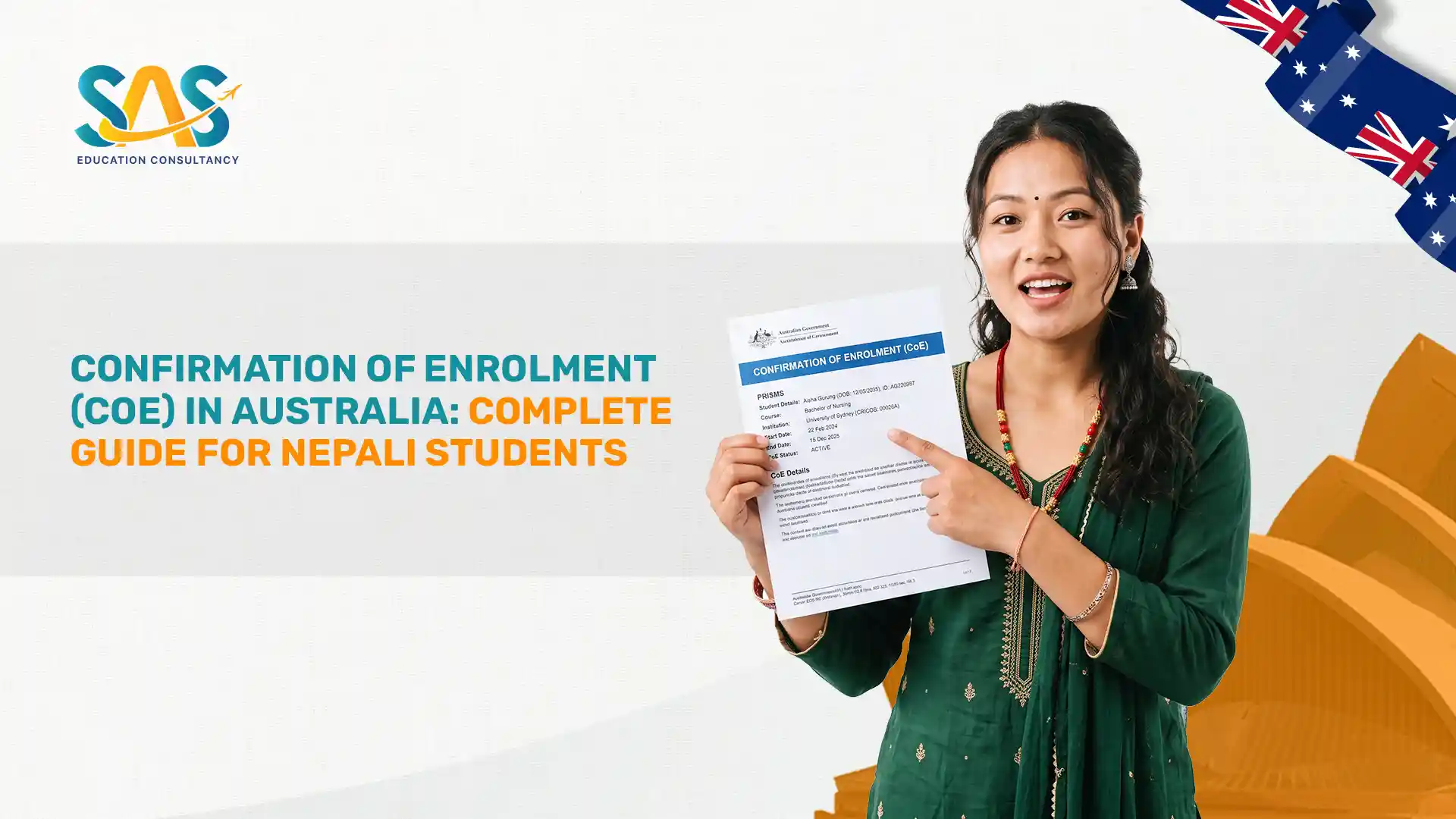
A lot of Nepali students get their offer letter, breathe a sigh of relief, and assume the hard part is done only to realise weeks later that they still can't apply for their visa. That's because the offer letter and the CoE (Confirmation of Enrolment) are two completely different documents, and only one of them actually unlocks the Subclass 500 student visa application. This mix-up is more common than it should be, and it often costs students valuable time they didn't need to lose.
This guide breaks down exactly what a CoE is, how it differs from your offer letter, and what to check before using it for your visa application. By the end, you'll know exactly what stage you're actually at in the process and what still needs to happen before you can apply to study in Australia.
In this blog
What Is a Confirmation of Enrolment (CoE)?
A Confirmation of Enrolment (CoE) is an official document issued by an Australian education provider confirming that a student has accepted their offer, paid the required deposit or fees, and is formally enrolled in a specific course, and it is required to apply for a student visa. Unlike the offer letter, which simply confirms you're eligible for a place, the CoE confirms that a place has actually been secured. It's the document Australian authorities treat as proof that you're genuinely enrolled, not just accepted, which is why meeting the Australia Study requirements from Nepal is so critical.
Aspect | Offer Letter | CoE |
|---|---|---|
| Stage | Issued Before Enrolment | Issued After Enrolment Confirmed |
| Requires Payment | No | Yes, Deposit or Full Fees Paid |
| Used for Visa Application | No | Yes, Required for Subclass 500 |
| Confirms | Course Eligibility | Actual Enrolment |
How Is a CoE Different from an Offer Letter?
A CoE is different from an offer letter because the offer letter simply confirms eligibility for a course, while the CoE confirms actual enrolment after the student has accepted the offer and paid the required fees, making it the document that visa applications are based on.
An offer letter from one of the top universities in Australia for Nepalese students tells you that the institution is willing to give you a place, based on your academic background and application, but it doesn't mean anything has actually been locked in yet. A CoE, by contrast, is only issued once you've accepted that offer and paid the required deposit or fees, which is why it represents a genuinely confirmed enrolment rather than a conditional possibility. This distinction matters directly for your visa application, since the Department of Home Affairs only accepts the CoE, not the offer letter, as valid proof of enrolment for a Subclass 500 application.
What Steps Lead to Receiving a CoE?
Steps that lead to receiving a CoE include accepting the offer letter, paying the required tuition deposit or fees, submitting Overseas Student Health Cover (OSHC) details, and having the education provider confirm enrolment before issuing the CoE.
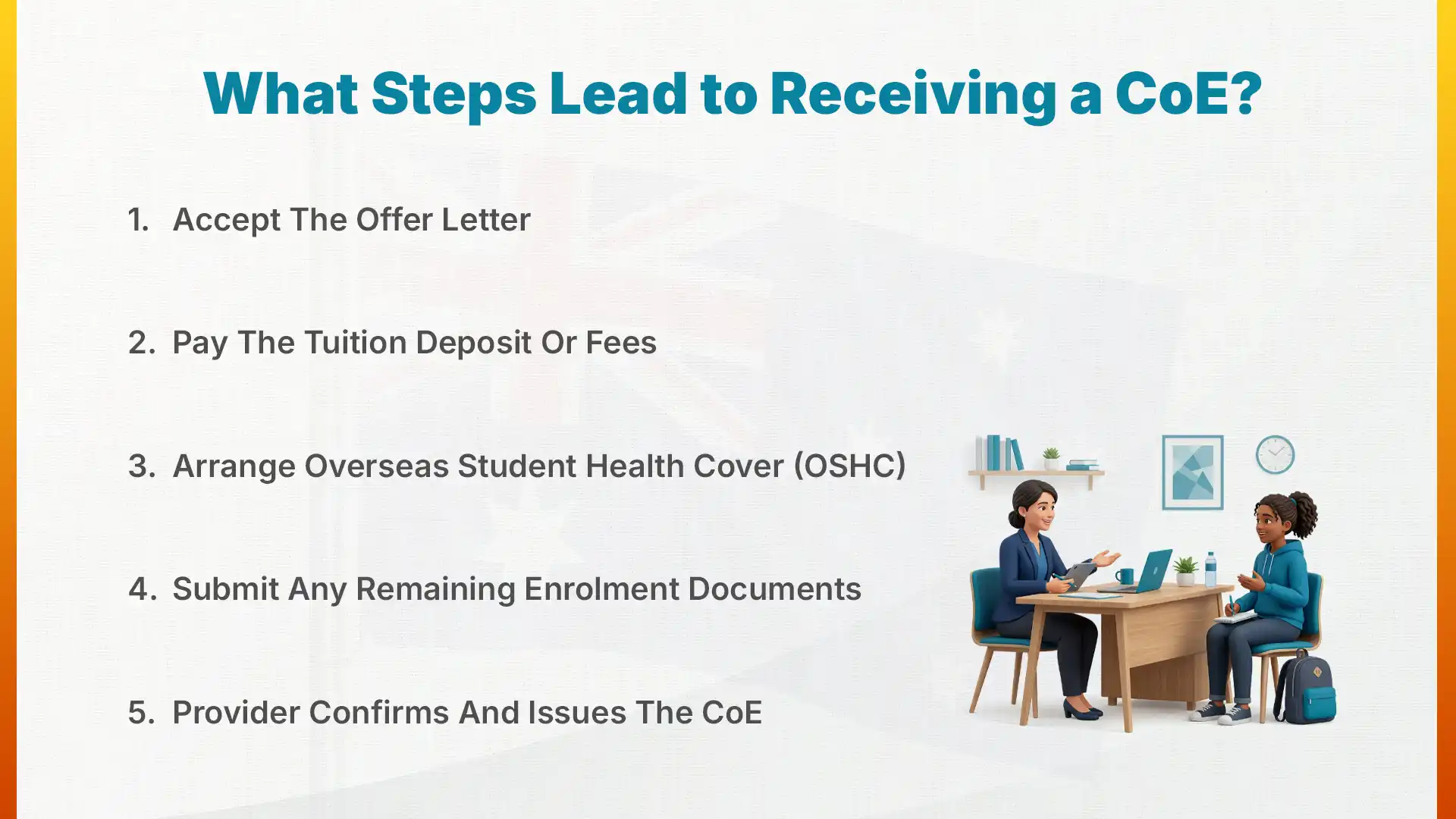
1. Accept The offer letter.
Formally confirm to the institution that you're accepting your place, which is the first step before any enrolment can be processed. This is usually done through a simple acceptance form or online portal provided by the institution.
2. Pay The Tuition Deposit Or Fees
Submit the required deposit or, in some cases, full tuition payment as specified by the institution, since this is what converts an offer into a confirmed enrolment. Payment methods and accepted currencies vary by institution, so it's worth confirming the exact process in advance to avoid delays.
3. Arrange Overseas Student Health Cover (OSHC)
Set up mandatory health cover for the duration of your intended stay, as most institutions require proof of this before issuing a CoE. OSHC can often be arranged directly through the institution or an approved provider, and proof of purchase is generally straightforward to obtain.
4. Submit Any Remaining Enrolment Documents
Provide any outstanding documents the institution has requested, such as identification or academic verification, to complete the enrolment file. Missing even one requested document at this stage can hold up the entire CoE issuance process.
5. Provider Confirms And Issues The CoE
Once everything is in order, the institution formally confirms your enrolment and issues the CoE, usually through the PRISMS system. This is the final step, and once issued, the CoE is what you'll use to proceed with your visa application.
Why Is a CoE Required for the Australian Student Visa?
A CoE is required for the Australian student visa because the Department of Home Affairs uses it to verify that an applicant has a genuine, confirmed enrolment with a registered education provider before granting a Subclass 500 student visa. The CoE acts as proof of genuine enrolment specifically because it can only be issued after fees have been paid and enrolment has been formally processed, unlike an offer letter, which reflects intent rather than commitment.
Every Subclass 500 application must be linked to a valid CoE, and the visa itself is generally granted for a duration tied to the course length shown on that CoE, which is why accuracy on this document matters so much. If a visa application is submitted without a valid CoE, or with details that don't match, it will typically be considered incomplete or invalid, since the CoE is a mandatory component of the application rather than a supporting document.
What Is the Difference Between a Single and eCoE?
A single CoE covers one specific course at one institution, while an eCoE (electronic CoE) is the digital version of the same document that most Australian institutions now issue directly through the government's PRISMS system, and students may receive multiple CoEs if enrolled in packaged courses.
A single CoE is issued when a student is enrolled in just one programme at one institution, covering the full duration of that course from start to finish. Students enrolled in trade and vocational courses in Australia, for example, an English language programme followed by a diploma, or a diploma followed by a bachelor's degree, will typically receive multiple CoEs, one for each stage of the package, since each component is tracked and confirmed separately. Almost all CoEs issued today are eCoEs, generated and verified through PRISMS (the Provider Registration and International Student Management System), which allows both students and the Department of Home Affairs to confirm the document's authenticity directly.
What Should Students Check Before Using Their CoE for a Visa Application?
Before using a CoE for a visa application, students should check that their name and personal details match their passport exactly, confirm the course dates and provider details are correct, ensure all listed CoEs are included if enrolled in a packaged course, and verify the CoE is genuine through PRISMS if needed.
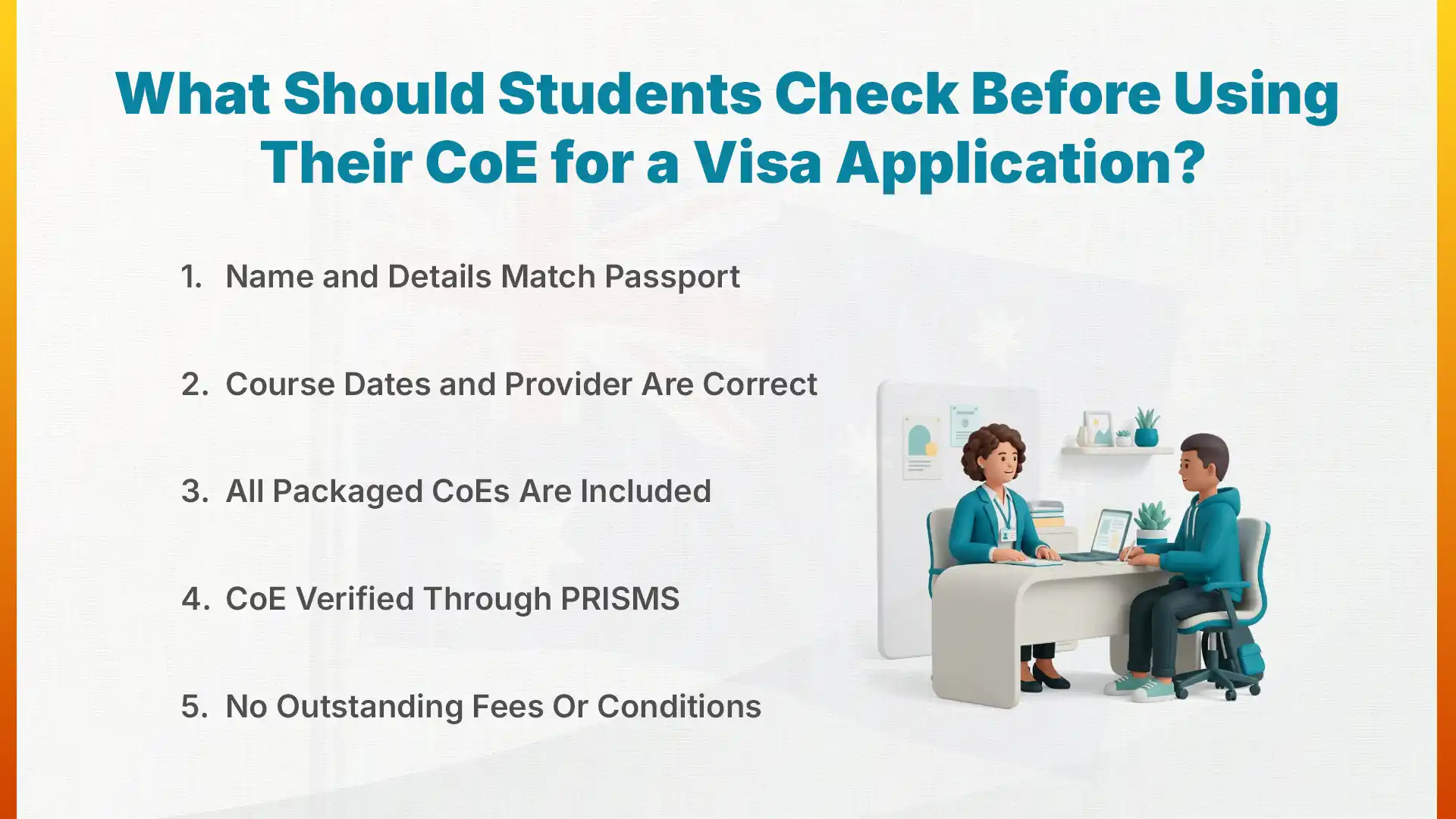
1. Name and Details Match Passport
Confirm that your name, date of birth, and other personal details on the CoE exactly match your passport, since even minor spelling differences can cause complications during visa processing. If you spot a discrepancy, contact the institution immediately to have it corrected before submitting your application.
2. Course Dates and Provider Are Correct
Check that the course start and end dates, along with the institution's details, are accurate and reflect what you actually enrolled in. Errors here can affect your visa duration or eligibility, so it's worth reviewing this line by line rather than skimming it.
3. All Packaged CoEs Are Included
If you're enrolled in a packaged course, make sure every CoE in the sequence is included in your visa application, not just the final one. Missing a CoE from the package can lead to processing delays or complications, since the visa is meant to cover the full duration of all linked courses.
4. CoE Verified Through PRISMS
Where possible, verify that your CoE details match what's recorded in PRISMS, since this is the system the Department of Home Affairs cross-checks against during assessment. Any mismatch between your physical copy and the PRISMS record should be resolved with your institution before applying.
5. No Outstanding Fees Or Conditions
Confirm there are no unresolved fee balances or hidden costs of study in Australia attached to your enrolment, since outstanding issues here can affect the validity of your CoE. Managing your finances carefully prevents this risk.
What Happens If a CoE Is Cancelled or Withdrawn?
If a CoE is cancelled or withdrawn, the student's enrolment with that provider is no longer valid, which can affect their existing or pending student visa status, making it important to understand the reason for cancellation and respond quickly through the provider or Department of Home Affairs. Common reasons a CoE gets cancelled include non-payment of fees, failure to meet enrolment conditions, visa refusal, or a student choosing to withdraw or transfer to another institution. If a student already holds a visa linked to a cancelled CoE, this can directly affect their visa status, since the visa was originally granted on the basis of that specific enrolment.
In some cases, institutions are required to report enrolment cancellations, which can trigger a review of the student's visa. Students facing a CoE cancellation should act quickly: understanding the specific reason, contacting the institution directly to clarify options, and in more serious cases, seeking guidance from a registered migration or education agent to understand how it affects their visa status and next steps.
Conclusion
The CoE, not the offer letter, is the document that actually unlocks your Australian student visa application, and getting every detail on it right, from passport-matching personal information to complete packaged-course documentation, avoids unnecessary delays down the line. Understanding this distinction early saves a lot of confusion later in the process.
If you're navigating your enrolment and want to make sure your CoE and visa application are error-free, SAS Education Consultancy can help you review your documents, verify details through PRISMS, and prepare a complete Subclass 500 application. Reach out to SAS Education Consultancy today to keep your Australian study plans on track.