How to Transition from a Student Visa to a Work Visa in the UK

Jul 30, 2026
Thousands of international students complete their degrees in the UK every year, hoping to stay on and build a career there, but moving from student status to a full work visa isn't automatic. It happens in stages, each with its own eligibility rules, deadlines, and costs, and missing a step can mean losing your legal right to stay.
This guide breaks down exactly how the transition works for students who studied in the UK and go from the Graduate Route through to the Skilled Worker visa, so you know what to do and when to do it
In this blog
What Is the Student-to-Work Visa Transition in the UK?
The student-to-work visa transition in the UK is the legal process that allows international students to change their immigration status from a student route visa to an employment-based work visa without leaving the country.
This pathway enables graduates who have successfully completed an eligible course at a recognized UK institution to remain in the UK and take up full-time employment, provided they meet specific salary, skill level, and licensed sponsor requirements mandated by the UK Home Office.
Understanding the UK Visa Pathway After Graduation
The UK visa pathway after graduation follows two connected steps: moving from the Student Route to the Graduate Route and then from the Graduate Route to a long-term work visa such as the Skilled Worker route. Each step has a different purpose; one gives you time to work or job-search freely, and the other gives you a settled path toward staying in the UK long-term.
1. From Student Route to Graduate Route
Once you complete your degree, your student visa remains valid for a short grace period (usually four months). During this time, or ideally just before your course ends, you must apply for the Graduate Route visa. This post-study work visa allows you to stay in the UK for two years (or three years if you completed a PhD) to work, look for work, or start a business. You do not need a job offer or a sponsor to apply for this visa.
2. From Graduate Route to Skilled Worker Visa
While the Graduate Visa buys you time, it does not lead directly to Indefinite Leave to Remain (ILR). To secure your long-term future in the UK, you must transition from the Graduate Route to a Skilled Worker Visa. This requires finding an employer willing to sponsor you, meeting specific salary thresholds, and proving your job meets the required skill level.
Eligibility Requirements for Switching from a Student to a Work Visa
Eligibility to switch from a student visa to a work visa depends on three things: completing your course correctly, securing a job that meets salary and skill requirements, and applying while your current visa is still valid. Meeting all three at once is what separates a successful switch from a refusal.
1. Course and Sponsor Requirements
You must have successfully completed a course at a UK higher education provider with a track record of compliance. Furthermore, your prospective employer must be an approved licensed sponsor by the UK Home Office. It is highly recommended to choose your academic program with future employment in mind. You can explore the best courses in the UK for Nepalese students to ensure your degree aligns with the UK's shortage occupation list or high-demand sectors, making it easier to find a licensed sponsor.
2. Job Offer and Salary Threshold
You must have a genuine job offer for a specific role. As of recent updates, the general minimum salary threshold for a Skilled Worker Visa is £26,200 per year, or £10.75 per hour, whichever is higher. However, if your role has a specific "going rate" set by the Home Office, you must meet that going rate, which is often higher than the general threshold. To understand what salaries to expect, you can review the highest-paying jobs in the UK.
3. Skill Level (RQF) Requirements
The job you are offered must be at a specific skill level. Under the current rules, the role must meet Regulated Qualifications Framework (RQF) Level 3 or above. This typically includes managerial, professional, technical, and skilled trade roles (equivalent to A-levels or higher). For context, students graduating from highly specialized programs, such as a petroleum engineering course in the UK or chemical engineering in the UK, naturally qualify for these high RQF levels and often command the higher "going rates" required by the Home Office.
Step-by-Step Process to Switch from a Student Visa to a Work Visa
Switching from a student visa to a work visa follows five main steps: securing a sponsored job offer, obtaining a Certificate of Sponsorship, confirming salary and skill compliance, submitting your application, and completing biometrics before receiving a decision. Following these in order avoids the most common delays and errors.
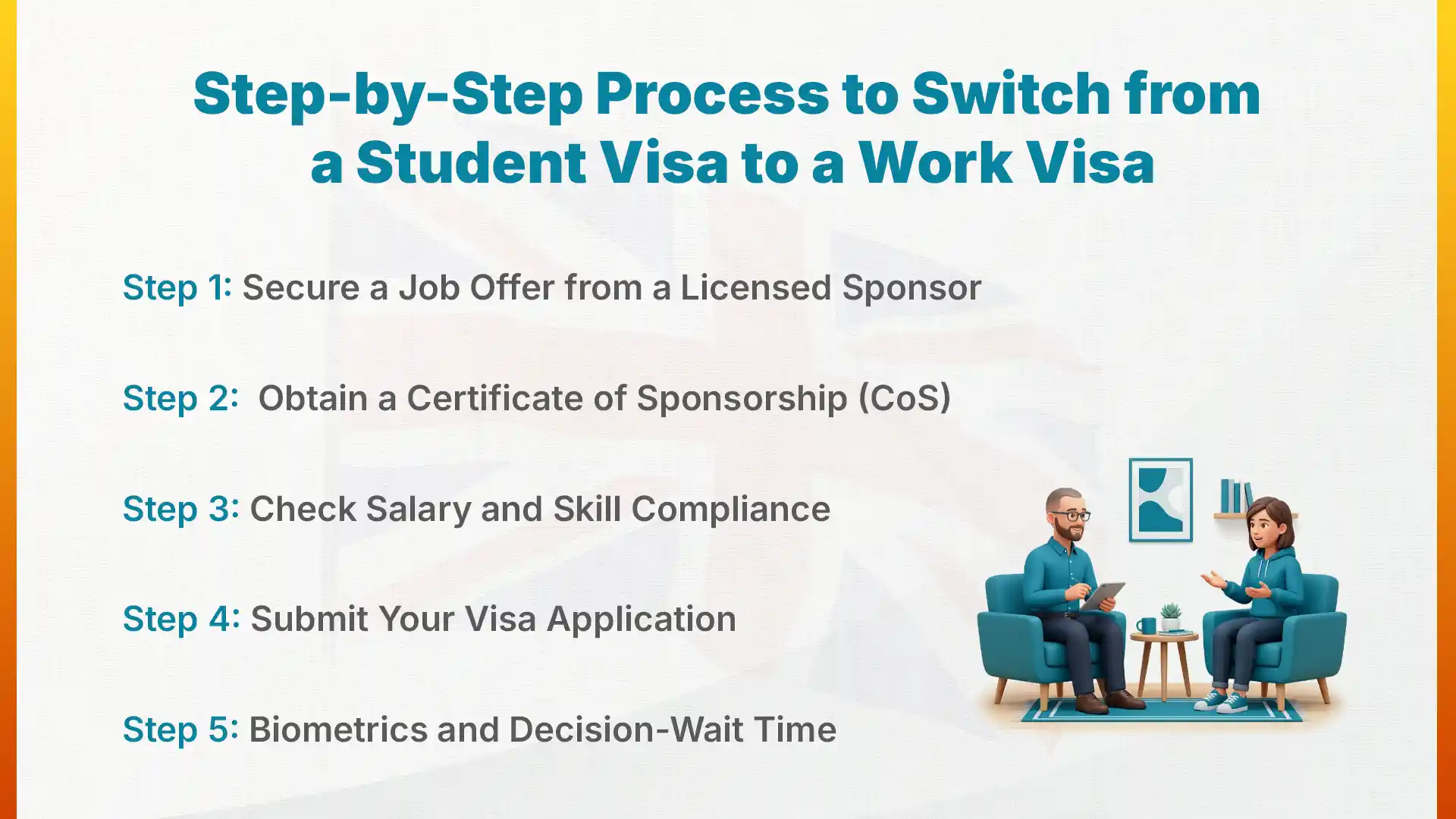
Step 1: Secure a Job Offer from a Licensed Sponsor
Begin your job hunt well before your course ends. Utilize university career fairs, graduate portals, and professional networking sites like LinkedIn. Ensure the company offering you a role is officially listed on the UK government's register of licensed sponsors.
Step 2: Obtain a Certificate of Sponsorship (CoS)
Once you accept the job offer, your employer will assign you a Certificate of Sponsorship (CoS). This is not a physical document but a unique electronic reference number containing details about your role, salary, and sponsor information.
Step 3: Check Salary and Skill Compliance
Double-check that the salary offered on your CoS meets both the general threshold (£26,200) and the specific "going rate" for your occupation code. Ensure the role's RQF level is 3 or higher.
Step 4: Submit Your Visa Application
You can apply for the Skilled Worker Visa online via the UK government website. You must apply before your current visa (student or graduate) expires. You will need to create a UKVI account, fill out the application form, and upload your supporting documents.
Step 5: Biometrics and Decision-Wait Time
After submitting the application and paying the fees, you must book an appointment at a UK Visa and Citizenship Application Services (UKVCAS) center to provide your biometrics (fingerprints and a photograph). Standard processing takes about 8 weeks, but you can pay for Priority (5 working days) or Super Priority (1 working day) services.
Visa Routes Available After Studying in the UK
Beyond the standard Graduate Route to Skilled Worker path, the UK offers several other routes for international graduates, each suited to a different career stage or level of achievement. Choosing the right one depends on whether you have a job offer, exceptional academic standing, or recognized talent in your field.
1. Graduate Route (Post-Study Work Visa)
As mentioned, this is a 2-year (3-year for a PhD) open work visa. It allows you to work in almost any sector, switch employers freely, and acts as a stepping stone to long-term work visas.
2. Skilled Worker Visa
The primary route for long-term employment. It leads to eligibility for Indefinite Leave to Remain (ILR) after 5 years. You are tied to a specific sponsor, though you can change sponsors if the new employer issues a new CoS.
3. High Potential Individual (HPI) Visa
If you graduated from a top global university (outside the UK) within the past 5 years, you may be eligible for this visa. It allows you to work in the UK without a sponsor for up to 2 years.
4. Global Talent Visa
Designed for highly skilled individuals in fields like science, digital technology, arts, and research. If you have a proven track record of exceptional talent, you do not need a job offer to apply for this visa, which can lead to ILR in as little as 3 years.
Documents Required to Switch Visas
When submitting your application to switch from a student to a work visa, you must provide the following documentation:
Valid Passport: Your current passport containing your previous UK visas.
Certificate of Sponsorship (CoS) Reference Number: Provided by your employer.
Proof of Qualifications: Degree certificate and final transcripts proving you completed your course (required if the job has a specific qualification requirement).
Proof of English Language Proficiency: Often waived if you have a UK degree, but you may need to provide a UKVI-approved SELT test result if requested.
Financial Evidence: Bank statements showing you have at least £1,270 in your account for 28 consecutive days, unless your employer is an A-rated sponsor who has certified your maintenance.
Current BRP: Your Biometric Residence Permit.
Costs Involved in Switching from Student to Work Visa
Switching from a student visa to a work visa involves three main cost categories: the application fee itself, the Immigration Health Surcharge, and optional priority processing fees. Together these can add up to several thousand pounds, so budgeting accurately in advance is essential. If you are just starting your journey, reviewing the total cost to study in the UK from Nepal can give you a realistic baseline for your overall financial planning.
1. Visa Application Fee
The Graduate Route application fee and the Skilled Worker application fee (which varies by visa length and whether you're applying from inside or outside the UK) are two separate costs across the two stages of the switch. Always confirm the exact current fee on GOV.UK before applying, since Home Office fees are revised periodically.
2. Immigration Health Surcharge (IHS)
The IHS is currently £1,035 per year of visa validity for most adult applicants, paid upfront for the full length of the visa. This is separate from and often larger than the application fee itself.
3. Priority and Super Priority Service Fees
Optional priority services can speed up a decision from the standard 8-week window to as little as a few working days, for an additional fee.
When to Start the Visa-Switching Process
Timing is one of the biggest factors in a successful visa switch; starting too late is the most common reason students end up scrambling to secure a sponsor before their Graduate Route expires. The process naturally breaks into three phases: before course completion, during the Graduate Route, and in the final months before your visa runs out.
1. Before Course Completion
You cannot apply for a Skilled Worker Visa until your university confirms to the Home Office that you have successfully completed your course. However, you should start applying for jobs and interviewing 3 to 6 months before your graduation date. Ensuring your initial application to the UK was flawless is the foundation of this journey; you can review the standard requirements to study in the UK from Nepal to see how early compliance matters.
2. During the Graduate Route Period
If you secure the graduate visa, you have a full 24 months of breathing room. It is highly recommended to secure your sponsored role within the first 12 to 18 months. This leaves ample time to gather documents, negotiate salaries, and apply for the Skilled Worker Visa without stress.
3. Deadline Considerations Before Visa Expiry
Whether you are switching directly from a student visa or from a graduate visa, you must apply before your current visa expires. If you apply in time, your existing visa conditions will continue under Section 3C leave while the Home Office processes your new application.
Common Reasons for Refusal
Failing to meet the specific salary threshold for the occupation code.
The employer losing their sponsor license or providing an invalid CoS.
Submitting insufficient proof of qualifications or English language skills.
Missing the application deadline (applying after the current visa expired).
Can You Reapply or Appeal?
You generally cannot appeal a Skilled Worker Visa decision, but you can apply for an Administrative Review if you believe the Home Office made a caseworking error (e.g., they calculated your salary incorrectly based on the going rate). Alternatively, if your circumstances have changed (e.g., you found a new sponsor offering a higher salary), you can submit a completely new application.
Common Mistakes to Avoid When Switching Visas
Waiting until the last minute: Do not wait until your visa expires to start the job hunt or application process.
Ignoring the "Going Rate": Assuming the £26,200 minimum is enough, when your specific job code might require £30,000+.
Working outside visa conditions: Working full-time on a student visa before officially graduating, which is a direct violation of visa rules.
Miscalculating the IHS: Failing to budget for the massive upfront cost of the Immigration Health Surcharge.
Not verifying the sponsor: Failing to check the public register to ensure the employer’s license is active and valid for Skilled Workers.
Conclusion
Transitioning from a student visa to a work visa in the UK is a highly rewarding process that opens the door to a global career and long-term settlement opportunities. By understanding the eligibility criteria, budgeting for the application costs, and adhering to strict timelines, you can seamlessly shift from academia to the professional world.
The key is early preparation: choosing the right course, securing a licensed sponsor, and submitting a flawless application. If you are ready to start this journey from Nepal and want to ensure your study choices lead directly to UK employment, contact SAS Education Consultancy today, or explore our dedicated page to study in the UK with expert guidance.