Common Australian Student Visa Refusal Reasons for Nepali Students

Aug 18, 2026
A confirmed CoE, a strong academic record, and months of preparation, and still, a refusal letter. It happens more often than it should, and rarely because a student was genuinely ineligible. Most subclass 500 refusals for Nepali applicants come down to a small, repeatable set of mistakes: a genuine student statement that doesn't build a credible case, financial documents that don't quite hold up, or CoE details that don't line up with the rest of the application.
This matters even more now that Nepal sits at Assessment Level 3, where the documentation bar is higher and there's less room for error. If you aren't fully aware of what this means for your application, it helps to understand the specifics of Nepal’s Assessment Level 3 status. This blog breaks down exactly what causes these refusals and what to check before you submit.
In this blog
What Are the Most Common Reasons Australian Student Visas Get Refused?
Weak genuine student evidence, insufficient or inconsistent financial documentation, English test shortfalls, and CoE or application discrepancies are the most common reasons Australian student visas are refused for Nepali applicants, with most cases tied to preventable preparation gaps rather than genuine ineligibility.
Reason | What Goes Wrong |
|---|---|
| Genuine Student Statement | Vague, Generic, or Unconvincing Study Intent |
| Financial Documentation | Insufficient Funds, Inconsistent History, Unclear Source |
| English Proficiency | Score Below the Required Threshold |
| CoE/Application Discrepancies | Details Not Matching Enrolment or Personal Documents |
| Immigration History | Previous Refusals or Overstays Not Properly Addressed |
Why Does a Weak Genuine Student Statement Lead to Refusal?
A weak, genuine student statement leads to refusal when an applicant's course choice, career goals, and personal circumstances don't form a clear, credible narrative, causing the case officer to doubt whether the applicant genuinely intends to study in Australia rather than use the visa for other purposes.
1. Vague or Generic Study Intent
A statement that reads like a template, without specific reasoning tied to the applicant's own background and goals, gives a case officer little to work with in assessing genuine intent. Specific, personal detail is far more convincing than broad, generic claims about wanting a "good education" or "better future."
2. Course Choice Not Matching Academic or Career Background
When a chosen course has little logical connection to an applicant's prior study or stated career plans, it can raise questions about whether the course is genuinely part of a coherent plan. Explaining the reasoning behind a shift in direction, if there is one, helps close this gap convincingly.
3. Unclear Ties To Nepal Or Return Intentions
Case officers weigh an applicant's circumstances in Nepal, like family, career prospects, property, or other commitments, as part of assessing genuine temporary intent. A statement that doesn't address these ties at all can leave a significant gap in an otherwise strong application.
What Genuine Student Statement Mistakes Should Nepali Applicants Avoid?
Nepali applicants should avoid genuine student statement mistakes such as using generic or templated language, failing to explain why the specific course and provider were chosen, providing unclear post-study plans, not explaining genuine ties to Nepal, and giving inconsistent information across the visa application.
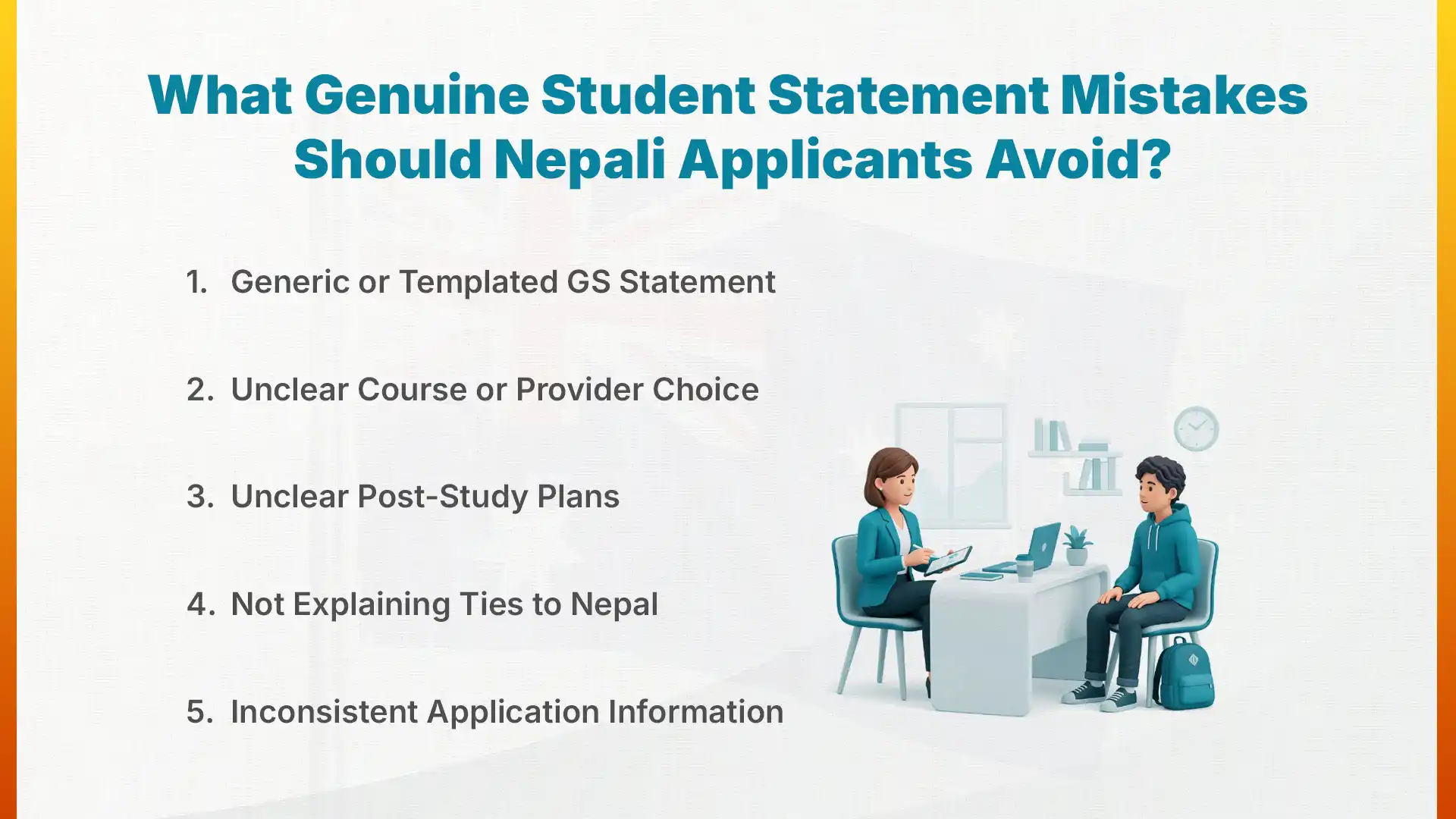
1. Generic or Templated GS Statement
Statements that sound copied from a standard template rarely demonstrate genuine, personal intent. Writing in your own words and including specific details about your background, study goals, and career plans makes the statement more credible.
2. Unclear Course or Provider Choice
Failing to explain why you selected a particular course and education provider can make your study decision appear poorly researched. Explain how the course connects with your previous education, experience, skills, and future career goals.
3. Unclear Post-Study Plans
Giving a vague explanation of what you intend to do after completing your studies can make your overall study plan appear incomplete. Include a realistic career direction, such as mapping out long-term PR pathways for Nepali graduates, and explain how the qualification will support your future goals.
4. Not Explaining Ties to Nepal
Leaving out relevant family, career, business, or property ties in Nepal can weaken the explanation of your personal circumstances. Where applicable, explain these genuine connections and how your Australian studies fit into your longer-term plans.
5. Inconsistent Application Information
When the information in your GS statement conflicts with your academic history, financial documents, employment details, or other parts of the visa application, it can raise concerns about the accuracy of your claims. Review the entire application to ensure all information is accurate and consistent.
Why Do Financial Documentation Issues Cause Visa Refusals?
Financial documentation issues cause Australian student visa refusals when applicants fail to show the required funds with a stable, verifiable history, use unrecognized banks, or submit fund sources that can't be clearly traced or explained to the case officer's satisfaction. Before gathering your paperwork, it is vital to be accurate when calculating the true cost of studying in Australia so you know exactly how much to show.
1. Insufficient or Unstable Fund Evidence
The visa application requires proof of sufficient funds to cover tuition, travel, and living costs, and any shortfall can result in refusal. Inconsistent balances or sudden large fluctuations across statements can also raise doubts about whether the funds are genuinely stable and available. For many families, securing an education loan for studying in Australia is the best way to demonstrate a clear, verifiable source of funds.
2. Unrecognized or Unverifiable Bank Sources
Funds held with smaller or less recognized financial institutions can introduce delays or complications in verification, since case officers need to be able to confirm the legitimacy of the funds. Using well-established, verifiable banks makes this evidence far easier to accept.
3. Unclear or Unexplained Source of Funds
When funds come from a sponsor rather than the applicant's own savings, the relationship and source must be clearly documented and explained. Missing or vague explanations here are one of the most common and most avoidable reasons for refusal.
How Do CoE and Application Discrepancies Cause Refusals?
CoE and application discrepancies cause visa refusals when details on the Confirmation of Enrolment, such as course dates, provider information, or personal details, don't match the visa application or supporting documents, raising doubts about the application's accuracy and consistency. You can avoid many of these errors by understanding the strict visa rules surrounding your Confirmation of Enrolment (CoE).
1. Mismatched Personal or Course Details
Even small discrepancies, like a slightly different spelling of a name or a mismatched date of birth between the CoE and passport, can trigger closer scrutiny or refusal. Reviewing every field on the CoE against official documents before applying is an essential step.
2. Missing CoEs In Packaged Course Applications
Students enrolled in packaged courses need every CoE in the sequence included in their application, not just the final one. Missing a CoE from the package is a straightforward but surprisingly common reason applications run into trouble.
3. Incomplete Supporting Documents
If documents referenced elsewhere in the application, such as academic transcripts, English test results, or financial evidence, aren't fully included, this gap alone can be enough to trigger a refusal. Cross-referencing the full checklist before submission helps catch this early.
What Should Nepali Students Double-Check Before Submitting an Australian Visa Application?
Before submitting an Australian visa application, Nepali students should carefully review their financial documents, CoE details, English test results, genuine student statement, and supporting documents. A final check helps ensure that the application is complete, accurate, and consistent across all sections.
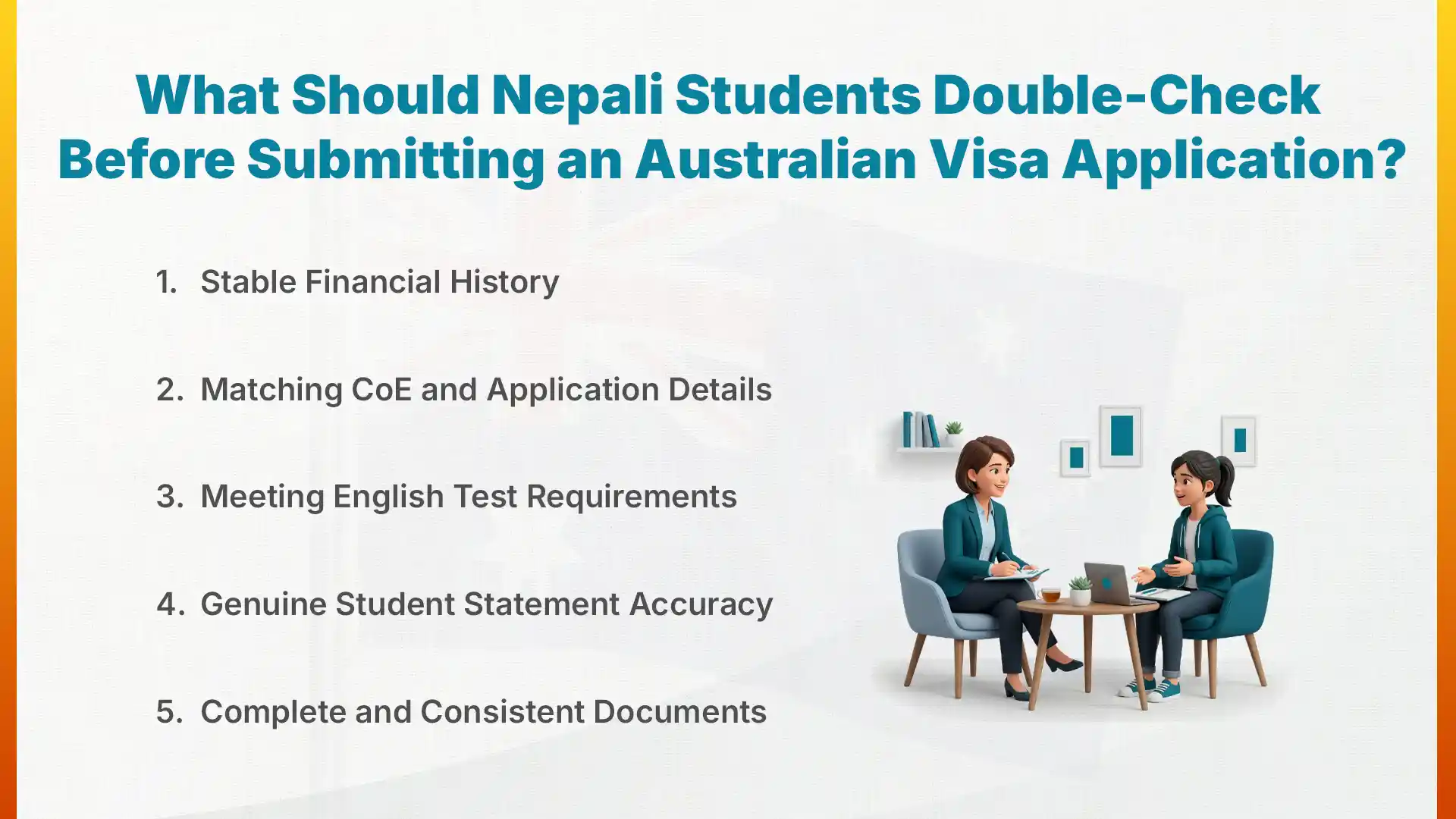
1. Stable Financial History
Check that your financial documents show a stable and verifiable history rather than unexplained recent deposits or inconsistencies. Make sure the funds shown can be properly supported with relevant financial evidence.
2. Matching CoE and Application Details
Compare your CoE with your visa application and passport to ensure important details such as your name, course, provider, and dates match. Correct any discrepancies before submitting the application.
3. Meeting English Test Requirements
Confirm that your English test type and score meet the current requirements for your intended course and visa application. If you are still in the preparation phase, spend time deciding between IELTS and TOEFL for Australian admissions to ensure you pick the right test. Check both the required score and whether your test is accepted.
4. Genuine Student Statement Accuracy
Review your GS statement to ensure it clearly explains your course choice, provider choice, future plans, and personal circumstances. The information should be honest and consistent with the rest of your application.
5. Complete and Consistent Documents
Check that all required supporting documents are included and that names, dates, qualifications, employment details, and financial information are consistent throughout the application. A final document-by-document review can help identify avoidable errors before submission.
How Does Assessment Level 3 Affect Refusal Risk for Nepali Applicants?
Assessment Level 3 affects refusal risk for Nepali applicants because it requires full financial, academic, and genuine student evidence to be submitted upfront with stricter scrutiny, meaning incomplete or poorly prepared applications face a higher chance of refusal than under a lower assessment level.
1. Higher Documentation Standards Under Level 3
Since Nepal moved to Assessment Level 3, applicants must submit complete financial evidence, English test results, and genuine student statements upfront rather than providing them later in the process, leaving far less room for gaps or omissions.
2. Incomplete Applications Face Greater Risk
Under this higher scrutiny, applications that would have been acceptable at a lower assessment level with minor gaps or less detailed evidence are now more likely to be refused, since case officers are applying a stricter standard across the board.
3. Preparing a Decision-Ready Application
This makes submitting a fully complete, internally consistent application from the outset more important than ever. A "decision-ready" application, with every requirement met and every detail cross-checked, gives applicants the strongest possible chance under the current framework.
What Happens If an Australian Student Visa Is Refused?
If an Australian student visa is refused, applicants receive a refusal letter explaining the specific grounds, and depending on the reason, they may be able to reapply with corrected documentation or, in limited cases, seek a review through the Administrative Review Tribunal.
1. Understanding the Refusal Letter
The refusal letter outlines exactly which requirement wasn't met, and reading it carefully is the first step toward deciding whether to reapply or seek further guidance. Treating this letter as a diagnostic tool, rather than a final dead end, is key to moving forward effectively.
2. Reapplying With Corrected Documentation
In most cases, especially where the refusal was due to a documentation or evidence gap rather than genuine ineligibility, applicants can reapply after correcting the specific issue identified. A stronger, more carefully reviewed second application often succeeds where the first did not.
3. When Administrative Review Is an Option
In more limited circumstances, where an applicant believes a genuine case-working error was made, a review through the Administrative Review Tribunal may be available. This option is narrower than reapplying and generally requires professional guidance to pursue effectively.
Conclusion
Most Australian student visa refusals for Nepali applicants aren't about genuine ineligibility; they come down to preventable mistakes: a genuine student statement that doesn't build a credible case, financial documents that don't quite meet the required standard, or a CoE detail that doesn't match the rest of the application. With Nepal now at Assessment Level 3, careful preparation and a thorough final review before submission matter more than ever.
If you want to make sure your Australian student visa application is free of these common mistakes before you submit, SAS Education Consultancy can review your financial documents, CoE details, and Genuine Student statement to give your application its strongest possible chance. Reach out to our visa experts today to get your application checked before you apply.