IELTS or TOEFL for Australia: Requirements, Difficulty & Tips for Nepalese Students

Jun 18, 2026
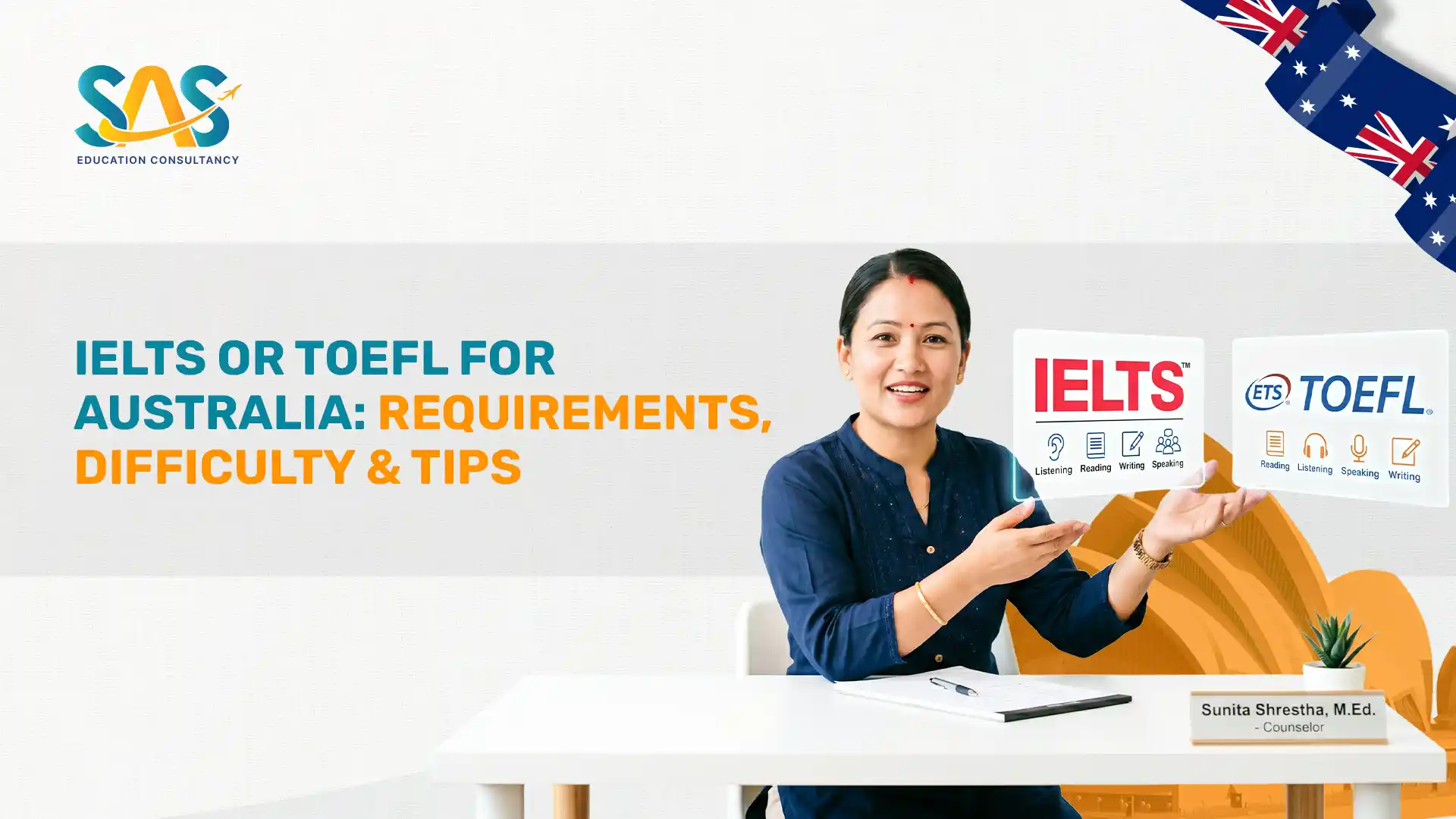
Both IELTS and TOEFL are accepted in Australia, but they are not equal in how widely they are recognized, how familiar Nepalese students are with the format, or how straightforward they are to sit for from Nepal. For most Nepalese students applying to Australian universities and the Subclass 500 student visa, IELTS is the more widely accepted and more commonly taken test, but TOEFL is a legitimate and sometimes better alternative depending on your strengths.
This guide gives you a direct, honest comparison of both so you can make the right choice before you start preparing. Nepalese students who are still planning their study journey can also explore studying in Australia for a broader overview before focusing on English test requirements.
In this blog
Is IELTS or TOEFL Accepted for Australia Student Visa?
Both IELTS and TOEFL are accepted for the Australian Student Visa (Subclass 500) by the Department of Home Affairs, and both are accepted by the vast majority of Australian universities for undergraduate and postgraduate admissions. The key difference is that IELTS is accepted by every single Australian university without exception, while TOEFL is accepted by most but not all institutions, making IELTS the safer choice if your university shortlist includes smaller or regional institutions.
IELTS: Accepted by all Australian universities and by the Department of Home Affairs for the Subclass 500 visa
TOEFL: Accepted by most major Australian universities, including Group of Eight institutions, but not universally accepted at all colleges and smaller providers
Visa acceptance: Both IELTS and TOEFL are on the IRCC-equivalent list for Australian student visa English proficiency evidence
Both work for the visa. For university admissions, IELTS is the safest choice. Always verify TOEFL acceptance with each specific institution on your shortlist before sitting the test. Nepalese students who want to know the exact IELTS score required for their target university can check the IELTS requirement for Australia before shortlisting
IELTS vs TOEFL: Quick Comparison Table
Before diving into the detailed breakdown, here is a side-by-side snapshot of how IELTS and TOEFL compare across the factors that matter most to Nepalese students applying to Australia: format, cost, acceptance, minimum scores, and difficulty. Use this table to get a quick sense of which test suits your situation before reading the full comparison.
Factor | IELTS Academic | TOEFL iBT |
|---|---|---|
| Format | Paper or Computer-Based | Computer-Based Only |
| Duration | 2 Hours 45 Minutes | Approximately 2 Hours |
| Cost in Nepal | NPR 28,000 – NPR 32,000 | NPR 25,000 – NPR 28,000 |
| Results Time | 3 to 13 Days | 4 to 8 Days |
| Accepted by Australian Universities | 100% | Most (Verify Per Institution) |
| Accepted for Subclass 500 Visa | Yes | Yes |
| Minimum Score for Australia (General) | 6.0 – 6.5 Overall | 60 – 79 iBT |
| Speaking Test Format | Face-to-Face with Examiner | Computer Microphone Recording |
| Difficulty for Nepalese Students | More Familiar; Face-to-Face Speaking Preferred | Less Familiar; Entirely Computer-Based |
What Are the Minimum Score Requirements for Australia?
The minimum English test scores for Australian universities generally start at IELTS 6.0, TOEFL iBT 60, or PTE 50 for general undergraduate programs, rising to 7.0, 94, and 65, respectively, for professional programs like nursing and teaching. The breakdowns below cover all three tests so you can compare requirements before deciding which one to sit.
1. IELTS Score Requirements for Australia
Most Australian universities require a minimum IELTS Academic score of 6.0 to 6.5 overall for undergraduate programs, with no individual band typically falling below 6.0. Higher-demand programs such as nursing, medicine, teaching, and social work require 7.0 or above due to the professional communication standards of those fields.
Program Type | Minimum IELTS Score |
|---|---|
| General Undergraduate | 6.0 – 6.5 Overall |
| Business and Commerce | 6.5 Overall |
| Nursing and Healthcare | 7.0 Overall, No Band Below 7.0 |
| Teaching and Education | 7.0 – 7.5 Overall |
| Medicine and Law | 7.0 – 7.5 Overall |
2. TOEFL Score Requirements for Australia
Most Australian universities that accept TOEFL require a minimum iBT score of 60 to 90 for undergraduate programs, with higher requirements for professional and healthcare programs.
Program Type | Minimum TOEFL iBT Score |
|---|---|
| General Undergraduate | 60 – 79 |
| Business and Commerce | 79 – 90 |
| Nursing and Healthcare | 94 – 100 |
| Teaching and Education | 94 – 100 |
| Medicine and Law | 94 – 100 |
3. PTE Score Requirements for Australia
PTE Academic is also widely accepted in Australia and is worth mentioning as a third alternative. Most universities require a PTE score of 50 to 65 for undergraduate programs, with higher requirements for professional programs. PTE is particularly popular in Australia because results are available within 48 hours and the fully automated scoring is considered objective and consistent.
4. Score Equivalency Comparison
The table below shows how IELTS, TOEFL iBT, and PTE Academic scores compare at each proficiency level so you can identify your equivalent target score across all three tests.
IELTS | TOEFL iBT | PTE Academic |
|---|---|---|
| 6.0 | 60 – 64 | 50 – 52 |
| 6.5 | 79 – 80 | 58 – 62 |
| 7.0 | 94 – 95 | 65 – 70 |
| 7.5 | 102 – 105 | 73 – 76 |
Which Test Is More Widely Accepted in Australia?
IELTS is more widely accepted in Australia than TOEFL, with 100% of Australian universities and the Department of Home Affairs recognizing it for both admissions and visa purposes. TOEFL is accepted by most Group of Eight universities and major institutions but is not universally accepted across all registered course providers, colleges, and vocational education institutions.
IELTS: Accepted by the University of Melbourne, University of Sydney, ANU, UQ, Monash, RMIT, and all other Australian universities without exception
TOEFL: Accepted by most major universities, but students must confirm acceptance with each institution individually; particularly important for colleges, pathway programs, and smaller providers
Subclass 500 visa: Both IELTS and TOEFL are accepted by the Australian Department of Home Affairs as valid evidence of English proficiency for the student visa application
If universal acceptance across all institutions is your priority, IELTS wins outright. If you are applying only to major research universities that you have confirmed accept TOEFL, it is a fully valid alternative.
IELTS vs TOEFL: Which Is Easier for Nepalese Students?
For most Nepalese students, IELTS is the easier test due to its face-to-face speaking format and British English style that aligns more closely with Nepal's school curriculum. However, the right answer depends on your individual strengths, learning style, and comfort with technology. The breakdown below compares both test formats in detail so you can make an informed decision before committing to preparation.
1. IELTS Format and Structure
IELTS Academic consists of four sections: Listening (30 minutes), Reading (60 minutes), Writing (60 minutes), and Speaking (11 to 14 minutes face-to-face with an examiner). The speaking section is conducted as a live conversation, which most Nepalese students find more natural and less intimidating than speaking into a computer microphone. Reading passages are academic texts, and writing tasks include a graph or data description (Task 1) and an argumentative essay (Task 2).
2. TOEFL Format and Structure
TOEFL iBT is fully computer-based and consists of four sections: Reading (35 minutes), Listening (36 minutes), Speaking (16 minutes recorded into a microphone), and Writing (29 minutes). The integrated tasks in TOEFL, where students must read, listen, and then write or speak in response, are considered more complex than IELTS tasks and require stronger multitasking skills. The speaking section requires recording responses into a computer, which many Nepalese students find less comfortable than a live examiner conversation.
3. Key Differences Between IELTS and TOEFL
The key differences between IELTS and TOEFL lie in the speaking format, writing task structure, English accent, and overall test delivery. IELTS uses a face-to-face examiner and British English, while TOEFL is fully computer-based with American English. The table below breaks down these differences side by side.
Factor | IELTS | TOEFL |
|---|---|---|
| Speaking | Face-to-Face with Examiner | Recorded into Computer |
| Writing Task 1 | Describe a Graph or Diagram | Integrated Reading, Listening, and Writing |
| Accent | British English | American English |
| Reading Style | Academic Passages | Academic Passages with Integrated Tasks |
| Best For | Students Comfortable with British English and Live Speaking | Students Comfortable with American English and Computer-Based Formats |
4. Best Fit for Nepalese Students
For most Nepalese students, IELTS is the more comfortable and familiar format. Secondary and higher education in Nepal follows a British-influenced curriculum, making British English spelling and vocabulary more familiar. The face-to-face speaking test is generally considered less stressful than recording responses into a microphone, and IELTS preparation materials are more widely available in Nepal. TOEFL is a better fit for students who have spent significant time consuming American English content or who are also applying to US universities where TOEFL is the standard.
IELTS vs TOEFL: Cost and Availability in Nepal
Both IELTS and TOEFL are available in Nepal, though IELTS has more test centers and more frequent test dates, making it significantly more accessible for Nepalese students across the country.
Factor | IELTS | TOEFL iBT |
|---|---|---|
| Cost in NPR | NPR 28,000 – NPR 32,000 | NPR 25,000 – NPR 28,000 |
| Cost in USD | USD 210 – USD 240 | USD 200 – USD 220 |
| Test Centres in Nepal | Multiple in Kathmandu, Some in Other Cities | Kathmandu Only |
| Test Frequency | Multiple Dates per Month | Limited Dates per Month |
| Results Available | 3 to 13 Days | 4 to 8 Days |
| Score Validity | 2 Years | 2 Years |
IELTS is slightly more expensive but significantly more accessible in Nepal with more test dates and locations. TOEFL is marginally cheaper but limited to Kathmandu with fewer available dates. For students outside Kathmandu, IELTS is the practical choice.
Students who want to understand the exact IELTS exam fee before booking can check the IELTS exam fee in Nepal for the most current pricing
How to Prepare for IELTS or TOEFL for Australia?
Preparation strategy depends on which test you choose, but both require structured practice across all four skills, reading, writing, listening, and speaking, over a minimum of 6 to 12 weeks for most Nepalese students.
IELTS Preparation Tips:
Practice Task 1 writing using real IELTS graphs and charts; this is the section most Nepalese students underestimate
Record yourself speaking and listen back critically; most errors are in fluency and coherence, not vocabulary
Use official Cambridge IELTS practice books (books 13 to 18) for the most accurate test simulation
TOEFL Preparation Tips:
Practice integrated writing tasks, specifically reading a passage, listening to a lecture, and writing a response is the hardest TOEFL skill for most Nepalese students
Use the ETS Official TOEFL Prep materials; third-party TOEFL materials vary significantly in quality
Practice speaking into a microphone daily to build comfort with the recorded-response format before test day
Nepalese students who want structured classroom preparation before sitting IELTS can enroll in IELTS preparation classes to build the skills and band confidence needed to reach their target score for Australian universities.
Which Test Should Nepalese Students Choose for Australia?
For most Nepalese students applying to Australian universities, IELTS is the recommended choice, but the right answer depends on your specific situation.
Choose IELTS if:
You want a test accepted by every Australian university without needing to verify
You prefer a face-to-face speaking test over recording into a computer
You are more comfortable with British English spelling and vocabulary
You are applying to nursing, healthcare, or teaching programs that specifically require IELTS
Nepalese students applying to nursing or healthcare programs should also check the requirements to study in Australia from Nepal since those programs have stricter English thresholds.
Choose TOEFL if:
You have confirmed that your specific Australian universities accept TOEFL
You are also applying to US universities where TOEFL is the standard
You are more comfortable with American English and a fully computer-based format
You want faster results TOEFL returns scores in 4 to 8 days
IELTS is the safer, more universally accepted, and more familiar choice for Nepalese students applying to Australia. TOEFL is a valid alternative for students with specific reasons to prefer it, but always verify acceptance with your target institutions before committing to preparation.
Conclusion
Both IELTS and TOEFL are legitimate routes to meeting the English proficiency requirements for Australian universities and the Subclass 500 student visa, but for most Nepalese students, IELTS is the more practical, more widely accepted, and more comfortable choice. Whichever test you choose, starting preparation early and using official practice materials gives you the best chance of reaching your target score on the first attempt.
Need help choosing the right English test or university for Australia? Contact SAS Education Consultancy for a free counseling session and let us help you plan your English test strategy, shortlist the right universities, and submit the strongest possible visa application.