Nepal's Australia Assessment Level 3 Explained: What It Means for Nepali Students in 2026

Aug 10, 2026
If you're a Nepali student planning to study in Australia, here's something you need to factor into your application: since 8 January 2026, Nepal has been classified under Australia's Assessment Level 3 the highest-risk tier in the country's student visa framework. This isn't a ban, and it doesn't mean Nepali students have stopped getting approved but it does mean stricter documentation, deeper scrutiny, and a lot less room for incomplete or inconsistent applications.
This blog breaks down exactly what Assessment Level 3 means, what changed, what documents you now need, and how to strengthen your application under the current requirements.
In this blog
What Is Australia's Assessment Level System?
Australia's Assessment Level system, part of the Simplified Student Visa Framework (SSVF), categorizes student source countries into risk tiers, Level 1, 2, or 3, based on historical visa compliance, with Level 3 representing the highest risk category requiring the strictest evidence and documentation for anyone planning to study in Australia.
Level 1 represents the lowest-risk countries, generally requiring the least documentation, while Level 2 sits in the middle with moderate evidence requirements, and Level 3 is the highest-risk tier, where applicants must submit full financial proof, English test results, and genuine student evidence upfront rather than providing it later in the process. These levels are set based on a country's historical visa compliance record how many applications from that country have been genuine, how many have involved fraudulent documentation, and how visa outcomes have trended over recent years meaning a country's level can move up or down as this track record changes.
Assessment level isn't the only factor in play either, since Australia also assigns a separate risk level to each education provider, and the two combine to shape the overall scrutiny an application receives, meaning the institution you apply to matters just as much as your country's classification.
Assessment Level | Risk Category | Documentation Required |
|---|---|---|
| Level 1 | Lowest Risk | Minimal Upfront Evidence |
| Level 2 | Moderate Risk | Partial Evidence, Some Submitted Later |
| Level 3 | Highest Risk | Full Financial, English, and GS Evidence Upfront |
What Changed for Nepal in 2026?
On 8 January 2026, Australia moved Nepal from Assessment Level 2 back to Assessment Level 3 under the SSVF, alongside India, Bangladesh, and Bhutan, reversing the upgrade Nepal had received on 31 March 2025 after seven years at Level 3. Nepal's path here has been anything but stable: after spending roughly seven years at the highest-risk tier, it finally moved up to Level 2 in March 2025, only to be reclassified back to Level 3 less than a year later.
Reporting around the reversal points to integrity concerns as the main driver, including instances of forged certificates and fraudulent bank guarantees identified during peak intake periods, exactly the kind of compliance issue the Assessment Level system exists to catch. Notably, Nepal wasn't singled out in this update; India, Bangladesh, and Bhutan were reclassified to Level 3 in the same policy change, pointing to a broader regional review of visa integrity rather than an issue specific to Nepal alone.
What Documents Are Now Required Under Assessment Level 3?
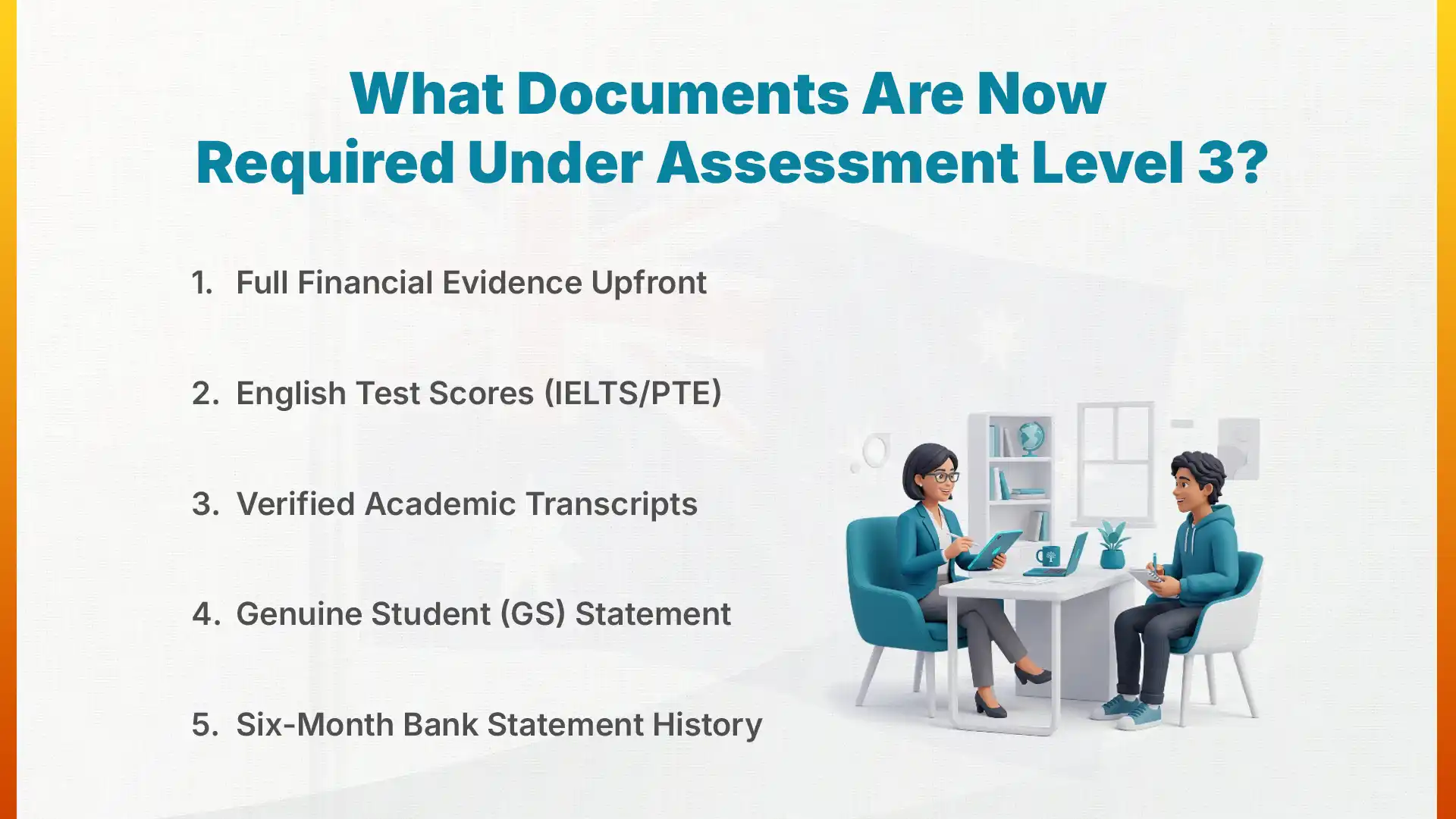
Under Assessment Level 3, Nepali applicants must submit full financial evidence, English language test scores, verified academic transcripts, and a strong Genuine Student (GS) statement upfront with their visa application, rather than providing these later in the process.
1. Full Financial Evidence Upfront
Applicants must now submit complete proof of funds at the time of lodging, rather than being able to provide it later in the process as was possible under Level 2. This shift means students need to have their financial documentation fully organized well before they're ready to submit their application.
2. English Test Scores (IELTS/PTE)
A valid English language test result is required for almost all applications, with scores needing to meet the current minimum thresholds set by the Department of Home Affairs. Students should plan their test date early, since rescheduling or retaking the test can add unexpected delays to the overall timeline.
3. Verified Academic Transcripts
Academic records must be submitted in verified form, with case officers cross-checking details directly with institutions where necessary. Any discrepancy between submitted transcripts and institutional records can significantly slow down processing or raise red flags. Meeting these requirements to study in Australia from Nepal is now strictly enforced at the initial lodging stage.
4. Genuine Student (GS) Statement
Applicants must provide a clear, honest statement explaining their study intentions and ties to Nepal, replacing the older Genuine Temporary Entrant requirement. Vague or templated statements are far more likely to draw additional scrutiny than specific, personalized responses.
5. Six-Month Bank Statement History
Financial evidence must show a consistent six-month history rather than a single snapshot, helping demonstrate that funds are genuine rather than recently borrowed. Large, unexplained deposits shortly before applying are one of the most common triggers for further verification regarding the cost of study in Australia from Nepal.
What Are the Financial Requirements Under Assessment Level 3?
Under Assessment Level 3, Nepali applicants must show access to at least AUD 29,710 to cover living costs, in addition to tuition and travel expenses, with bank statements needing a clear six-month history from Class A commercial banks to be accepted as genuine.
1. Minimum Living Cost Requirement
The AUD 29,710 figure covers estimated annual living costs and sits on top of tuition and travel expenses, which must also be demonstrated separately. This figure is set by the Department of Home Affairs and can be revised, so it's worth confirming the current amount on the official Subclass 500 page before lodging an application.
2. Acceptable Bank and Fund Sources
Funds should come from recognized Class A commercial banks in Nepal to ensure they're accepted without complication by the Department of Home Affairs. Using smaller or less recognized institutions can introduce unnecessary verification delays.
A clean six-month history with consistent balances helps demonstrate that funds are genuine rather than borrowed shortly before application. Case officers under Assessment Level 3 are known to verify transactions directly with banks, so inconsistencies or last-minute large deposits can raise red flags.
Does Assessment Level 3 Mean Nepali Students Can't Get a Visa?
No, Assessment Level 3 does not mean student visas are unavailable to Nepali applicants; it means applications face stricter scrutiny and higher documentation standards, with genuine, well-prepared applications continuing to be approved.
1. Higher Scrutiny, Not A Ban
Assessment Level 3 simply raises the evidence bar. Case officers examine financial proof, academic history, and genuine student intent more closely, but approval remains entirely achievable for applicants who prepare thoroughly and honestly.
2. Impact On Refusal Rates For Poorly Prepared Applications
Industry observations suggest refusal rates for poorly guided or incomplete applications have risen noticeably under Assessment Level 3, in some cases by a significant margin. This makes the quality and completeness of an application far more consequential than it was under Level 2.
A "decision-ready" application, one submitted with every required document complete and consistent from the outset, is now essential rather than optional. Reported success rates for well-prepared Nepali applicants have remained strong, underscoring that preparation, not nationality alone, is the deciding factor.
How Can Nepali Students Strengthen Their Application Under Level 3?
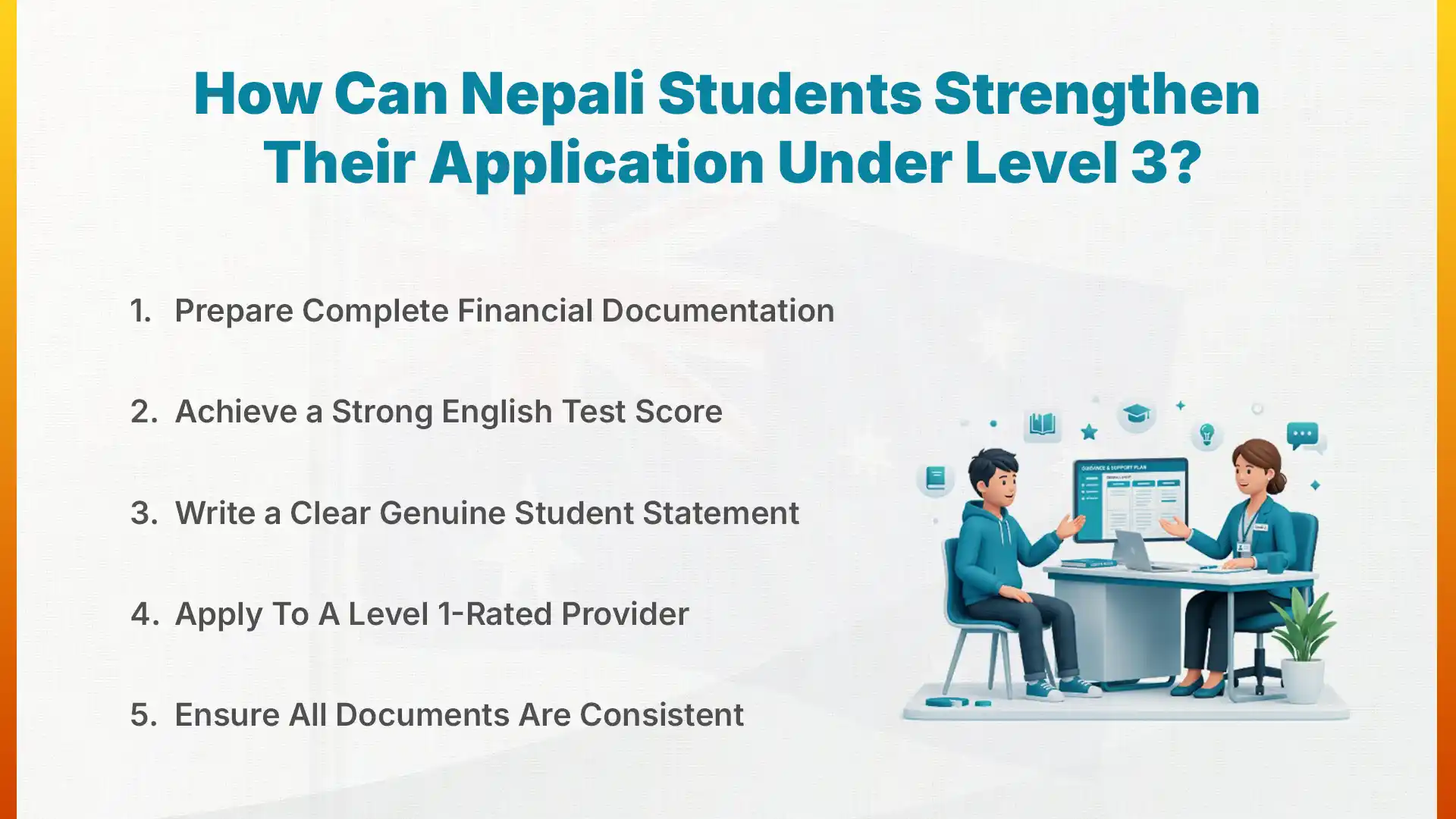
Nepali students can strengthen their application under Assessment Level 3 by preparing complete financial documentation in advance, achieving a strong English test score, writing a clear and honest genuine student statement, and applying to a Level 1-rated education provider to help balance the country's risk classification.
1. Prepare Complete Financial Documentation
Gather bank statements, income sources, and proof of funds well in advance rather than assembling them at the last minute before applying. Starting early also gives time to correct any inconsistencies before they become a problem during assessment.
2. Achieve a Strong English Test Score
Aim for a PTE score of around 58 or IELTS 6.5 to comfortably meet current minimum requirements, giving some buffer above the threshold. Scoring above the minimum also reduces the risk of falling short if test results are marginally lower than expected.
3. Write a Clear, Genuine Student Statement
Focus on honest, specific answers about your study purpose and career plans in Nepal, rather than relying on generic or templated responses. A statement that reflects your actual circumstances and goals is far more convincing to a case officer than one that reads like a standard template.
4. Apply To A Level 1-Rated Provider
Choosing a well-established, Level 1 institution can help balance Nepal's country-level risk classification in the combined assessment. This is worth weighing alongside the best course in Australia and the cost when comparing institutions.
5. Ensure All Documents Are Consistent
Cross-check that names, dates, and figures match exactly across every submitted document, since inconsistencies are a common trigger for closer scrutiny. Even small discrepancies, like a slightly different spelling of a name, can prompt additional verification requests.
How Does the Provider Risk Level Affect Nepali Applicants?
The provider risk level affects Nepali applicants because Australia combines the country's assessment level with the education provider's own risk rating, meaning applying to a Level 1 institution can help offset Nepal's Level 3 classification and result in a more balanced overall risk profile.
1. How Provider Risk Levels Are Set
Education providers are assigned their own risk level based on factors like historical visa compliance among their international student cohort and institutional track record, similar in principle to how country-level assessment is determined.
2. Combined Risk Assessment in Practice
When a Nepali applicant applies to a Level 1 institution such as a well-established university, the combined risk profile tends to be more balanced than applying to a lower-rated private college, even with Nepal sitting at Level 3.
3. Choosing Providers That Improve Application Strength
This makes institution choice a genuine strategic factor under the current framework, not just for academic reasons, but because it directly affects how an application is assessed and processed.
Conclusion
Nepal's move to Assessment Level 3 raises the bar for what a strong Australian student visa application looks like, but it doesn't close the door. Genuine students with complete financial documentation, solid English test scores, and honest, well-written student statements continue to be approved under the new framework. The difference now is that preparation matters more than ever, and there's far less room for incomplete or inconsistent applications.
If you're planning to apply for an Australian student visa under the current Assessment Level 3 requirements, SAS Education Consultancy can help you prepare decision-ready documentation, strengthen your Genuine Student statement, and choose a provider that works in your favor. Contact SAS Education Consultancy today to start your application with confidence.