Why UK Student Visas Are Rejected for Nepali Students: Common Mistakes to Avoid

Aug 11, 2026
A confirmed university offer, a valid CAS (Confirmation of Acceptance for Studies), and months of preparation, and still, a rejection letter. It happens more often than you'd think, and rarely because a student was genuinely ineligible. Most UK student visa refusals for Nepali applicants come down to a small, repeatable set of mistakes: financial documents that don't quite meet the rules, a personal statement that doesn't build a credible case, or CAS details that don't line up with the rest of the application.
This blog explains exactly what causes UK student visa rejections and what you should check before submitting your application so you can avoid common mistakes and improve your chances of a smooth journey to study in the UK.
In this blog
What Are the Most Common Reasons UK Student Visas Get Rejected?
Financial documentation issues, weak or inconsistent study intent, incomplete CAS details, and English language shortfalls are the most common reasons UK student visas are rejected for Nepali applicants, with most cases traceable to preventable errors rather than genuine ineligibility.
Reason | What Goes Wrong |
|---|---|
| Financial Documentation | Insufficient Funds, Inconsistent Bank History, Unclear Fund Source |
| Study Intent (Credibility) | Vague or Generic Statement, Unclear Career Reasoning |
| CAS Discrepancies | Details Not Matching the Visa Application or Offer |
| English Proficiency | Score Below the Required Threshold or Invalid Test Type |
| Immigration History | Previous Refusals or Overstays Not Properly Addressed |
Why Do Financial Documentation Issues Cause Visa Rejections?
Financial documentation issues cause UK student visa rejections when applicants fail to show the required funds for the correct 28-day period, provide bank statements from unrecognized institutions, or submit fund sources that can't be clearly traced or explained.
1. Insufficient Or Inconsistent Fund Evidence
The visa application requires proof of sufficient funds to cover tuition and living costs, and any shortfall, even a small one, can result in refusal. Inconsistent balances across statements can also raise doubts about whether the funds are genuinely available and stable.
The visa application requires proof of sufficient funds to cover the total cost to study, tuition, and living;with any shortfall, even a small one, can result in refusal. Inconsistent balances across statements can also raise doubts about whether the funds are genuinely available and stable.
2. The 28-Day Rule and Common Errors
Applicants must show that the required funds have been held continuously for at least 28 days before the date of application, and this is one of the most frequently misunderstood requirements. A single dip below the required balance during that window, even briefly, can invalidate the entire financial evidence.
3. Unclear Or Unexplained Source Of Funds
When funds come from a source other than the applicant's own savings, such as a parent or sponsor, the relationship and source must be clearly documented and explained. Missing or vague explanations here are a common, avoidable reason for refusal.
What Financial Mistakes Should Nepali Applicants Avoid?
Nepali applicants should avoid financial mistakes such as depositing large sums just before applying, using unrecognized banks, letting the 28-day fund requirement lapse, and submitting statements that don't clearly match the funds declared in their application.
1. Large Last-Minute Deposits
Depositing a large sum shortly before applying is one of the clearest red flags to an entry clearance officer, since it suggests the funds may not genuinely belong to the applicant. Spreading out savings well in advance avoids this issue entirely.
2. Unrecognized or Unverifiable Banks
Using a bank that isn't easily verifiable or recognized can slow down or complicate the assessment process. Sticking to well-established, verifiable financial institutions makes the evidence far easier to accept at face value.
3. Broken 28-Day Fund Period
Letting the balance dip below the required amount at any point during the 28-day window resets the clock and can invalidate the evidence entirely. Checking the balance consistently throughout this period helps catch any accidental dips early.
4. Mismatched Fund Amounts
If the amount stated in the application doesn't match what's shown in the bank statement, it creates an immediate inconsistency that case officers are trained to catch. Double-checking figures across every document before submission avoids this simple but costly error.
5. Missing Fund Source Explanation
Failing to explain where sponsored funds come from, or how the applicant is related to the sponsor, leaves an obvious gap in the application. A clear, documented explanation closes that gap and strengthens the overall credibility of the financial evidence.
Why Does Weak Study Intent Lead to Visa Refusal?
Weak study intent leads to UK visa refusal when an applicant's course choice, career goals, and personal circumstances don't form a clear, credible narrative, causing the entry clearance officer to doubt whether the applicant genuinely intends to study and return rather than use the visa for other purposes.
1. Vague or Generic Personal Statements
A personal statement that reads like a template, without specific reasoning tied to the applicant's own background and goals, gives a case officer little to work with in assessing genuine intent. Specific, personal detail is far more convincing than broad, generic claims.
2. Course Choice Not Matching Academic Or Career Background
When a course choice has little logical connection to an applicant’s previous studies or stated career goals, it can raise questions about whether the course is part of a genuine academic and professional plan. Clearly explaining the reason for a change in direction, especially when applying to one of the best universities in the UK for Nepalese students, helps demonstrate a coherent and credible study pathway.
3. Unclear Post-Study Plans
Applicants who can't clearly articulate what they intend to do after completing their course, whether that's returning to Nepal, pursuing further study, or another credible path, often struggle to convince a case officer of genuine study intent.
How Do CAS and Documentation Errors Cause Rejections?
CAS and documentation errors can lead to UK student visa refusals when details on the Confirmation of Acceptance for Studies (CAS), such as course dates, tuition fees, or personal information, do not match the visa application or supporting documents. These inconsistencies can raise doubts about the accuracy and credibility of the application. Understanding the difference between a conditional and unconditional offer letter before your CAS is issued can help prevent documentation mistakes later in the visa process.
1. Mismatched Personal or Course Details
Even small discrepancies, like a slightly different spelling of a name or a mismatched date of birth between the CAS and passport, can trigger closer scrutiny or outright refusal. Reviewing every field on the CAS against official documents before applying is a simple but essential step.
2. Expired Or Incorrect CAS Information
A CAS has a limited validity window, and applying with outdated or incorrect information, such as an old course start date, can undermine the application. Confirming the CAS is current and accurate immediately before submission avoids this.
3. Missing Supporting Documents Referenced In The CAS
If the CAS references specific qualifications or documents that aren't included in the application, this gap alone can be enough to trigger a refusal. Cross-referencing the CAS against the full document checklist before submission helps catch this early.
What Should Nepali Students Double-Check Before Submitting a UK Visa Application?
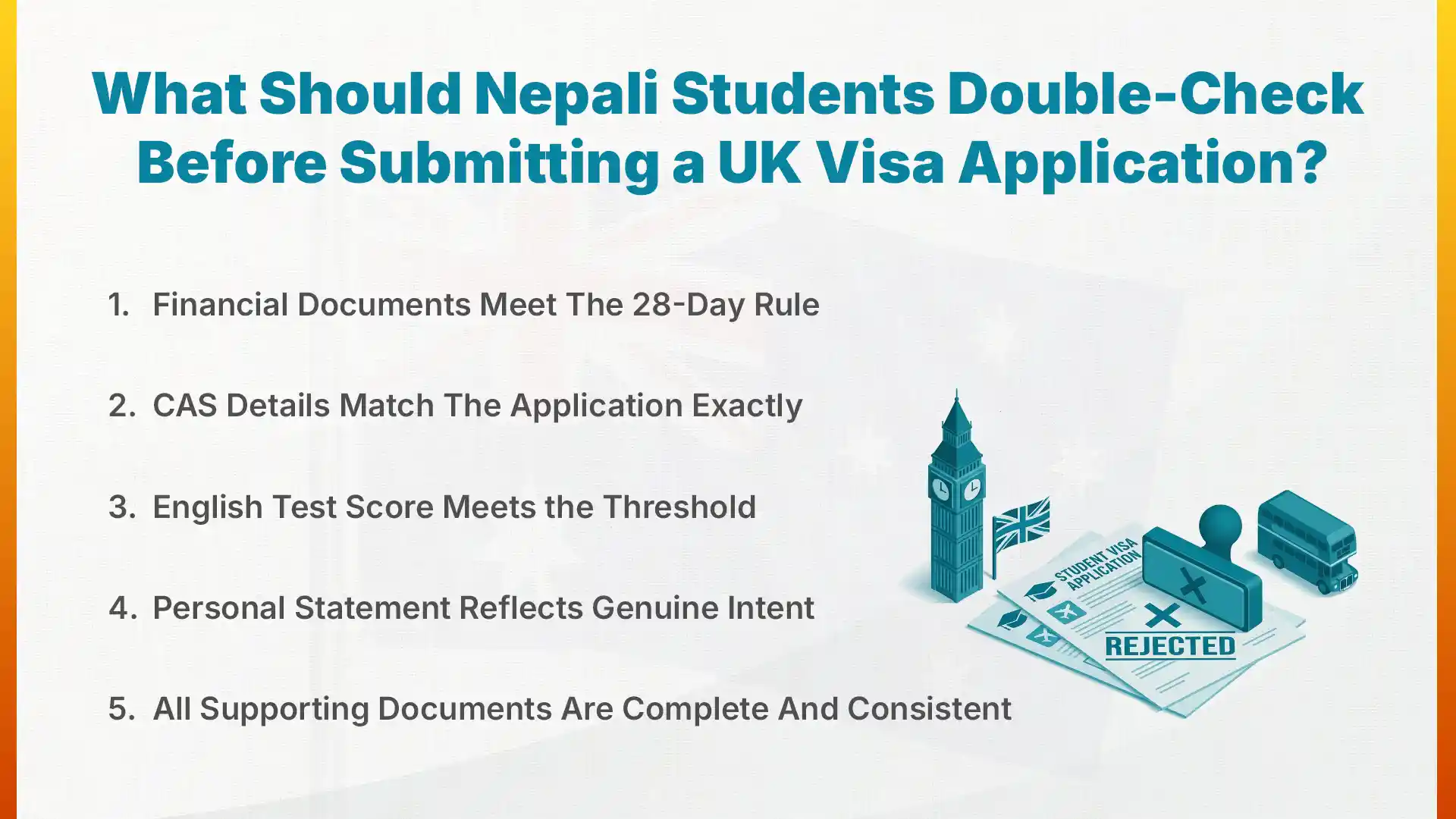
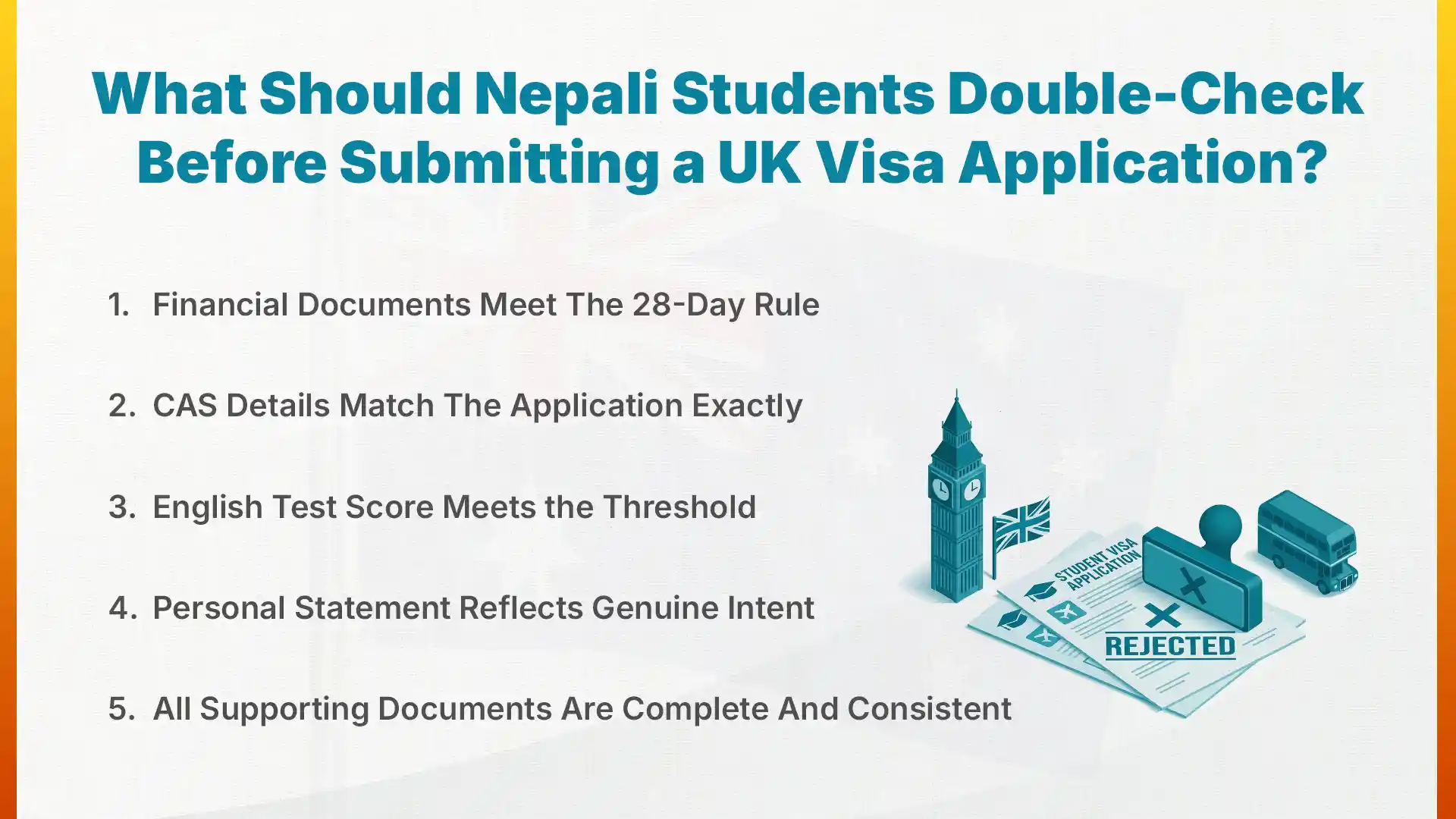
Before submitting a UK visa application, Nepali students should double-check that financial documents meet the 28-day rule, all CAS details match their application exactly, and the English test scores meet the required threshold, and their personal statement clearly and honestly reflects their study and career intentions.
1. Financial Documents Meet The 28-Day Rule
Confirm the required balance has been held continuously for the full 28 days without dipping below the threshold at any point. This is one of the most common technical errors, so it deserves a careful final check.
2. CAS Details Match The Application Exactly
Compare every field on the CAS against the visa application and passport details line by line. Even a minor mismatch can prompt unnecessary scrutiny or delay.
3. English Test Score Meets the Threshold
Verify the test type and score meet the current minimum requirements for the specific course and visa category. Using an unaccepted test type is an easily avoidable but surprisingly common mistake.
4. Personal Statement Reflects Genuine Intent
Read the statement back and ask whether it clearly explains why this course, why now, and what comes after. A statement that answers these questions specifically is far stronger than a generic one.
5. All Supporting Documents Are Complete and Consistent
Make sure every document referenced elsewhere in the application is actually included and consistent in spelling, dates, and figures. Gathering all the supporting documents is one of the simplest reasons to avoid any change of visa being rejected.
What Happens If a UK Student Visa Is Rejected?
If a UK student visa is rejected, applicants receive a refusal letter explaining the specific reasons, and depending on the grounds for refusal, they may be able to reapply with corrected documentation or, in limited cases, request an administrative review. The refusal letter outlines exactly which requirement wasn't met, and reading it carefully is the first step toward deciding whether to reapply, appeal, or seek further guidance. It's worth treating this letter as a diagnostic tool rather than a final dead end.
In most cases, especially where the refusal was due to a documentation error rather than genuine ineligibility, applicants can reapply after correcting the specific issue identified, and a stronger, more carefully reviewed second application often succeeds where the first did not. In more limited circumstances, where an applicant believes a genuine case-working error was made rather than an issue with the evidence itself, an administrative review may be available though this option is narrower than reapplying and generally requires professional guidance to pursue effectively.
How Can Nepali Students Avoid Visa Rejection?
Nepali students can avoid UK visa rejection by preparing complete and consistent financial documentation well in advance, writing a clear and honest study intent statement, verifying every CAS detail against their application, and consulting a registered education agent before submission.
1. Preparing Documentation Well In Advance
Starting the financial and document preparation process early, rather than close to the application deadline, gives enough buffer to fix the 28-day rule, correct inconsistencies, and gather any missing paperwork without time pressure.
2. Writing a Clear and Consistent Study Intent Statement
A statement that's specific, honest, and consistent with the rest of the application, which is aligned with your course choice, academic background, and career goals, builds a far more credible case than one written generically or in a rush.
3. Getting Professional Review Before Submission
Having a registered education consultancy review the full application before submission catches the kind of small, easily missed errors that commonly lead to refusal, giving the application its best possible chance the first time around.
Conclusion
Most UK student visa refusals for Nepali applicants aren't about genuine ineligibility; they come down to preventable mistakes: a financial document that doesn't quite meet the 28-day rule, a personal statement that doesn't build a credible case, or a CAS detail that doesn't match the rest of the application. Careful preparation, and a thorough final review before submission, make the biggest difference between a smooth approval and an avoidable rejection.
If you want to make sure your UK student visa application is free of these common mistakes before you submit, SAS Education Consultancy can review your financial documents, CAS details, and personal statement to give your application its strongest possible chance. Contact SAS Education Consultancy today to get your application checked before you apply.