IELTS Requirement for Canada: Minimum IELTS Score for Students & PR

Jun 15, 2026
"What IELTS score do I actually need for Canada?"
If you have been searching for answers, you have probably seen different numbers everywhere. One website says 6.0 is enough, another says you need 6.5, while some universities ask for even higher scores.
The truth is that the IELTS requirement for Canada depends on what you plan to do. A diploma, bachelor's degree, master's program, nursing course, and permanent residency (PR) can all have different IELTS requirements for a Nepali student.
In this article, I have tried to simplify all the IELTS requirements for studying in Canada. Be it for a diploma, a bachelor’s or a master’s degree. By the end, all your confusions must be answered. Common in, let’s gain the clarity you deserve!
In this blog
How Much IELTS Score is Required for Canada?
The minimum IELTS score for Canada is usually 6.0 overall for most diploma and undergraduate programs, while master's programs often require 6.5 or higher. However, the exact requirement depends on your course, institution, and future goals. Before choosing a target score, it is important to understand how IELTS requirements vary across different pathways.
Minimum IELTS Score for Different Purposes in Canada
Canada does not have one fixed IELTS requirement for everyone. The score you need depends on why you are going to Canada. Here’s a snippet of the general IELTS requirements for different purposes of migrating to Canada:
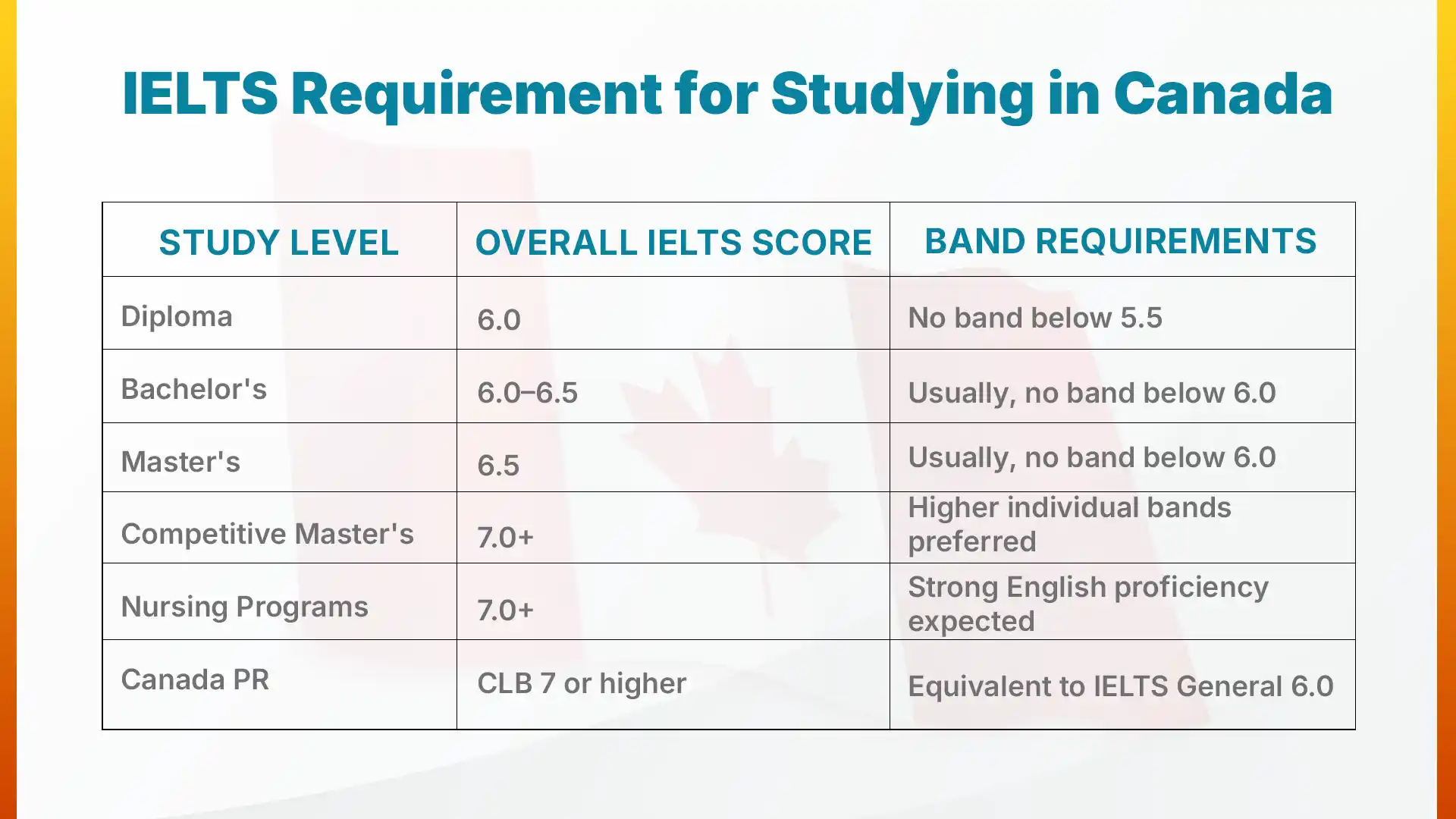
Although these are common benchmarks, some institutions may have slightly different requirements.
What is the IELTS Requirement for a Canadian Student Visa?
There is no separate IELTS score set by Canada's study permit system for every student. In most cases, your IELTS score should meet the admission requirements of your chosen institution. A stronger score can also help demonstrate that you are prepared for studying in an English-speaking environment.
1. Is IELTS Mandatory for a Canada Student Visa?
IELTS is not always legally mandatory, but it is the most widely accepted English proficiency test for Canadian study applications. Most colleges and universities require proof of English skills before offering admission. As a result, IELTS remains the most common pathway for Nepalese students.
2. Minimum IELTS Score for Study Permit Approval
Although visa approval depends on many factors, most successful applicants have already met their institution's language requirements. Generally, an overall IELTS score of 6.0 or above aligns with admission standards for many programs. Meeting the minimum score alone, however, does not guarantee visa approval.
3. Can You Get a Canada Student Visa with 6.0 Bands?
Yes, many diploma and undergraduate programs accept an overall IELTS score of 6.0. However, some institutions may also require minimum scores in each individual band. Therefore, always check both overall and sectional requirements before applying.
What is the IELTS Score Required for Diploma in Canada?
Most diploma programs in Canada require an overall IELTS score of 6.0 with no band below 5.5. This makes diplomas one of the most accessible study options for Nepalese students. Let's look at what that means in practice.
Most diploma programs in Canadian colleges have straightforward entry requirements. Most programs ask for:
- Overall IELTS: 6.0
- No band below: 5.5
- Completed +2 or equivalent
Some colleges may offer flexibility depending on the program and intake.
1. Diploma Programs with Lower IELTS Requirements
Some colleges offer English pathway programs for students who do not meet direct entry requirements. These pathways allow students to improve their language skills before starting their academic program. This can be a useful option for students who narrowly miss the required score.
2. Can You Study in Canada with 5.5 in One Module?
In some cases, yes. Many diploma programs allow one module score of 5.5 as long as the overall score remains 6.0. However, more competitive programs may require 6.0 in every band.
IELTS Requirement for Bachelor's Degree in Canada
Most bachelor's programs in Canada require an IELTS score between 6.0 and 6.5 overall. Competitive universities often expect stronger scores, especially in writing and speaking. Understanding the difference between colleges and universities can help you plan better.
Most Nepalese students apply for bachelor's programs in Canada immediately after completing +2. Typical requirements include:
Requirement | Typical Score |
|---|---|
| Overall IELTS | 6.0–6.5 |
| Reading | 6.0 |
| Writing | 6.0 |
| Listening | 6.0 |
| Speaking | 6.0 |
Higher scores can increase your admission options.
1. IELTS Requirement in Top Universities vs Colleges After +2
Colleges often accept IELTS 6.0 overall, while universities commonly require 6.5 or higher. Competitive institutions may also have stricter sectional score requirements. Therefore, students aiming for top-ranked universities should target higher bands.
2. IELTS 6.0 vs IELTS 6.5: Which Opens More Options?
An IELTS score of 6.0 can qualify you for many programs, but 6.5 significantly expands your choices. More universities, scholarships, and competitive courses become available. For this reason, many students aim beyond the minimum requirement.
IELTS Requirement for Canada Masters
Most master's programs in Canada require an IELTS score of at least 6.5 overall. Highly competitive programs may ask for 7.0 or higher. Since postgraduate study involves advanced academic work, language expectations are naturally higher.
Most universities expect:
- Overall IELTS: 6.5
- No band below 6.0
- Strong academic background
Research-intensive programs may have additional language expectations.
What IELTS Score Is Required for Different Master's Degree in Canada?
Different master's programs in Canada can have slightly different IELTS requirements. While 6.5 overall is enough for many postgraduate courses, some specialized and research-focused programs may expect higher scores.
The table below gives a quick overview of the typical IELTS scores required for studying a master's degree in Canada.
IELTS Requirement for MSc Nursing in Canada
MSc Nursing programs generally require higher IELTS scores than many other courses. Most universities expect at least 7.0 overall because nursing involves direct communication with patients and healthcare teams. As a result, language standards are particularly strict.
Master's Program Type | Typical IELTS Requirement |
|---|---|
| General Master's (Business, Education, Social Sciences, etc.) | 6.5 Overall |
| MBA Programs | 6.5–7.0 Overall |
| Engineering Master's Programs | 6.5 Overall |
| Research-Based Master's Programs | 7.0+ Overall |
| Competitive/Top Universities | 7.0+ Overall |
1. Minimum IELTS Score for MSc Nursing
Typical requirements for mastery in nursing programs in Canada include:
Component | Common Requirement |
|---|---|
| Overall IELTS | 7.0 |
| Reading | 6.5–7.0 |
| Writing | 7.0 |
| Listening | 7.0 |
| Speaking | 7.0 |
Always verify requirements with your chosen university.
2. Why Nursing Has Higher English Requirements in Canada?
Healthcare professionals must communicate clearly and accurately. Even small misunderstandings can affect patient care. Therefore, nursing programs prioritize strong English proficiency.
What Are the IELTS Requirements for Canada PR?
If you decide to apply for Canada PR in the future, you will usually need to take IELTS General Training, even if you previously took IELTS Academic in Nepal for your studies. Canada then converts your IELTS scores into Canadian Language Benchmark (CLB) levels, which are also the scores used to evaluate your PR eligibility and award immigration points. Most PR pathways require at least CLB 7, while higher scores can improve your CRS score and PR chances.
Here’s an overview of the IELTS score you’ll need for you PR in Canada:
Requirement | Details |
|---|---|
| IELTS Test Type for PR | IELTS General Training |
| Minimum Target | CLB 7 |
| Listening | 6.0 |
| Reading | 6.0 |
| Writing | 6.0 |
| Speaking | 6.0 |
| Better PR Chances | CLB 9 or above |
IELTS Academic vs IELTS General: Which One Should Nepalese Students Choose?
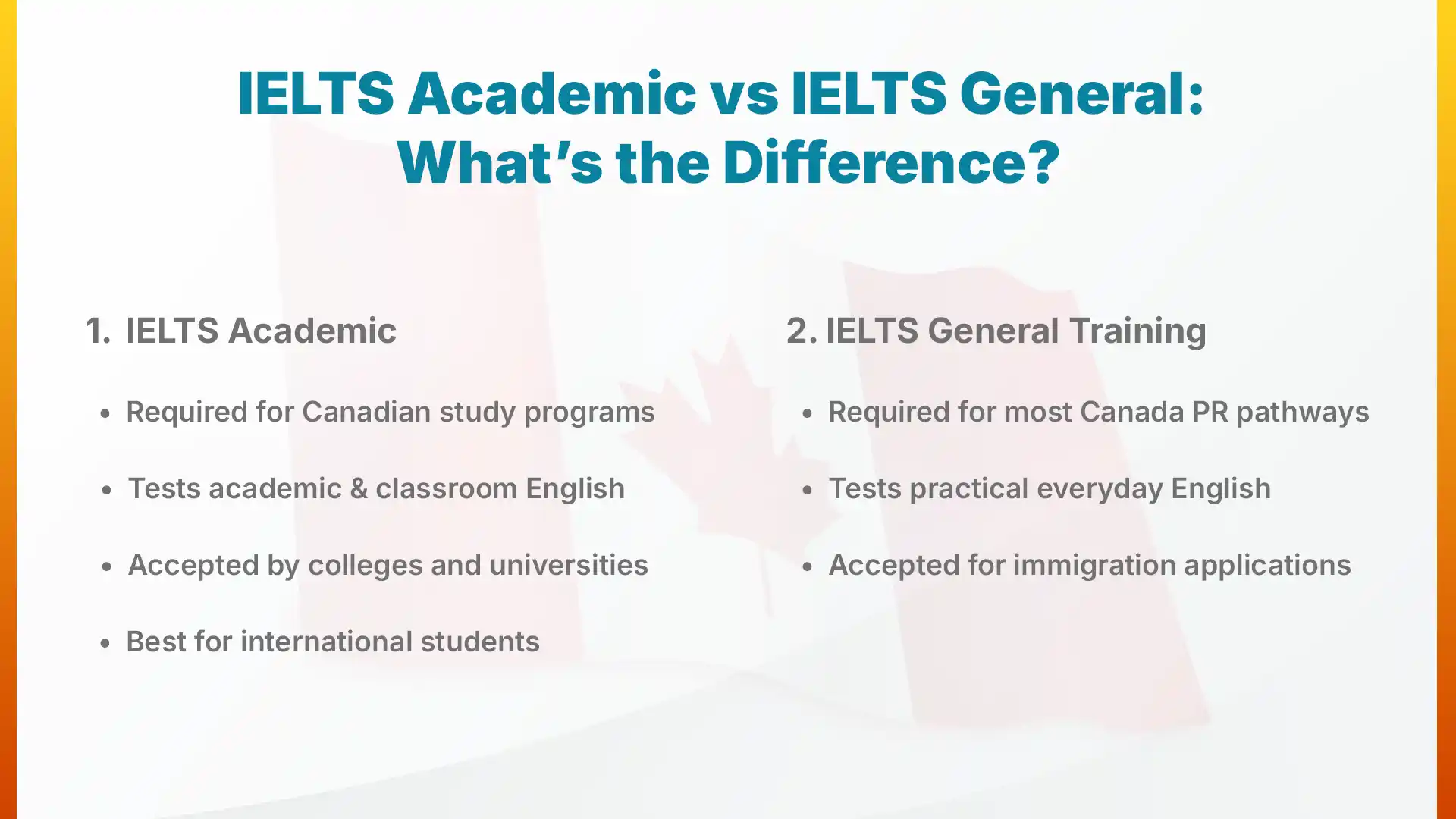
The right IELTS test depends entirely on your future plans. Students should focus on Academic IELTS first, while future PR applicants will need General Training later. Let's simplify the decision.
If Your Goal Is Studying in Canada
Choose IELTS Academic. This is the version accepted by most Canadian colleges and universities. It is the correct choice for study applications.
If Your Goal Is PR After Graduation
You will likely take IELTS Academic for admission and IELTS General later for immigration. Many international students follow this exact pathway. Therefore, taking two different IELTS exams is completely normal.
Can You Study in Canada with a Low IELTS Score?
Yes, some Canadian institutions offer alternative pathways for students who do not meet direct IELTS requirements. However, opting to study in Canada without IELTS may limit your course and college options. Here are some common alternatives:
- Some colleges may accept IELTS 5.5 for selected programs.
- English pathway programs allow students to improve their language skills before starting their main course.
- Some institutions also accept alternative tests such as:
- PTE Academic
- TOEFL iBT
- Duolingo English Test
- CAEL
Requirements vary by institution, so always check the latest admission criteria before applying.
Tips to Achieve Your Target IELTS Score for Canada
Achieving your target IELTS score becomes much easier when you prepare strategically. Consistent practice often matters more than studying for long hours occasionally. The following tips can help you reach your goal faster.
1. Understand Your Target Score First
Know exactly what your chosen program requires. Preparing for a 6.5 is different from preparing for a 7.5. Having a clear target keeps your preparation focused.
2. Focus on Writing and Speaking
Many Nepalese students lose marks in these two sections. Regular feedback and practice can make a significant difference. Improvement here often raises the overall score quickly.
3. Practice with Timed Mock Tests
Mock tests help you become comfortable with exam pressure. They also reveal your weak areas before the actual test. Consistent practice improves confidence and accuracy.
4. Learn Common Academic Vocabulary
A strong vocabulary improves reading, writing, speaking, and listening performance. Instead of memorizing difficult words, focus on practical academic language used in everyday contexts.
5. Avoid Retaking IELTS Multiple Times
Many students repeatedly take the exam without changing their preparation strategy. Instead, identify weak areas and work on them systematically. Smart preparation is usually more effective than repeated attempts.
Conclusion
The IELTS requirement for studying in Canada depends on what you plan to do, whether it is a diploma, bachelor's degree, master's degree, or PR application. Most students need an IELTS score between 6.0 and 6.5, while some programs and immigration pathways may require higher scores.
The good news is that once you know your target score, preparing becomes much easier. Start early, practice consistently, and aim for the highest score you can. A strong IELTS result can give you more study and career opportunities in Canada.
Not sure what IELTS score you need for your Canada study plans? Consult SAS Education Consultancy, a trusted education consultancy in Nepal, for expert guidance on IELTS requirements, university selection, applications, and student visas.