12 Most Popular Diploma Courses in Canada for +2 Graduates

Jun 08, 2026

Are you staring at your plus two results, wondering what to do next after class 12?
Let’s make this simple: a Diploma in Canada might just be your smartest move. It’s practical, career-focused, and gets you job-ready faster than most traditional routes.
But the real question is not whether diplomas are good or not, but which one is the best for you. With so many options in business, IT, healthcare, and more, it’s easy to feel stuck in overthinking mode.
The good news? This article helps you answer just that!
In this guide, we’ll break down the best diploma options in Canada. You will explore a dozen of most popular, high-paying diploma courses in Canada that can help you build a fantastic career and life in Canada.
Let's dive in and find the perfect path for your exciting future!
In this blog
Why Study a Diploma Course in Canada After 12th?
Studying a diploma in Canada after 12th is the fastest and most affordable way to gain job-ready skills. These 1-to-2-year programs focus heavily on practical learning rather than boring theory. Let’s look at the biggest benefits of taking this step.
- Affordable tuition fees compared to degrees.
- Fast entry into the Canadian job market.
- Hands-on training and cooperative programs (co-op).
- Easy pathway to post-study work permits.
- Relaxed academic and English entry requirements.
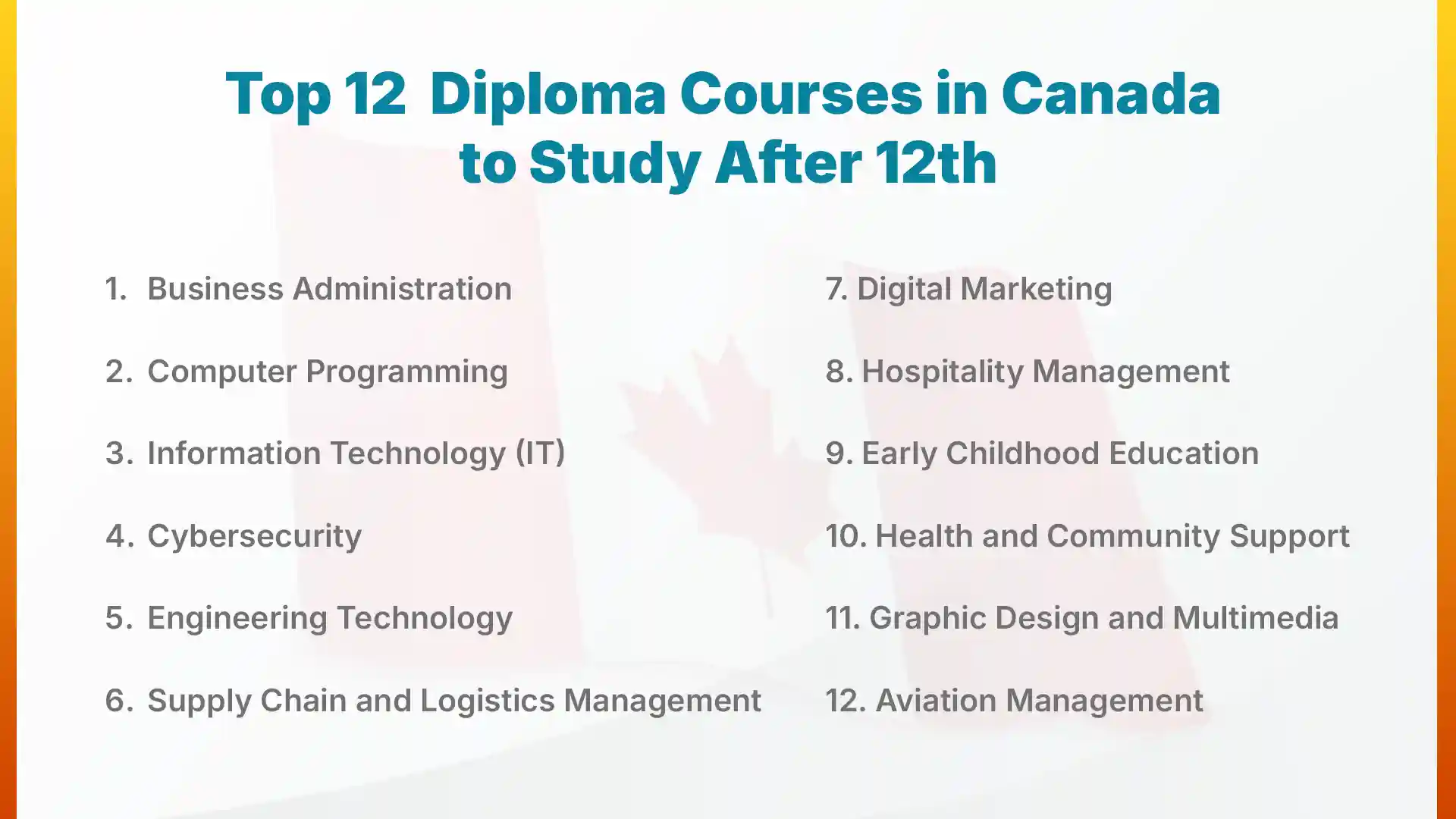
Top 12 Diploma Courses in Canada to Study After 12th
The best diploma courses in Canada include Business Administration, Computer Programming, and Hospitality Management. These practical programs align with high-demand job markets to help you secure employment quickly. Here is a breakdown of the top options for you.
1. Diploma in Business Administration
A Diploma in Business Administration teaches management, marketing, finance, and business operations. Typically completed in 1–2 years, it is one of the most versatile diploma programs in Canada, preparing graduates for careers across industries such as retail, banking, sales, and corporate administration.
Key Subjects Covered:
- Principles of Management
- Marketing Fundamentals
- Business Communication
- Accounting Basics
- Human Resource Management
- Business Law
Careers & Salary
Administrative Assistant, Business Coordinator, Sales Representative, Marketing Assistant, and Office Manager. Average starting salary: CAD $40,000–$60,000 per year.
This course is ideal for students who enjoy leadership, communication, teamwork, and problem-solving. It is particularly suitable for those seeking flexible career options across multiple industries in Canada.
2. Diploma in Computer Programming
A Diploma in Computer Programming helps you build solid skills in writing software code, testing applications, and designing databases. This program usually runs for two years and is extremely popular in Canada’s booming tech industry. It is an amazing choice if you want a career that pays well and offers endless growth opportunities.
Key Subjects Covered
- Object-Oriented Programming
- Database Design and SQL
- Web Application Development
- Systems Analysis and Design
- Software Testing and Quality
- Data Structures and Algorithms
Career & Salary
Graduates are hired by tech startups, large banks, and government agencies to build and maintain their software systems. You can land jobs like Software Developer, Web Programmer, Database Administrator, QA Analyst, with a starting salary of approximately CAD $50,000–$75,000 per year.
This course is perfect for students who love logic, puzzles, and technology. If you have strong math skills and enjoy spending hours on a computer finding creative solutions, this tech path is definitely for you.
3. Diploma in Information Technology (IT)
A Diploma in Information Technology (IT) focuses on computer systems, networks, and technical support. Typically completed in two years, this hands-on program prepares students to maintain business technology infrastructure and solve real-world IT challenges.
Key Subjects Covered
- Computer Network Fundamentals
- Operating Systems Management
- IT Helpdesk Support
- System Administration
- Basic Network Security
- Cloud Computing Basics
Career & Salary
Organizations across Canada depend on IT professionals to keep their systems running efficiently. Graduates commonly work as IT Support Technicians, Network Administrators, Helpdesk Analysts, and Systems Support Specialists, earning approximately CAD $45,000–$70,000 per year.
This program suits students who enjoy troubleshooting technology and solving practical computer-related problems.
4. Diploma in Hospitality Management
A Diploma in Hospitality Management prepares students to oversee operations in hotels, restaurants, resorts, and tourism businesses. Usually lasting one to two years, the program combines customer service, business management, and practical industry training.
Key Subjects Covered
- Front Office Operations
- Food and Beverage Service
- Hospitality Accounting
- Event and Meeting Planning
- Customer Service Excellence
- Human Resources in Hospitality
Career & Salary
Hotels, resorts, event companies, and tourism operators actively recruit hospitality graduates. Popular roles include Front Desk Supervisor, Event Coordinator, Guest Relations Agent, and Food & Beverage Supervisor, with starting salaries ranging from CAD $38,000–$55,000 per year.
A great choice for students who enjoy working with people, organizing events, and thriving in dynamic environments.
5. Diploma in Health and Community Support
A Diploma in Health and Community Support equips students with the skills to assist older adults, individuals with disabilities, and vulnerable community members. The program typically takes two years and includes practical training in healthcare and social service settings.
Key Subjects Covered
- Human Growth and Development
- Basic Personal Care Skills
- Mental Health Fundamentals
- Community Resource Navigation
- Crisis Intervention Skills
- Health and Safety Standards
Career & Salary
Canada's growing demand for support workers creates strong employment opportunities in healthcare and community services. Graduates often work as Community Support Workers, Personal Care Assistants, Social Services Assistants, and Family Support Associates, earning around CAD $40,000–$60,000 annually.
Best suited to compassionate students who want a meaningful career helping others.
6. Diploma in Early Childhood Education
A Diploma in Early Childhood Education (ECE) prepares students to support the learning and development of young children. Usually completed in two years, the program combines classroom theory with practical placements in childcare settings.
Key Subjects Covered
- Child Growth and Development
- Play-Based Learning Strategies
- Language and Literacy Development
- Child Health and Nutrition
- Family and Community Engagement
- Classroom Management
Career & Salary
Licensed childcare centres and educational institutions regularly hire ECE graduates. Career options include Early Childhood Educator, Preschool Teacher, Childcare Assistant, and Special Needs Support Worker, with starting salaries of approximately CAD $35,000–$50,000 per year.
Ideal for students who enjoy working with children and supporting their growth through creativity and learning.
7. Diploma in Engineering Technology
A Diploma in Engineering Technology develops practical skills used in civil, mechanical, and electrical engineering environments. Lasting two to three years, the program focuses on technical applications, design tools, and industry-based problem-solving.
Key Subjects Covered
- Computer-Aided Design (CAD)
- Engineering Materials and Testing
- Technical Mathematics
- Surveying and Site Planning
- Project Management Basics
- Workplace Safety Regulations
Career & Salary
Construction companies, manufacturers, and engineering consultancies frequently hire diploma graduates. Common roles include Engineering Technician, CAD Drafter, Construction Inspector, and Project Coordinator, with salaries typically ranging from CAD $48,000–$70,000 per year.
A strong option for students who enjoy technical work, design, and hands-on projects.
8. Diploma in Supply Chain and Logistics Management
A Diploma in Supply Chain and Logistics Management teaches students how goods move from manufacturers to consumers. Typically completed in one to two years, this program has gained popularity due to the rapid growth of e-commerce and global trade.
Key Subjects Covered
- Logistics and Transportation
- Inventory Management
- Purchasing and Supply Management
- Operations Planning
- International Trade
- Supply Chain Analytics
Career & Salary
Retailers, logistics companies, and distribution centres rely on supply chain professionals to manage operations efficiently. Graduates often secure roles such as Logistics Coordinator, Warehouse Supervisor, Inventory Specialist, and Supply Chain Analyst, earning approximately CAD $42,000–$63,000 annually.
Well-suited for organized students who enjoy planning, coordination, and problem-solving.
9. Diploma in Digital Marketing
A Diploma in Digital Marketing teaches students how to build online brands, attract customers, and create effective digital campaigns. Usually lasting one to two years, the program combines creativity with data-driven marketing strategies.
Key Subjects Covered
- Search Engine Optimization (SEO)
- Social Media Marketing
- Content Marketing
- PPC Advertising
- Web Analytics
- Email Marketing
Career & Salary
Marketing agencies, startups, and established businesses constantly seek digital marketing talent. Graduates can work as Social Media Coordinators, SEO Specialists, Content Creators, and Digital Marketing Assistants, with starting salaries of around CAD $40,000–$65,000 per year.
Recommended for students who enjoy creativity, communication, and online content creation.
10. Diploma in Cybersecurity
A Diploma in Cybersecurity focuses on protecting computer systems, networks, and sensitive information from cyber threats. Typically completed in two years, it is one of Canada's fastest-growing technology programs due to increasing demand for security professionals.
Key Subjects Covered
- Network Security Fundamentals
- Ethical Hacking
- Security Operations
- Cloud Security
- Digital Forensics
- IT Risk Management
Career & Salary
As cyberattacks become more sophisticated, employers across banking, technology, healthcare, and government sectors need qualified security specialists. Graduates often work as Cybersecurity Analysts, SOC Specialists, Network Security Technicians, and IT Security Coordinators, earning approximately CAD $55,000–$85,000 per year.
An excellent fit for analytical students interested in technology, security, and problem-solving.
11. Diploma in Graphic Design and Multimedia
A Diploma in Graphic Design and Multimedia develops creative skills in visual communication, digital design, and multimedia production. Usually lasting one to two years, the program prepares students for careers in Canada's growing creative and digital industries.
Key Subjects Covered
- Graphic Design Principles
- Digital Illustration
- Web Design and UI/UX
- Typography
- Motion Graphics
- Portfolio Development
Career & Salary
Creative agencies, media companies, and businesses regularly hire design professionals to produce engaging visual content. Graduates commonly work as Graphic Designers, Visual Designers, Multimedia Assistants, and UI/UX Associates, with salaries ranging from CAD $38,000–$58,000 per year.
A natural fit for creative students who enjoy design, storytelling, and visual expression.
12. Diploma in Accounting
A Diploma in Accounting provides practical knowledge of bookkeeping, taxation, payroll, and financial reporting. Typically completed in one to two years, this program offers a direct pathway into one of the most stable and in-demand business fields.
Key Subjects Covered
- Financial Accounting
- Cost and Managerial Accounting
- Accounting Software
- Canadian Taxation
- Business Mathematics
- Payroll Administration
Career & Salary
Businesses, accounting firms, and government offices consistently hire accounting graduates to manage financial records and reporting. Popular roles include Bookkeeper, Accounting Assistant, Payroll Administrator, and Accounts Payable Officer, with starting salaries of approximately CAD $40,000–$62,000 per year.
Best suited for detail-oriented students who enjoy working with numbers and structured processes.
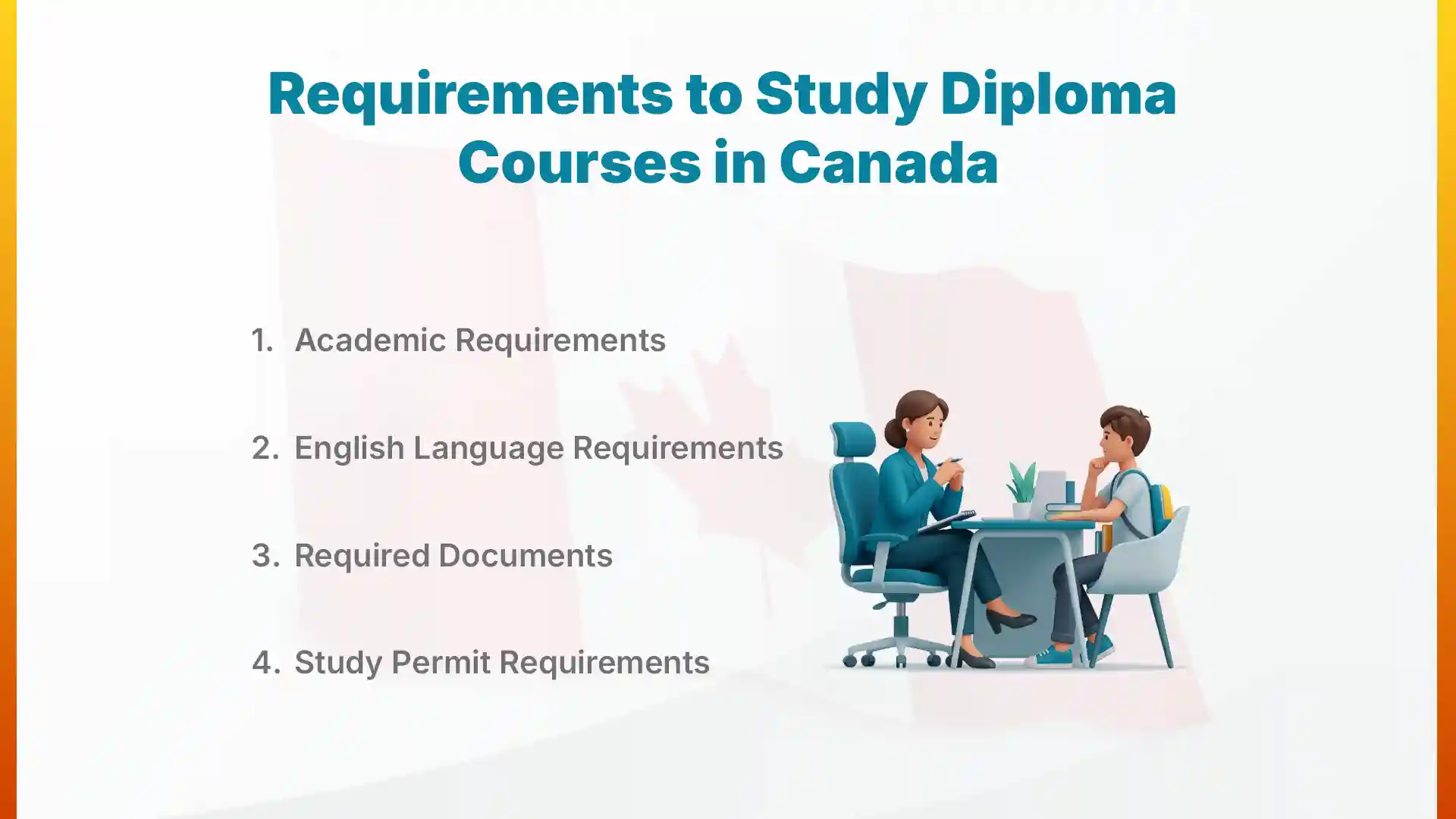
What are the Requirements to Study Diploma Courses in Canada?
To study a diploma in Canada, you must meet specific academic, language, financial, and visa requirements. Having these items ready beforehand ensures your visa process goes smoothly without any delays. Let’s break down the main requirements you need to prepare.
1. Academic Requirements
To enroll in a Canadian diploma course, you must have successfully completed your high school education (plus two). Here are the core academic points to keep in mind:
- Completion of Class 12 (or equivalent) from a recognized board.
- Minimum aggregate score of 50% to 60%.
- Specific subject requirements for some courses (like math for engineering or programming).
2. English Language Requirements
Since classes in Canada are taught in English, you will need to prove your language skills through a standardized test. The accepted English proficiency tests and their typical score requirements include:
- IELTS Academic: An overall score of 6.0, with no individual band lower than 5.5.
- PTE Academic: A score between 50 and 58 overall.
- TOEFL iBT: An overall score of 80 or higher.
- Duolingo English Test: A score between 105 and 115.
Join the Best IELTS Preparation Classes Today!
3. Required Documents
Here is a checklist of the essential documents you will need to submit:
Complete academic transcripts and character certificates from Class 10 and Class 12.
A valid passport with at least six months of validity.
A well-written Statement of Purpose (SOP) explaining why you chose this course and country.
Academic recommendation letters and a detailed resume.
4. Canadian Study Permit Requirements
Once you receive your Letter of Acceptance (LOA) from a Canadian college, you can apply for your Canadian student visa, known as a Study Permit. To secure this permit from the Canadian government, you need to prove that you are a genuine student who can afford the trip. The main requirements include:
An official Letter of Acceptance (LOA) from a Designated Learning Institution (DLI).
A valid No Objection Certificate (NOC) from the Ministry of Education in Nepal.
Proof of funds to pay for your first year of tuition and your living expenses.
Up-front medical exam clearance
A clean police clearance certificate.
How to Choose the Right Diploma Course in Canada?
Choosing the right diploma in Canada depends on your career interests, budget, and future goals. Selecting a path that matches your natural skills makes studying abroad much easier. Let’s look at how to make the best choice.
1. Match Your Course with Your Personal Talents
First, choose a program that matches what you already enjoy doing. If you love math and coding, tech courses are great for you. However, if you are social, digital marketing or hospitality will feel much more natural.
2. Look for Fields with High Job Demand in Canada
Next, pick a field with high job demand in Canada. Research which industries are hiring in the province where you want to live. For example, childcare and healthcare are booming, making it much easier to get a work permit.
3. Find a Program That Fits Your Budget
After that, compare college tuition fees to find a program that fits your family's budget. Remember to check local living costs, too. Choosing a smaller, cheaper town over big cities like Toronto will greatly reduce your financial stress. Understanding the total cost to study in Canada beforehand eases many uninvited problems later.
4. Seek Out Programs That Offer Co-Op Internships
Furthermore, look for courses with co-op internships to gain real Canadian work experience while earning money. Working full-time during your studies builds connections with local employers. Many students get permanent job offers directly from their co-op placements.
5. Choose a Path That Allows Future University Studies
Finally, pick a diploma that lets you transfer your credits to a university later. These "pathway programs" let you study for two years at college and two at university, saving you a massive amount of money on tuition.
Conclusion
Starting your study abroad journey in Canada after your plus two exams is a life-changing decision. Choosing a practical diploma course is undoubtedly the smartest and most affordable way to gain real-world skills, enter the job market quickly, and build a successful future in Canada.
Choose a course, find universities, and prepare your documents. With the right guidance and a clear plan, your dream of studying in Canada is entirely within reach.
Are you ready to take the next big step toward your Canadian dream? Book your free counselling session with us today, and let’s start planning your exciting future together!