Cybersecurity Courses in the USA: Programs, Requirements & Careers 2026

May 22, 2026
If you have spent any time researching tech careers abroad, the USA has probably come up more than once. And honestly, it should. But most students stop at "the USA is great for cybersecurity" without ever figuring out what that actually means for them personally. What programs exist? What does it really cost? What happens after you graduate?
This guide covers everything you need to know about study in the USA for cybersecurity: courses, universities, costs, scholarships, visa steps, work rights, and career outcomes.
In this blog
Why Study Cybersecurity in the USA?
Study cybersecurity in the USA because no other country combines government-certified academic programs, direct access to the world's largest cybersecurity job market, and up to three years of legal post-study work all in one place. Every year, hundreds of thousands of cybersecurity positions go unfilled across US government agencies, technology companies, banks, and defense contractors. For a Nepali student willing to invest and put in the work, that gap is a genuine and life-changing opportunity.
1. NSA/DHS Centers of Academic Excellence
The USA has a government-run quality certification system for cybersecurity university programs that does not exist anywhere else in the world. The NSA and DHS jointly designate universities as Centers of Academic Excellence (CAE) in Cybersecurity, a rigorous evaluation that checks whether programs actually teach what the industry needs. Graduating from a CAE-designated program tells employers your degree has been validated by the same agencies protecting US national security.
2. Top-Ranked Universities With Global Industry Access
MIT, Stanford, and Carnegie Mellon universities are not just famous names. They are institutions embedded within ecosystems of technology companies, government agencies, research laboratories, and professional networks that no other country replicates in the same concentration. As a student, you are building a professional network that will follow you for the rest of your career.
3. OPT and STEM OPT: Up to Three Years of Post-Study Work
After graduation, Optional Practical Training (OPT) gives you twelve months to work in the USA without employer sponsorship. Because cybersecurity is STEM-classified, you can then apply for the STEM OPT extension for an additional twenty-four months. That is up to three years of legal work authorization in the USA after your degree, more than any other major English-speaking study destination offers.
4. Government Investment Driving Real Demand
US Executive Order 14028 on Improving the Nation's Cybersecurity mandated sweeping investment in workforce development and academic research. This is not a short-term trend. It is a policy-level commitment backed by legislation that continues to generate consistent demand for qualified professionals year after year.
What Cybersecurity Courses Are Available in the USA?
Cybersecurity courses in the USA for international students are available at multiple levels, from two-year associate degrees at community colleges to four-year bachelor's programs and advanced master's qualifications at research universities. The USA is home to some of the world's most respected cybersecurity programs, many of which hold the National Security Agency's Center of Academic Excellence (CAE) designation, a government-recognized quality benchmark that signals strong curriculum standards and employer credibility. The right entry point depends on your existing qualifications, career goals, and budget. Below is a clear breakdown of each available option.
1. Bachelor's Degree in Cybersecurity
A four-year undergraduate program covering network security, ethical hacking, digital forensics, cryptography, and risk management. Most programs include internship opportunities that give you real professional exposure before graduation. If you are wondering what to do after NEB +2, this could be your go-to option. Moreover, graduating from a CAE-designated institution adds meaningful weight to your resume when applying for jobs in both the USA and internationally.
2. Master's Degree in Cybersecurity
Designed for students who already hold a relevant bachelor's degree and want to move into specialist or senior roles. Programs run one and a half to two years and offer specializations including penetration testing, cloud security, digital forensics, and cybersecurity policy. A master's degree from a well-ranked US university also significantly strengthens your OPT and H-1B prospects, giving you more time and options to build a professional career in the USA after graduation. For further details about a master's degree in cybersecurity in the USA, read our full guide.
3. Graduate Certificate Programs
Shorter qualifications, typically six months to one year, for professionals wanting to add a specific technical skill set without committing to a full master's. These programs are a cost-effective way to upskill quickly and are particularly useful for students who already hold a degree and want to pivot into cybersecurity from a related field. Note that certificate programs may not carry the same OPT eligibility as full degrees, so always confirm your visa entitlements before enrolling.
4. Associate Degree Community College Pathway
Two-year programs at a fraction of four-year university costs, making them one of the most affordable entry points into cybersecurity education in the USA. Many community colleges hold CAE designations and have formal transfer agreements with four-year universities, allowing you to complete your associate degree and then transfer directly into the third year of a bachelor's program. This pathway is worth serious consideration for Nepali students who want to manage their costs carefully without sacrificing the quality of their eventual degree.
Types of Cybersecurity Courses in the USA
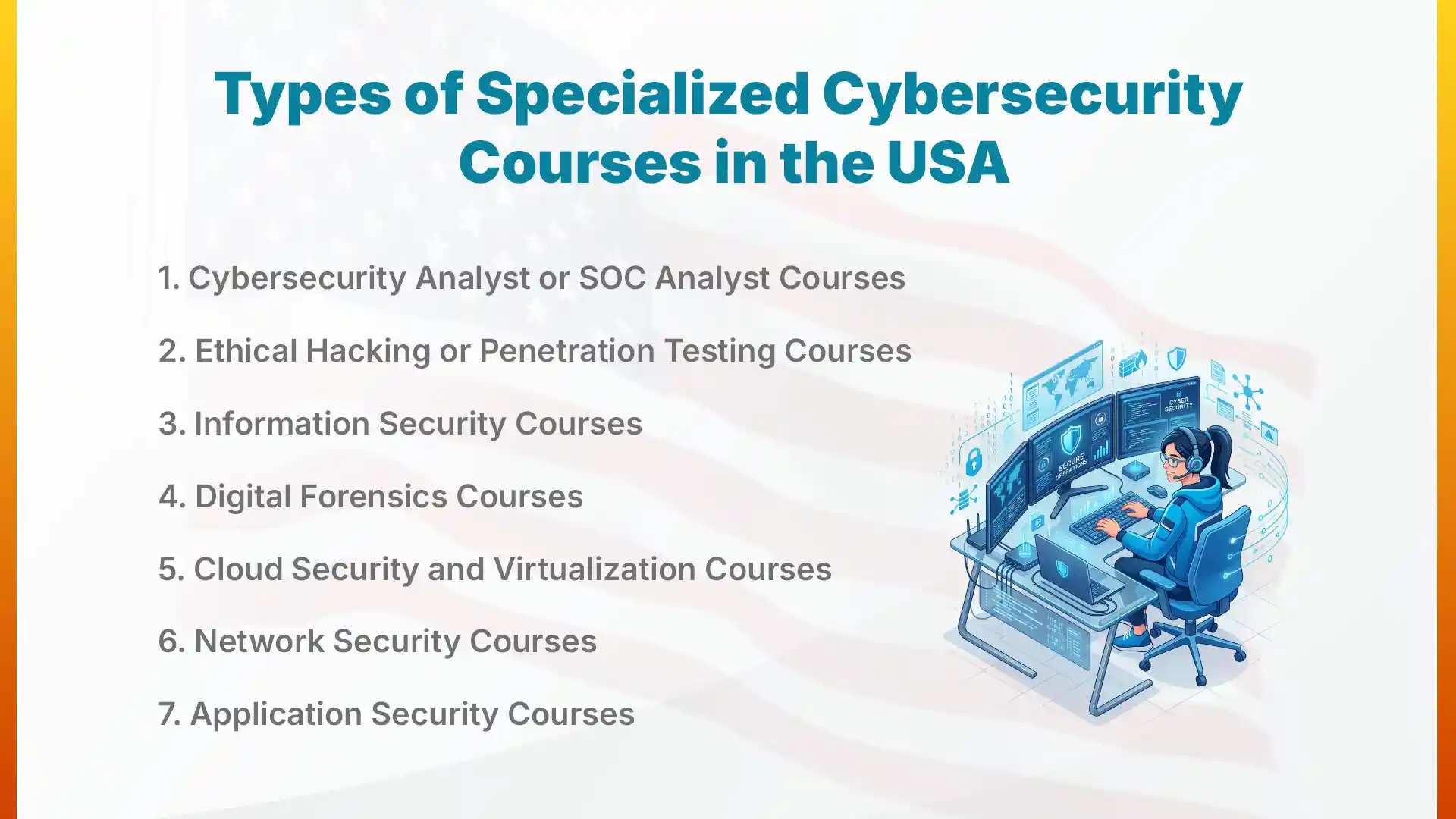
The most common types of cybersecurity courses available in the USA include cybersecurity analyst and SOC analyst training, ethical hacking and penetration testing, information security, digital forensics, cloud security and virtualization, network security, and application security. Each specialization leads to a different set of job roles, employers, and salary ranges, so the type of course you choose directly shapes the work you do after graduation. Below is a breakdown of each specialization to help you identify which path best fits your strengths and career goals.
1. Cybersecurity Analyst or SOC Analyst Courses
The frontline of cybersecurity. SOC analysts monitor systems in real time, detect threats before they become breaches, and respond when something goes wrong. If you enjoy solving problems under pressure, this path suits you. It is also one of the most in-demand entry-level roles in the USA, making it a practical first step for Nepali graduates entering the American job market for the first time.
2. Ethical Hacking or Penetration Testing Courses
Ethical hackers are paid to break into systems legally and find vulnerabilities before malicious actors do. Certifications like CEH and OSCP are closely tied to this path and are highly valued by US employers. This specialization consistently commands some of the highest starting salaries in the cybersecurity field and is well suited to students who enjoy technical problem-solving and thinking like an attacker.
3. Information Security Courses
Covers how organizations protect data from hackers, leaks, and compliance failures. Leads naturally into roles like information security manager or chief information security officer with experience. For Nepali students with an interest in both technology and organizational strategy: Information security offers one of the clearest pathways into senior and leadership positions over time.
4. Digital Forensics Courses
Digital forensics specialists investigate breached systems, recover deleted data, and build evidence trails for legal proceedings. Graduates often work with law enforcement agencies, government bodies, or private investigation firms. This is a highly specialized field with strong job stability, particularly in the USA, where government and federal agencies are among the largest employers of digital forensics professionals.
5. Cloud Security and Virtualization Courses
One of the fastest-growing and highest-paying specializations in the field right now. Cloud security specialists secure AWS, Azure, and Google Cloud environments, and US employers are actively struggling to find enough qualified people. Pairing a cloud security specialization with a certification like AWS Certified Security Specialty or Microsoft Azure Security Engineer significantly accelerates your employability and earning potential after graduation.
6. Network Security Courses
The foundational layer of almost every cybersecurity career path. Covers firewalls, VPNs, intrusion detection systems, and secure network design. A strong grounding in network security is valuable regardless of which specialization you pursue later, and most undergraduate cybersecurity programs in the USA include it as a core component of the curriculum.
7. Application Security Courses
Application security specialists find and fix vulnerabilities in software before they are exploited. As DevSecOps grows globally, demand for this specialization is rising rapidly across the USA. This path is particularly well suited to students with a background or interest in software development, as it sits at the intersection of coding and security and is becoming increasingly central to how American tech companies build and ship products.
Not sure which to choose? Most undergraduate programs cover several of these areas before asking you to specialize. Starting with a broad bachelor's degree gives you the exposure you need to make an informed decision about where to focus before committing to a specific career direction.
Requirements to Study Cybersecurity in the USA
To study cybersecurity in the USA, you must meet the academic requirement generally +2 graduate with mathematics or science subjects.,For language, students must secure an overall IELTS of 6.5 and documentation requirements set by their chosen university and the United States Department of Homeland Security. The requirements for your US education vary depending on the program level you are applying for and the institution you choose, so confirming the exact criteria directly with your target university before applying is essential. l.
1. Academic Qualifications by Course Level
To study cybersecurity in the USA, you must meet the academic entry requirements set by your chosen university and the program level you are applying for. For most Nepali students, a completed NEB +2 with mathematics or science subjects is the standard starting point for undergraduate and associate degree programs. If you already hold a relevant bachelor's degree, you may apply directly for a master's or graduate certificate program. The table below outlines the minimum academic qualification required at each level.
Course Level | Minimum Academic Requirement |
|---|---|
| Bachelor's Degree | NEB +2 or equivalent with Mathematics or Science |
| Master's Degree | Recognized Bachelor's in IT, Computer Science, or related field |
| Graduate Certificate | Recognized Bachelor's degree in a relevant field |
| Associate Degree | SEE or NEB +2 or equivalent |
Note: Specific grade requirements vary between universities. Always confirm directly with your chosen institution.
2. Language Requirements: IELTS, TOEFL, or Duolingo?
English language proficiency is mandatory for all cybersecurity programs in the USA, as all coursework, assessments, and professional placements are conducted entirely in English. Most universities accept TOEFL iBT, IELTS, or Duolingo English Test scores, though the accepted test and minimum score required vary between institutions. Begin your language test preparation at least six to twelve months before your application deadline to give yourself sufficient time to meet the required scores comfortably.
Undergraduate: Minimum TOEFL iBT 80 or IELTS 6.5 overall
Postgraduate: TOEFL iBT 90–100 or IELTS 7.0 overall
Duolingo: Increasingly accepted by US universities as an alternative
Top institutions like MIT, Stanford, and Carnegie Mellon may set higher thresholds. Always confirm requirements on each university's official admissions page. Begin your IELTS preparation for the USA well in advance.
3. Standardized Tests
Some US universities require standardized test scores as part of the undergraduate or postgraduate admissions process, though policies vary widely between institutions. Many universities have moved to test-optional policies in recent years, meaning scores are no longer mandatory but can still strengthen your application if submitted. Always check each program's current standardized test policy directly on the university's admissions page before preparing for or registering to sit a test.
Undergraduate: SAT or ACT may be required; many universities have moved to test-optional policies
Master's: GRE required at some programs, optional at many others; check each program individually
4. Documents Required for Admission
Preparing your documents well in advance is one of the most important steps in the US university application process. Many documents require official translation, notarization, or third-party verification, all of which take significantly more time than most students expect. Having everything organized and ready before you begin your application prevents unnecessary delays in receiving your offer letter, I-20 form, and student visa approval.
These are the major documents you'll need for studying in the USA:
Academic transcripts and certificates (Grade 10, 11, and 12)
Valid passport
English proficiency results (TOEFL, IELTS, or Duolingo)
Statement of Purpose (SOP for USA)
Two to three Letters of Recommendation
Updated CV or Resume
Financial sponsorship documents
SAT/ACT or GRE scores (if required)
I-20 Form issued by your university after accepting your offer
How to Apply for Cybersecurity Courses in the USA in 2026
To apply for a cybersecurity course in the USA, you first shortlist SEVP-certified and CAE-designated institutions that match your academic background and budget, then prepare and notarize your documents, and submit your application through the Common App or the university's official portal. Once you receive your I-20 form, you apply for an F-1 student visa through the US Embassy in Kathmandu. The USA application process involves more steps and longer lead times than most other study destinations, so starting at least eight to twelve months before your intended intake date is strongly recommended. Follow each step below in order to give yourself the best chance of a smooth and successful application.
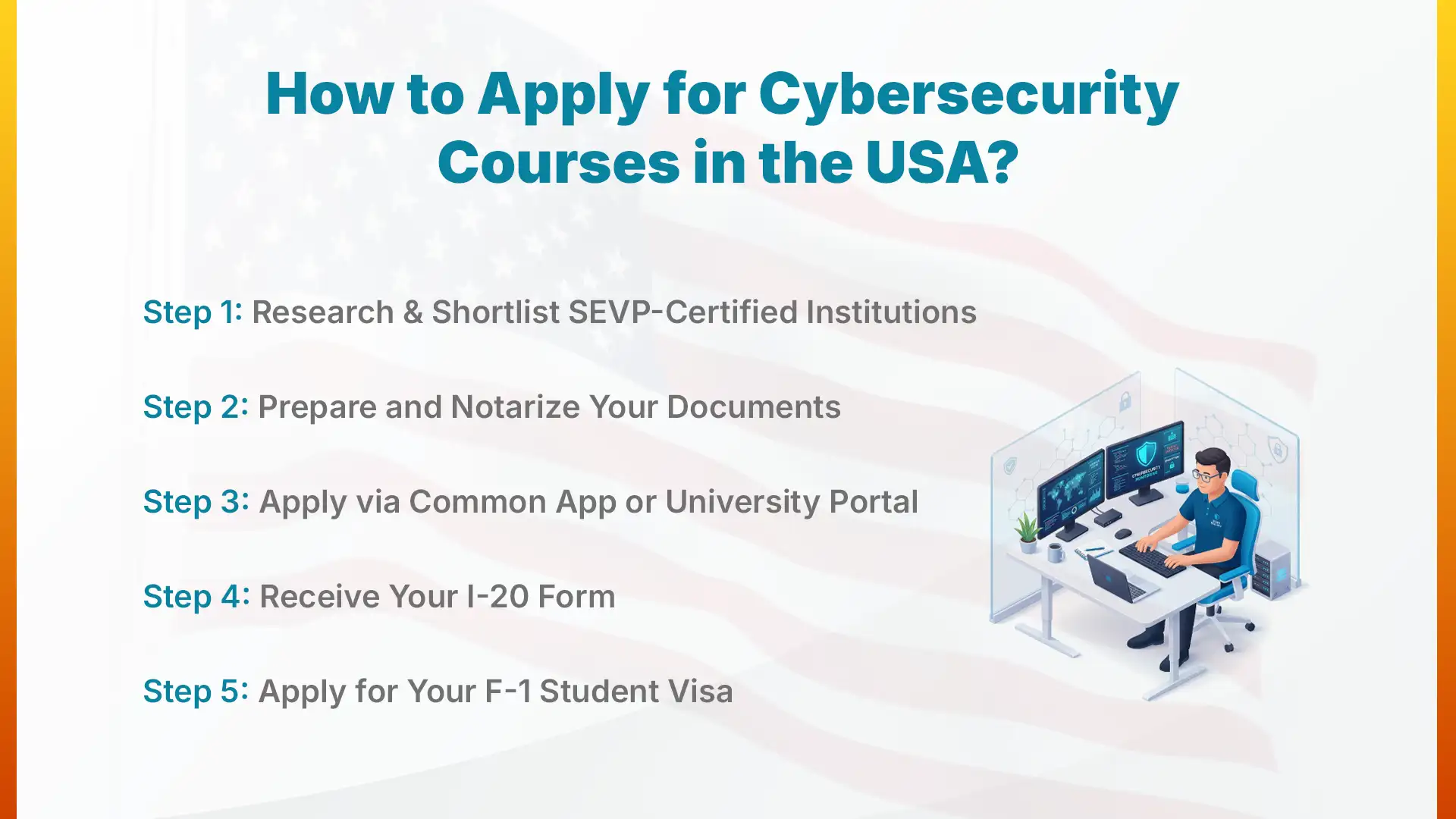
Step 1: Research and Shortlist SEVP-Certified Institutions
Identify universities that are SEVP-certified and CAE-designated. Compare programs, internship opportunities, scholarship availability, and city location before finalizing two to four institutions. Applying to a mix of reach, match, and safety schools gives you the strongest chance of receiving at least one strong offer within your target budget and program quality range.
Step 2: Prepare and Notarize Your Documents
Gather transcripts, a passport, English test results, an SOP, and recommendation letters. Documents in Nepali must be translated and notarized. Start this process early, translation. Notarization and third-party verification take significantly more time than most students expect, and incomplete documents are the most common reason for application delays.
Step 3: Apply via Common App or University Portal
Undergraduate applications go through commonapp.org or individual university portals. Postgraduate applications go directly through each university. Apply to more than one institution simultaneously, and note that deadlines for competitive programs can fall as early as November or December. Missing these windows means waiting an entire additional year.
Step 4: Receive Your I-20 Form
After accepting your offer, your university issues the I-20 Form, the Certificate of Eligibility for Nonimmigrant Student Status. Read all conditions carefully before accepting and paying any deposit. Your I-20 is a critical document required at every stage of your visa application and entry into the USA, so keep multiple copies in a safe place from the moment you receive it.
Step 5: Apply for Your F-1 Student Visa
Pay the SEVIS fee, complete the DS-160 form, schedule your visa interview at the US Embassy in Kathmandu, and attend with your I-20, financial documents, and academic records. Be clear and honest about your study plans during the interview, as visa officers assess your intent to return to Nepal after completing your studies. Confirm the current document checklist and visa fee at travel.state.gov before submitting your application.
Top Universities in the USA for Cybersecurity
The top cybersecurity universities in the USA are globally recognized institutions, widely known for their research output, government partnerships, and industry connections. MIT is renowned for its world-leading security research, Carnegie Mellon for its dedicated CyLab cybersecurity center, Stanford for its Silicon Valley industry access, the University of Maryland for its proximity to US intelligence and federal agencies, and Georgia Tech for delivering top-ranked programs at one of the most competitive tuition rates among elite US institutions. Each university offers a distinct advantage depending on your career goals, budget, and preferred location. Always verify that your chosen university is SEVP-certified at studyinthestates.dhs.gov before applying.
University | Location | Notable Feature |
|---|---|---|
| MIT | Cambridge, MA | Global top 5; world-leading security research |
| Carnegie Mellon University | Pittsburgh, PA | Home to CyLab, one of the world's largest cybersecurity research centers |
| Stanford University | Stanford, CA | Silicon Valley location; unmatched industry access |
| University of Maryland | College Park, MD | NSA/DHS CAE designated; proximity to US intelligence agencies |
| Georgia Institute of Technology | Atlanta, GA | Strong STEM OPT outcomes; affordable top-ranked programs |
1. MIT
MIT is the global benchmark for technology education, with direct government and industry connections that shape the cybersecurity field worldwide. Its research output in areas like cryptography, systems security, and AI-driven threat detection is unmatched, and graduates enter the job market with one of the most recognized credentials in the technology industry. For Nepali students aiming for the very highest standard of cybersecurity education available anywhere in the world, MIT is the benchmark institution. You can also compare other universities located near Boston.
2. Carnegie Mellon
Carnegie Mellon trains some of the world's leading cybersecurity professionals through CyLab and applied industry research. The university's dedicated School of Computer Science and Information Networking Institute offer some of the most specialized and industry-aligned cybersecurity programs available at any US institution. Graduates consistently secure roles at top technology companies, government agencies, and national security organizations across the USA and internationally.
3. Stanford
Stanford puts you in Silicon Valley next to Google, Cisco, Apple, and hundreds of cybersecurity startups. This location gives Stanford cybersecurity students unparalleled access to internships, industry events, and employer networks that simply do not exist at universities in other parts of the country. For Nepali students who want to build connections in the global technology industry from day one of their studies, Stanford's location is as valuable as its academic program.
4. University of Maryland
The University of Maryland is the choice for students interested in government and intelligence careers, sitting at the center of Washington, D.C.'s security ecosystem. Its NSA and DHS CAE designation, combined with its proximity to federal agencies including the NSA, the CIA, and the Department of Homeland Security, creates direct research and internship pathways that are not available at universities in other cities. Graduates from Maryland are particularly well positioned for roles in national security, federal law enforcement, and government cybersecurity operations.
5. Georgia Tech
Georgia Tech offers top-ranked programs at significantly lower tuition than private institutions, making it one of the most cost-effective paths to a prestigious US cybersecurity degree. Its strong STEM OPT track record means graduates have a proven pathway to post-study work authorization, giving Nepali students more time to build professional experience and explore longer-term career options in the USA. For Nepali families balancing program quality against total cost, Georgia Tech represents one of the strongest value propositions available at any top-ranked American university.
Cost of Studying Cybersecurity in the USA
The cost of studying cybersecurity in the USA is approximately USD 35,000 to USD 80,000, covering tuition, accommodation, food, transport, health insurance, and personal expenses. Planning your finances carefully and exploring scholarship options early can make a significant difference to your total cost of study.
1. Tuition Fees by Course Level
Tuition fees in the USA vary more widely than in almost any other English-speaking study destination, ranging from affordable community college associate degrees to premium private university programs at institutions like MIT and Stanford. Public universities generally charge lower tuition than private institutions and can offer strong value without compromising on program quality or CAE designation status.
Course Level | Estimated Annual Tuition (USD) | Approximate NPR Equivalent |
|---|---|---|
| Bachelor's Degree | USD 20,000 – 55,000 | NPR 2,700,000 – 7,400,000 |
| Master's Degree | USD 25,000 – 60,000 | NPR 3,400,000 – 8,100,000 |
| Graduate Certificate | USD 10,000 – 25,000 | NPR 13,50,000 – 34,00,000 |
| Associate Degree | USD 6,000 – 15,000 | NPR 800,000 – 2,000,000 |
Always confirm exact fees directly with your chosen university. Exchange rates fluctuate.
2. Monthly Living Costs by City
Living costs in the USA vary dramatically depending on which city your university is located in. Major metropolitan areas like New York and San Francisco are among the most expensive cities in the world to live in, while cities like Pittsburgh and Atlanta offer a significantly more manageable cost of living without sacrificing access to strong cybersecurity employers and industry networks.
Expense | New York / San Francisco | Pittsburgh / Atlanta | College Park |
|---|---|---|---|
| Accommodation | USD 1,500 – 2,500 | USD 700 – 1,200 | USD 800 – 1,400 |
| Food | USD 400 – 600 | USD 250 – 400 | USD 300 – 450 |
| Transport | USD 150 – 250 | USD 50 – 100 | USD 80 – 150 |
| Health Insurance | USD 100 – 200 | USD 80 – 150 | USD 80 – 150 |
| Miscellaneous | USD 150 – 300 | USD 100 – 200 | USD 100 – 200 |
| Total Monthly | USD 2,400 – 4,030 | USD 1,250 – 2,170 | USD 1,440 – 2,480 |
3. Additional Costs
Budget for the SEVIS fee (currently USD 350; confirm at studyinthestates.dhs.gov), the F-1 visa application fee (confirm at travel.state.gov), mandatory university health insurance (USD 1,000 – 3,000 per year), the CompTIA Security+ exam (approximately USD 400 per attempt), and textbooks (USD 500 – 1,500 per year). Plan for all of this before you leave Nepal.
If you want to compare costs with other UK, read our complete guide on cybersecurity courses in the UK to see how both countries compare for Nepali students.
Scholarships for Cybersecurity Students in the USA
Scholarship for Cybersecurity Students in the USA generally have the CyberCorps Scholarship for Service (SFS), university merit awards, and assistantships. Students aspiring to gain more scholarships should strive for more excellence in their field of cybersecurity.
1. CyberCorps Scholarship for Service (SFS)
A US government-funded program covering full tuition, fees, and a living stipend in exchange for working at a US government agency after graduation. Primarily available to US citizens and permanent residents, most F-1 international students are not eligible. Check current eligibility at sfs.opm.gov.
2. University Merit Awards and Assistantships
The most realistic scholarship opportunity for Nepali students. Most US universities offer merit-based scholarships and graduate assistantships for high-achieving international applicants. At the master's and PhD levels, assistantships can cover full or partial tuition plus a monthly stipend. Carnegie Mellon, Georgia Tech, and the University of Maryland all offer international student funding worth exploring. Note deadlines; they often fall earlier than standard admission deadlines.
3. Nepal-Side Funding Options
Several Nepali banks offer NRB-regulated education loans for overseas study. Check with Nepal's Ministry of Education, Science, and Technology for any bilateral agreements between Nepal and the USA. Contact the US Embassy in Kathmandu for updated funding guidance available to Nepali students.
Work Rights and Post-Study Pathways in the USA
International students in the USA have legal rights to work both during their studies and after graduation, making it one of the most structured post-study work destinations available to Nepali cybersecurity graduates. However, it is important to understand that work rights in the USA are more conditional and competitive than in Canada or the UK
1. Part-Time Work During Studies
F-1 visa holders can work up to twenty hours per week on campus during term time and full-time during vacation periods. Off-campus work requires Curricular Practical Training (CPT) authorization through your university. Always confirm work rules with your university's designated school official before taking on any employment.
2. OPT Twelve Months After Graduation
Optional Practical Training gives you twelve months of work authorization in the USA in a role related to your field after graduation. No employer sponsorship is needed at the outset. Apply up to ninety days before your graduation date through your university's international student office.
3. STEM OPT Extension: Two Additional Years
Cybersecurity graduates can apply for the STEM OPT extension, twenty-four additional months of work authorization on top of OPT. That is three years total. The extension requires employer sponsorship through E-Verify and USCIS approval. Consult your university's DSO for current guidance.
4. H-1B Visa Long-Term Work Pathway
Graduates who secure employment with a sponsoring US employer after OPT can be sponsored for the H-1B visa for long-term skilled employment. The H-1B is subject to an annual cap and lottery; it is competitive and not guaranteed. Cybersecurity's critical shortage status gives graduates a genuine advantage in this process. For accurate guidance, consult uscis.gov or a registered US immigration attorney.
Career Opportunities and Salaries After Studying Cybersecurity in the USA
Career opportunities after studying cybersecurity in the USA are broad and consistently well-compensated, spanning roles such as SOC analyst, cloud security engineer, penetration tester, incident response analyst, threat intelligence analyst, digital forensics specialist, cybersecurity consultant, and information security manager. Also explore a master's in data science in the USA as a related tech career.
1. In-Demand Job Roles
These are the few ongoing in-demand roles a cybersecurity graduate can get after completing their cybersecurity course.
Security Analyst
Penetration Tester / Ethical Hacker
SOC Analyst
Cloud Security Engineer
Incident Response Analyst
Digital Forensics Analyst
Cybersecurity Consultant
Information Security Manager
Threat Intelligence Analyst
CISO with significant experience
2. Top Hiring Sectors
US government agencies NSA, CISA, and the FBI Cyber Division recruit directly from CAE-designated universities. Major tech companies including Google, Microsoft, and AWS maintain large security teams. US financial institutions, including JPMorgan Chase and Goldman Sachs, are among the largest private-sector cybersecurity employers. Defense contractors, including Lockheed Martin and Raytheon, recruit heavily from strong technical programs.
3. Cybersecurity Salaries in the USA
Cybersecurity salaries in the USA are among the highest in the global technology sector and vary depending on your role, specialization, employer, city, and years of experience. The figures below give you a realistic picture of what to expect at each stage of your career as a cybersecurity professional in the USA.
Experience Level | Estimated Annual Salary (USD) | Approximate NPR Equivalent |
|---|---|---|
| Entry Level (0–2 years) | USD 70,000 – 100,000 | NPR 9,400,000 – 13,500,000 |
| Mid-Level (3–7 years) | USD 100,000 – 150,000 | NPR 13,500,000 – 20,200,000 |
| Senior Level (8+ years) | USD 150,000 – 250,000+ | NPR 20,200,000 – 33,700,000+ |
Source: US Bureau of Labor Statistics, Information Security Analysts. Exchange rates are approximate.
4. Certifications Worth Pursuing
The most valued certifications for cybersecurity professionals in the USA include CompTIA Security+ for entry-level roles, CEH for penetration testing, CISSP for senior positions, CISM for management roles, and AWS Certified Security Specialty for cloud security. Many US universities integrate certification preparation into their curriculum so you can sit these exams before graduation, giving you a meaningful head start over candidates who pursue certifications independently after completing their degree. Beginning your certification preparation during your final year of study is strongly recommended, as arriving in the job market with both a degree and a recognized certification makes you a significantly more competitive candidate from day one.
Common Mistakes to Avoid while Applying for US
Common Mistakes to avoid before Applying to study cybersecurity in the USA involves multiple connected steps: academic eligibility, language requirements, visa compliance, financial planning, and post-study work authorization, and a gap in any one of these areas can have serious consequences for your application, your visa status, or your career prospects after graduation. Many of these mistakes are entirely avoidable with the right preparation and honest guidance. Understanding the most common pitfalls before you begin is just as important as following the right step
Choosing a university not SEVP-certified or CAE-designated: verify both before applying
Leaving TOEFL, PTE or IELTS preparation too late: Allow at least six months of focused study
Missing scholarship deadlines. Scholarships are often open months before the course start date
Not understanding CPT, OPT, and STEM OPT before arriving in the USA
Failing to budget for health insurance, the SEVIS fee, and the F-1 visa fee
Trusting unregistered or fraudulent education consultants in Nepal
Submitting incomplete or poorly notarized application documents
Ignoring professional certifications: a degree alone is increasingly not enough
Misunderstanding the H-1B lottery before your OPT period ends
Conclusion
Studying cybersecurity in the USA is one of the most significant investments a Nepali student can make and, when done right, one of the most rewarding. Government-certified programs, the world's most active job market, and three years of post-study work authorization create an opportunity that simply does not exist in the same form anywhere else. Visit the best consultancy in Nepal for USA studies today.
Plan carefully. Verify your university is SEVP-certified and CAE-designated. Prepare your language test early. Explore scholarships before your intended start date. And reach out to a trusted advisor who can guide you through every step from program selection to your F-1 visa interview.
Your cybersecurity career in the USA starts with one good decision. Make it today by contacting SAS Education Consultancy for expert guidance.