Master of Cybersecurity in USA: Programs, Specialisations & Admission

Apr 20, 2026
Cyber attacks are growing faster than ever. From banks and hospitals to airports and online shopping apps, almost every system now depends on digital security. This is exactly why cybersecurity has become one of the fastest-growing fields in the world.
In the USA, companies are struggling to find enough skilled cybersecurity professionals. There are thousands of open jobs, high salaries, and strong career growth in this field. Because of this, many Nepali students are now looking at a Master of Cybersecurity in the USA as a smart way to build an international career.
If you are thinking about studying cybersecurity in the USA, this guide will help you understand everything clearly. From universities and costs to scholarships, admission steps, and career options, we will walk through it all together.
In this blog
What is Master of Cybersecurity in USA?
A Master of Cybersecurity in the USA is a graduate degree that teaches you how to protect computers, networks, apps, and data from hackers and cyber attacks. During the course, you learn how to identify risks, stop attacks, and keep digital systems safe. Most programs take around 1.5 to 2 years to complete.
Cybersecurity is slightly different from Information Security and Computer Science. Cybersecurity focuses mainly on preventing attacks and protecting systems. Information Security is broader and covers how data is stored, managed, and protected. Computer Science is more focused on coding, software, algorithms, and system development.
Within a cybersecurity degree, you can choose from many focus areas depending on your interest. Some students enjoy Network Security and Ethical Hacking, while others prefer Digital Forensics or Cloud Security. You may also study Cyber Law and Policy, Artificial Intelligence in Security, and Risk Management. This gives you the freedom to build a career path that matches your strengths.
Why Study Master of Cybersecurity in the USA?
The USA is one of the best places to study cybersecurity because it offers top universities, advanced technology, strong job demand, and high salaries after graduation. Students also get access to research labs, internships, and work opportunities through OPT and STEM OPT. To understand why this field is becoming so popular, let us look at the major reasons in detail:
1. Global Demand for Cybersecurity Professionals
Cyber attacks are increasing every year, and companies are spending more money to protect themselves. Banks, hospitals, airlines, schools, and even governments all need cybersecurity experts today. This means the demand for skilled workers is not limited to just one industry.
The USA has one of the biggest shortages of cybersecurity professionals in the world. According to recent reports, there are hundreds of thousands of cybersecurity jobs that remain unfilled every year. Because of this gap, graduates often find jobs faster than students from many other fields.
Cybersecurity is also a career with strong long-term security. Technology will keep growing, and hackers are not going away anytime soon. In simple words, this is one field where your skills will stay valuable for many years.
2. Advanced Education and Practical Learning
American universities are known for giving students both theory and hands-on learning. Instead of only reading books, you will often work in cybersecurity labs, solve real-world cases, and use the same tools used by companies.
Many universities also have partnerships with tech companies and government agencies. Because of this, students can work on live projects, research work, or internships. These experiences make your resume much stronger when you apply for jobs later.
You will also learn modern topics like cloud security, artificial intelligence in security, ethical hacking, and digital forensics. Since cyber threats keep changing, these updated skills help you stay ahead of the competition.
3. Better Career Opportunities
One of the biggest reasons students choose the USA is the career opportunity after graduation. Cybersecurity graduates can work in companies, banks, hospitals, universities, government agencies, and consulting firms.
International students in the USA can also use OPT to work after graduation. Since cybersecurity falls under STEM, students can usually stay and work for up to 3 years through STEM OPT. This gives you enough time to gain experience and build a strong career.
The salaries are another major attraction. Many entry-level cybersecurity jobs already offer very good pay, and the salary usually increases quickly with experience. For Nepali students, this can make the return on investment much more attractive.
Types of Cybersecurity Master’s Degrees in the USA
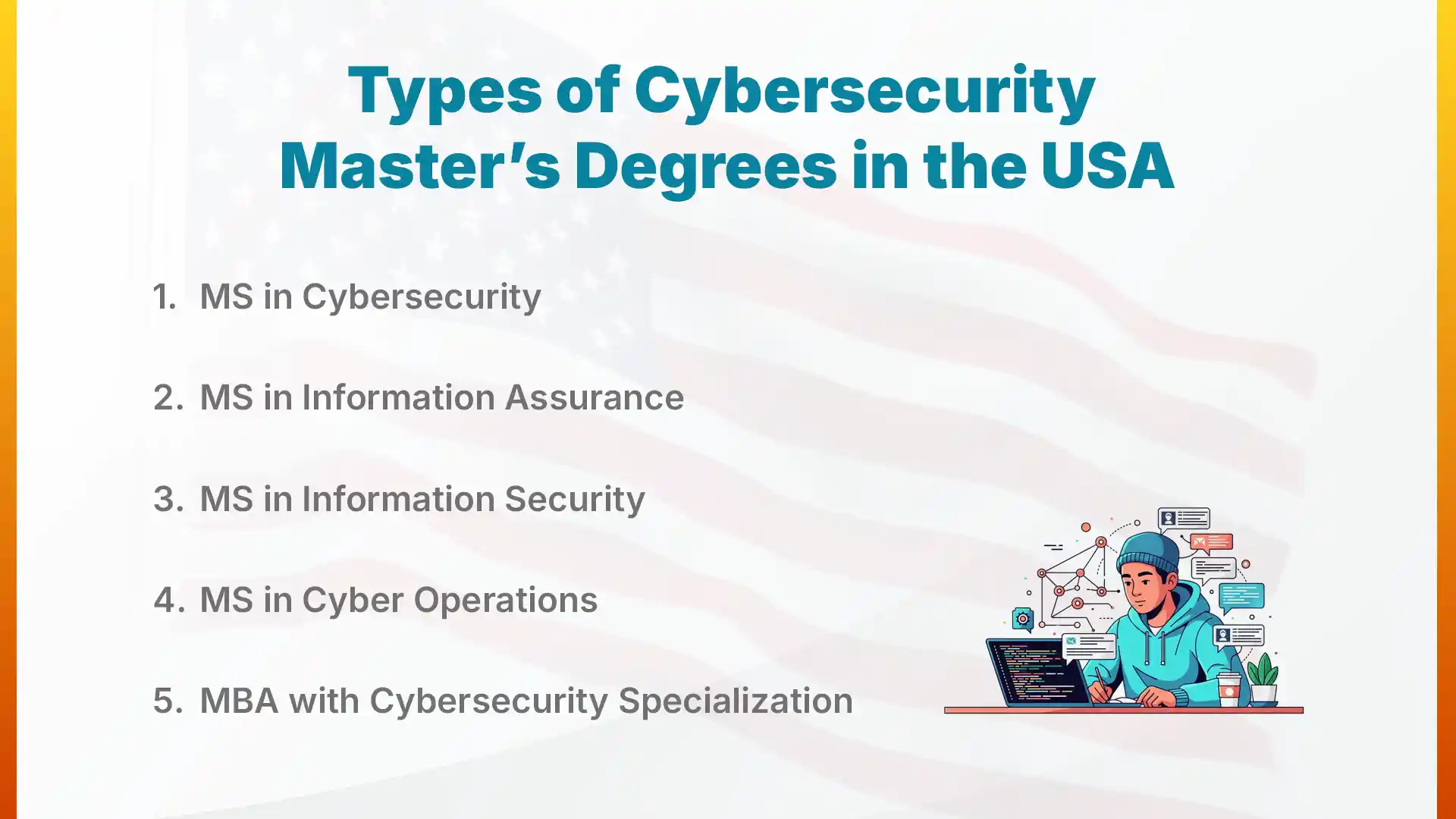
Students can choose from different types of cybersecurity master’s programs, such as MS in Cybersecurity, MS in Information Assurance, MS in Information Security, MS in Cyber Operations, and even MBA with a Cybersecurity Specialization. Each program has a different focus depending on whether you want a technical, management, or business-related career. Let us look at the most common options.
1. MS in Cybersecurity
This is the most popular cybersecurity degree in the USA. It focuses on network security, ethical hacking, cyber defense, cloud security, and risk management. Students who want a direct technical career in cybersecurity usually choose this degree.
An MS in Cybersecurity is a good fit if you enjoy solving technical problems and learning about digital threats. It can prepare you for roles like Security Analyst, Penetration Tester, or Cybersecurity Engineer. Many universities also allow you to choose electives based on your interests.
2. MS in Information Assurance
This degree focuses on protecting information and making sure systems stay secure, reliable, and available. It covers topics like data protection, compliance, security policies, and risk management.
Students who are interested in planning, security governance, and data management may prefer this option. It is often a good choice for those who want leadership roles in the future. You may also learn how companies create security rules and respond to data breaches.
3. MS in Information Security
MS in Information Security is closely related to cybersecurity, but it focuses more on keeping data and systems protected. You may study topics like encryption, database security, secure software, and access control.
This program is useful for students who want to work with sensitive company data or secure software systems. It can also lead to jobs in banking, finance, healthcare, and government sectors. Since these industries handle private data, they need strong information security teams.
4. MS in Cyber Operations
This program is more technical and often focuses on defending systems during active cyber attacks. Students learn how to detect threats, investigate incidents, and respond quickly to security problems.
MS in Cyber Operations is a good choice if you are interested in real-time cyber defense and security monitoring. Many courses include simulations where students practice handling attacks. It is often best for students who enjoy fast-moving and high-pressure work.
5. MBA with Cybersecurity Specialization
This option combines business and cybersecurity together. In this MBA in the USA, students learn about business management, leadership, finance, and cybersecurity risks.
It is a strong option if you want to become a manager, consultant, or business leader in the cybersecurity field. Instead of focusing deeply on technical work, this degree teaches you how to manage teams and make security decisions for companies. It is especially useful for students who already have work experience.
Top Universities in the USA for Master of Cybersecurity
The USA has both top-ranked universities like MIT, Carnegie Mellon, Stanford, UC Berkeley, and Georgia Tech, as well as more affordable universities like University of New Haven, Pace University, Wichita State University, University of North Texas, and Dakota State University. The best US university for you depends on your budget, academic profile, and career goals. Let us explore both top-ranked and affordable options.
1. Top-Ranked Universities for Cybersec Studies in USA
University | Approximate Tuition (2026/27 USD) | Key Strength |
| Massachusetts Institute of Technology (MIT) | $62,000 – $92,000+ | Global leader in STEM and Management (MIT Sloan); focus on "Mens et Manus." |
| Carnegie Mellon University (CMU) | $53,000 – $75,000 | Interdisciplinary pioneer in Robotics, AI, and Cybersecurity. |
| Stanford University | $64,000 – $78,000+ | Silicon Valley integration; powerhouse for entrepreneurship and innovation. |
| University of California, Berkeley | $35,000 – $55,000 | Premier public research university; elite Computer Science and Engineering. |
| Georgia Institute of Technology | $32,000 – $48,000 | Top-ranked Engineering ROI; leader in Aerospace and Analytics. |
These universities are highly respected around the world and have strong cybersecurity programs. They offer access to top professors, advanced labs, and research projects. Students also benefit from strong alumni networks and better job opportunities after graduation.
However, admission can be very competitive. Most of these universities expect strong grades, a good SOP, and sometimes research or work experience. Even though they are expensive, scholarships and assistantships can help lower the cost.
2. Affordable Tech Universities in USA for Nepali Students
University | Approximate Tuition (2026/27 USD) | Key Strength |
| University of New Haven | $21,000 – $47,000 | Top-tier for Criminal Justice and Forensic Science; strong "Charger" scholarships. |
| Pace University | $45,000 – $56,000 | Unbeatable Wall Street proximity; #1 for undergraduate internship placements in NYC. |
| Wichita State University | $18,000 – $25,000 | Innovation Campus partnership with Deloitte and Airbus; extremely high ROI. |
| University of North Texas (UNT) | $21,000 – $29,000 | R1 Research University; massive career support in the Dallas-Fort Worth metroplex. |
| Dakota State University | $12,000 – $19,000 | National Center of Academic Excellence in Cyber Defense; ultra-affordable. |
These universities are more budget-friendly and can be a better fit for many Nepali students. They still offer quality education, but the tuition and living costs are often lower. In some cases, students may also find more scholarship opportunities.
Choosing an affordable university does not mean compromising on your future. What matters most is your skills, projects, internships, and work experience. Many students from affordable universities also go on to build excellent careers.
What are the Best Cybersecurity Courses and Specializations for Nepalese Students?
Popular cybersecurity specializations include Ethical Hacking, Cloud Security, Digital Forensics, Cyber Intelligence, Data Privacy, and Incident Response. Each specialization prepares you for a different career path and skill set. That is why it is important to choose a focus area that matches your interests.
1. Ethical Hacking and Penetration Testing
This specialization teaches you how hackers attack systems so that you can learn how to stop them. Students learn about network testing, finding weaknesses, and improving security.
If you enjoy problem-solving and technical work, this can be a very exciting field. Many companies hire ethical hackers to test their systems before real hackers can attack them. This specialization can lead to jobs like Penetration Tester or Security Consultant.
2. Cloud Security
Today, many companies store their data and systems on cloud platforms like AWS, Azure, and Google Cloud. Because of this, cloud security has become one of the fastest-growing areas in cybersecurity.
Students learn how to secure cloud systems, protect online data, and manage risks in cloud platforms. Since many businesses now depend on the cloud, professionals in this field are in very high demand.
3. Digital Forensics
Digital Forensics focuses on investigating cyber crimes and collecting digital evidence. Students learn how to recover deleted files, trace attacks, and study damaged systems.
This specialization is useful for students who enjoy investigation work. It is often connected to law enforcement, government agencies, and large companies. In simple words, it is like being a detective in the digital world.
4. Cyber Intelligence
Cyber Intelligence is about collecting and studying information about cyber threats before they happen. Students learn how to track hackers, monitor threats, and protect organizations.
This area is important because companies do not want to wait for an attack to happen. Instead, they want to stop it before it causes damage. It is a strong option for students who enjoy research and analysis.
5. Data Privacy and Risk Management
This specialization teaches students how to keep customer and company data safe. It also covers laws, privacy rules, and how companies manage security risks.
As countries create stricter privacy laws, companies need experts who understand both technology and legal rules. This makes data privacy an important and growing career area. It is especially useful for students interested in leadership roles.
6. Security Operations and Incident Response
This field focuses on what happens during and after a cyber attack. Students learn how to detect problems, respond quickly, and reduce damage.
It is a practical specialization that suits students who enjoy action and teamwork. Many large companies have Security Operations Centers where teams work day and night to stop attacks. This means there are many job opportunities in this area.
Eligibility Requirements for Master’s of Cybersecurity from Nepal
Most universities require a bachelor’s degree, minimum GPA, English test scores, and sometimes GRE or work experience. The exact requirements for your US studies can vary depending on the university and program. Before applying, it is always smart to check the official requirements of each university.
1. Academic Requirements
Most universities ask for a bachelor’s degree in IT, Computer Science, Engineering, Information Technology, or a related field. Some universities may also accept students from other backgrounds if they have technical skills.
A GPA of around 2.8 to 3.0 or higher is often considered safe for many universities. However, top universities may expect a stronger academic record. If your GPA is lower, you can balance it with work experience, certifications, or a strong SOP.
2. English Language Requirements
International students usually need to prove their English ability through IELTS, TOEFL, or Duolingo. Most universities ask for an IELTS score of 6.5 to 7.0. For TOEFL, many universities prefer scores between 80 and 100. Some universities also accept Duolingo scores, especially after the pandemic. Since each university has different score requirements, always double-check before applying.
3. Standardized Tests
Some universities still ask for GRE scores, especially competitive universities. However, many universities have now made GRE optional or removed it completely.
If you have a good GRE score, it can strengthen your application. On the other hand, if you do not want to take GRE, you can still find many universities that do not require it. This gives students more flexibility.
4. Work Experience
Work experience is usually optional for most Master of Cybersecurity programs. However, having internships, job experience, or technical projects can make your profile stronger.
If you have already worked in IT, networking, programming, or cybersecurity, it can help during admission. Even simple projects, certifications, or freelance work can show your interest in the field. Universities like students who already have some hands-on experience.
Documents Required for Master’s Admission in USA
To apply for a Master of Cybersecurity in the USA, you usually need academic transcripts, passport copy, English test scores, SOP, LORs, and a resume. Some universities may also ask for GRE scores or work experience documents. Here is a simple checklist to help you stay organized.
- Academic transcripts
- Passport copy
- IELTS/TOEFL score
- GRE score if required
- Statement of Purpose (SOP for USA)
- Letters of Recommendation (LOR)
- Resume/CV
- Work experience documents if applicable
What is the Cost of Studying Master of Cybersecurity in the USA?
A Master of Cybersecurity in the USA can cost around USD 30,000 to USD 80,000 per year depending on the university and location. Public universities are often cheaper than private universities, while living costs can vary greatly from one city to another. Let us break down the total cost estimation so you can plan better.
1. Tuition Fees
Tuition fees depend mainly on whether the university is public or private. Public universities may charge around USD 15,000 to USD 35,000 per year for international students.
Private universities are usually more expensive and can charge between USD 35,000 and USD 60,000 per year. Highly ranked universities may cost even more. However, scholarships and assistantships in the USA can reduce the total amount significantly.
2. Living Expenses
Living costs in the USA can range from USD 10,000 to USD 20,000 per year. Students need to budget for accommodation, food, transport, insurance, books, and personal expenses.
Big cities like New York, San Francisco, and Boston are more expensive. Smaller cities are often much more affordable. Sharing apartments, cooking at home, and using student discounts can help you save money.
3. Total Estimated Cost for Nepali Students
For most Nepali students, the total yearly cost may be around USD 30,000 to USD 70,000, depending on the university. Over two years, the total cost of studying in the USA can reach around USD 60,000 to USD 140,000.
This number may sound big at first, but scholarships, part-time jobs, and assistantships can lower the burden. Also, because cybersecurity salaries are high, many students recover their investment within a few years of working.
Master of Cybersec Scholarships in USA for Nepali Students
Nepali students can apply for merit-based scholarships, need-based scholarships, assistantships, university scholarships, and external programs like Fulbright. These funding options can reduce tuition fees and living expenses significantly. Since studying in the USA can be expensive, scholarships can make a big difference.
1. Merit-Based Scholarships
Merit-based scholarships are given to students with strong academic records, good test scores, or outstanding achievements. There are partial to full scholarships available in USA. Universities often offer these scholarships automatically when you apply.
Students with a high GPA, strong SOP, and good IELTS or TOEFL scores have a better chance of receiving merit scholarships. Even small scholarships can help reduce your tuition burden. So, it is always worth applying early.
2. Need-Based Scholarships
Some universities also offer need-based scholarships for students who show financial need. These scholarships are helpful for students who may not be able to afford the full cost.
To apply, you may need to show bank statements, family income details, or other financial documents. Need-based support is less common than merit scholarships, but it is still available in some universities.
3. Graduate Assistantships
Graduate assistantships are one of the best ways to reduce your study cost. Students work part-time as teaching assistants or research assistants and get a salary or tuition waiver.
Assistantships can cover a large part of your tuition fees. They also help you gain valuable experience and build relationships with professors. Many students actively search for these positions after joining university.
4. University-Specific Scholarships
Many universities have their own scholarships for international students. Some may offer partial tuition waivers, while others may give larger awards.
It is important to check each university website carefully because scholarship rules are different everywhere. In many cases, you do not need a separate application. The university considers you automatically when you apply.
5. External Scholarships
There are also external scholarships available for Nepali students. Programs like Fulbright are very popular and highly respected.
Apart from Fulbright, some organizations, governments, and private foundations also support international students. These scholarships can be competitive, so it is important to prepare early and submit strong applications.
Admission Process for the Master of Cybersecurity in USA from Nepal
The admission process usually includes researching universities, preparing for tests, collecting documents, applying to universities, receiving offers, getting the I-20, applying for a visa, and preparing for departure. Starting early can make the entire process much smoother. Let us go through each step one by one.
Step 1: Research Universities and Courses
Start by making a list of universities that match your budget, academic profile, and career goals. Look at tuition fees, scholarships, location, course subjects, and internship opportunities.
Do not only focus on rankings. Sometimes, a lower-ranked university may offer better scholarships or lower living costs. Try to shortlist at least 5 to 8 universities with a mix of safe, moderate, and ambitious options.
Step 2: Prepare for IELTS, TOEFL, or GRE
Most students need to prepare for IELTS or TOEFL first. If your chosen universities require GRE, you may also need time for that.
Start preparing at least a few months early. Good scores can improve your admission chances and sometimes even help with scholarships. Since test dates fill up quickly, book your exam in advance.
Step 3: Collect Documents
Once your test scores are ready, start collecting all your documents. This includes transcripts, passport, SOP, LORs, resume, and work experience papers.
It is better to prepare these early because some documents can take time. For example, recommendation letters may depend on teachers or employers. Starting early can save you from last-minute stress.
Step 4: Apply to Universities
After collecting your documents, you can begin filling out university applications. Most applications are completed online through the university website.
Be careful while entering your details because small mistakes can create problems later. Also, keep track of deadlines because different universities have different closing dates.
Step 5: Receive Offer Letter
If your application is successful, you will receive an offer letter from the university. Some students may receive offers from multiple universities.
At this stage, compare the universities carefully. Look at tuition costs, scholarships, location, ranking, and future job opportunities. Then choose the option that gives you the best overall value.
Step 6: Pay Deposit and Get I-20
After choosing your university, you usually need to pay a deposit to confirm your seat. Then the university will issue your I-20 form.
The I-20 is an important document for your visa application. You will need it during your visa interview and while entering the USA. So, make sure all details on it are correct.
Step 7: Apply for US Student Visa
Once you receive your I-20, you can begin the visa process for your US education. This includes paying the SEVIS fee, filling out the DS-160 form, and booking your visa interview.
During the interview, the officer may ask about your university, future plans, finances, and why you chose the USA. The best approach is to answer clearly, honestly, and confidently.
Step 8: Prepare for Departure
After your visa is approved, you can start preparing for your journey. Book your flight, arrange accommodation, and collect important documents.
It is also a good idea to learn about the weather, transport system, and local culture in your new city. The more prepared you are, the easier your transition will be.
Career Opportunities After a Master of Cybersecurity in the USA
A Master of Cybersecurity in the USA can lead to careers like Cybersecurity Analyst, Security Engineer, Penetration Tester, Consultant, Digital Forensics Expert, and Cloud Security Specialist. Since cyber threats are increasing, companies across many industries need skilled professionals. Let us look at the most common job roles and opportunities.
1. Popular Job Roles for Cybersec Graduates with Salary
Cybersecurity jobs are among the highest-paying technology careers in the USA. Even entry-level positions often offer strong salaries, and experienced professionals can earn much more. The exact salary depends on your role, location, skills, and years of experience.
2. Top Companies Hiring Cybersecurity Graduates
Large tech companies like Google, Amazon, Microsoft, IBM, Cisco, and Deloitte regularly hire cybersecurity graduates. Apart from tech companies, banks, hospitals, universities, and government agencies also need security experts.
Job Role | Average Annual Salary (2026 USD) |
| Cybersecurity Analyst | $83,000 – $115,000 |
| Information Security Analyst | $90,000 – $135,000 |
| Security Engineer | $105,000 – $155,000 |
| Penetration Tester / Red Teamer | $95,000 – $145,000 |
| Cybersecurity Consultant | $100,000 – $155,000 |
| Digital Forensics Expert | $80,000 – $125,000 |
| Cloud Security Specialist | $120,000 – $175,000+ |
Working at a well-known company can help you build your career faster. These companies often provide better salaries, training, and career growth. However, they can also be competitive, so internships and projects can make your application stronger.
3. OPT and STEM OPT Benefits
International students can work in the USA for 12 months through OPT after graduation. Since cybersecurity is a STEM field, students can usually extend this period by another 24 months.
This means many students can work in the USA for up to 3 years after finishing their degree. That extra time is very valuable because it helps you gain work experience, build connections, and possibly move toward long-term career opportunities.
Challenges Nepali Students May Face in the USA
Nepali students may face challenges like high tuition fees, technical coursework, cultural adjustment, and finding internships or jobs. These problems can feel stressful in the beginning, but they can be managed with good planning. Knowing the challenges early can help you prepare better.
1. High Tuition Costs
Studying in the USA is expensive, and this is often the biggest challenge for students. Tuition, accommodation, insurance, and daily expenses can add up quickly.
The good news is that scholarships, assistantships, and part-time jobs can reduce the pressure. Choosing an affordable university can also make a big difference. Careful planning before departure is very important.
2. Tough Technical Curriculum
Cybersecurity programs can be challenging because they include technical subjects like coding, networking, cloud security, and ethical hacking. Students who are new to these topics may feel overwhelmed at first.
The best way to handle this is by building your basic knowledge before classes begin. Free online courses, YouTube tutorials, and practice labs can help you prepare. Once you build confidence, the coursework becomes easier.
3. Cultural Adjustment
Moving to a new country can feel exciting but also difficult. Students may struggle with homesickness, food, weather, language, or making friends.
The good news is that most universities have student clubs and support services. Joining Nepali communities, attending events, and staying active can make you feel more comfortable. Slowly, the new environment starts to feel like home.
4. Finding Internships and Jobs
Finding internships can be difficult, especially in the beginning. Many students apply for dozens of positions before getting a response.
To improve your chances, start early and build a strong LinkedIn profile, resume, and project portfolio. Networking with professors, seniors, and classmates can also help. Sometimes, one small connection can open a big door.
Is a Master of Cybersecurity in the USA Worth It?
For many Nepali students, a Master of Cybersecurity in the USA is definitely worth it. The field has strong job demand, high salaries, and good long-term growth. Even though the cost can be high, the return on investment is often very good.
Many students spend a large amount on tuition and living costs, but cybersecurity jobs in the USA often pay very well. In some cases, graduates can recover a large part of their investment within just a few years of working. This is one reason why many students see cybersecurity as a smart career choice.
Apart from money, this degree can also give you long-term career security. Technology will keep changing, but companies will always need people who can protect their systems and data. So, if you enjoy technology, problem-solving, and want a career with strong future potential, this degree can be a great option.
Conclusion
A Master of Cybersecurity in the USA can open the door to strong career opportunities, high salaries, and global work experience. From top universities and exciting specializations to scholarships and long-term job demand, the USA remains one of the best places for Nepali students to study cybersecurity.
Yes, the journey can feel expensive and competitive at times. However, with the right planning, a strong profile, and clear goals, it is absolutely possible. Many Nepali students have already taken this path and built successful careers abroad.
If cybersecurity is something that truly interests you, do not wait too long to start preparing. Research universities, improve your skills, visit the best consultancy in Nepal for USA, and take that first step. Sometimes, one decision today can completely change your future tomorrow.