Study MBA in USA from Nepal: Eligibility, Fees & Best Colleges

Mar 18, 2026

Dreaming of an international MBA but not sure where to start? Many students in Nepal look toward the USA for better career opportunities, but once they explore the process, it can quickly feel confusing and overwhelming.
From high tuition fees to entrance exams like GMAT, the path often seems complicated at first. Questions start coming up: Can I afford it? Do I qualify? Is it really worth it?
The good news is, it’s more achievable than it seems with the right guidance and planning. The USA continues to be a top destination for an MBA because of its global recognition, career growth, and strong return on investment.
In this guide, you’ll find everything you need to know, from eligibility and costs to the best universities for an MBA study in the USA, so you can move forward with clarity and confidence.
In this blog
MBA in USA for Nepalese Students
An MBA in the USA is one of the most popular choices for students who want to build a strong career in business, management, or leadership. It is designed to teach practical skills like decision-making, problem-solving, and teamwork, not just theory. Courses often include finance, marketing, operations, management, and entrepreneurship, giving you a well-rounded understanding of how businesses operate globally.
Most MBA programs focus on hands-on learning. You will work on case studies, group projects, business simulations, and internships that allow you to apply concepts in real situations. This approach ensures that by the end of your MBA, you are not only knowledgeable but also confident in handling workplace challenges.
By completing an MBA in the USA, you gain a combination of technical skills, leadership abilities, and global business insight. These deliverables prepare you to step directly into managerial roles, make impactful decisions, and succeed in competitive international careers.
1. MBA Duration in USA
The duration of an MBA in the USA usually ranges from 1 to 2 years, depending on the program you choose. A full-time MBA is the most common and is completed in about 2 years, while some universities also offer 1-year accelerated options. On the other hand, part-time and executive MBAs are more flexible and designed for working professionals, allowing you to study while continuing your job.
2. MBA Fees in USA
MBA fees in the USA can vary widely, but on average, tuition ranges from around $20,000 to $80,000 per year. Public universities are generally more affordable, while private and top-ranked schools tend to be more expensive. The total cost also depends on factors like location, program type, and university reputation.
Why Study MBA in USA?
Studying an MBA in the USA gives you a globally recognized degree, practical skills, and better career opportunities. US programs focus on real-world learning, leadership, and business experience. Here are the main reasons why Nepali students often choose the USA for their MBA studies:
1. Global Recognition of US Degrees
US MBA degrees are respected worldwide, which makes it easier to get jobs in top companies. Schools like Harvard, Stanford, and Wharton are highly ranked and trusted by employers. This recognition shows that you have strong skills and leadership training. For Nepali students, it increases your chances of working anywhere in the world.
2. Strong Networking Opportunities
US MBA programs help you meet classmates, teachers, alumni, and business leaders. You can attend career fairs, seminars, and group projects to build connections. These networks often lead to internships or job opportunities. For Nepali students, networking can open doors to high-paying roles and global careers.
3. High ROI and Career Growth
Although studying in the USA can be expensive, MBA graduates earn good salaries. On average, salaries range from $70,000 to $150,000 per year, depending on experience and specialisation. This means the investment pays off quickly with promotions and better jobs. Nepali students can benefit from both learning and higher earning potential.
4. Exposure to Diverse Industries
MBA programs cover industries like technology, finance, healthcare, and hospitality. You get hands-on experience through projects, case studies, and internships. This helps you learn how different businesses work and make better career choices. Graduates gain skills that are useful in many industries around the world.
MBA in USA: Eligibility Requirements for Nepalese Students
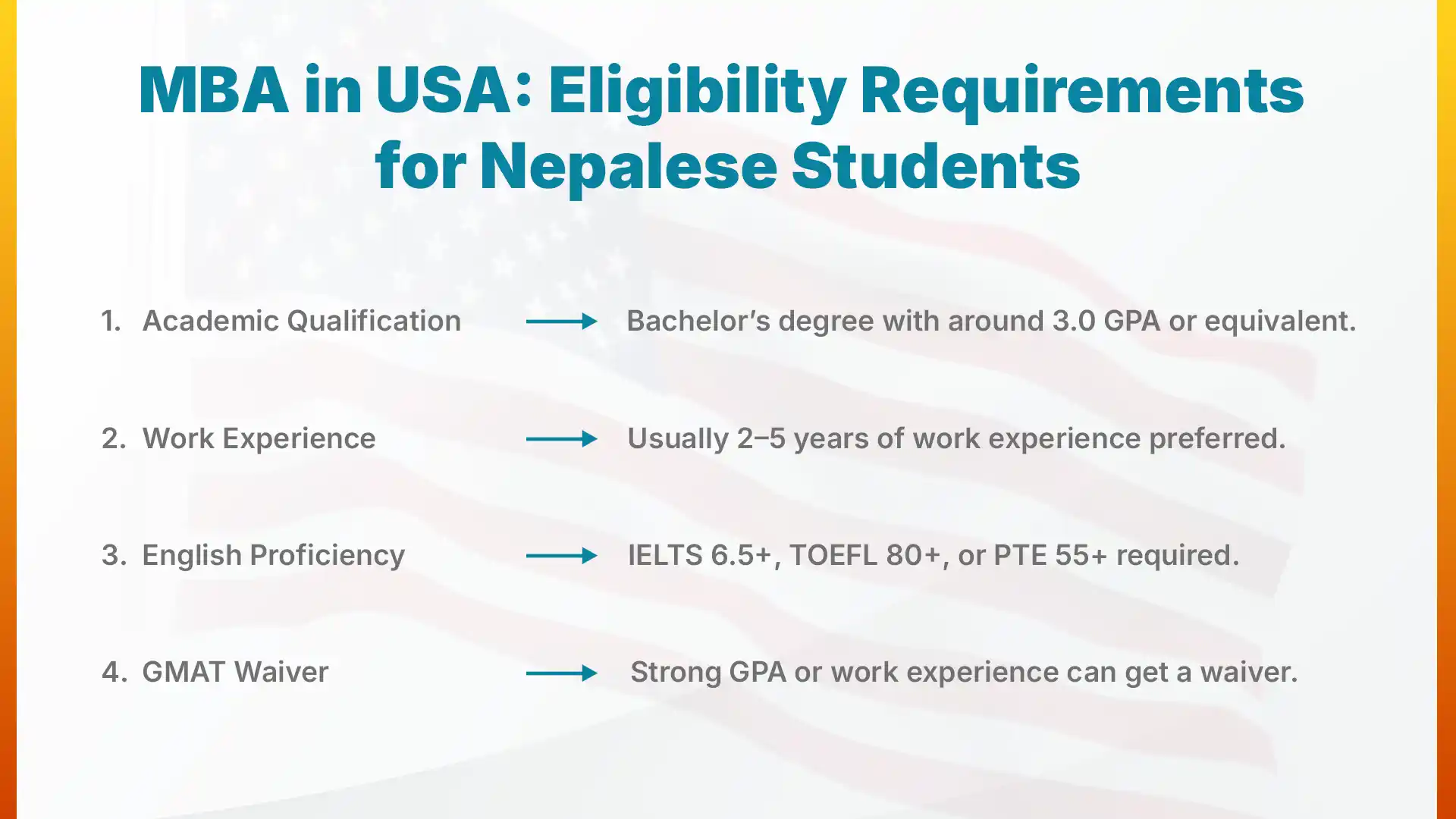
To study an MBA in the USA, Nepali students generally need a bachelor’s degree, English test scores, and sometimes work experience or GMAT. However, the exact requirements can vary depending on the university and program you choose. Let’s break down each requirement for US studies so you clearly understand what you need to prepare.
1. Academic Requirements (GPA)
Most universities require a bachelor’s degree with a GPA of around 3.0 or equivalent. You can apply with a degree in any subject, not just business, though having basic analytical or quantitative skills can help. Some top programs may expect higher grades, but a strong overall profile can balance slightly lower scores.
2. Work Experience Expectations
Many MBA programs prefer 2–5 years of professional work experience, especially for full-time or executive courses. However, some universities also accept fresh graduates for early-career MBA options.
3. English Proficiency (IELTS/PTE/TOEFL)
International students must prove their English skills, usually with IELTS 6.5+ (no band below 6.0), TOEFL 80+, or PTE 55+. This ensures you can keep up with lectures, assignments, and group work.
4. MBA in USA Without GMAT for International Students
Some universities waive the GMAT requirement for applicants with a strong GPA, relevant work experience, or prior graduate degrees. These waivers make it easier for qualified students to apply without the extra exam pressure.
Best MBA Colleges and Universities in USA for Nepalese Students
The USA is home to some of the world’s most prestigious MBA programs, offering excellent education, networking, and career opportunities. Top US universities focus on leadership, global business exposure, and practical learning, making them highly competitive. At the same time, there are affordable options for students who want quality education without extremely high fees.
1. Top MBA Universities in USA
For students aiming at the most prestigious MBA programs, these schools are widely recognized for their academic excellence, global exposure, and strong career opportunities. While they are highly competitive, graduating from any of these universities can open doors to top companies, international networks, and leadership roles worldwide.
Here’s a quick overview of some of the top-ranked MBA universities in the USA:
University Name | Tuition (2025-26) | Total Cost (Single) | Key Highlights |
| Harvard Business School | $78,700 | ~$126,536 | Global reputation, leadership focus, strong alumni network. |
| Stanford GSB | $85,755 | ~$135,771 | Innovation-driven, entrepreneurship, top-tier faculty. |
| Wharton School | $87,970 | ~$132,404 | Finance and strategy excellence, extensive global network. |
| MIT Sloan | $89,000 | ~$142,668 | Technology and analytics focus, strong corporate connections. |
| Kellogg School | $86,370 | ~$128,852 | Marketing, teamwork, and leadership-oriented curriculum. |
| Booth School | $87,354 | ~$129,403 | Data-driven decision-making, finance and consulting opportunities. |
2. Best Universities in USA for MBA with Low Fees
University Name | Average Tuition (Per Year) | Location |
| University of Florida – Warrington | $25,000 | Gainesville, FL |
| University of Wisconsin – Madison | $26,000 | Madison, WI |
| University of Iowa – Tippie | $24,000 | Iowa City, IA |
| Texas A&M University – Mays | $27,000 | College Station, TX |
| Indiana University – Kelley | $28,000 | Bloomington, IN |
MBA Courses & Specialisations in USA for International Students
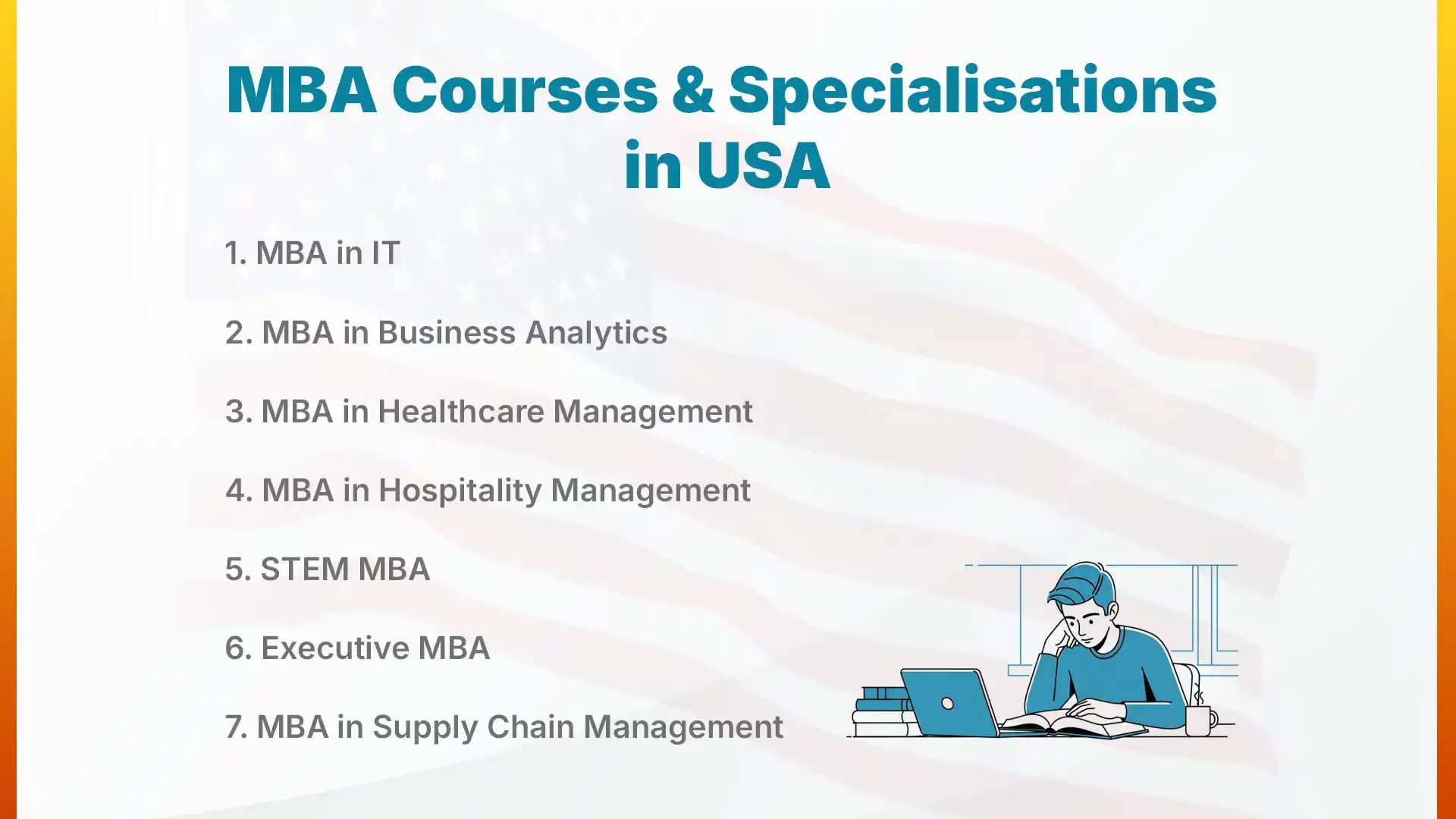
For an MBA in the USA, you have a wide range of courses and specialisations to choose from, including MBA in IT, Business Analytics, Healthcare Management, Executive MBA, and Supply Chain Management. Each of these programs is designed to focus on specific industries or skills, helping you gain practical knowledge and career-ready expertise.
Choosing the right specialisation depends on your career goals, interests, and the kind of industries you want to work in after graduation. Let’s look at each of these courses in the USA in detail so you know what to expect.
1. MBA in IT
An MBA in IT focuses on combining business management skills with technology knowledge. You will learn how to manage IT projects, lead tech teams, and make strategic decisions in tech-driven companies. The program usually covers topics like information systems, cybersecurity, data management, and emerging technologies. Graduates can pursue roles such as IT manager, technology consultant, or project leader in software, tech startups, and multinational companies. This MBA is ideal for students who want to bridge the gap between business strategy and technology.
2. MBA in Business Analytics
MBA in Business Analytics is designed for students who want to turn data into actionable business decisions. You will learn tools and techniques to analyze large datasets, understand market trends, and solve complex business problems. Courses often include data analytics, statistics, predictive modelling, and business intelligence. After graduation, you can work as a business analyst, data consultant, or strategy manager in industries like finance, consulting, and retail. This specialisation is perfect for those who enjoy numbers, research, and making decisions based on data insights.
3. MBA in Healthcare Management
An MBA in Healthcare Management combines business skills with healthcare industry knowledge. You will learn about hospital administration, healthcare policies, finance, and leadership in medical organisations. The program prepares you to manage hospitals, clinics, insurance companies, or pharmaceutical businesses efficiently. Graduates can work as healthcare managers, operations directors, or policy advisors. This course is ideal for students interested in improving healthcare services while building strong management expertise.
4. MBA in Hospitality Management
MBA in Hospitality Management prepares students for leadership roles in hotels, resorts, restaurants, and tourism companies. You will study hotel operations, customer service, marketing, and financial management in hospitality. The program also emphasizes practical experience through internships and real-world projects. After graduation, careers may include hotel manager, operations director, or tourism consultant. This specialisation is perfect for those who enjoy service, travel, and managing people and experiences.
5. STEM MBA
A STEM MBA combines traditional business management skills with science, technology, engineering, and mathematics knowledge. You will gain advanced analytical, quantitative, and problem-solving skills to make data-driven decisions in modern businesses. The program often focuses on technology, innovation, and global business strategies. Graduates can pursue roles in technology firms, consulting, or analytics-driven industries. This MBA is particularly valuable for international students as it may offer extended work opportunities in the USA under STEM OPT.
6. Executive MBA (EMBA)
Executive MBA is tailored for working professionals who want to advance their careers without leaving their jobs. Classes are usually scheduled on weekends or in modular formats to fit a busy schedule. The program emphasizes leadership, strategic thinking, and real-world business applications. Graduates can move into senior management, executive, or entrepreneurial roles. EMBA is ideal for professionals who already have work experience and want to accelerate career growth while continuing to work.
7. MBA in Supply Chain Management
MBA in Supply Chain Management focuses on the flow of goods, services, and information across businesses. You will study logistics, procurement, operations, and inventory management to ensure efficient supply chains. The program often includes real-world case studies and projects with companies. After graduation, you can work as supply chain manager, operations director, or logistics consultant. This specialisation is perfect for students interested in operational efficiency and global business coordination.
What is the Average Salary After MBA in USA?
The average salary after an MBA in the USA ranges from around $70,000 to $150,000 per year, depending on the specialisation and university. Salaries can vary widely between entry-level roles and experienced professionals, as well as across industries like finance, technology, or healthcare. Let’s break down how salaries differ by specialisation, experience level, and return on investment so you can understand what to expect.
1. Salary By MBA Specialisation
MBA Specialisation | Average Salary (USD/year) |
| MBA in IT | $90,000 – $140,000 |
| MBA in Business Analytics | $85,000 – $130,000 |
| MBA in Healthcare Management | $80,000 – $120,000 |
| MBA in Hospitality Management | $70,000 – $110,000 |
| STEM MBA | $95,000 – $150,000 |
| Executive MBA | $120,000 – $160,000 |
| MBA in Supply Chain Management | $80,000 – $125,000 |
2. Entry-Level vs Experienced MBA Salaries
Entry-level MBA graduates in the USA can expect salaries in the range of $70,000 to $100,000 per year, depending on specialisation and location. With 3–5 years of work experience, or after holding managerial roles, salaries typically rise to $120,000 or more, especially in sectors like technology, finance, and consulting. This growth reflects both the value of practical experience and the enhanced skills an MBA brings.
3. Return on Investment for MBA in USA
While MBA tuition and living costs in the USA can be high, the long-term benefits often outweigh the initial investment. A strong MBA program not only increases earning potential but also opens doors to international careers, leadership roles, and professional networks. For Nepali students, careful planning, scholarships, and choosing the right specialisation can make the ROI highly rewarding.
Cost of MBA in USA for International Students
The cost of studying an MBA in the USA typically ranges between $50,000 and $120,000 per year, depending on the university, location, and program type. This includes tuition, living expenses, and other essential costs. Understanding these expenses of US education helps Nepali students plan effectively and avoid surprises.
1. Tuition Fees: How Much Does MBA Cost?
MBA tuition varies widely based on the university. Top-ranked schools like Harvard, Stanford, or Wharton can charge $70,000–$120,000 per year, while mid-range or public universities may cost $30,000–$60,000 annually. Tuition usually covers classroom instruction, case studies, and access to campus resources.
2. Living Expenses & City-Wise Variation
Living costs depend on the city and lifestyle. Major cities like New York, San Francisco, or Boston have higher costs, around $20,000–$30,000 per year, while smaller cities may cost $12,000–$18,000. This includes rent, food, transportation, and daily expenses.
3. Hidden Costs (Insurance, Books, etc.)
Apart from tuition and living, international students should budget for health insurance, textbooks, lab fees, and personal expenses. These can add $3,000–$5,000 per year, so planning ahead is essential to manage finances effectively.
Scholarships & Funding Opportunities for MBA in USA
Scholarships can significantly reduce the cost of studying an MBA in the USA, and they are available for both international and Nepali students. These awards are offered by universities, private organizations, and sometimes governments, based on merit, need, or specific criteria. Here’s an overview of popular MBA scholarships:
Scholarship Name | Type | Eligibility / Key Details (2026/27) |
| Fulbright Foreign Student Program | Merit-based | Academic excellence, leadership potential, USA government-funded. Requires home-country return. |
| Stanford Reliance Dhirubhai Scholarship | Need & Merit | For Indian citizens; covers up to $150,000. Commitment to work in India for 2 years post-graduation. |
| Harvard Business School Fellowships | Need-based | HBS offers need-based aid (~$46,000/year avg). Merit is considered for admission, but dollars follow need. |
| Wharton MBA Fellowships | Merit-based | Automatic consideration upon admission. Includes Joseph Wharton & Emerging Economy Fellowships. |
| Forté Foundation Fellowships | Merit-based | For women in MBAs at partner schools. Focuses on leadership and advancing women in business. |
| AICPA John L. Carey Scholarship | Merit-based | For non-business majors (Liberal Arts) moving into Graduate Accounting. Requires US citizenship/PR. |
Most MBA scholarships fall into three categories: merit-based, awarded for strong academics or achievements; need-based, given to students who demonstrate financial requirement; and university-specific, which are offered directly by individual schools based on various criteria. Some scholarships cover full tuition, while others provide partial funding or stipends for living expenses.
How to Get a Scholarship for an MBA in USA?
To improve your chances, focus on building a strong overall profile, including your academic record, work experience, and leadership achievements. A well-written Statement of Purpose (SOP) can make a huge difference, showing your motivation, goals, and potential impact. Here’s how you can land a scholarship in USA for your MBA studies:
- Research scholarships early and thoroughly
- Craft a compelling, clear SOP
- Highlight leadership and achievements
- Strengthen your professional experience
- Apply before deadlines strictly
How to Write an SOP for MBA in USA? (2026)
Your Statement of Purpose (SOP) is your chance to tell universities who you are beyond grades and scores. Think of it as a story, about your journey, your achievements, and your goals. A strong SOP shows why you are ready for an MBA in the USA and why the program is the right fit for you.
Follow this format to write a winning SOP for your US studies:
1. Introduction
Begin your SOP with a short personal story or motivation that explains why you want to pursue an MBA. This could be a turning point in your education or work experience that inspired your career path. The goal is to capture the reader’s attention immediately and make your SOP memorable. Keep it genuine and concise, setting the tone for the rest of your essay.
2. Academic Background
Talk about your bachelor’s degree, important projects, or academic achievements that sparked your interest in business. Highlight any relevant courses or experiences that prepared you for an MBA. This section shows that you have a solid educational foundation and are ready to handle graduate-level studies.
3. Professional Experience
Explain your work experience, focusing on leadership roles, key responsibilities, and measurable accomplishments. Give examples of projects you led or challenges you overcame. This helps the admissions committee see your practical skills and ability to apply knowledge in real-world situations.
4. Why MBA & Why USA
Describe why pursuing an MBA is important for your career growth and why studying in the USA is the right choice. You can mention global exposure, networking opportunities, and quality of education. This section shows that you’ve thought carefully about your decision and understand the benefits of the program.
5. Career Goals
Share your short-term goals after completing the MBA, and also outline your long-term vision. Be specific about the industry, roles, or impact you want to make. Clear career goals demonstrate focus and purpose, which makes your SOP stronger.
6. Conclusion
End your SOP by summarizing your strengths and expressing enthusiasm for the program. Reinforce why you are a strong candidate and what you bring to the table. Finish confidently, leaving a positive impression on the admissions committee.
Conclusion
Now that you have reached the end of this blog, you know the requirements for an MBA in the USA, how to plan your application from Nepal, and what to expect in terms of costs and salaries.
It’s normal to feel that pursuing an MBA abroad is challenging, especially from Nepal. But remember, every successful student started with careful planning, the right information, and a clear goal. With dedication, research, early preparation, and professional study abroad support, the dream of studying in the USA can become a reality.
Take the first step today! Research programs, strengthen your profile, and start your applications with confidence. Every small action now brings you closer to an MBA that can transform your career and future.