Study MBA in UK: Specializations, Eligibility & Admission

Mar 27, 2026
Dreaming of building a global career with an MBA, but not sure where to start?
Many students in Nepal look at the MBA courses in the UK and think, “Is it really worth it? Can I afford it? Will I get a job after?”
The answer is mostly positive. The UK is one of the most popular destinations for MBA studies. But without the right guidance, it’s easy to feel lost between course options, requirements, and costs.
That’s exactly why this guide is here.
In this blog, you’ll learn everything you need to know about studying an MBA in the UK, from specializations and top UK universities to fees, scholarships, and career opportunities. Step by step, you’ll get a clear path so you can move forward with confidence.
In this blog
Why Study MBA in the UK?
Studying an MBA in the UK is a smart choice because it offers globally respected degrees, shorter course duration, and strong career opportunities after graduation. On top of that, you also get exposure to an international business environment and access to a post-study work visa. Now, let’s break down exactly why these benefits matter for you.
1. Globally Recognized Business Degrees
MBA degrees from the UK are respected worldwide. Universities like University of Oxford and University of Cambridge are known for high academic standards and strong business programs. This means your degree is not just valuable in the UK, but also in countries like Canada, Australia, and the USA.
Because of this global recognition, employers trust UK graduates and often prefer them. As a result, you get better job opportunities and a stronger career start, no matter where you choose to work.
2. Short Course Duration Compared to Other Countries
One of the biggest advantages of studying in the UK is the short duration. Most MBA programs are completed in just 1 year, while countries like the USA or Canada usually take 2 years. This means you save both time and money on tuition and living expenses.
In addition, you enter the job market faster and start earning sooner. For students from Nepal, this is a huge benefit because it reduces overall financial pressure and increases return on investment.
3. Strong Career Opportunities and Global Exposure
The UK has a strong business environment with many global companies and startups. While studying, you get chances to attend networking events, internships, and real-world projects. This helps you build connections with professionals from different countries.
Because of this exposure, you gain practical skills and confidence to work in international settings. In the long run, this increases your chances of getting high-paying jobs and growing your career globally.
4. Post-Study Work Visa Benefits in the UK
After completing your MBA, you can apply for the UK’s Graduate Route visa. This allows you to stay and work in the UK for up to 2 years without needing a job offer immediately. It gives you enough time to find the right job and gain work experience.
This is especially helpful for Nepali students who want international exposure after graduation. In simple terms, it gives you a clear pathway from study to career in the UK.
Types of MBA Courses in UK for International Students
There are three main types of MBA courses in the UK: full-time, part-time, and executive MBA (EMBA), each designed for different student needs. While some are ideal for fresh graduates, others are better for working professionals who want to grow in their careers. So, let’s understand each option clearly so you can choose what fits you best.
1. Full-Time MBA
A full-time MBA in the UK is the most popular choice for international students, especially those who can dedicate their time fully to study. These programs usually take 12 to 15 months, making them fast and intensive. You will attend regular classes, group projects, and workshops, which help you build strong business skills quickly.
In addition, many universities include internships, consulting projects, or industry visits as part of the course. This means you don’t just study theory, you gain real experience. As a result, you graduate job-ready and more confident to enter the global job market.
2. Part-Time MBA
A part-time MBA is designed for students who want to study while working. Classes are usually held in the evenings or on weekends, which gives you flexibility to manage both your job and studies. These programs typically take 2 to 3 years to complete.
This option is especially useful if you are already in the UK or have work experience and don’t want to leave your job. At the same time, you can apply what you learn directly at work. So, you grow your career step by step without putting everything on hold.
3. Executive MBA (EMBA)
An Executive MBA (EMBA) is made for professionals with significant work experience, usually 5 to 10 years or more. Classes are structured in a flexible format, such as weekend blocks or short intensive sessions. This allows you to continue working in senior roles while studying.
The focus of an EMBA is on leadership, decision-making, and real business challenges. You will also network with experienced managers and industry leaders, which adds great value. In the long run, this program helps you move into higher positions like management or executive roles.
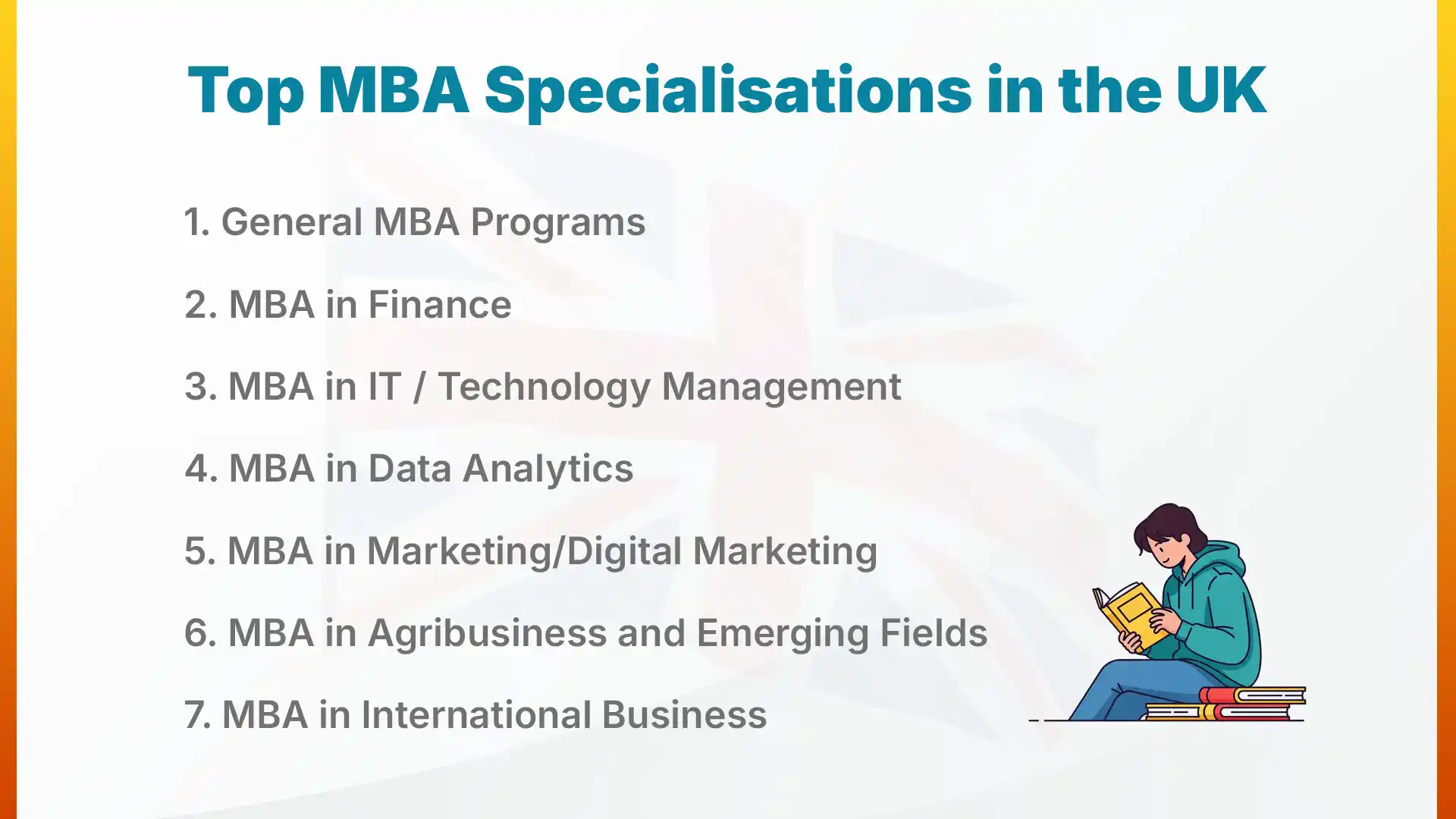
What Are the Top 7 MBA Specialisation Programs in the UK?
The UK offers a wide range of MBA specialisations, allowing you to choose a course that matches your career goals and interests. Each specialisation focuses on a specific industry or skill set, which helps you build deeper expertise. Now, let’s explore the most popular MBA specialisations and what they offer.
1. General MBA Programs
A General MBA is the most flexible option, covering all key areas like finance, marketing, operations, and leadership. You will study business strategy, management principles, and decision-making through case studies and group projects. This gives you a complete understanding of how businesses work.
Because of this broad knowledge, it is ideal if you are unsure about your exact career path. After graduation, you can explore roles in management, consulting, or even start your own business. It gives you strong, all-round career options.
2. MBA in Finance
An MBA in Finance focuses on managing money, investments, and financial risks. You will study subjects like corporate finance, financial markets, accounting, and investment analysis. Many programs also include real-world case studies from banks and financial firms.
This specialisation is perfect if you enjoy numbers and want a career in banking or finance. After completing this MBA, you can work as a financial analyst, investment banker, or finance manager. It often leads to high-paying roles with strong career growth.
3. MBA in IT / Technology Management
This MBA combines business knowledge with technology skills, which are in high demand today. You will learn about IT strategy, digital transformation, project management, and innovation. The course often includes working on tech-based business problems.
It is a great choice if you have an IT background or want to move into the tech industry. Career options include IT manager, product manager, or technology consultant. As businesses rely more on technology, this field continues to grow rapidly.
4. MBA in Data Analytics
An MBA in Data Analytics teaches you how to use data to make smart business decisions. You will learn data analysis, statistics, business intelligence tools, and data-driven strategy. Many courses include hands-on projects using real datasets.
This is ideal if you enjoy working with data and problem-solving. After graduation, you can work as a business analyst, data analyst, or strategy consultant. Since companies depend on data today, this specialisation offers strong job demand and growth.
5. MBA in Marketing/Digital Marketing
This MBA focuses on how businesses promote and sell their products in modern markets. You will study marketing strategy, consumer behavior, branding, and digital tools like social media and SEO. Practical projects often include real campaign planning.
It is a good fit if you are creative and interested in understanding customers. Career options include marketing manager, brand manager, or digital marketing specialist. With businesses moving online, this field has strong and growing opportunities.
6. MBA in Agribusiness and Emerging Fields
An MBA in Agribusiness focuses on managing agriculture-related businesses and supply chains. You will study food production, agribusiness management, sustainability, and global trade. Some programs also include field visits and industry projects.
This is especially useful for students from countries like Nepal, where agriculture plays a big role. After graduation, you can work in agribusiness firms, NGOs, or even start your own venture. It connects business skills with real-world impact.
7. MBA in International Business
An MBA in International Business prepares you to work across global markets. You will learn about international trade, global strategy, cross-cultural management, and international finance. The course often includes case studies from multinational companies.
This specialisation is ideal if you want to work in global companies or international roles. Career paths include international business manager, export manager, or global consultant. It helps you build a career that is not limited to one country.
How Many Years is MBA in the UK?
The duration of an MBA in the UK is usually 1 year for full-time programs, 2 years for part-time MBAs, and 1–2 years for Executive MBA programs, depending on the university and study mode. The duration of an MBA in the UK is one of its biggest advantages, as most programs are shorter compared to other countries. This helps you save both time and money while still getting a high-quality degree. Let’s break down how long each type of MBA usually takes.
1. Standard 1-Year MBA Programs
Most full-time MBA programs in the UK are completed in 12 to 15 months. These courses are fast-paced and intensive, covering all key business subjects within a short time. You will have regular classes, group work, and practical projects throughout the year.
Because of this shorter duration, you save on living costs and enter the job market faster. This is especially helpful for Nepali students who want a quicker return on their investment. In simple terms, you spend less time studying and more time building your career.
2. Part-Time and Executive MBA Duration
Part-time and Executive MBA (EMBA) programs usually take 2 to 3 years to complete. These are designed for working professionals, so classes are scheduled in the evenings, weekends, or in short study blocks. This makes it easier to balance work and study at the same time.
Although the duration is longer, you continue earning while studying. At the same time, you can apply what you learn directly to your job. So, instead of pausing your career, you grow it step by step.
3. Comparison with MBA Duration in Other Countries
Compared to the UK, countries like the USA and Canada usually offer MBA programs that take 2 years or more. This means higher tuition fees and longer living expenses. In contrast, the UK’s shorter MBA helps reduce overall costs significantly.
Because you graduate earlier, you can start working and earning sooner. For many students, this makes the UK a more practical and cost-effective choice. It’s a faster path from education to career success.
MBA in UK Requirements for International Students
To study an MBA in the UK, you need to meet a few key requirements, including your academic background, English skills, and sometimes work experience. While the exact criteria can vary by university, most follow a similar standard. Let’s go through each requirement for your UK education so you know exactly what to prepare.
1. Academic Qualifications
You must have a bachelor’s degree from a recognized university to apply for an MBA in the UK. Most universities expect at least a second-class degree (around 2:1 or 2:2 equivalent), which usually means a GPA of around 2.5–3.0 or above.
Your degree does not always have to be in business, but having a related background can be helpful. Some universities may also look at your academic consistency. So, maintaining good grades increases your chances of getting into top MBA programs.
2. Work Experience Requirements (if applicable)
Many UK universities prefer students with at least 2–3 years of work experience, especially for top MBA programs. This is because MBA courses focus on real-world business problems and leadership skills.
However, some universities do offer MBA programs without work experience or with minimal experience. In such cases, strong academic performance and a good profile can help. Overall, having work experience gives you an advantage and makes your application stronger.
3. English Language Requirements (IELTS/PTE)
Since the UK is an English-speaking country, you need to prove your language skills. Most universities require an IELTS score of 6.5 to 7.0, with no band less than 6.0. You can also study in the UK without IELTS. Some universities also accept Pearson Test of English (PTE) with similar score requirements.
A good English score is important not just for admission, but also for understanding your classes and participating in discussions. So, preparing well for these tests is a key step in your MBA journey.
4. GMAT/GRE Requirements (Optional or Required)
The GMAT or GRE is not always required for MBA in the UK, especially in many mid-range universities. However, top universities may ask for a GMAT score (usually 600 or above) as part of their selection process.
If your academic scores are average, a good GMAT score can improve your chances. On the other hand, if your profile is strong, you may not need it at all. So, always check the specific requirements of your chosen university before applying.
What Documents Are Required for an MBA in the UK?
To apply for an MBA in the UK, you need to prepare a set of important documents that show your academic background, experience, and career goals. While the exact list may vary slightly by university, most requirements are similar. Let’s go through each document so you can prepare them the right way.
1. Statement of Purpose (SOP) for MBA in UK
Your SOP is one of the most important parts of your application. It explains who you are, why you want to study an MBA, and what your future goals are. Universities use it to understand your motivation and whether you are a good fit for the program.
A strong SOP for UK clearly connects your past studies, work experience, and future plans. It should be honest, well-structured, and focused on your career goals. A good SOP can often make a big difference, even if other parts of your profile are average.
2. Letters of Recommendation (LOR)
Most universities ask for 1–2 letters of recommendation from people who know you professionally or academically. This could be your employer, manager, or university professor. These letters highlight your skills, work ethic, and potential as a student.
A strong LOR should include real examples of your achievements and strengths. So, choose someone who knows you well and can write in detail. This helps universities trust your profile more and see your true potential.
3. Academic Transcripts and Certificates
You need to submit your academic transcripts and certificates from your previous studies. These documents show your subjects, grades, and overall academic performance. Universities use them to check if you meet their academic requirements.
Make sure your documents are clear, complete, and properly certified if required. If your grades are strong, they can improve your chances of admission. So, it’s important to keep them well-prepared and ready before applying.
4. CV/Resume for MBA Applications
Your CV or resume gives a quick overview of your education, work experience, and skills. For MBA applications, it should be clear, professional, and focused on your achievements.
Instead of just listing tasks, highlight your results and impact. For example, projects you handled or goals you achieved. A strong CV shows that you are serious, capable, and ready for a business program. It also supports your SOP and overall application.
5. Additional Documents for Executive MBA
If you are applying for an Executive MBA (EMBA), you may need a few extra documents. These can include a detailed work portfolio, leadership experience proof, or employer support letter. Some universities may also require an interview.
These documents help show your experience in management and leadership roles. So, the more clearly you present your achievements, the better your chances. For EMBA, your professional journey matters just as much as your academic background.
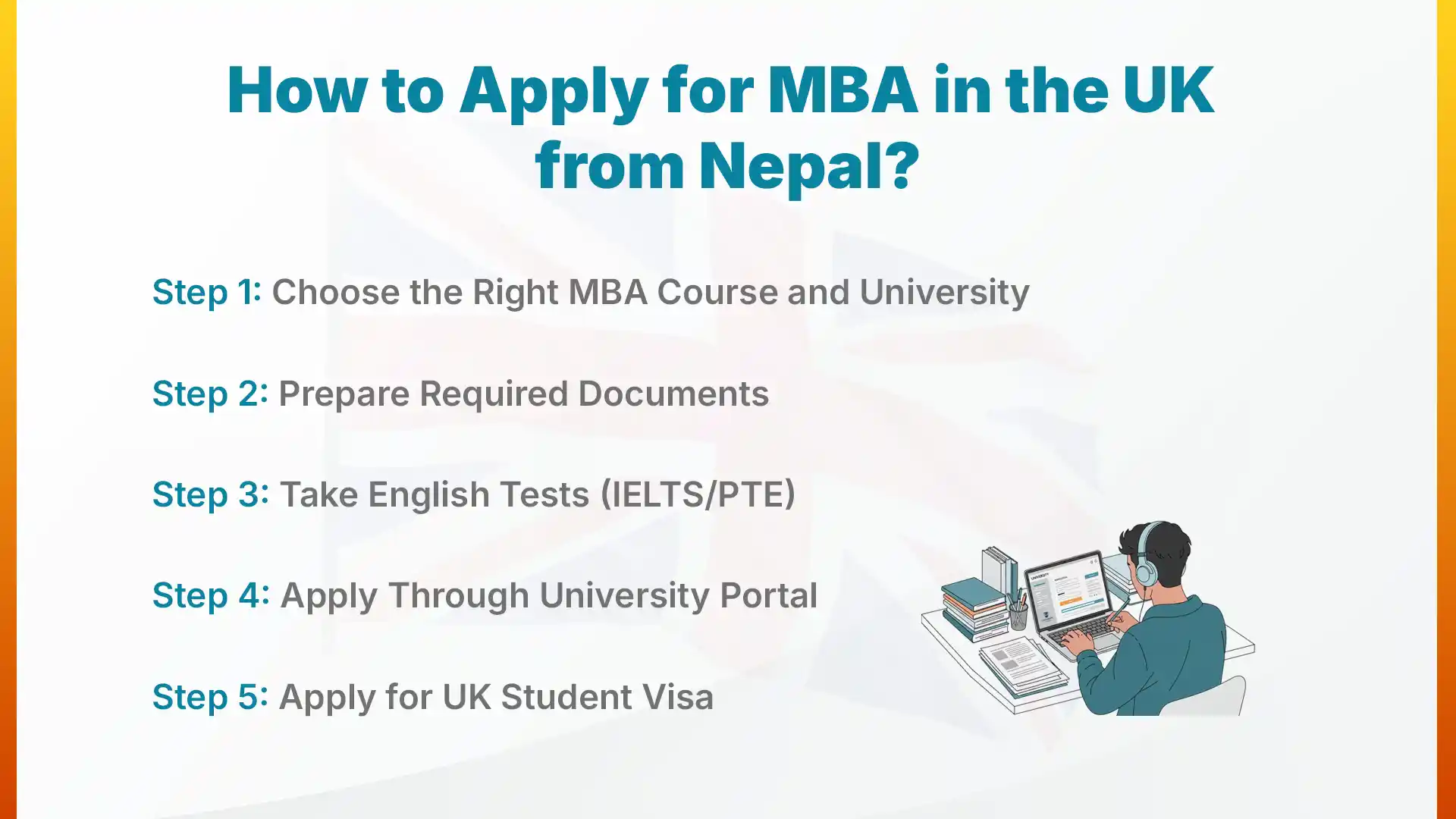
How to Apply for MBA in the UK from Nepal?
Applying for an MBA in the UK from Nepal becomes much easier when you follow a clear step-by-step process. Each stage matters because UK universities check your academic background, English skills, and documents carefully. So, if you plan properly from the start, your chances of acceptance become much stronger. Let’s go through the exact steps you need to follow.
Step 1: Choose the Right MBA Course and University
Start by selecting the MBA program that matches your career goal, whether it is Finance, IT, Marketing, or Data Analytics. Different universities in the UK offer different strengths, so you should compare course structure, tuition fees, and location.
Also, check whether the university accepts your academic profile and work experience. For example, some universities require 2–3 years of experience, while others may accept fresh graduates with strong academics. This step helps you avoid wrong choices and saves both time and money.
Step 2: Prepare Required Documents
You will need several important documents for your MBA application. These usually include academic transcripts, bachelor’s degree certificate, passport copy, CV, and a Statement of Purpose (SOP). Some universities may also ask for letters of recommendation.
Your SOP is especially important because it explains your goals, motivation, and why you want to study in the UK. So, take time to write it clearly and honestly. A strong SOP can make your application stand out.
Step 3: Take English Tests (IELTS/PTE)
Most UK universities require proof of English proficiency through IELTS or PTE. Generally, MBA programs ask for an IELTS score of around 6.5 to 7.0 overall, depending on the university.
You should prepare well in advance because test scores play a big role in admission decisions. A good score not only meets requirements but also increases your confidence during the application process. Without this step, your application will not move forward.
Step 4: Apply Through University Portal
Once your documents are ready, you can apply directly through the university’s official website. Fill out the application form carefully and upload all required documents. Some universities may also charge a small application fee.
After submission, you will receive updates through email or your application portal. If selected, you may also be invited for an interview. So, make sure your profile is complete and accurate before applying.
Step 5: Apply for UK Student Visa
After receiving your offer letter, the final step is applying for the UK Student Visa (Tier 4 / Student Route Visa). You will need your CAS letter, financial proof, passport, and other supporting documents.
You also need to show that you can cover tuition fees and living costs in the UK. Once approved, you can travel and begin your MBA journey. This is the final step that turns your dream into reality.
Top MBA Universities in the UK: Best Business Schools
The UK is home to many top MBA universities, offering high-quality education, global recognition, and strong career outcomes. From elite institutions to more affordable options, you have a wide range of choices based on your budget and goals. Let’s explore the main categories of top UK universities to help you shortlist the right universities.
1. Russell Group Universities Offering MBA
Russell Group universities are known for their academic excellence, strong research, and global reputation. Institutions like Oxford and Cambridge are highly competitive but offer world-class MBA education and strong industry links. These universities can significantly boost your global career profile.
University Name | 2026 Tuition (MBA/MSc Business) | Location |
| University of Oxford (Saïd) | £78,510 | Oxford, England |
| University of Cambridge (Judge) | £71,436 | Cambridge, England |
| London Business School | £115,000 | London, England |
| University of Manchester (Alliance) | £48,000 | Manchester, England |
| University of Warwick | £53,750 | Coventry, England |
| University of Edinburgh | £38,500 – £41,000 | Edinburgh, Scotland |
| University of Birmingham | £34,000 – £36,500 | Birmingham, England |
2. Affordable Universities for International Students
These universities offer MBA programs at comparatively lower tuition fees while still maintaining good academic quality and career support. They are ideal for students who want a balance between cost and education quality. Many Nepali students choose these options to manage their budget effectively.
University Name | Estimated MBA Tuition (Intl.) | Location |
| University of Bedfordshire | ~£18,900–£21,000 | Luton, England |
| Teesside University | ~£17,000 per year | Middlesbrough, England |
| University of West London | ~£18,500 per year | London, England |
| University of Sunderland | ~£9,420 total | Sunderland, England |
| Leeds Beckett University | £15,000 – £18,440 (total) | Leeds, England |
| University of Hertfordshire | ~£22,000–£23,000 per year | Hatfield, England |
| University of Derby | ~£18,000 (total) | Derby, England |
3. Popular MBA Colleges for Nepali Students
These universities are popular among Nepali students due to flexible entry requirements, supportive environments, and diverse student communities. They also offer practical learning and internship opportunities, which help in building real-world skills.
University Name | Estimated MBA Tuition (Intl. 2026/27) | Location |
| Coventry University | ~£20,350 | Coventry, England |
| Ulster University | ~£18,140 – £24,250 | Belfast, Northern Ireland |
| University of West London | ~£18,500 – £22,500 | London, England |
| University of Greenwich | ~£19,975 – £20,800 | London, England |
| Birmingham City University | ~£20,370 – £22,400 | Birmingham, England |
| Sheffield Hallam University | ~£21,375 | Sheffield, England |
| Nottingham Trent University | ~£25,000 | Nottingham, England |
How Much Does an MBA Cost in the UK?
The total cost of studying an MBA in the UK usually ranges between £25,000 and £65,000 for tuition and around £12,000 to £18,000 per year for living expenses. However, the total expenses of your UK education largely depend on the university, location, and type of program you choose. Let’s break it down clearly so you can plan your budget without confusion.
1. Average Tuition Fees in the UK
The average tuition fee for an MBA in the UK ranges from £15,000 to £60,000 per year. Top universities like London Business School can charge much higher fees, sometimes above £80,000. On the other hand, many affordable universities offer MBA programs closer to £15,000–£25,000.
The cost depends mainly on the university ranking, course structure, and specialization. For example, finance or analytics MBAs may cost slightly more due to advanced training. So, choosing the right university can make a big difference in your total budget.
2. Living Expenses for International Students
Living expenses in the UK usually range from £900 to £1,500 per month, depending on your lifestyle and city. This includes accommodation, food, transport, and personal expenses. Students living in shared housing can reduce costs significantly.
On average, smaller cities are more affordable than big cities. If you manage your spending wisely, you can maintain a comfortable student life without financial stress. Planning your monthly budget early helps you avoid unnecessary pressure later.
3. City-wise Cost Differences (London vs Other Cities)
Studying in London is more expensive compared to other UK cities. In London, monthly living costs can go up to £1,200–£1,800, especially for accommodation. However, cities like Manchester, Birmingham, Leeds, and Sheffield are more affordable, with costs closer to £800–£1,200 per month.
London offers more job opportunities and networking events, but smaller cities help you save money. So, your choice depends on whether you prioritize career exposure or budget control.
4. Hidden Costs (Visa, Insurance, Materials)
Apart from tuition and living costs, there are some hidden expenses you should plan for. A UK student visa usually costs around £558 (from April 8, 2026), and the Immigration Health Surcharge (IHS), which is typically about £776 per year. These are mandatory for international students.
You should also budget for books, study materials, and travel costs, which can add a few hundred pounds per year. While these costs may seem small individually, they add up over time. So, planning ahead helps you avoid financial surprises during your studies.
MBA Scholarships in the UK for Nepalese Students
Scholarships for MBA in the UK help international students reduce the overall cost of studying and make their dream more affordable. Many universities and the UK government offer financial support based on merit, leadership, and academic performance. Let’s look at the main scholarship options in the UK you should know before applying.
1. UK Government Scholarships
One of the most popular options is the Chevening Scholarship, funded by the UK government. It covers full tuition fees, living expenses, and travel costs, making it one of the most competitive scholarships for international students. It is awarded to students with strong leadership potential and academic excellence.
You usually need at least 2 years of work experience, a strong academic background, and clear career goals. The application process is competitive, so a well-written SOP and leadership experience can significantly improve your chances. For many Nepali students, this is a life-changing opportunity.
2. University-Specific MBA Scholarships
Many UK universities offer their own MBA scholarships to attract talented international students. These scholarships are usually based on academic performance, work experience, or leadership skills. Some universities may offer partial fee waivers, while others reduce tuition by a fixed amount.
You must apply either automatically or through a separate scholarship application, depending on the university. Strong academic records and a good SOP can increase your chances. These scholarships help reduce financial pressure, especially for students from countries like Nepal.
3. Scholarships for Asian / Nepali Students
Some scholarships are specifically aimed at students from Asia, including Nepal. These may come from universities, private organizations, or international education funds. They often focus on students with strong academic performance but limited financial resources.
While fully funded scholarships are rare, partial funding options are more common. These can significantly reduce your tuition or living costs. So, applying early and preparing strong documents can improve your chances of securing financial support.
MBA Salary in the UK After Graduation
MBA graduates in the UK earn strong starting salaries compared to many other countries, especially when they enter roles in finance, consulting, or technology. The salary usually depends on your university, specialization, and prior work experience. With the right skills and networking, an MBA can significantly boost your earning potential and career growth. Now, let’s break down the salary details more clearly.
1. Average Salary After MBA Graduates in the UK
On average, MBA graduates in the UK earn between £45,000 to £90,000 per year right after graduation. Graduates from top business schools like London Business School or Oxford often earn even higher packages, especially in consulting or investment banking roles.
Your salary also depends on your work experience before the MBA. If you already have 3–5 years of experience, your starting pay can move closer to the upper range. Over time, this salary grows quickly with promotions and performance.
2. Salary by Specialization (Finance, IT, Analytics)
Different MBA specializations lead to different salary levels in the UK. For example, MBA in Finance graduates often earn around £55,000–£100,000, especially in banking and investment firms. Finance roles usually offer faster salary growth in big cities like London.
For IT or Technology Management MBAs, salaries range from £50,000–£95,000, depending on company size and role. Meanwhile, Data Analytics MBA graduates can earn £50,000–£90,000, as demand for data-driven decision-making continues to grow in UK companies.
3. Top UK Recruiters and In-Demand Industries
Top recruiters for MBA graduates in the UK include companies like Deloitte, PwC, KPMG, McKinsey, Amazon, Microsoft, HSBC, and Barclays. These companies actively hire MBA graduates for leadership, consulting, finance, and strategy roles.
Industries such as consulting, banking, technology, and healthcare management offer the highest salaries. Many students also find opportunities in startups, especially in London, where innovation-based roles are growing quickly.
4. Is MBA in the UK Worth It?
Yes, an MBA in the UK is often worth it if you choose the right university and specialization. The average tuition cost may feel high, but strong salary packages help recover the investment within a few years.
Most graduates see a clear salary jump of 50% to 100% compared to their pre-MBA earnings. Along with salary growth, you also gain global exposure, which increases long-term career value. So, the return on investment is strong if you plan wisely and build your skills during the course.
Conclusion
An MBA in the UK gives you a fast, globally recognized degree with strong career opportunities, different specializations, and a simple application process. From understanding course types and requirements to exploring top universities, costs, scholarships, and salaries, you now have a clear picture of what studying in the UK looks like.
If you are a student in Nepal, this journey might feel big right now, but it is absolutely possible with the right direction. The key is to start early, choose a specialization that matches your career goals, and prepare your documents carefully. Small, consistent steps today can open big opportunities tomorrow.
And if you ever feel confused about where to begin, getting guidance from experienced UK counselors can make your path much smoother. A little expert support at the right time can help you avoid mistakes and move forward with confidence.