Master of Engineering in USA: Top Universities and Requirements

Mar 30, 2026
You've decided to pursue a master's in engineering in the USA; now comes the hard part. Choosing between an M.Eng. and M.S., figuring out which universities fit your profile, and understanding what admissions committees actually expect can feel like solving a puzzle with missing pieces.
The US hosts over 100 graduate engineering programs across dozens of specializations, each with different requirements, costs, and career outcomes. This guide walks you through the top-ranked universities, admission requirements, tuition costs, visa steps, and funding options so you can move from research to application with a clear plan.
In this blog
What is a Master of Engineering Degree
A Master of Engineering (M.Eng.) is a professionally-oriented graduate degree that typically takes one to two years to complete, focusing on advancing technical expertise and leadership skills for industry roles rather than academic research. The program emphasizes practical application over theoretical research, making it ideal for students planning to enter the workforce immediately after graduation.
Most M.Eng. programs require 30 to 36 semester credit hours, with annual tuition ranging from $50,000 to $60,000+ at top institutions. You'll complete advanced coursework in your specialization, often finishing with a capstone project or industry practicum instead of a traditional thesis. This structure works well if you're planning to enter the workforce directly after graduation.
M.Eng. vs M.S. in Engineering
The M.Eng. focuses on practical, industry-oriented coursework while the M.S. emphasizes research and theoretical foundations. Your choice between these degrees should align with whether you're targeting immediate industry employment or considering doctoral studies and research careers.
Choosing between an M.Eng. and an M.S. often confuses students, yet the distinction matters for your career path.
Curriculum and Coursework Focus
The M.Eng. curriculum centers on practical coursework, real-world applications, and capstone projects that simulate industry challenges. The M.S. in Engineering includes more theoretical foundations and research methodology, preparing you for advanced research roles. If you prefer hands-on learning over academic theory, the M.Eng. typically fits better.
Thesis and Research Requirements
An M.S. program usually requires a thesis, which is a substantial research project you complete under faculty supervision and defend before a committee. The M.Eng. rarely requires a thesis, instead offering alternatives like design projects, industry internships, or comprehensive exams. This fundamental difference affects your daily experience throughout the program and the skills you'll develop.
Career Path and Industry Relevance
M.Eng. graduates often move directly into engineering roles at companies, with employers viewing the degree as a signal of immediate industry readiness. M.S. graduates may pursue PhD programs or research positions in academia or specialized research labs. Both degrees are respected, though the M.Eng. signals immediate industry readiness to employers while the M.S. opens doors to research-intensive careers.
Which Engineering Master's Degree Should You Choose
Your decision depends on your goals. If you want to work in industry right away, the M.Eng. offers a faster, more practical path with direct application of skills. If you're considering a PhD or research career, the M.S. provides stronger preparation through its emphasis on research methodology and theoretical foundations.
Why Pursue a Master's of Engineering in the USA
The United States offers unmatched engineering education through world-class research facilities, diverse specializations, and extended post-study work authorization. American universities combine cutting-edge technology access with globally recognized degrees that open career doors worldwide.
Here's what draws students to American universities.
World-Class Research Facilities and Innovation
American universities invest heavily in cutting-edge laboratories, industry partnerships, and innovation hubs that define the future of engineering. You'll have access to resources that aren't available in many other countries, from advanced computing clusters to specialized testing equipment. These facilities allow you to work on projects using the same technology employed by leading tech companies and research institutions.
Wide Range of Engineering Specializations
Whether you're interested in artificial intelligence, biomedical devices, sustainable energy, or aerospace systems, US universities offer an extraordinary breadth of specializations. This variety allows you to tailor your degree precisely to your career interests, with many programs offering interdisciplinary tracks that combine multiple fields. You can even customize your coursework to match emerging industry trends and your specific professional goals.
STEM OPT and Post-Study Work Rights
STEM OPT (Optional Practical Training) allows engineering graduates to work in the USA for up to three years after completing their degree. This extended work authorization makes the US particularly attractive compared to destinations with shorter post-study work periods. The three-year window gives you substantial time to gain professional experience, build your network, and potentially transition to longer-term work authorization.
Global Recognition of US Graduate Engineering Degrees
Employers worldwide recognize and value engineering degrees from American institutions, viewing them as markers of rigorous training and technical excellence. A US master's degree can open doors not just in America but across international job markets. This global recognition means your investment in US education pays dividends regardless of where your career takes you.
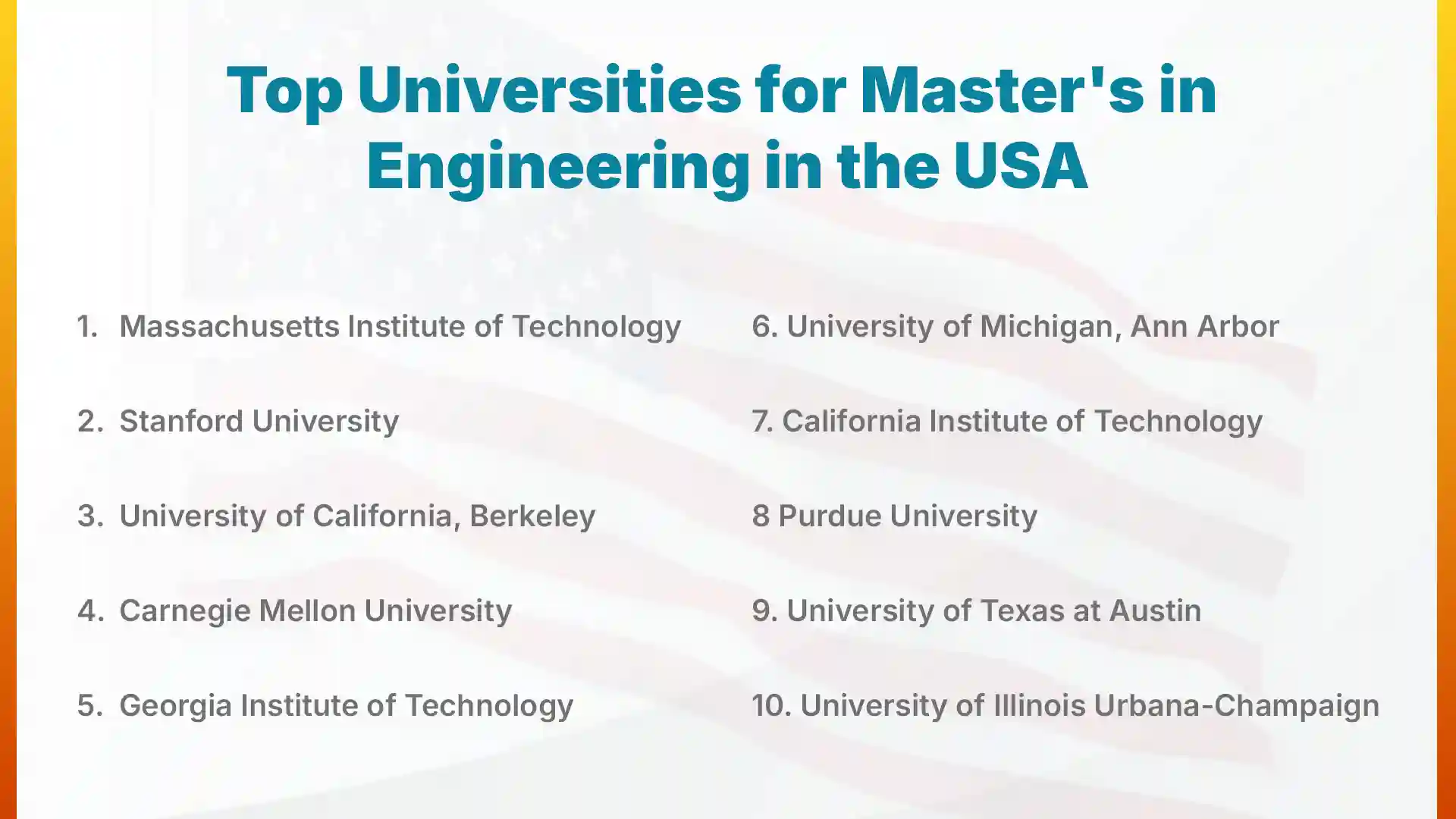
Top Universities for Master's in Engineering in the USA
MIT, Stanford, UC Berkeley, and Carnegie Mellon consistently rank among the top engineering schools, each offering distinct strengths in research, industry connections, and specializations. These institutions combine academic excellence with strong career outcomes and extensive alumni networks.
According to U.S. News & World Report, the following institutions consistently rank among the best for graduate engineering education.
Massachusetts Institute of Technology
MIT is synonymous with engineering innovation, consistently ranking as the world's top engineering school. The program emphasizes interdisciplinary research and collaboration across departments, allowing you to work on projects that span multiple engineering disciplines. MIT's location in the Boston-Cambridge innovation corridor provides unmatched access to startups, established tech companies, and venture capital networks.
Stanford University
Stanford's engineering school benefits from deep ties to Silicon Valley's tech industry, creating a unique ecosystem where academic research and entrepreneurship intersect. Many students secure internships and jobs at leading technology companies while completing their degrees. The university's culture encourages innovation and startup creation, with numerous successful companies founded by Stanford engineering graduates.
University of California, Berkeley
As a top public research university, UC Berkeley offers world-class engineering education at relatively lower tuition compared to private institutions. The school's proximity to San Francisco and Silicon Valley provides excellent industry connections and internship opportunities. Berkeley's engineering programs are particularly strong in electrical engineering, computer science, and civil engineering.
Carnegie Mellon University
Carnegie Mellon is particularly renowned for computer science, robotics, and artificial intelligence programs that consistently rank among the world's best. The university pioneered many foundational concepts in these fields and continues to lead in cutting-edge research. CMU's strong industry partnerships, especially in tech and autonomous systems, create excellent career pathways for graduates.
Georgia Institute of Technology
Georgia Tech provides excellent engineering education with strong industry partnerships, often at more affordable tuition than private universities. The school's cooperative education program allows students to alternate semesters of study with paid industry work experience. Georgia Tech's location in Atlanta provides access to a growing tech hub with lower living costs than coastal cities.
University of Michigan, Ann Arbor
Michigan offers comprehensive engineering programs across virtually every discipline, with extensive research opportunities and state-of-the-art facilities. The university's strong alumni network and industry connections, particularly in automotive and manufacturing sectors, create excellent career prospects. Michigan combines the resources of a large research university with a supportive academic community.
California Institute of Technology
Caltech is small and intensely research-focused, offering close faculty mentorship in intimate academic environments where students work directly with leading researchers. The low student-to-faculty ratio means you'll receive personalized attention and guidance throughout your program. Caltech's emphasis on fundamental research attracts students interested in pushing the boundaries of engineering knowledge.
Purdue University
Purdue's engineering school is one of the largest in the country, offering diverse specializations and strong industry recruitment pipelines across multiple sectors. The university's reputation for producing work-ready engineers makes it a favorite recruiting ground for major corporations. Purdue's relatively affordable tuition and lower cost of living make it an attractive option for value-conscious students.
University of Texas at Austin
UT Austin excels in petroleum, aerospace, and computer engineering, benefiting from Texas's strong energy and technology sectors. The university's location in Austin, a rapidly growing tech hub, provides excellent internship and employment opportunities. UT Austin combines top-tier engineering education with a vibrant city culture and relatively affordable living costs.
University of Illinois Urbana-Champaign
UIUC is a leader in electrical and computer engineering, with programs that consistently rank among the nation's best and produce highly sought-after graduates. The university's research output and industry partnerships create opportunities to work on cutting-edge projects. UIUC's strong reputation among employers, particularly in tech and engineering sectors, translates to excellent career outcomes.
Popular Engineering Master's Programs and Specializations
Computer science, electrical engineering, and data science lead as the most in-demand specializations, driven by tech industry growth and digital transformation across sectors. These fields offer strong job prospects, competitive salaries, and opportunities to work on cutting-edge technologies.
US universities offer specializations across virtually every engineering discipline. Here are the most in-demand fields.
Computer Science and Software Engineering
This remains the most popular specialization, driven by tech industry growth and the increasing digitalization of every sector. Many programs now include tracks in artificial intelligence, machine learning, and cybersecurity, reflecting the skills most valued by employers. The field offers excellent salary prospects and diverse career paths, from software development to systems architecture to technical leadership roles.
Electrical and Electronics Engineering
This field covers semiconductors, telecommunications, and embedded systems, offering strong job prospects in both traditional industries and emerging tech sectors. The specialization provides foundational knowledge applicable across multiple industries, from consumer electronics to aerospace. Electrical engineers remain in high demand as technology becomes increasingly integrated into every aspect of modern life.
Mechanical Engineering
A traditional discipline with modern applications in robotics, manufacturing automation, and sustainable energy systems that address contemporary challenges. Mechanical engineering principles apply across diverse industries, from automotive to aerospace to renewable energy. The field's versatility makes it an excellent choice for students who want to keep their career options open.
Civil and Environmental Engineering
Infrastructure development, sustainability, and environmental systems are growing areas as governments invest in climate-resilient construction and green infrastructure. This specialization addresses critical challenges like aging infrastructure, climate change adaptation, and sustainable urban development. Civil and environmental engineers play crucial roles in shaping the built environment and addressing environmental challenges.
Data Science and Artificial Intelligence
This interdisciplinary field combines engineering with analytics, preparing graduates for roles in tech companies, finance, healthcare, and beyond. The explosive growth of data and AI applications across industries creates exceptional demand for professionals with these skills. Programs typically cover machine learning, statistical modeling, and big data technologies that drive modern business decisions.
Biomedical Engineering
Medical device design and healthcare technology applications make this specialization attractive for students interested in improving human health through engineering innovation. The field combines engineering principles with biological and medical sciences to develop solutions for healthcare challenges. Biomedical engineers work on everything from prosthetics to diagnostic equipment to drug delivery systems.
Admission Requirements for Engineering Master's Programs in the USA
Most programs require a bachelor's degree in engineering or a related STEM field, a competitive GPA (typically 3.0+), English proficiency test scores, and strong letters of recommendation. While requirements vary by university, these core components form the foundation of most engineering master's applications.
Requirements vary by university, but most programs expect the following components.
Academic Qualifications and Minimum GPA
You'll typically need a bachelor's degree in engineering or a related STEM field from an accredited institution to be considered for admission. Competitive programs often expect a GPA of 3.0 or higher on a 4.0 scale, though top-tier universities may have higher expectations. Your undergraduate coursework should demonstrate strong foundations in mathematics, physics, and core engineering principles relevant to your intended specialization.
GRE Score Requirements and GRE-Optional Programs
The GRE (Graduate Record Examination) is a standardized test measuring verbal, quantitative, and analytical writing skills that many programs traditionally require. Many programs have become GRE-optional in recent years, so check each university's current requirements before investing time in test preparation. When required, competitive programs typically expect strong quantitative scores that demonstrate your mathematical and analytical abilities.
IELTS and TOEFL English Proficiency Scores
If English isn't your first language, you'll demonstrate proficiency through IELTS, TOEFL, or similar tests that assess your ability to succeed in an English-language academic environment. Most programs expect IELTS scores of 6.5–7.0 or TOEFL scores of 90–100, though requirements vary by institution. Strong English skills are essential not just for admission but for succeeding in coursework, collaborating with peers, and communicating technical concepts effectively.
Join IELTS Preparation Classes Today!
Letters of Recommendation
Most programs require two to three letters from professors or employers who can speak to your academic abilities and professional potential. Strong recommendations provide specific examples of your technical skills, problem-solving abilities, and potential for graduate-level work. Choose recommenders who know your work well and can provide detailed, personalized assessments rather than generic praise.
Statement of Purpose and Essays
Your statement of purpose (SOP) explains your goals, background, and fit with the program, serving as your opportunity to present your story beyond grades and test scores. This essay often carries significant weight in admissions decisions, as it reveals your motivations, career plans, and how the specific program aligns with your goals. A compelling SOP demonstrates clear thinking, genuine interest in the field, and a realistic understanding of how the program will advance your career.
Relevant Work Experience
Some programs prefer applicants with professional experience, while others welcome fresh graduates, so research each program's typical student profile. Work experience can strengthen your application by demonstrating a practical understanding of engineering challenges and professional maturity. Even internships or research experience can provide valuable material for your application essays and interviews.
- Bachelor's degree: Engineering or related STEM field from an accredited institution
- GPA: Competitive academic record (requirements vary by university)
- GRE scores: Required by some programs; many are now test-optional
- English proficiency: IELTS or TOEFL for non-native speakers
- Recommendations: Two to three letters from academic or professional references
- Statement of Purpose: Essay explaining your goals and program fit
How Much Does a Master of Engineering Cost in the USA
Annual tuition ranges from $30,000-$40,000 at public universities to $50,000-$70,000 at private institutions, with total costs including living expenses typically reaching $60,000-$90,000 per year. Your actual costs depend heavily on the institution type, location, and lifestyle choices.
Tuition and living expenses vary significantly depending on the institution and location.
Tuition Fees at Public Universities
Public universities generally charge lower tuition, especially for in-state students, though these rates rarely apply to international students. International students typically pay higher out-of-state rates that can range from $30,000 to $50,000 annually, depending on the institution. Despite higher international rates, public universities often remain more affordable than private institutions while still offering excellent education quality.
Tuition Fees at Private Universities
Private institutions like MIT, Stanford, and Carnegie Mellon often charge higher annual tuition, typically ranging from $50,000 to $70,000 or more. However, private schools may offer more generous financial aid packages that can significantly reduce your actual costs. The higher sticker price doesn't always mean higher out-of-pocket expenses once scholarships and assistantships are factored in.
Living Expenses by Major City
Your location significantly affects living costs, with expenses varying dramatically between different regions of the country. Cities like San Francisco, New York, and Boston are considerably more expensive than smaller college towns, with rent alone potentially doubling or tripling. Consider the total cost of attendance, not just tuition, when comparing programs in different locations.
Books, Insurance, and Miscellaneous Costs
Health insurance is often mandatory for international students, typically costing $2,000-$3,000 annually if purchased through the university. Books, technology fees, and personal expenses add to your annual budget, though these costs are generally more manageable than tuition and housing. Budget an additional $3,000-$5,000 annually for these miscellaneous expenses to avoid financial surprises.
Scholarships and Financial Aid for Engineering Master's Students
Merit-based scholarships, graduate assistantships, and external funding programs can significantly reduce your costs, with some students receiving full tuition coverage plus stipends. Exploring all funding options early in your application process maximizes your chances of securing financial support.
Funding options can make your degree significantly more affordable.
Merit-Based University Scholarships
Many universities offer scholarships based on academic excellence, test scores, and achievements, recognizing outstanding applicants with financial awards. Awards can cover partial or full tuition, with the most competitive scholarships sometimes including living stipends as well. Apply early and maintain strong academic credentials to maximize your chances of receiving merit-based funding.
Graduate Assistantships and Research Fellowships
Assistantships involve working as a teaching or research assistant in exchange for tuition waivers and monthly stipends that can cover living expenses. Positions are competitive but highly valuable, providing both financial support and professional experience that enhances your resume. Research assistantships also allow you to work closely with faculty on cutting-edge projects, building relationships that can benefit your career.
External Scholarships for International Students
Programs like Fulbright, government scholarships from your home country, and private foundations offer funding for international students pursuing graduate education. These external sources can provide substantial financial support, sometimes covering the full costs of attendance. Research and apply to multiple external scholarships to increase your chances of securing funding.
Employer and Government Sponsorship Options
Some students receive funding from employers or home-country government programs, particularly for fields aligned with national development priorities. Employer sponsorships often come with return-of-service obligations, requiring you to work for the sponsoring organization after graduation. Government scholarships may have similar requirements but can provide comprehensive financial support, including tuition, living expenses, and travel costs.
F-1 Student Visa Requirements for Engineering Students
After receiving admission, you'll need an I-20 form from your university, proof of financial support, and a successful visa interview to obtain your F-1 student visa. The visa process typically takes several weeks to months, so begin immediately after receiving your admission offer.
Securing your student visa is a critical step after receiving admission.
I-20 Form and SEVIS Registration Process
After admission, your university issues an I-20 form, the official document confirming your enrollment and eligibility for F-1 student status. You'll then register in SEVIS (Student and Exchange Visitor Information System) and pay the SEVIS fee before scheduling your visa interview. Keep your I-20 safe, as you'll need it throughout your studies and for any travel outside the United States.
Financial Documentation and Bank Statements
You'll prove you can fund your education and living expenses through bank statements, scholarship letters, or sponsor affidavits that demonstrate sufficient financial resources. Visa officers want assurance that you can complete your program without financial hardship or unauthorized employment. Prepare clear, organized financial documentation showing funds covering at least your first year of study.
Visa Interview Preparation Tips
During your visa interview, be prepared to explain your study plans, funding sources, and ties to your home country in a clear and confident manner. Visa officers assess whether you're a genuine student with legitimate educational goals and intent to return home after your studies. Practice articulating your academic interests, career plans, and reasons for choosing your specific program and university.
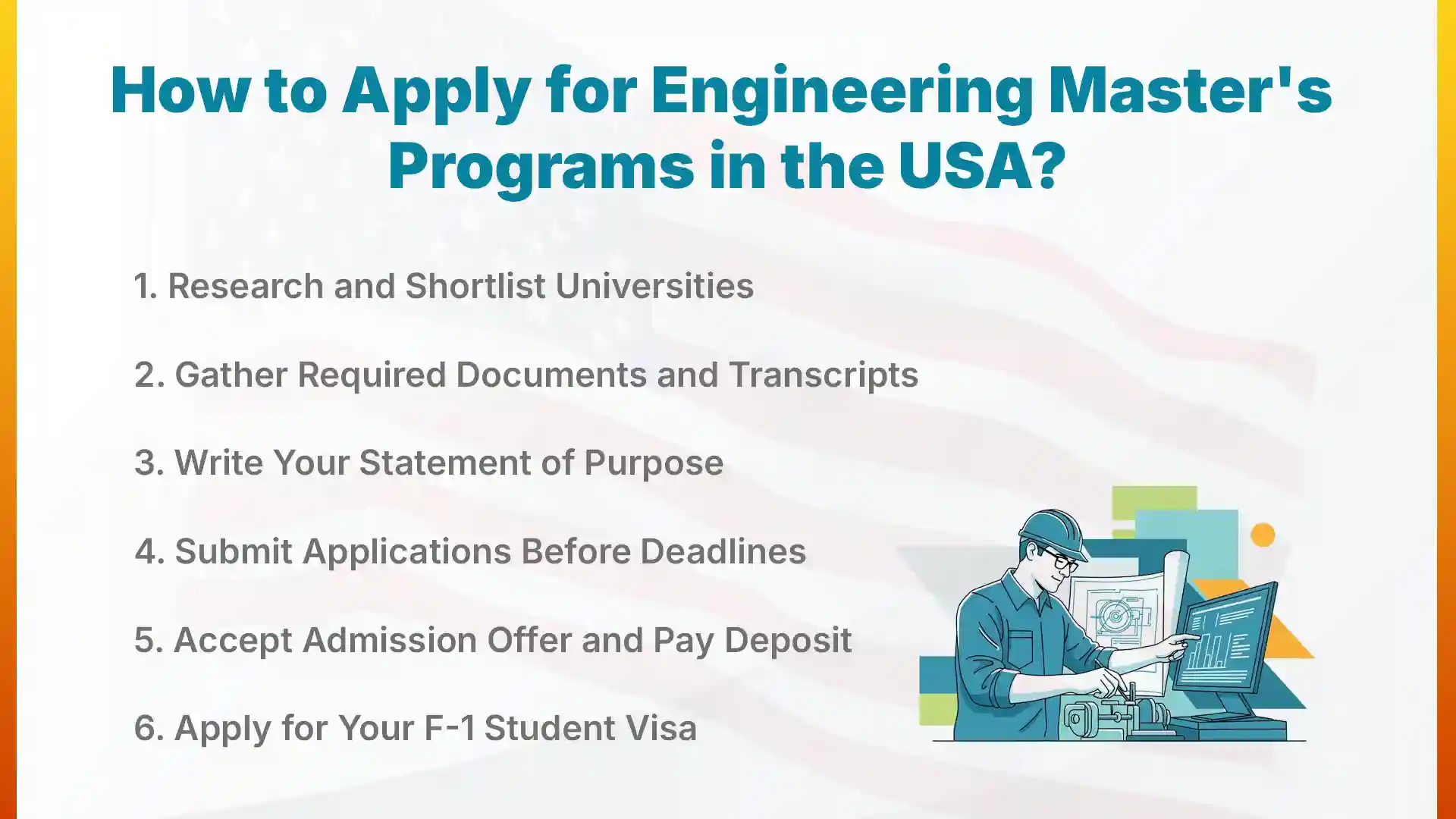
How to Apply for Engineering Master's Programs in the USA
Start by researching and shortlisting 6-10 universities, then gather required documents, write tailored statements of purpose, and submit applications before deadlines. A systematic approach helps you manage multiple applications while maintaining quality across all materials.
Following a structured approach helps you stay organized throughout the application process.
1. Research and Shortlist Universities
Use rankings, program fit, location, and funding options to narrow your list to 6–10 schools that align with your academic profile and career goals. Consider a mix of reach, match, and safety schools to maximize your chances of admission while pursuing your top choices. Research each program's specializations, faculty expertise, and career outcomes to ensure they match your interests and aspirations.
2. Gather Required Documents and Transcripts
Collect academic records early and get transcripts evaluated if your university uses a different grading system than the US 4.0 scale. Request official transcripts from your undergraduate institution, allowing several weeks for processing and delivery. Organize all required documents systematically to avoid last-minute scrambling as deadlines approach.
3. Write Your Statement of Purpose
Craft a compelling essay highlighting your goals, relevant experience, and fit with each program, demonstrating clear thinking about your academic and career trajectory. Tailor your SOP for each application, referencing specific faculty, research areas, or program features that attract you to that particular university. Strong statements of purpose tell a coherent story about your background, motivations, and future plans while showing genuine enthusiasm for the field.
4. Submit Applications Before Deadlines
Most programs have Fall deadlines between December and February, with earlier submission sometimes providing advantages in rolling admissions processes. Spring deadlines typically fall in September or October, offering an alternative entry point if you missed Fall deadlines or need more preparation time. Create a spreadsheet tracking all deadlines, requirements, and submission status to ensure nothing falls through the cracks.
5. Accept Admission Offer and Pay Deposit
Once admitted, confirm your spot by paying the enrollment deposit before the deadline, which secures your place in the incoming class. Review all admission materials carefully, including information about orientation, housing, and next steps. Compare offers from multiple universities if you're fortunate enough to have choices, considering factors beyond just rankings.
6. Apply for Your F-1 Student Visa
After receiving your I-20, gather your F-1 visa documents and begin the application process promptly to allow time for processing. Schedule your visa interview as early as possible, as appointment availability can be limited during peak seasons. Prepare thoroughly for your interview by practicing responses to common questions and organizing your supporting documents.
Fall vs Spring Intake for Engineering Master's Programs
Fall intake (August/September) offers more program options, larger cohorts, and greater scholarship availability, making it the preferred choice for most students. Spring intake (January) serves as an alternative for students who missed Fall deadlines or need additional preparation time.
Fall intake (August/September): Larger cohort, more program options, more scholarship availability
Spring intake (January): Smaller cohort, fewer programs available, good for students who missed Fall deadlines
Most students prefer the fall intake because of greater program availability and funding opportunities.
Career Outcomes After Your Engineering Master's Degree
Engineering master's graduates enjoy strong career prospects with access to three years of US work authorization through STEM OPT, high starting salaries, and opportunities across tech, aerospace, automotive, and energy sectors. Your degree opens doors to advanced technical roles, leadership positions, and specialized career paths.
OPT and STEM OPT Work Authorization
Engineering graduates qualify for 12 months of OPT plus an additional 24-month STEM extension, allowing up to three years of work authorization in the USA. This extended period provides substantial time to gain professional experience, build your network, and potentially transition to H-1B visa sponsorship. The three-year work authorization is one of the most valuable benefits of pursuing engineering education in the United States.
High-Demand Engineering Sectors in the USA
Tech, aerospace, automotive, healthcare technology, and energy sectors actively recruit engineering master's graduates for roles ranging from technical positions to project management. The digital transformation of industries creates a growing demand for engineers who can bridge technical expertise with business understanding. Emerging fields like artificial intelligence, renewable energy, and biotechnology offer particularly strong growth prospects.
Average Starting Salaries for Engineering Graduates
Engineering master's holders typically earn higher starting salaries than bachelor's degree holders, with compensation varying by field and location. Software engineers and data scientists often command the highest salaries, particularly in tech hubs like Silicon Valley and Seattle. Even in more traditional engineering disciplines, master's degrees provide salary premiums and faster career advancement compared to bachelor 's-level positions.
How SAS Education Consultancy Helps You Study Engineering in the USA
SAS Education Consultancy provides personalized counseling to help you identify programs matching your profile, prepare competitive applications, and navigate the visa process with confidence. From university selection through visa approval, the consultancy supports you at every step of your journey to studying engineering in the USA.
Navigating the application process for US engineering programs can feel overwhelming when you're managing test preparation, university selection, and visa requirements simultaneously.
Through UniFinder, you can explore university options systematically. The consultancy's test preparation hub helps you achieve competitive IELTS scores, while application support ensures your documents present your strongest case. Visa guidance helps you approach your F-1 interview with confidence.