Which is the Best GRE Class in Kathmandu?

Nov 27, 2025

Thinking about applying to top graduate programs abroad? The GRE (Graduate Record Examination) is one of the most important steps on that journey. Universities in the USA, Canada, and many other countries rely on GRE scores to assess candidates for master’s programs and scholarships.
For Nepali students, preparing for the GRE can feel challenging. The math questions can be tricky, verbal reasoning requires careful strategy, and the Analytical Writing section often catches students off guard. Without structured guidance, self-study can be stressful, inefficient, and sometimes overwhelming.
That’s why choosing the right GRE classes matters. In this guide, we cover everything you need to know, from understanding the exam to choosing the best GRE institute in Nepal, checking fees, and applying effective preparation strategies to improve your score.
In this blog
What Is GRE and Why Is It Important?
The GRE (Graduate Record Examination) is a test that many universities around the world, especially in the USA and Canada, use to see if a student is ready for graduate studies. It checks how well you can think, reason, and solve problems. The exam helps schools understand if you have the skills needed for tough academic work and can succeed in a graduate program.
The GRE measures three main skills:
1. Verbal Reasoning
This evaluates your ability to understand, analyze, and interpret written material. It tests vocabulary, reading comprehension, and logical reasoning in context. Strong verbal skills help you perform well in coursework, presentations, and research tasks during graduate studies.
2. Quantitative Reasoning
This section assesses your problem-solving skills and basic mathematics knowledge, including algebra, geometry, and data analysis. It measures how well you can interpret quantitative information, solve real-world problems, and think critically with numbers.
3. Analytical Writing
This part examines your ability to express ideas clearly and coherently in writing. It focuses on forming logical arguments, analyzing issues, and communicating effectively. These skills are vital for research, thesis writing, and academic communication.
Nepali students aiming for top universities must perform well in all three sections to remain competitive. Your GRE score doesn’t just influence admissions; it can also affect scholarship opportunities, assistantships, and sometimes visa applications.
Join the Best GRE Preparation Classes Today!
Which is the Best GRE Institute in Kathmandu?
SAS Education Consultancy is one of the top GRE coaching centres in Kathmandu. Their lessons are simple and easy for Nepali students to understand. Small classes and regular practice tests help students learn faster. Teachers give support and tips so students feel ready and confident for the GRE. Choosing the right one means matching your learning style, schedule, and preparation goals with what the institute offers.
Why SAS Education Consultancy is a Top GRE Coaching Center
SAS Education Consultancy is one of the well-known options for GRE preparation in Kathmandu for its experienced instructors, structured curriculum, and student-focused approach. However, the best institute really depends on what you are looking for. These are the factors that make SAS’s GRE Classes the top choice for Nepalese students:
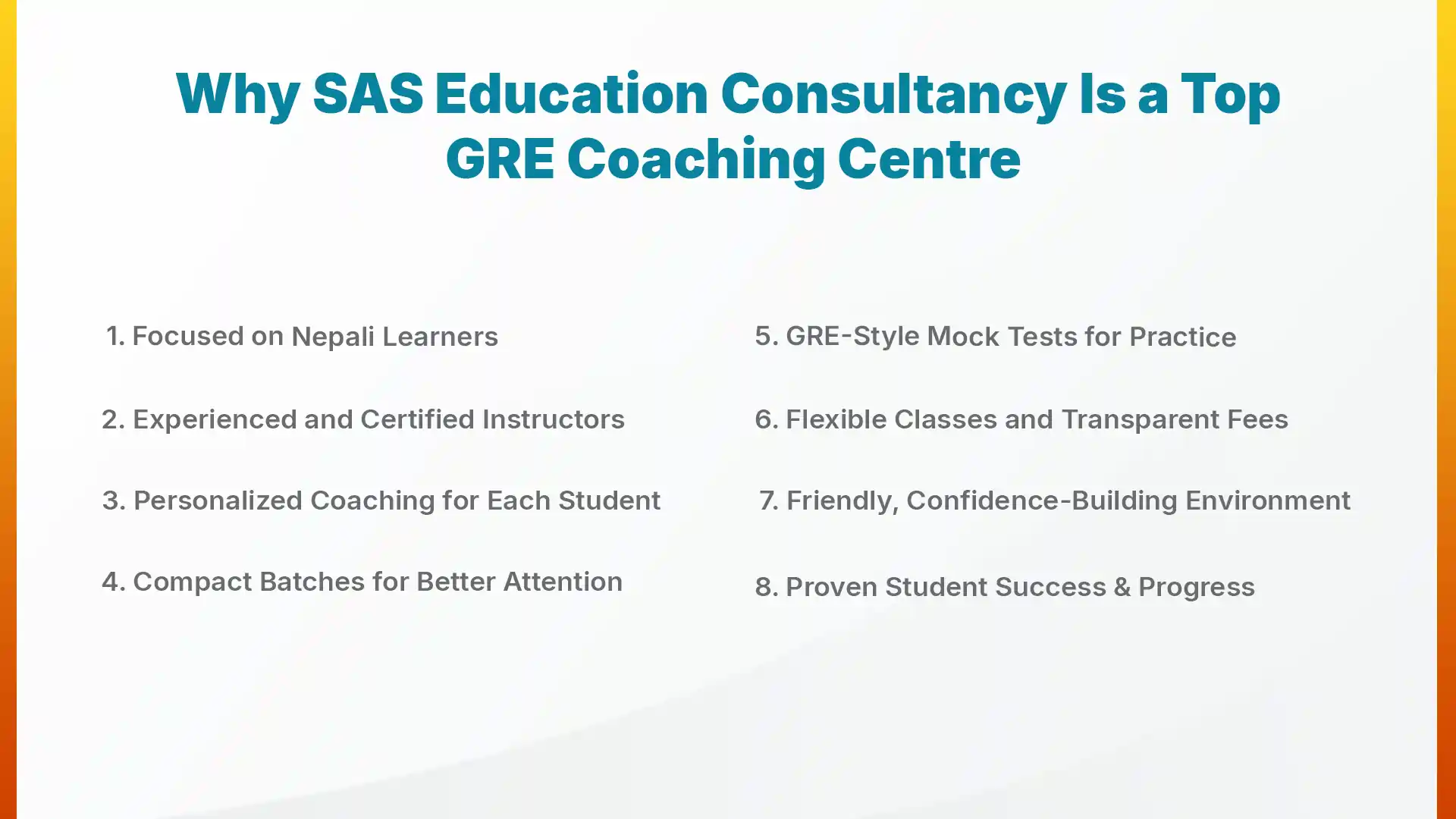
1. Focused on Nepali Learners
Lessons are designed to address the common challenges Nepali students face in the GRE, making learning simpler and more effective. The examples and exercises often relate to situations you can understand easily. This makes complex concepts like quantitative reasoning or analytical writing much easier to grasp. Students feel less overwhelmed and more confident as they progress.
2. Experienced and Certified Instructors
Trainers are certified and have extensive experience guiding students through the GRE. They provide strategies that go beyond basic teaching and are tailored to each student’s needs. Their experience helps in anticipating common mistakes and providing shortcuts to tackle tough questions. You benefit from proven methods that save time and improve scores.
3. Personalized Coaching for Each Student
Progress is tracked closely, and students receive individual feedback on verbal, quantitative, and writing skills. Trainers suggest improvements and create strategies to help you strengthen weak areas. Every student gets attention according to their pace, so no one gets left behind. This ensures consistent improvement across all GRE modules.
4. Compact Batches for Better Attention
Small class sizes allow students to get more individual attention and ask questions freely. This ensures concepts are understood clearly, and mistakes are corrected quickly. Interaction with the trainer is easier, and students can discuss doubts without hesitation. Learning in a smaller group also motivates you to stay focused and participate actively.
5. GRE-Style Mock Tests for Practice
Regular mock tests replicate real GRE conditions and help students experience exam timing and pressure. After each test, detailed analysis highlights where to improve and refine strategies. Students also learn time management techniques that are critical on test day. The feedback helps in developing a clear plan for the next set of practice sessions.
6. Flexible Classes and Transparent Fees
Options are available for morning, evening, or weekend classes, making it easier to fit preparation into your schedule. The fee structure is clear and competitive, ensuring quality coaching without unnecessary stress. Students can choose courses that fit their pace and budget without compromising on content. This flexibility reduces last-minute pressure and allows consistent learning.
7. Friendly, Confidence-Building Environment
Students are encouraged to ask questions, discuss strategies, and practice without hesitation. A supportive environment builds confidence, which can make a significant difference in performance. Trainers create a safe space for mistakes, helping learners improve faster. It also makes long study hours more enjoyable and less stressful.
8. Proven Student Success and Progress
Many students from SAS have achieved high GRE scores and gained admission to top universities abroad. The institute tracks results and continuously refines its teaching methods to maintain high success rates. Past students’ progress stories inspire new learners and set a benchmark for what is achievable. This also gives students a clear roadmap for their preparation journey.
Planning to Take the GRE Soon?
Get expert help with classes, mock tests, and university guidance. Start preparing the right way and move one step closer to your graduate study goals.
How to Choose the Best GRE Institute in Kathmandu?
Choosing the right GRE institute can make a big difference in your preparation and final score. The best institute depends on your goals, learning style, and schedule. Here’s a simple guide to help Nepali students pick wisely.
1. Check Trainer’s Credentials
Look for certified and experienced GRE trainers who know the exam inside out. Trainers familiar with common Nepali student challenges can explain tricky concepts clearly. Good teachers provide practical tips that save time and boost confidence.
2. Prioritize Realistic Mock Tests
Regular mock tests under timed conditions are crucial. They help you practice like the real GRE and identify areas for improvement. Institutes offering detailed feedback after each test give you a clear path to improve.
3. Consider Class Size
Smaller classes allow trainers to focus on each student. You get personal attention, can ask questions freely, and fix weak areas faster. Large classes often make it harder to track your progress.
4. Evaluate Study Materials
Check that the institute provides updated books, practice questions, and online resources. Materials should cover Verbal, Quantitative, and Analytical Writing sections. Extra tools like video lessons or formula sheets are a bonus.
5. Review Past Student Performance
Look at the results from previous batches to see if their teaching works. Alumni reviews can give you insights into the learning experience. Consistent success shows the institute has a proven method.
6. Decide Between Online and Offline
Choose the format that fits your schedule and learning preference. Online classes offer flexibility, while offline classes give more interaction. Some institutes also provide hybrid options for convenience.
7. Understand Fees Clearly
Know what the fees include. Ask if they provide study materials and mock tests apart from classes. Ask about extra charges for workshops or one-on-one sessions. A clear understanding avoids surprises later and helps you plan your budget.
How Much Do GRE Classes Cost in Kathmandu?
GRE preparation in Kathmandu comes with different price ranges depending on the institute, course type, and included resources. On average, standard GRE classes range from NPR 30,000 to NPR 60,000 for a full course, which usually covers all three sections: Verbal, Quantitative, and Analytical Writing. Some institutes include additional study materials, extra mock tests, or personalized coaching, which may slightly increase the fee.
1. Average GRE Class Fee Range (Updated 2026)
Most reputable GRE institutes in Kathmandu charge between NPR 30,000 and NPR 60,000 for a complete preparation course. Short-term or fast-track classes may cost less, while premium packages with personal coaching or extensive materials can go higher.
A typical GRE course fee generally covers classroom sessions, study guides, and a set of mock tests. Many institutes also provide online resources, formula sheets, and access to previous GRE questions. These inclusions help students practice effectively without needing extra materials.
2. GRE Exam Fee in Nepal
Apart from preparation classes, students also need to account for the official GRE exam fee. The GRE General Test registration fee in Nepal is currently USD 220 (approximately NPR 31,000), which covers sending scores to up to four universities. Additional score reports, rescheduling, or changing test centers may incur extra charges. Being aware of these costs helps students plan their budget and avoid last-minute surprises.
3. Extra Charges
Some institutes may charge separately for extra workshops, additional mock tests, or one-on-one tutoring. Always clarify these costs before enrolling to avoid surprises. Transparent fee structures help students plan their budget and focus fully on preparation.
How Long Does GRE Preparation Take?
Most students need about 8 to 12 weeks to prepare for the GRE. This timeframe gives you enough time to practice each section separately (Verbal, Quantitative, and Analytical Writing) without rushing. It also helps ensure steady, balanced progress across all areas. The exact time, however, may vary. Some students take longer than 12 weeks, while others score well even within a shorter preparation span.
The typical GRE preparation period ranges from 8 to 12 weeks, depending on your current skill level and target score. Students with weaker math or verbal skills, or those who haven’t practised standardised tests recently, may need longer preparation. Whatsoever, students with a strong English and math foundation, or those retaking the exam to improve their score, can often finish in a shorter timeframe. Taking regular mock tests helps determine the right preparation length and ensures you are ready for the actual exam.
Who Needs to Prepare Longer for GRE?
Students with weaker math or verbal skills, first-time test-takers, or those who haven’t practiced standardized tests recently may need extra weeks. Additional preparation helps strengthen fundamentals, improve test strategies, and build confidence. Taking more time ensures you are ready for the exam without stress.
Who Can Finish GRE Preparation Faster?
Students with a strong background in English and math, or those who study consistently every day, can complete preparation in a shorter period. Retakers who only need to address specific weak points often require less time. Efficient daily practice and focused review can make shorter timelines effective.
Mock tests are the best way to gauge your readiness. They show where you are improving and what still needs work. Regular practice tests also help you get used to the exam format and timing, reducing anxiety on the real test day.
GRE Preparation Tips for Faster Improvement
To prepare for the GRE, you need a clear plan, consistent practice, and strategies for each section. Focusing on all three parts: verbal, quantitative, and analytical writing, while practising real test questions, will give you the best results. Reviewing mistakes and managing your time wisely can boost your score faster and with less stress.
1. Build a Consistent Study Routine
Consistency is key when preparing for the GRE. Set aside specific hours every day for study and stick to them. Short, regular study sessions are often better than long, irregular ones. A steady routine keeps your mind fresh and helps you retain what you learn.
2. Focus on Verbal, Quant, and Writing Equally
All three sections of the GRE are important for your overall score. Don’t just focus on your strongest area. Spend enough time on weaker sections to balance your skills. Regularly rotate between verbal, math, and writing practice so no area is neglected.
3. Practice Real GRE Questions, Not Random Exercises
Using real GRE questions is the best way to prepare. Random exercises may help practice skills, but don’t reflect the actual test format. Practice questions from official sources or past tests. This helps you understand question patterns and improves your confidence on test day.
4. Review Mistakes With a Trainer
Going over mistakes is more important than doing many questions. A trainer can point out where you went wrong and suggest better strategies. Take notes on repeated mistakes and work specifically on those areas. This makes your practice much more effective.
5. Use Time Management Techniques
Managing time during the test is crucial. Practice completing questions within the allotted time for each section. Learn when to move on from a question if it takes too long. Good time management ensures you can answer all questions and reduce last-minute stress.
Conclusion
Choosing the right GRE institute can feel overwhelming, but it really depends on what matters most to you. Quality of teaching, personalised guidance, flexible schedules, and a supportive learning environment are all key factors. Reputed education and visa consultants like SAS Education Consultancy stand out for their certified trainers, structured step-by-step classes, small batches, and student-focused approach.
In short, the best GRE class is the one that matches your learning style, goals, and schedule. For many Nepali students, SAS Education Consultancy provides a complete approach that makes GRE preparation less stressful, more effective, and clearly directed toward achieving your study abroad dreams. Your GRE journey begins with the right institute, and with careful planning, consistent practice, and the right guidance, a high score is entirely achievable.