Master’s Degree in USA For International Students

Mar 24, 2026
Ever wondered why so many students dream of studying in the USA, and whether it’s really worth the time, money, and effort? From world-ranked universities to global career opportunities, the idea sounds exciting but also a bit overwhelming. Choosing the right course, understanding costs, and preparing documents, it can feel like solving a puzzle with too many pieces (and no clear starting point).
In this blog, we’ll walk you through everything about a Master’s Degree in USA for International Students, from top courses, eligibility, and costs to scholarships, visa process, and career opportunities. Whether you’re just exploring or already planning your application, this guide will help you make informed decisions with clarity and confidence as you plan to study in USA.
In this blog
Why USA Is Top Choice for a Master’s Degree for International Students?
USA is a top choice for a master’s degree because it offers world-class education, diverse program options, strong career opportunities, and global exposure. Students benefit from advanced learning systems, practical experience, and access to leading industries. The combination of academic excellence and career prospects clearly shows why study in USA is a popular decision among international students. It’s not just about studying, it’s about building a global future.
1. Globally Ranked Universities and Education Quality
The USA is home to some of the world’s top-ranked universities known for their high academic standards. These institutions offer cutting-edge research facilities and experienced faculty. Degrees from US universities are recognized globally, increasing career opportunities. Students also get exposure to innovative teaching methods. This ensures both theoretical knowledge and practical skills.
2. Wide Range of Specialized Master’s Programs
US universities offer a wide variety of master’s programs across different fields and specializations. Students can choose courses tailored to their career goals and interests. Interdisciplinary programs allow flexibility and skill diversification. This makes it easier to align education with future job demands. You’re not stuck in one rigid path.
3. OPT & CPT Work Opportunities After Graduation
Programs like CPT (Curricular Practical Training) and OPT (Optional Practical Training) allow students to gain real work experience. Students can work during or after their studies in their field of interest. This improves employability and helps build a strong resume. It also allows students to earn while learning. Practical exposure is a big advantage here.
4. High Salary and Career Growth Potential
Graduates from US universities often have access to high-paying job opportunities globally. Industries value US degrees due to their quality and relevance. Career growth prospects are strong, especially in fields like technology, business, and healthcare. Many students secure jobs soon after graduation. It’s an investment that often pays off well.
5. Multicultural Environment and Global Exposure
The USA offers a diverse and multicultural environment with students from all over the world. This helps in building global networks and cultural understanding. Students learn to adapt to different perspectives and environments. It also enhances personal growth and communication skills. You don’t just study, you experience the world.
What Are the Best Master’s Courses in USA for International Students?
The best master’s courses in the USA for international students are those that offer strong career prospects, high demand in the job market, and global recognition. Fields like technology, business, engineering, and healthcare dominate due to their excellent salary potential and job opportunities. Choosing the right course depends on your interests, career goals, and plans, often building on your bachelor's degree in USA or equivalent qualification. The USA offers flexibility, allowing students to specialize deeply or even switch fields. In short, the “best” course is the one that aligns with both passion and market demand.
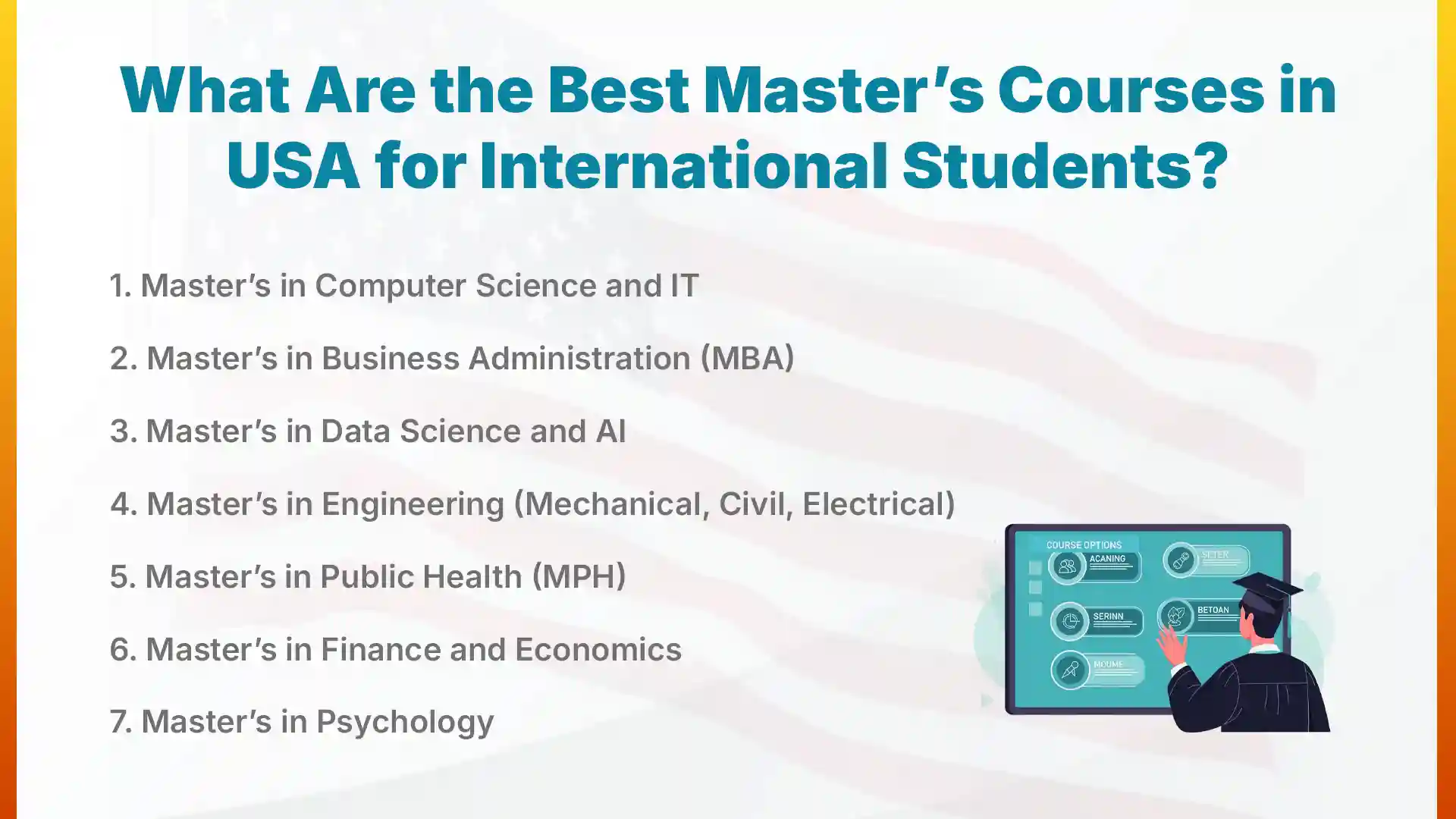
1. Master’s in Computer Science and IT
This is one of the most popular and high-demand courses in the USA. It covers areas like software development, cybersecurity, and cloud computing. Graduates have access to top tech companies and high-paying roles. The demand for IT professionals continues to grow globally. It’s ideal for students looking for strong career stability and growth. It also offers excellent opportunities for innovation and research.
2. Master’s in Business Administration (MBA)
An MBA in the USA offers leadership, management, and business strategy skills. It is highly valued by employers worldwide and opens doors to managerial roles. Many programs offer networking opportunities and internships. It is especially beneficial for those with some work experience. It’s a great choice for future business leaders. It also helps build strong global professional connections.
3. Master’s in Data Science and AI
With the rise of big data and artificial intelligence, this field is booming. Students learn data analysis, machine learning, and AI technologies. Companies across industries are actively hiring data professionals. It offers excellent salary packages and global opportunities. This is one of the fastest-growing career paths today. It also provides strong long-term career security.
4. Master’s in Engineering (Mechanical, Civil, Electrical)
Engineering programs in the USA are known for their practical and research-based approach. Students can specialize in various fields based on their interests. These degrees are highly respected and offer strong job prospects. Many programs also include internships and industry exposure. It’s ideal for students with technical backgrounds. It also opens doors to global engineering careers.
5. Master’s in Public Health (MPH)
Public Health focuses on healthcare systems, epidemiology, and global health challenges. It is a great option for students interested in healthcare and social impact. Graduates can work in hospitals, NGOs, or international organizations. The demand for public health professionals has increased globally. It offers both purpose and career stability. It also allows you to contribute to global health improvement.
6. Master’s in Finance and Economics
This program is ideal for students interested in banking, investment, and financial markets. It provides strong analytical and decision-making skills. Graduates can work in corporate finance, investment firms, or financial institutions. The USA offers excellent exposure to global financial systems. It’s a solid choice for high-paying careers. It also builds strong financial and analytical expertise.
7. Master’s in Psychology
Psychology programs in the USA cover areas like clinical, counseling, and organizational psychology. It is suitable for students interested in human behavior and mental health. Graduates can work in healthcare, education, or corporate sectors. The field is growing, especially in mental health awareness. It combines both science and human understanding. It also opens pathways for research and specialized careers.
Eligibility Requirements for a Master’s Degree in USA for International Students
To apply for a Master’s Degree in USA for International Students, you need to meet certain academic, language, and documentation requirements set by universities. While exact criteria may vary by institution and program, most universities follow a similar structure. These requirements to study in USA ensure that students are academically prepared and capable of handling advanced studies. Understanding them early can save you a lot of last-minute stress (and trust me, there’s already enough of that during applications).
1. Bachelor’s Degree and Academic GPA Requirements
You must have a completed bachelor’s degree from a recognized institution. Most US universities require a minimum GPA, usually around 2.5 to 3.5 on a 4.0 scale. Competitive programs may have higher GPA expectations. Your academic background should also be relevant to the chosen master’s program. Strong grades improve your chances of admission significantly. It forms the foundation of your entire application.
2. English Language Tests (IELTS / TOEFL / Duolingo)
International students must prove English proficiency through tests like IELTS, TOEFL, or Duolingo. Each university sets its own minimum score requirements. This ensures you can understand lectures, participate in discussions, and complete assignments effectively. Higher scores can strengthen your application. Some universities may waive this if your previous education was in English. It plays a key role in your admission eligibility.
3. GRE / GMAT Requirements (Optional or Required)
Some universities require standardized tests like GRE or GMAT, especially for technical and business programs. However, many universities have made these tests optional in recent years. A good score can enhance your profile, especially for competitive universities. It shows your analytical and problem-solving skills. Always check the specific requirements of your chosen program. A strong score can give you an extra edge.
4. Work Experience (For MBA and Some Programs)
Work experience is often required for MBA programs and some specialized master’s degrees. It helps demonstrate practical knowledge and leadership potential. Typically, 1-3 years of experience is preferred. For other programs, work experience may not be mandatory, but can still add value. It strengthens your overall application. It also shows your readiness for advanced studies.
5. Required Documents (SOP, LOR, Resume, Transcripts)
You need to submit essential documents such as Statement of Purpose (SOP), Letters of Recommendation (LOR), academic transcripts, and a resume. These documents highlight your academic background, goals, and achievements. A strong SOP can make a big difference in your application. LORs add credibility through third-party recommendations. Together, these documents tell your complete story to the university. They play a crucial role in final admission decisions.
What Is the Duration of a Master’s Degree in the USA?
The duration of a master’s degree in the USA is typically between 1 to 2 years, depending on the program, specialization, and university. Some courses are designed to be completed quickly, while others may take longer due to research or internships. The flexibility of the US education system allows students to choose programs that match their pace and career goals. Duration can also vary based on whether the program is STEM or non-STEM. Overall, students have multiple options to plan their academic timeline.
1. Standard 1–2 Year Master’s Programs
Most master’s programs in the USA are designed to be completed within 1 to 2 years. Coursework-based programs usually take around 12–18 months, while thesis-based programs may take up to 2 years. This structure allows students to gain in-depth knowledge within a short period. It also helps reduce overall study costs compared to longer programs. Many universities offer flexible course loads to suit student needs.
2. STEM vs Non-STEM Program Duration
STEM programs (Science, Technology, Engineering, Mathematics) may take slightly longer due to technical coursework and research components. They also offer extended OPT opportunities, which is an added advantage. Non-STEM programs are often shorter and more focused on coursework. The duration difference is usually not huge but depends on program structure. Choosing between them depends on your career goals.
3. Fast-Track and Accelerated Programs
Some universities offer accelerated master’s programs that can be completed in less than a year. These programs are intensive and require a higher academic workload. They are ideal for students who want to save time and enter the job market. However, they may offer limited flexibility compared to standard programs. Still, they are a great option for highly motivated students.
Total Cost of Master’s Degree in USA for International Students
The total cost of a Master’s Degree in USA for International Students typically ranges between $50,000 to $80,000 per year, depending on the university, location, and lifestyle. For a full 2-year program, students may spend around $100,000 to $160,000 in total. Tuition fees make up the largest portion, followed by living expenses and other costs. Planning your budget carefully is very important before applying. Because let’s be honest, studying in the USA is an investment, not just an expense.
1. Tuition Fees by University Type (Public vs Private)
Tuition fees vary significantly depending on whether you choose a public or private university. Public universities usually cost around $20,000 to $40,000 per year for international students and are relatively more affordable. Private universities, on the other hand, can range from $35,000 to $60,000+ annually, though they may offer better scholarships. Professional programs like MBA can go even higher, sometimes exceeding $70,000 per year. Choosing the right university can greatly impact your total cost. It’s always a balance between budget and value.
2. Living Expenses in USA (City-Based Comparison)
Living costs in the USA can range from $1,500 to $2,500 per month, depending on the city and lifestyle. High-cost cities like New York or San Francisco can cost $29,000–$37,000 annually, while moderate cities like Chicago or Miami may cost around $21,000–$31,000. Budget-friendly cities like Houston or Pittsburgh can be as low as $10,000–$24,000 per year. Your lifestyle choices also play a big role in expenses. Smart budgeting can help you save a lot here.
3. Health Insurance and Student Fees
Health insurance is mandatory for international students in the USA. University plans typically cost between $1,800 to $4,800 per year, while private options may range from $1,500 to $3,500. In addition, universities charge student fees of around $450 to $1,600 per semester. These fees cover services like student activities, technology, and health facilities. Though often overlooked, these costs add up quickly. It’s important to include them in your budget.
4. Additional Costs (Visa, SEVIS, Flights, Books)
There are several additional costs that students often underestimate. The F-1 visa fee is $185, and the SEVIS fee is $350. Flights to the USA can cost around $1,000 to $1,500, depending on timing. Books and study materials may cost $900 to $2,000 per year. Standardized tests like GRE/GMAT can add another $220 to $300 per attempt. These small costs may seem minor, but together they make a noticeable difference.
Scholarships for Master’s Degree in USA for International Students
Scholarships for a Master’s Degree in USA for International Students help reduce the financial burden and make studying more affordable. Many universities, governments, and private organizations offer funding options based on merit, need, or specific criteria. These scholarships in USA can cover tuition, living expenses, or both. The key is to research early and apply on time, because competition can be quite high. A good scholarship can make a huge difference in your study journey.
1. University-Based Scholarships
Many US universities offer scholarships directly to international students based on academic performance and achievements. These can be partial or fully funded depending on the program and institution. Some are automatically considered during admission, while others require separate applications. They help reduce tuition costs significantly. Top universities often provide strong merit-based funding opportunities.
2. Government Scholarships (Fulbright, etc.)
Government-funded scholarships like the Fulbright Program are among the most prestigious options. These scholarships often cover tuition, living expenses, travel, and insurance. They are highly competitive and require strong academic and leadership profiles. Many countries also have their own scholarship partnerships with the USA. These programs are ideal for students looking for full financial support.
3. Assistantships (TA/RA Opportunities)
Teaching Assistantships (TA) and Research Assistantships (RA) allow students to work part-time while studying. In return, they receive stipends, tuition waivers, or both. These opportunities are common in research-based programs. They also provide valuable academic and professional experience. It’s like earning while learning, and gaining skills at the same time.
4. External and Private Scholarships
Various private organizations, foundations, and NGOs offer scholarships for international students. These can be based on academic merit, field of study, or financial need. While they may not always cover full costs, they still provide valuable financial support. Students often combine multiple scholarships to reduce expenses. Exploring different options increases your chances of funding.
Student Visa Process for USA (F-1 Visa Guide)
The F-1 visa process is a crucial step for international students planning to study in the USA. It involves multiple stages, from securing admission to attending a visa interview. While the process may seem complicated at first, it becomes manageable if followed step by step. Proper preparation and documentation are key to a successful visa approval. Getting this right is just as important as getting your university admission.
1. I-20 Form and University Admission
The I-20 form is issued by the university after you receive your admission offer. It confirms your acceptance and includes important details like your program and estimated cost. You need this document to apply for an F-1 visa. Make sure all information is accurate before proceeding. It is one of the most important documents in the visa process.
2. SEVIS Fee Payment Process
After receiving the I-20, you must pay the SEVIS (Student and Exchange Visitor Information System) fee. This fee is mandatory and currently costs around $350. It registers you in the US student tracking system. Keep the payment receipt safe, as it is required for your visa interview. Without this step, you cannot proceed further.
3. DS-160 Form and Visa Application
The DS-160 is an online visa application form that you must fill out carefully. It requires personal, academic, and travel information. Once completed, you will receive a confirmation page. This confirmation is necessary for scheduling your visa interview. Accuracy is very important here, small mistakes can cause delays.
4. Visa Interview Preparation Tips
The visa interview is the final and most important step in the process. You will be asked about your study plans, university choice, and future goals. Confidence and honesty are key during the interview. Prepare answers in advance and carry all required documents. A well-prepared interview greatly increases your chances of approval.
5. Financial Documents and Proof of Funds
You must show proof that you can afford your education and living expenses in the USA. This includes bank statements, sponsor letters, or scholarship documents. The amount should match or exceed what is mentioned in your I-20 form. Proper financial proof builds trust with the visa officer. It shows that you are financially prepared for your studies.
Best Universities in USA for Master’s Degree Programs
USA is home to some of the world’s best universities offering top-quality master’s programs across various fields. These universities are known for their academic excellence, research opportunities, and strong global reputation. Choosing the right university depends on your budget, course preference, and career goals. From elite Ivy League institutions to affordable public universities, there are many best universities in USA to choose from for every type of student. The key is finding the right balance between quality and cost.
1. Top Ivy League Universities
Ivy League universities like Harvard, Yale, and Princeton are among the most prestigious institutions in the world. They offer world-class faculty, advanced research facilities, and strong global recognition. Admission is highly competitive, but the career opportunities after graduation are exceptional. These universities also provide generous scholarships and networking opportunities. Studying here can significantly boost your career prospects.
2. Leading Public Universities in USA
Public universities like the University of California, University of Texas, and University of Michigan offer high-quality education at relatively lower costs. They are well-known for their strong academic programs and research output. These universities attract a large number of international students. They also offer diverse courses and campus experiences. It’s a great option for students seeking quality education with better affordability.
3. Affordable Universities for International Students
Several universities in the USA offer affordable tuition fees without compromising on education quality. These institutions are ideal for students with budget constraints. They may also provide scholarships or financial aid options. Choosing an affordable university can reduce financial pressure significantly. It allows students to focus more on studies and career growth.
4. STEM-Focused Universities in USA
STEM-focused universities specialize in science, technology, engineering, and mathematics programs. These institutions offer strong technical training and research opportunities. Graduates from STEM programs often have high employability and salary potential. Many of these universities also provide extended OPT benefits. They are ideal for students aiming for careers in tech and innovation.
How to Choose the Right Master’s Degree in USA for International Students?
To choose the right Master’s Degree in USA for International Students, you need to align your academic interests with career goals, budget, and long-term opportunities. The right program should not only match your passion but also offer strong job prospects after graduation. With so many options available, it’s important to evaluate key factors before making a decision. A smart choice here can shape your entire career path.
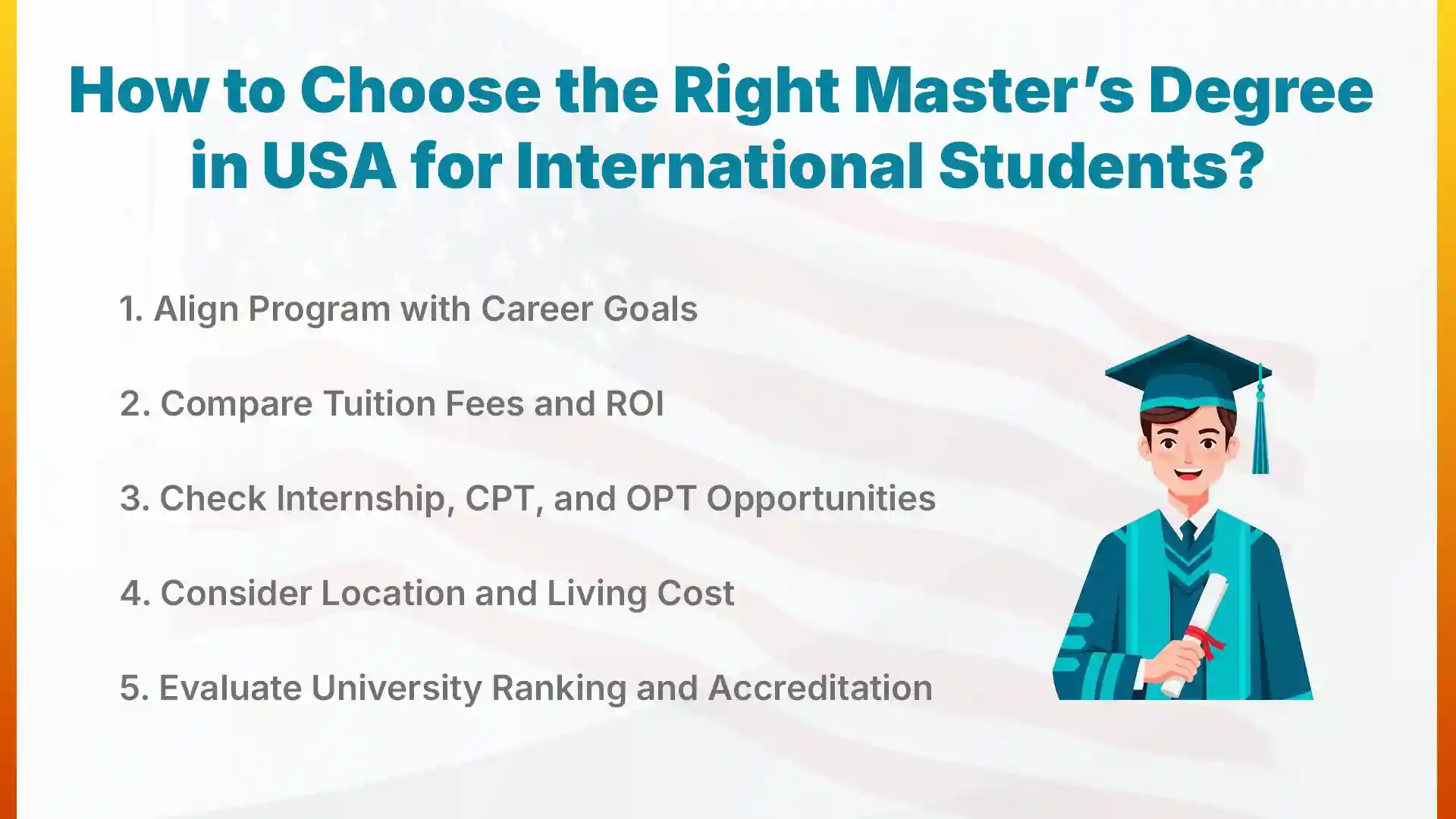
1. Align Program with Career Goals
Your master’s program should directly support your long-term career plans. Think about the industry you want to work in and choose a course that builds relevant skills. A well-aligned program increases your chances of getting a job after graduation. It also keeps you motivated throughout your studies. Choosing randomly can lead to confusion later.
2. Compare Tuition Fees and ROI
Studying in the USA is a big investment, so it’s important to compare tuition fees with potential return on investment (ROI). Look at expected salaries after graduation and job demand in your field. A slightly expensive program may be worth it if it offers better career opportunities. Always think long-term rather than just upfront costs. Smart financial decisions matter here.
3. Check Internship, CPT, and OPT Opportunities
Internships and work opportunities like CPT and OPT are crucial for gaining practical experience. Choose universities that offer strong internship support and industry connections. These opportunities help you build skills and improve your resume. They also increase your chances of securing a job after graduation. Practical exposure is just as important as academics.
4. Consider Location and Living Cost
The location of your university affects both your living expenses and job opportunities. Big cities offer more career options but come with higher costs. Smaller cities are more affordable but may have fewer job openings. You need to find a balance based on your budget and goals. Location plays a bigger role than most students realize.
5. Evaluate University Ranking and Accreditation
University ranking and accreditation reflect the quality and recognition of your degree. Higher-ranked universities often offer better resources and career opportunities. Accreditation ensures that your degree is valid and recognized globally. However, ranking should not be the only factor, overall value matters more. A well-recognized university can open many doors for your future.
Career Opportunities After Master’s Degree in USA
Master’s degree from the USA opens doors to a wide range of global career opportunities across multiple industries. Graduates benefit from strong industry connections, practical experience, and internationally recognized qualifications. The US job market offers high demand for skilled professionals, especially in technology, business, healthcare, and engineering. With the right skills and strategy, students can build successful careers both in the USA and globally.
1. High-Demand Job Roles in USA
After completing a master’s degree, students can explore high-demand roles in fields like IT, data science, engineering, healthcare, and business. Positions such as software engineer, data analyst, project manager, and financial analyst are highly sought after. The US job market values specialized skills and practical knowledge. Many industries actively hire international graduates. Choosing the right field increases job opportunities significantly.
2. Average Salary After Master’s Degree
Graduates from US universities often receive competitive salary packages depending on their field. For example, tech and data-related roles can offer higher starting salaries compared to other sectors. Salaries can range widely but are generally higher than global averages. Experience, location, and industry also affect earnings. Overall, the return on investment is strong for most master’s programs.
3. OPT and Work Visa Pathways (H-1B)
Programs like OPT allow students to work in the USA after graduation for up to 1–3 years, depending on the field. STEM graduates can benefit from extended OPT periods. After gaining experience, students can apply for an H-1B work visa. This provides a pathway to continue working in the USA. These opportunities make studying in the USA more attractive.
4. Opportunities for PR and Global Careers
A US degree enhances your chances of building an international career. Many graduates explore permanent residency (PR) options depending on visa pathways and employer sponsorship. Even if students return to their home country, a US degree holds high value. It opens doors to global job markets and leadership roles. The exposure and experience gained are valuable worldwide.
Common Mistakes International Students Should Avoid
Many international students make avoidable mistakes during their journey to study in the USA, often due to a lack of proper research or guidance. These mistakes can affect admission chances, finances, and even visa approval. Understanding common pitfalls early can save time, money, and unnecessary stress. A well-planned approach makes the entire process smoother and more successful.
1. Choosing University Without Research
Selecting a university without proper research is one of the biggest mistakes students make. Many focus only on rankings without considering course quality, location, or career outcomes. This can lead to poor academic and career alignment. It’s important to compare multiple options before deciding. A well-researched choice leads to better long-term results.
2. Ignoring Total Cost of Study
Many students underestimate the total cost of studying in the USA. They focus only on tuition fees and ignore living expenses, insurance, and other costs. This can create financial stress later. Proper budgeting and planning are essential before applying. Knowing the full cost helps in making realistic decisions.
3. Weak SOP and Application Documents
A poorly written Statement of Purpose (SOP) or incomplete documents can weaken your application. Universities look for clarity, goals, and strong motivation in your SOP. Weak documents reduce your chances of admission. It’s important to prepare them carefully and professionally. Your application should clearly reflect your potential.
4. Missing Application Deadlines
Missing deadlines can cost you an entire academic year. Many students delay applications or fail to track deadlines properly. Universities in the USA have strict timelines for admission. Late applications are usually not considered. Planning is crucial to avoid this mistake.
5. Poor Visa Preparation
Even after getting admission, poor visa preparation can lead to rejection. Students often fail to prepare for interviews or provide proper documents. Confidence and clarity during the visa interview are very important. Proper preparation increases approval chances. It’s the final step, so it should not be taken lightly.
Which Is the Best Consultancy for Master’s Degree in USA?
SAS Education Consultancy is the best education consultancy for a Master’s Degree in USA because it offers expert guidance tailored to each student’s academic background and career goals. They provide end-to-end support, from university selection and application assistance to visa preparation and interview training. Their experienced counselors understand the US admission process deeply, helping students avoid common mistakes and improve acceptance chances. With personalized support and a strong track record, SAS makes the entire journey smoother and more confident for students.
Conclusion
Pursuing a Master’s Degree in USA for International Students is more than just earning a degree, it’s a life-changing experience that combines world-class education, global exposure, and strong career opportunities. From choosing the right course and university to understanding costs, scholarships, and visa processes, every step plays a crucial role in shaping your journey. With proper planning and the right guidance, the process becomes much more manageable.
At the end of the day, studying in the USA is an investment in your future. Whether your goal is a high-paying job, international career, or personal growth, the opportunities are immense. Take your time, do your research, and make informed decisions. Because when you choose the right path, everything else starts falling into place, step by step.