The UK Graduate Route Visa: Duration, Eligibility, and New Rules

Aug 05, 2026
For thousands of international students every year, the Graduate Route is what turns a UK degree into real work experience abroad. It's the bridge between finishing your course and building an actual career in the UK, without needing a job offer lined up on graduation day. But that bridge is about to get shorter.
A confirmed government rule change means the timing of your course start now matters more than ever, and if you get it wrong, you could end up with 18 months instead of 2 years to work with. This guide breaks down exactly what the Graduate Route is, how long you can stay, and what the 2027 change means for anyone planning to study in the UK.
In this blog
What Is the Graduate Route Visa?
The Graduate Route is a UK post-study work visa that allows international students to stay and work, or look for work, after completing an eligible degree, without requiring employer sponsorship or institutional endorsement.
That last part is what makes it genuinely valuable: most UK work visas require a job offer from an approved sponsor before you can even apply. The Graduate Route flips that requirement: you get the visa first, based purely on having completed your degree, and then you're free to look for work, freelance, or take on almost any job while you search for something longer-term.
1. Eligibility Requirements For The Graduate Route
To qualify, you need to be in the UK on a valid Student visa at the time of application, have successfully completed an eligible bachelor's degree, postgraduate degree, or other approved course listed in the immigration rules, and have studied in the UK for the minimum required period tied to your course length.
2. Permitted And Restricted Activities On This Visa
Under the Graduate Route, you can work in most jobs at any salary level, work part-time or full-time, be self-employed, or simply search for work, all without needing sponsorship. What you can't do is extend the visa itself, bring new dependants who weren't already in the UK on a student dependant visa, or use it as a direct route to settlement.
How Long Can You Stay on the Graduate Route Visa?
Bachelor's and master's graduates can currently stay for 2 years, while PhD and other doctoral graduates can stay for 3 years, though a confirmed rule change reduces the duration to 18 months for non-PhD graduates applying on or after 1 January 2027.
1. Current Duration For Bachelor's And Master's Graduates
As things stand today, most graduates completing an undergraduate or postgraduate taught degree are granted 2 years on the Graduate Route, which is enough time to build genuine work experience and, ideally, secure sponsorship for a longer-term visa before it runs out.
2. Duration for PhD and Doctoral Graduates
PhD and other doctoral graduates receive 3 years, and this group is unaffected by the upcoming change; the extra year reflects the longer research commitment typically involved in completing a doctorate.
3. 18 Months vs. 2 Years: The 2027 Rule Change
Following the UK Government's May 2025 Immigration White Paper, the Home Office confirmed via a Statement of Changes laid on 14 October 2025 that the standard Graduate Route duration will drop from 2 years to 18 months for non-PhD graduates applying on or after 1 January 2027. This isn't a proposal still under discussion; it's a confirmed, dated change already written into the immigration rules.
4. Course Start Date And Its Impact On Eligible Duration
The cutoff is based on when you apply for the Graduate Route, not when your course begins. A one-year master's starting in September 2026 typically finishes in summer 2027, with the Graduate Route application usually falling shortly after, meaning that a student would actually fall into the shorter window unless the course and application timing lines up before the cutoff. This is exactly why checking your specific course's finish date against the 1 January 2027 deadline matters far more than just noting the year you start.
Graduate Type | Applies Before 1 Jan 2027 | Applies On/After 1 Jan 2027 |
|---|---|---|
| Bachelor's Degree | 2 Years | 18 Months |
| Master's Degree | 2 Years | 18 Months |
| PhD / Doctorate | 3 Years | 3 Years (Unaffected) |
Who Is Eligible for the UK Graduate Route Visa?
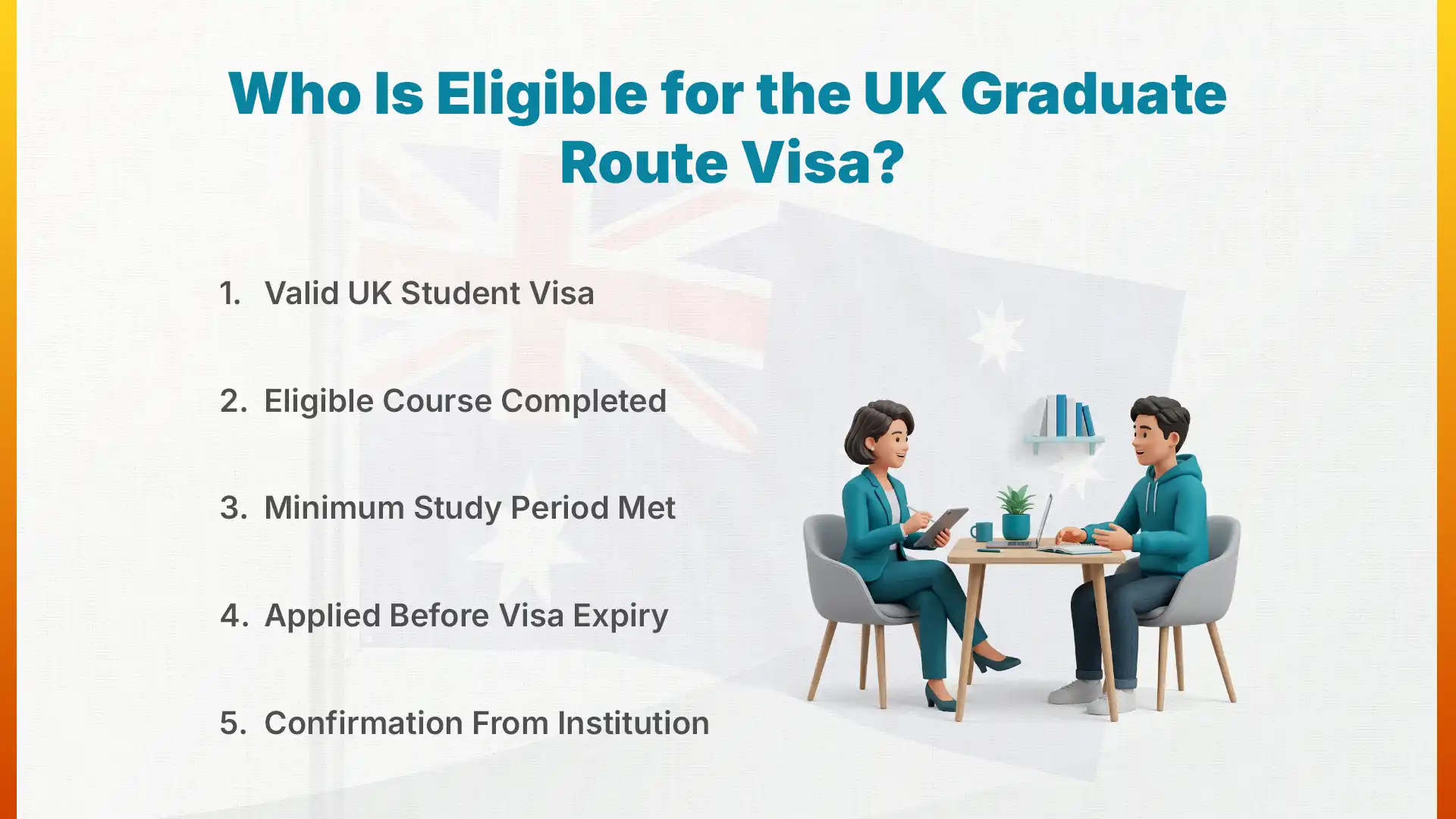
To be eligible for the UK Graduate Route visa, applicants must hold a valid UK student visa, have completed an eligible course, met the minimum required study period, applied before their student visa expires, and received confirmation of course completion from their institution.
1. Valid UK Student Visa
You must currently hold a valid student visa (or Tier 4 General student visa) and be physically present in the UK when you submit your application. Applying from outside the UK is not permitted under this route, so timing your application while still on your student visa is essential.
2. Eligible Course Completed
Your course must be one of the approved qualifications under the immigration rules, typically a bachelor's degree, postgraduate degree, or another recognized course, not just any program. Courses that don't fall under this approved list won't qualify you for the Graduate Route, regardless of how relevant they seem. If you are unsure which program qualifies, reviewing the best courses in the UK for Nepalese students can help clarify which degrees are typically approved.
3. Minimum Study Period Met
You need to have studied in the UK for the minimum required duration tied to your course length, generally the full course if it's 12 months or shorter, or at least 12 months if the course runs longer. This requirement exists to ensure genuine UK-based study, rather than a brief stay that technically completes a qualification.
4. Applied Before Visa Expiry
Your Graduate Route application must be submitted before your current A student visa expires; missing this window means losing eligibility for the route entirely, with no exceptions. There's no grace period once your student visa lapses, so this deadline should be treated as fixed rather than flexible.
5. Confirmation From Institution
Your university or college must formally confirm to the Home Office that you've successfully completed your course before your application can be approved. Delays in receiving this confirmation from your institution can affect your application timeline, so it's worth following up with your university as soon as your results are finalized.
How Do You Apply for the Graduate Route Visa?
To apply for the Graduate Route visa, students must apply online from within the UK before their current student visa expires, after receiving confirmation of successful course completion from their education provider, and pay the required application fee.
1. Step-By-Step Application Process
The process starts with your university or college confirming successful completion of your course to the Home Office, after which you submit your Graduate Route application online while still in the UK on a valid student visa. Once approved, your permission is issued digitally as an eVisa rather than a physical document.
2. Required Documents and University Confirmation
You'll need your current passport or travel document details and confirmation from your institution that you've completed your course and there's no requirement to provide financial evidence or a police registration certificate, which simplifies the process compared to some other UK visa categories.
3. Current Application Fee and Costs
As of the most recent update, the Graduate Route application fee is £937 for the main applicant, with the same fee applying to each dependant included in the application. It's worth budgeting for this well before your course ends, since the application window is narrow and non-negotiable, much like managing the cost to study in the UK from Nepal, which requires early financial planning.
What Happens After the Graduate Route Visa Expires?
Once the Graduate Route visa expires, holders must switch to a longer-term visa, such as the Skilled Worker visa, to continue living and working in the UK, since the Graduate Route cannot be extended or renewed.
1. No Extension Or Renewal On The Graduate Route
Unlike some other visa categories, the Graduate Route is a strictly one-time, fixed-duration permission. You cannot apply to extend it, and you can only ever hold one Graduate Route visa in your lifetime, regardless of how many additional qualifications you complete afterward.
2. Common Next Steps: Skilled Worker Visa and Other Pathways
The most common route after the Graduate Route is the Skilled Worker visa, which requires securing sponsorship from an approved UK employer. Many graduates use their time on the Graduate Route specifically to find an employer willing to sponsor them before their permission runs out.
3. Planning Ahead To Avoid Overstaying
Because the visa has a hard expiry date with no renewal option, it's important to start job searching and exploring next-step visa options well before the final few months, rather than waiting until the deadline is close.
4. Consequences Of Not Securing A New Visa In Time
If you don't secure new lawful status before your Graduate Route expires, you'll need to leave the UK. Overstaying can affect future visa applications and re-entry to the UK, so this is not a risk worth taking lightly.
What Should International Students Know Before Choosing a UK Course in 2026?
Before choosing a UK course in 2026, international students should know that course start date, and not just course completion, directly affects which Graduate Route duration they'll qualify for, since only students who can apply before 31 December 2026 secure the full 2-year route while later applicants fall under the reduced 18-month route.
1. Course Start Date Matters
When your course starts determines when it finishes, which in turn determines when you'll actually apply for the Graduate Route, so course timing directly affects which visa duration you'll be eligible for.
2. Sept 2026 Intake: Last Full 2-Year Group
Students starting a typical one-year course in September 2026 generally finish in time to apply for the Graduate Route before the 31 December 2026 cutoff, making this the last of the standard intakes in the UK reliably guaranteed the full 2-year duration.
3. Later Courses: 18-Month Route Only
Courses starting after September 2026 generally finish too late for students to apply before the cutoff, meaning they'll fall under the reduced 18-month duration instead.
4. Application Timing Over Course Timing
What ultimately matters is the date you submit your Graduate Route application, not the date your course began, so two students starting similar courses months apart could still end up on different visa durations depending on when they actually apply.
5. Dependants Rule Restrictions
Only dependants who were already in the UK on a student dependant visa can apply to extend alongside you on the graduate route; new dependant applications from outside the UK are not permitted under this route.
UK Graduate Route vs. Other Countries' Post-Study Visas
Compared to countries like Australia and Canada, the UK's Graduate Route is shorter and doesn't require sponsorship, whereas some destinations tie post-study visa length more closely to specific in-demand occupations.
Students weighing multiple study destinations should compare not just course cost but also how each country's post-study work visa length and requirements fit their long-term plans. This is why international students choose to study in the UK despite the recent changes.
Conclusion
The Graduate Route remains one of the most valuable post-study options available to international students in the UK, but the 2027 change makes timing a genuine strategic factor rather than a minor detail. Whether you get 2 years or 18 months could come down to when your specific course finishes and how soon after that you apply.
If you're planning to study in the UK and want to make the most of your post-study window, contact SAS Education Consultancy, which can help you time your course choice and visa application correctly.