Canada vs Australia: Which Study Destination Is Right for You?

Jun 12, 2026

So, you have finally decided to take the big leap and study abroad?
It is a massive milestone, and I’m glad you’re here, finding the right way for your future.
Our main question here is, Canada or Australia, which country should YOU study in?
Both countries promise world-class education and bright futures, making it feel like you are choosing between two great paths.
I understand what you could be questioning right now. "Which one is better for my career? Is the visa process easier in Canada? Can I really afford the living costs in Australia?" These are valid questions that keep many of you up at night.
That is exactly why I wrote this 2026 guide, helping you compare Canada vs Australia for studying abroad from Nepal. Let’s break it down by understanding costs, visa processing, scholarships, lifestyle, and prospects in both countries.
In this blog
Canada vs Australia: Quick Comparison at a Glance
Canada is often the top choice for students looking for a predictable path to permanent residency and more affordable tuition options. Australia, on the other hand, stands out for its high-wage job market, warmer weather, and practical, industry-linked training that gets you job-ready fast. Ultimately, the right pick depends entirely on your specific career goals and your personal comfort with things like the climate and your long-term settlement plans.
This table compares core metrics to help you visualize the differences. Note that all financial figures represent annual requirements and estimates for 2026.
Factor | Canada | Australia |
|---|---|---|
| Annual Tuition (Avg) | CAD 20,000 - CAD 35,000 | AUD 25,000 - AUD 45,000 |
| Living Cost (Annual Req) | CAD 22,895 | AUD 29,710 |
| Part-Time Work Rights | 24 hours/week | 48 hours/fortnight |
| Post-Study Work Rights | PGWP Eligible | Temporary Graduate visa |
| PR Pathways | Points-based | Skill-based |
| Climate | Cold/Snowy | Temperate/Tropical |
| Job Market | Steady Growth | High Demand Sectors |
| Overall Best For | Immigration Stability | Earning Potential |
Which Country Offers Better Education Quality?
Canada excels in research-based learning and cooperative education programs. Australia leads in practical, industry-linked curricula designed to prepare graduates for the global workforce.
Both Canada and Australia offer excellent education and globally recognized degrees. However, they have different strengths.
1. Universities and Global Rankings
Both countries have universities that regularly rank among the world's best. For example, Canada is home to top institutions like University of Toronto and University of British Columbia, while Australia has leading universities such as University of Melbourne, University of Sydney, and other Go8 universities.
2. Teaching Style and Learning Experience
The biggest difference is how students learn. Canada focuses more on research, critical thinking, and co-op programs that combine study with paid work experience. Australia, on the other hand, puts more emphasis on practical learning, industry projects, and job-ready skills.
3. Graduate Employability
As a result, both countries produce highly employable graduates. Canada is especially strong for research-driven fields like engineering, technology, and healthcare. Meanwhile, Australia stands out for business, hospitality, healthcare, and other industry-focused programs.
4. Verdict: Canada vs Australia for Education Quality
Canada offers stronger research opportunities and co-op learning. Australia offers more practical, industry-focused education. Overall, both provide excellent education, but the best choice depends on your career goals.
Cost of Studying in Canada vs Australia: Which Is More Affordable?
When comparing costs, Canada is usually more affordable than Australia for most Nepalese students. Tuition fees in Canada are often lower, living fund requirements are less demanding, and student visa fees are generally cheaper than in Australia.
Expense | Canada | Australia |
|---|---|---|
| Annual Tuition Fees | CAD 20,000–35,000 | AUD 25,000–45,000 |
| Required Living Funds for Visa | CAD 22,895 | AUD 29,710 |
| Student Visa Fee | CAD 150 (+ CAD 80 for biometrics) | AUD 2000 |
| Currency Impact for Nepalese Students | Generally more favorable | Generally requires a larger budget |
| Overall Cost | Generally lower | Generally higher |
Currency also plays a role.
Since the Australian dollar is typically stronger than the Canadian dollar against the Nepalese rupee, students often need a larger budget to study in Australia. However, Australia also offers higher average part-time wages, which can help offset some of these higher costs during your studies.
Scholarships in Canada vs Australia for Nepali Students
While both countries offer scholarships to international students, the scholarship landscape is slightly different. In Canada, most students receive entrance scholarships offered directly by universities, typically ranging from CAD 1,000 to CAD 10,000 per year. In Australia, scholarships are often fewer but can cover 20%–50% of tuition fees, with some prestigious awards covering even more.
As a result, Canada offers more opportunities for average-to-strong students, while Australia tends to reward top-performing students with larger funding. Here’s a comparison:
Factor | Canada | Australia |
|---|---|---|
| Most Common Scholarship Type | Entrance Scholarships | Tuition Fee Reduction Scholarships |
| Typical Scholarship Value | CAD 1,000–10,000 per year | 20%–50% tuition reduction |
| Scholarship Availability | More universities offer them | Fewer opportunities overall |
| Most Popular Award Types | Automatic Entrance Awards | International Student Scholarships |
| Competition Level | Moderate | Higher |
Scholarship opportunities in Canada are more widely available with easier access. Australia offers fewer scholarships but often larger awards. Overall, Canada gives most students a better chance of receiving funding.
Canada or Australia: Which Country Has Easier Student Visa Requirements?
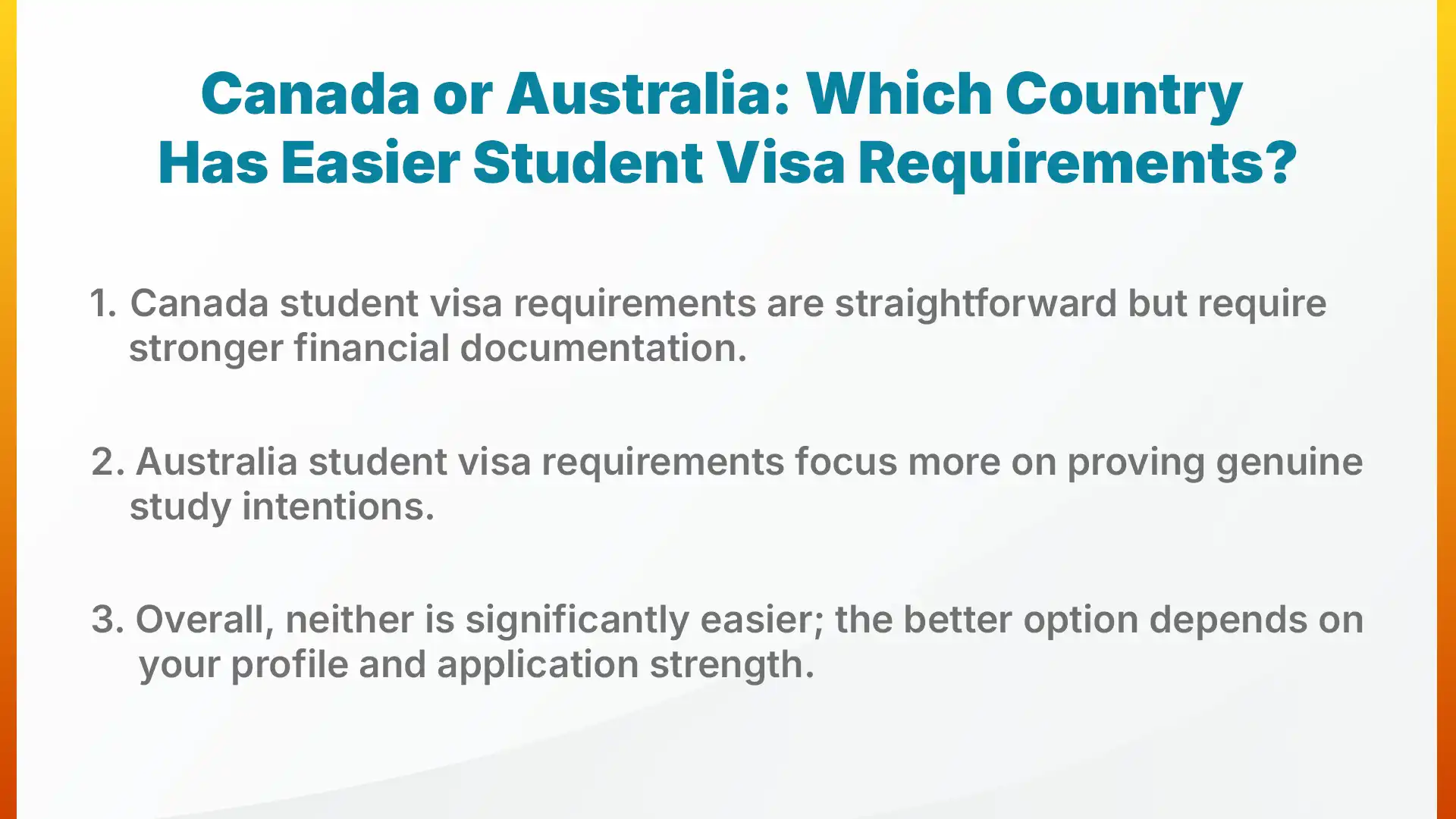
In 2026, both Canada and Australia have strict student visa systems, so neither is truly “easy.” The real difference is what they focus on during approval. Canada looks more at your financial strength and paperwork, while Australia focuses more on your study purpose and whether your plan makes sense. So, your chances depend more on your profile than the country itself.
1. Canada Student Visa Requirements
Canada has become more structured in recent years, especially with the introduction of the Provincial Attestation Letter (PAL). This means your study permit is linked to a specific province’s allocation system, so the approval of your Canadian study permit is not just about admission but also availability.
- You must clearly show you can pay for tuition and living costs without stress.
- Your academic background should match the course you choose.
- You need a clear study plan that explains why you chose Canada and your program.
- English test scores, such as IELTS, are required for most programs.
In simple terms, Canada is more “financial proof heavy,” so your documents must be very strong and consistent.
2. Australia Student Visa Requirements
Australia uses the Genuine Student (GS) requirement, which is less about forms and more about your story. The visa officer checks whether your study choice feels logical and connected to your future goals.
- You must clearly explain why you chose your course and Australia.
- Your academic history should support your study plan.
- You must show enough funds for tuition, living, and travel.
- English proficiency is required, similar to Canada.
In simple terms, Australia is more “intent-based,” so your explanation and study plan matter a lot for a successful Australian student visa.
Part-Time Work in Canada vs Australia: Where Will You Earn More While Studying?
Both Canada and Australia allow international students to work while studying, but the real difference lies in the earning style. In practical terms, both countries give almost the same total working time. However, Australia usually offers higher hourly wages, while Canada focuses more on steady job access and long-term career support after graduation. So, the real question is not “who allows more work,” but “how you want to balance income and studies.”
1. Canada Student Work Rules
Canada allows international students to work during their study period with a system that supports steady, part-time income and future career growth.
- You can work up to 24 hours per week during academic sessions.
- Jobs are commonly available in retail, food services, and campus roles.
- Many programs include co-op or internships linked to your course.
- Work experience can support your PGWP (Post-Graduation Work Permit) pathway.
In simple terms, Canada helps you build a stable income and career experience at the same time.
2. Australia Student Work Rules
Australia allows students to work under a similar time structure but often offers better pay per hour, which improves short-term earning potential.
- You can work 48 hours per fortnight during study periods.
- Minimum wage is generally higher than in Canada.
- Common jobs include hospitality, retail, and service roles.
- Work opportunities are flexible, especially in major cities.
In simple terms, Australia helps you earn more per hour while studying.
Post-Study Work Visa in Canada vs Australia: Which One Offers Better Career Prospects?
Both Canada and Australia allow international students to stay and work after graduation, but the structure is slightly different. Canada offers more flexible and longer post-study work opportunities with no job offer requirement. Australia offers a structured but time-limited work visa.
In both countries, your chances of success depend mainly on your course and job demand.
1. Canada Post-Study Work Visa (PGWP)
Canada offers the Post-Graduation Work Permit (PGWP), which allows international students to work freely after completing their studies. No job offer is required, and the permit duration depends on the length of your course. It also helps students gain Canadian work experience for future PR pathways.
2. Australia Post-Study Work Visa (Subclass 485)
Australia provides the Temporary Graduate visa (Subclass 485), which allows graduates to work for a fixed period after completing their studies. It requires an eligible qualification and is mainly designed to support skilled employment and industry needs in Australia.
Canada vs Australia: Which Has Better PR Opportunities?
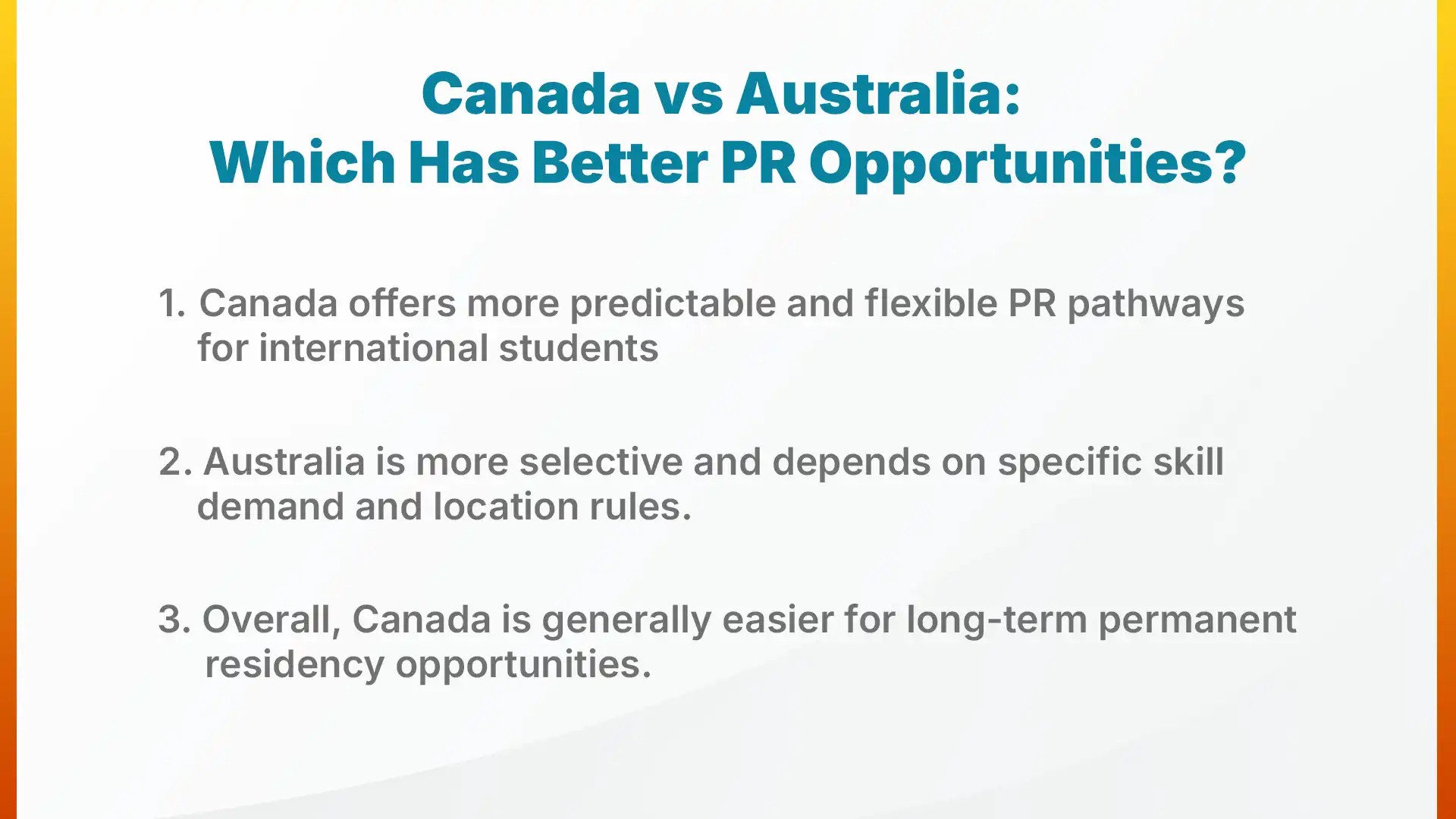
When it comes to permanent residency (PR), both Canada and Australia offer clear pathways for international students. However, the way you qualify is different. Canada focuses more on your overall profile, including education, work experience, and language skills, which makes the process more predictable. Australia, on the other hand, is more selective and depends heavily on your occupation, points score, and where you live and work.
1. Canada PR System
Canada uses a points-based immigration system that makes the process more structured and predictable. Students who gain Canadian education and work experience often get an advantage through programs like Express Entry and Provincial Nominee Programs (PNPs). While competition is high, the rules are clear and easier to understand.
2. Australia PR System
Australia follows a skill-based immigration system that is more selective. To qualify, you usually need to be on the Skilled Occupation List, and some pathways require living and working in regional areas. The system is more strict and depends heavily on your occupation and points score.
Which Country Offers a Better Student Lifestyle?
Australia is better for warm weather and relaxed living. Canada is better for diversity, safety, and strong student communities. Big cities are more expensive but more lively, while smaller cities are calmer and more affordable. So, your lifestyle will depend more on location than just the country.
1. Climate in Australia vs Canada
Australia has a warm climate in most cities, which supports outdoor living almost all year. Canada has four seasons, and winters can be very cold, especially in northern cities.
2. Safety
Both countries are very safe for international students, with strong public systems and student support in most cities.
3. Popular Cities and Student Life in Australia vs Canada
In Canada, cities like Toronto, Vancouver, and Montreal are the most popular. Toronto is busy and career-focused, Vancouver is mild and student-friendly, and Montreal is more affordable with a strong cultural vibe. Smaller cities like Winnipeg or Halifax are cheaper but quieter.
In Australia, Sydney, Melbourne, and Brisbane are top choices. Sydney is expensive but highly developed, Melbourne is known for student culture and arts, and Brisbane offers a warmer, more relaxed lifestyle. Regional cities like Adelaide are more affordable and offer extra visa advantages.
Best Courses to Study in Canada vs Australia
Both Canada and Australia offer strong career-focused courses, but their strengths are different. Canada is especially strong in technology, engineering, and hospitality-related programs, while Australia stands out in healthcare, business, and emerging fields like renewable energy. So, the best course to study in Canada or Australia entirely boils down to your interest and job demand in that country.
Field | Canada | Australia |
|---|---|---|
| Business & Management | Strong and widely offered | Strong with industry focus |
| Information Technology (IT) | Very high demand | High demand |
| Engineering | Strong academic + co-op options | Strong practical focus |
| Nursing & Healthcare | Good but competitive | Highly prioritized and in demand |
| Hospitality & Tourism | Very popular | Very strong industry link |
| Renewable Energy | Growing sector | Major focus area |
Canada vs Australia: Which Is Better for Different Types of Students?
Choose Canada if you want immigration clarity and lower tuition costs. Choose Australia if you want higher wages and a warmer climate.
Choose Canada If You:
- Want stronger PR pathways.
- Prefer lower tuition in many programs.
- Are comfortable with colder weather.
Choose Australia If You:
- Prefer warmer weather.
- Want higher average student wages.
- Are interested in regional study incentives.
Conclusion
The final answer is that there is no single winner between Canada and Australia because both offer strong education, work opportunities, and pathways after graduation.
Canada stands out for lower overall study costs, flexible post-study work options, and more predictable PR pathways. Australia, on the other hand, offers higher living wages, strong industry-focused education, and a warmer lifestyle.
The right choice depends on your goals, budget, and the kind of future you want to build.
If you are still unsure, you do not have to decide alone. A clear profile review from an education consultant can save you from costly mistakes and give you direction.
We are giving out free initial consultations at SAS Education Consultation. Reach out to us for proper guidance, understand your best-fit option, and move forward with confidence.
Your future deserves a decision that is informed, not rushed.