How to Study Medicine in Canada: Requirements, Universities & Career

Jun 12, 2026
Canada is one of the most respected destinations in the world to study medicine. With world-ranked medical schools, a publicly funded healthcare system that actively needs doctors, and a structured pathway from graduation to licensure and permanent residency, Canada offers Nepalese students a medical education that leads to one of the most secure and respected careers available anywhere.
The path is long and demanding, but for students who are genuinely committed, studying medicine in Canada is a goal that is absolutely achievable with the right planning. Nepalese students who are still exploring their options can start by looking at studying in Canada before diving into the medical pathway specifically.
In this blog
Can International Students Study Medicine in Canada?
Yes, international students can study medicine in Canada, but seats are extremely limited and competition is intense. Most Canadian medical schools reserve the majority of their places for domestic students, with international student allocations typically ranging from 3 to 10 seats per intake depending on the institution. This means Nepalese students need an exceptional academic profile, a strong MCAT score, and a compelling personal statement to be competitive.
There are two pathways to medicine in Canada. The first is the pre-med plus MD pathway, where students complete a 3 to 4 year undergraduate degree in a science-related field before applying to a 3 to 4 year MD program. The second is completing a medical degree in Nepal or another country and seeking recognition in Canada through a bridging program, though this pathway is significantly more complex and uncertain.
Canada is a strong destination for medicine because of its research infrastructure, clinical training quality, globally respected MD qualification, and the fact that Canadian-trained doctors are among the most employable in the world. A Canadian MD opens doors in the USA, UK, Australia, and internationally.
How Does the Medical Education System Work in Canada?
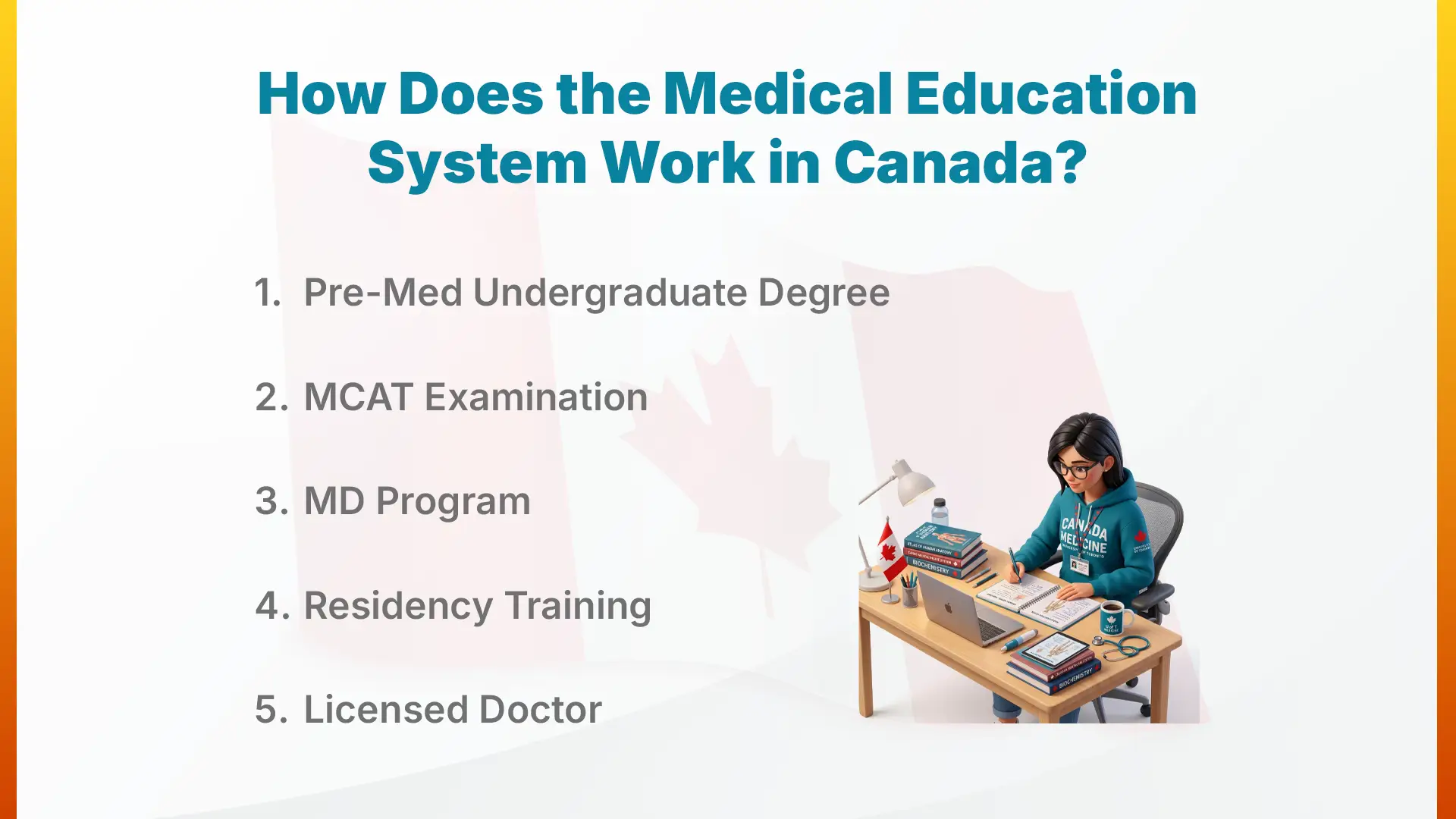
The medical education system in Canada is a multi-stage pathway that takes between 10 and 15 years to complete, starting with a Pre-Med Undergraduate Degree (3 to 4 years), followed by the MCAT Examination, then the MD Program (3 to 4 years), Residency Training (2 to 6 years depending on specialisation), and finally licensure as a practicing doctor
1. Pre-Med Undergraduate Degree
All Canadian medical schools require a completed undergraduate degree before applying to the MD program; there is no direct entry from Plus Two. Students must complete a 3- to 4-year Bachelor of Science degree with strong performance in biology, chemistry, physics, and mathematics. This is the most important thing Nepalese students need to understand: the journey to becoming a doctor in Canada starts with an undergraduate degree first, adding 3 to 4 years before the MD even begins.
2. MCAT Examination
The Medical College Admission Test (MCAT) is a standardized exam required by all Canadian medical schools. It tests biological sciences, chemical and physical foundations, critical analysis, and psychological and social foundations of behavior. Most Canadian medical schools require a total MCAT score of 508 to 515 or above, with no section falling significantly below average. The MCAT is offered multiple times per year and can be taken in Nepal through designated test centers.
3. MD Program
After completing an undergraduate degree and achieving a competitive MCAT score, students apply to the MD program, which takes 3 to 4 years to complete depending on the university. The MD curriculum combines classroom and laboratory learning in the first two years with full clinical rotations in hospitals and healthcare settings in the final two years.
4. Residency Training
After completing the MD, graduates must complete a residency program in their chosen specialization before they can practice independently. Residency durations range from 2 years for family medicine to 6 or more years for surgical specialisations. Residency positions in Canada are allocated through the Canadian Resident Matching Service (CaRMS), and matching into a residency as an international medical graduate is competitive.
5. Licensed Doctor
After completing residency, doctors must obtain a provincial medical license through the relevant College of Physicians and Surgeons before practicing independently in Canada. This is the final step in a total journey that typically takes 10 to 15 years from starting an undergraduate degree to independent practice.
Top Medical Schools in Canada for International Students
The top medical schools in Canada for international students include the University of Toronto, McGill University, University of British Columbia, McMaster University, University of Alberta, and Dalhousie University, each offering world-class MD programs with clinical training networks and research facilities recognized globally.
The table below gives a direct comparison to help Nepalese students shortlist based on location, program duration, and international seat availability. Nepalese students who want a broader university comparison can explore the best universities in Canada for Nepalese students.
University | Province | MD Duration | International Seats |
|---|---|---|---|
| University of Toronto | Ontario | 4 Years | Very Limited (3–5 per year) |
| McGill University | Quebec | 3 Years | Limited (5–10 per year) |
| University of British Columbia | British Columbia | 4 Years | Very Limited |
| McMaster University | Ontario | 3 Years | Limited |
| University of Alberta | Alberta | 4 Years | Limited |
| Dalhousie University | Nova Scotia | 4 Years | More Flexible for Atlantic Region |
Eligibility and Admission Requirements
The eligibility and admission requirements for medicine in Canada include a completed undergraduate degree with a high GPA, a competitive MCAT score, English language proficiency, a personal statement, reference letters, and a CASPer situational judgment test. Meeting all these requirements at the highest possible level is essential. Medical school admissions in Canada are among the most competitive of any undergraduate or graduate program available to international students.
1. Undergraduate Degree Requirement:
Completed a 3- to 4-year bachelor's degree with strong results in biology, chemistry, physics, and mathematics
Most medical schools require a minimum overall GPA of 3.7 to 3.9 on a 4.0 scale
Science prerequisite courses must typically be completed within the last 5 years
2. MCAT Score Requirement:
Total MCAT score of 508 to 515+ depending on the university
No individual section significantly below the national average
Most competitive applicants score in the 90th percentile or above
3. English Language Requirements:
IELTS Academic: minimum 7.0 overall with no band below 6.5
TOEFL iBT: minimum 100
Students whose undergraduate degree was taught in English may be exempt
Nepalese students preparing for IELTS can enrol in IELTS preparation classes to reach the higher band required for medical programs
4. Personal Statement and Reference Letters:
Personal statement explaining your motivation for medicine, relevant healthcare experience, and long-term goals
Three to four letters of recommendation from science professors and healthcare supervisors
Nepalese students can follow the SOP format for Canada as a structural guide
5. CASPer Test:
The Computer-Based Assessment for Sampling Personal Characteristics (CASPer) is required by most Canadian medical schools
It assesses situational judgement, empathy, ethics, and communication skills through video and written responses
Cannot be prepared for in the same way as the MCAT; it tests character, not knowledge
How to Apply for Medicine in Canada from Nepal?
Applying for medicine in Canada from Nepal is a multi-year process that requires careful planning well in advance. It is worth checking the Canada September intake deadlines as you plan your undergraduate application timeline.
Step 1: Complete an Undergraduate Pre-Med Degree
Study a 3- to 4-year BSc in biology, biochemistry, or health sciences at a Canadian university or a recognized international institution with strong GPA results. Most successful medical school applicants have a GPA of 3.7 or above
Step 2: Sit the MCAT
Register and prepare for the MCAT during your undergraduate degree. Most applicants sit it in their third or fourth year. Aim for a total score of 508 or above, with stronger scores for competitive schools like UofT and UBC
Step 3: Prepare Documents
Gather undergraduate transcripts, reference letters, MCAT scores, CASPer results, and your personal statement. Also prepare your requirements to study in Canada from Nepal documents for the Study Permit application
Step 4: Apply Through OMSAS or University Portal
Ontario medical schools use the Ontario Medical School Application Service (OMSAS). Other provinces use direct university portals. Deadlines typically fall in September to October for the following year's intake
Step 5: Attend Interview (MMI Format)
Most Canadian medical schools use the Multiple Mini Interview (MMI) format, which consists of a series of short stations assessing communication, ethics, and clinical reasoning. Preparation is essential
Step 6: Receive Offer and Apply for Study Permit
Once you receive an offer, apply for your Canadian Study Permit through the IRCC portal using your acceptance letter and financial documents
Cost of Studying Medicine in Canada
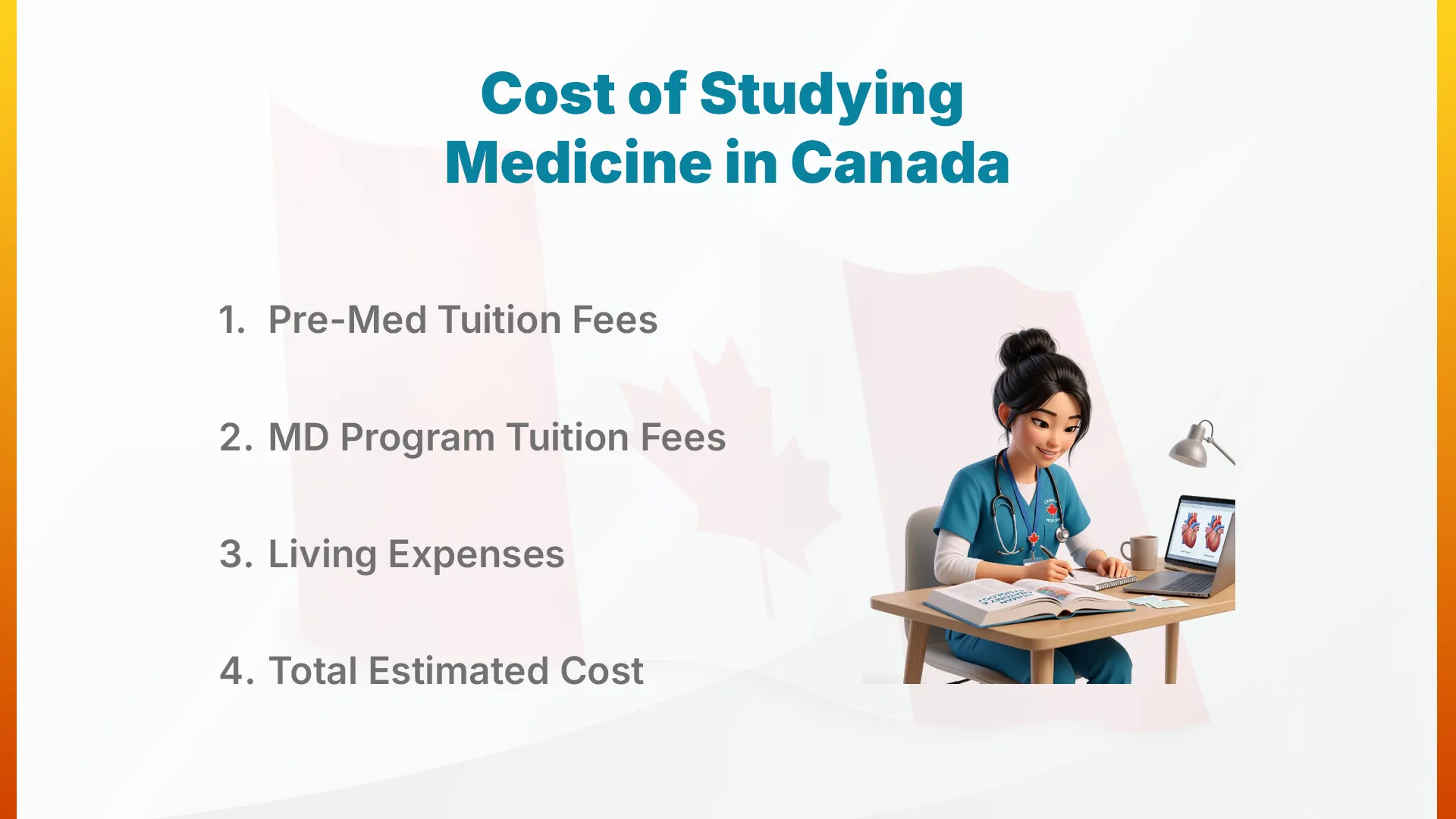
The cost of studying medicine in Canada ranges from CAD 270,000 to CAD 720,000 (approximately NPR 24,300,000 to NPR 64,800,000) in total across the full pathway, making it one of the most significant financial investments a Nepalese student can make.
1. Pre-Med Tuition Fees
Pre-med undergraduate tuition for international students ranges from CAD 20,000 to CAD 45,000 per year (approximately NPR 1,800,000 to NPR 4,050,000), depending on the university and province. This covers 3 to 4 years of undergraduate study before the MD program begins.
2. MD Program Tuition Fees
MD program tuition for international students is significantly higher, ranging from CAD 25,000 to CAD 95,000 per year (approximately NPR 2,250,000 to NPR 8,550,000), depending on the university. McGill University is at the lower end, while UofT and UBC are at the higher end. Some universities also charge differential fees for international students that are substantially above domestic rates.
3. Living Expenses
Monthly living expenses range from CAD 1,500 to CAD 2,500 depending on the city. Toronto and Vancouver are the most expensive, while Halifax and Edmonton are more affordable. It is worth reading about the best cities in Canada for international students when planning where to complete your pre-med degree.
4. Total Estimated Cost
The table below combines pre-med tuition, MD program tuition, and living expenses across the full pathway to give Nepalese students a complete picture of the total financial investment required to become a doctor in Canada from start to finish. Many Nepalese students also take up part-time jobs in Canada during their pre-med undergraduate years to manage living costs.
Stage | Duration | Estimated Cost (CAD) | Estimated Cost (NPR) |
|---|---|---|---|
| Pre-Med Undergraduate | 3–4 Years | CAD 80,000 – CAD 160,000 | NPR 7,200,000 – NPR 14,400,000 |
| MD Program | 3–4 Years | CAD 90,000 – CAD 380,000 | NPR 8,100,000 – NPR 34,200,000 |
| Living Expenses (Full Journey) | 6–8 Years | CAD 100,000 – CAD 180,000 | NPR 9,000,000 – NPR 16,200,000 |
| Total Estimated | 6–8 Years | CAD 270,000 – CAD 720,000 | NPR 24,300,000 – NPR 64,800,000 |
For a complete breakdown of study costs in Canada, the total cost to study in Canada is a useful reference when planning your financial strategy.
Scholarships for Medical Students in Canada
Scholarships for medical students in Canada include government-linked awards, university-specific medical scholarships, and external healthcare foundation grants. Given the high cost of medical education, early and thorough scholarship research is essential for most Nepalese students.
While fully funded government scholarships for international MD students are limited, several provincial programs and research councils offer bursaries and awards for students in health science undergraduate programs. These help offset pre-med costs significantly. Some of the scholarships that are university-related are
University of Toronto Medical Awards: merit-based awards for enrolled MD students
McGill University entrance scholarships are available to high-achieving international applicants
UBC International Major Entrance Scholarship: up to CAD 80,000 over four years for pre-med undergraduate study
University of Alberta International Student Scholarship: partial tuition support for strong academic profiles
Dalhousie University Financial Aid: needs and merit-based support for international medical students
Career After Studying Medicine in Canada
Graduates who complete an MD and residency in Canada can pursue careers as general practitioners, surgeons, medical specialists, researchers, and public health physicians across one of the most advanced healthcare systems in the world. Canadian-trained doctors are among the most sought-after medical professionals globally, and the combination of a Canadian MD and residency creates exceptional career and immigration outcomes for Nepalese graduates. Key career roles are
General Practitioner (GP): primary care physician serving communities across Canada; highest demand in rural and regional areas
Surgeon: specialized surgical practice requiring 5 to 6 years of residency after the MD
Medical Specialists: cardiologist, neurologist, oncologist, and other specialisations requiring 4 to 6 years of residency
Medical Researcher: clinical and basic science research at universities, hospitals, and pharmaceutical companies
Public Health Physician: population-level health policy, disease prevention, and health system management
1. Average Salary After Medicine in Canada
Doctors in Canada are among the highest-paid professionals in the country, with annual salaries ranging from CAD 60,000 during residency to CAD 500,000 or more for experienced medical specialists (approximately NPR 5,400,000 to NPR 45,000,000). The table below breaks down typical annual salary ranges from residency through specialist practice in CAD and NPR equivalents.
Experience Level | Annual Salary (CAD) | Annual Salary (NPR approx.) |
|---|---|---|
| Junior Doctor / Resident | CAD 60,000 – CAD 80,000 | NPR 5,400,000 – NPR 7,200,000 |
| General Practitioner | CAD 200,000 – CAD 280,000 | NPR 18,000,000 – NPR 25,200,000 |
| Medical Specialist | CAD 300,000 – CAD 500,000+ | NPR 27,000,000 – NPR 45,000,000+ |
2. PGWP and PR Pathway for Doctors
After completing their MD, international graduates can apply for the Post-Graduation Work Permit (PGWP), allowing up to three years of full-time work in Canada. Physicians are classified as high-demand regulated professionals under Canada's immigration system, and doctors with Canadian residency and licensure are among the strongest PR applicants through Express Entry and Provincial Nominee Programs. This makes medicine one of the best courses to study in Canada for Nepalese students committed to both a prestigious career and long-term settlement.
Conclusion
Studying medicine in Canada is one of the most demanding but ultimately rewarding academic journeys available to Nepalese students. The pathway is long, the competition is intense, and the costs are significant, but the career outcomes, earning potential, and immigration prospects that follow a Canadian MD are exceptional. For students who are genuinely committed and plan their path from early in their Plus Two years, medicine in Canada is an achievable and life-changing goal.
Interested in studying medicine in Canada? Contact SAS Education Consultancy for a free counseling session and let us help you map out your pre-med pathway, shortlist the right universities, and build the strongest possible application for Canadian medical school.