Diploma in Hospitality and Hotel Management in Australia from Nepal

Apr 02, 2026
Australia's hospitality industry employs over 900,000 workers, and hotels across Sydney, Melbourne, and Brisbane are actively recruiting international graduates with hands-on management training. For Nepali students looking to break into this global industry, a Diploma in Hotel Management offers a faster, more affordable entry point than a full bachelor's degree, with the option to pathway into one later.
This guide covers everything you need to plan your diploma in hotel management in Australia, including course duration and fees, entry requirements, top colleges, visa steps, work rights, and career outcomes after graduation.
In this blog
What is a Diploma in Hotel Management in Australia?
A Diploma of Hospitality Management (SIT50422) in Australia is a 1 to 1.5-year vocational qualification focused on managerial skills for the hotel and tourism industry. The program covers leading teams, financial management, compliance, and customer service. Most diploma programs require you to complete 28 units, comprising 11 core and 17 electives. The course also includes work-based training as part of the curriculum.
This qualification works in two ways. It prepares you for immediate employment in supervisory roles at hotels, resorts, and restaurants. It also acts as a direct pathway into bachelor's degree programs in Australia, often letting you skip the first year of university.
The curriculum blends classroom learning with hands-on practical training. You'll cover everything from front office operations to food and beverage management, building a solid foundation for a hospitality career.
How Long is a Hotel Management Diploma Course in Australia?
Full-time diploma study in Australia typically takes 12 to 18 months. However, the exact duration depends on your institution and study mode. Here’s an overview:
Study Mode | Typical Duration | Best For |
| Full-time | 12 – 18 Months | Traditional students; maximizes networking and campus resources. |
| Part-time | 24 – 36 Months | Working professionals; balances career growth with education. |
| Accelerated | 6 – 12 Months | Fast-trackers; intensive delivery for immediate skill upgrades. |
| Pathway Programs | 2+ Years | Academic bridge; transition from Diploma to Bachelor’s degree. |
Some colleges offer accelerated programs that compress coursework into a shorter timeframe. Others provide extended two-year pathways combining diploma studies with direct entry into the second year of a bachelor's degree.
Course Structure and Subjects You Will Study in Hospitality Diploma
The diploma curriculum balances theoretical knowledge with practical skill development. You'll spend time both in the classroom learning management principles and in simulated or real hospitality environments applying those skills. This dual approach ensures you graduate with capabilities employers actually need, not just textbook theory.
1. Core Units in Hotel Management
Core subjects form the foundation of your qualification:
- Lead and manage people: Developing team leadership and supervision skills
- Manage operational plans: Planning and coordinating daily hotel operations
- Manage finances within a budget: Understanding revenue management and cost control
- Manage conflict: Handling guest complaints and workplace disputes
- Manage quality customer service: Delivering exceptional guest experiences
2. Elective Options
Elective units allow you to specialize based on your career interests. Common options include events management, food and beverage operations, accommodation services, and tourism marketing.
3. Work-Integrated Learning and Internships
Most diploma programs include mandatory industry placement, typically ranging from 600 to 1200 hours. This hands-on experience lets you apply classroom learning in real hospitality settings while building professional networks.
Best Australian Colleges for Hotel Management Diplomas
Top Australian colleges for hotel management diplomas include TAFE colleges and private schools like Blue Mountains International Hotel Management School (BMIHMS), William Angliss Institute, and The Hotel School. These schools are known for strong hotel industry links and practical training. Next, here is a simple guide to compare them and pick the best fit for you.
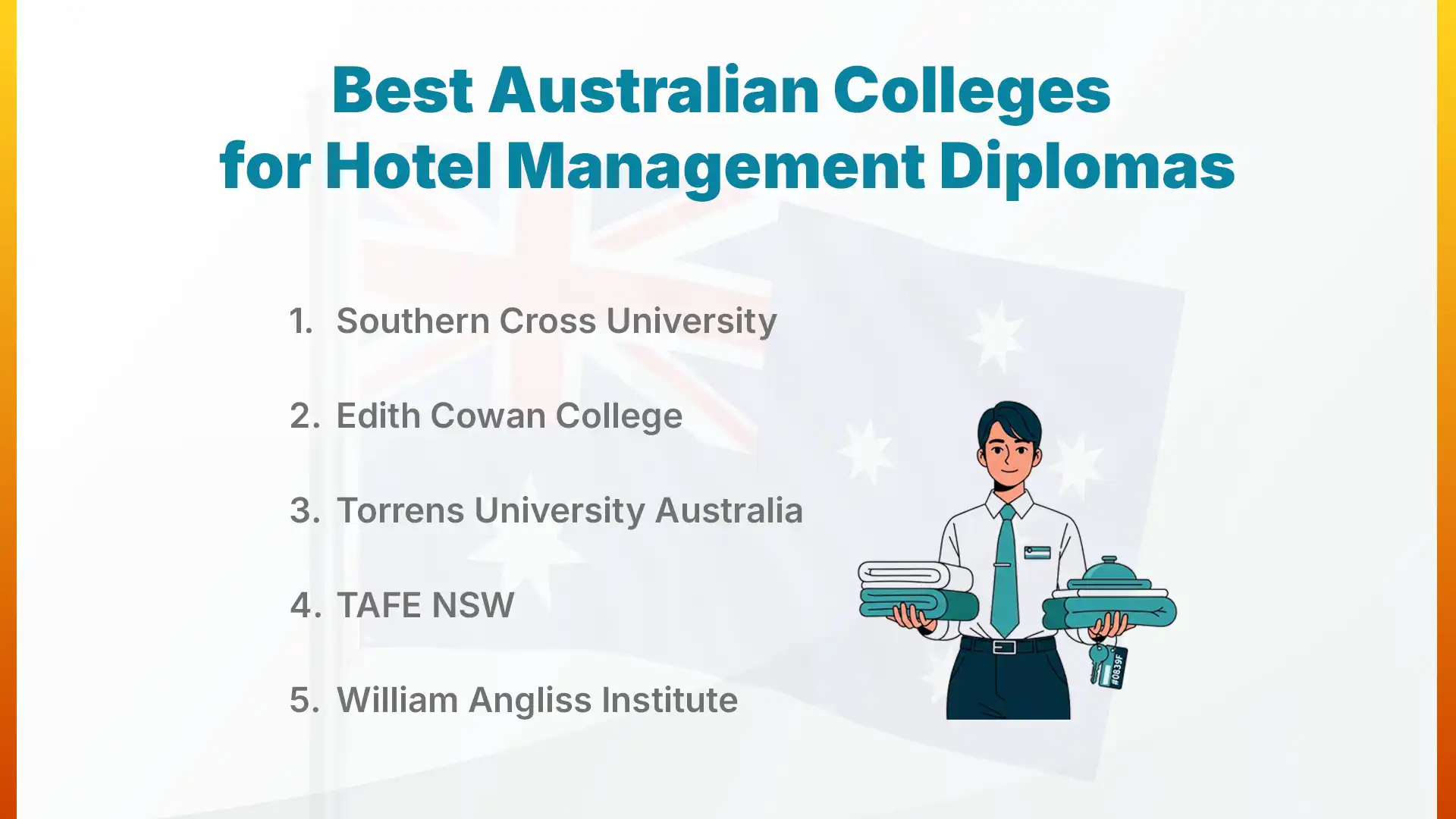
1. Blue Mountains International Hotel Management School (BMIHMS)
Part of Torrens University, BMIHMS is located in the Blue Mountains area near Sydney. It focuses on real hotel-style training and work-integrated learning in hotel-like settings. This helps you learn by doing, so you can build skills for a hotel career.
2. William Angliss Institute
William Angliss Institute is located in Melbourne and Sydney. It is a specialist school focused on hospitality and tourism diplomas with practical training. Because it is strongly industry-focused, it can help you get job-ready faster.
3. The Hotel School (Southern Cross University)
The Hotel School is operated with Southern Cross University and offers diploma programs in major cities like Sydney, Melbourne, and Brisbane. Its curriculum emphasizes real-world learning through industry connections, including links with Mulpha Australia’s hotel portfolio. This can make your training feel closer to actual hotel work.
4. Edith Cowan College
Located in Perth, Edith Cowan College provides a structured two-year diploma that feeds directly into ECU's Bachelor of Hospitality and Tourism Management. This pathway can save you both time and money compared to starting a bachelor's degree from scratch. It also helps you plan your study step-by-step toward a bigger degree.
5. TAFE NSW
For students seeking quality education at a more affordable price point, TAFE NSW delivers nationally accredited hospitality diplomas with strong practical components. Multiple campus locations across New South Wales provide flexibility. Students may also explore Level 2 universities in Australia for additional affordable pathway options.
Choosing the right institution can feel overwhelming. Here's a quick comparison of reputable colleges offering hotel management diplomas.
Institution | Location | Key Strength (2026/27) |
| Blue Mountains International Hotel Management School (BMIHMS) | Sydney, Leura | Ranked #1 in Australia (QS 2026); immersive residential learning at Leura. |
| William Angliss Institute | Melbourne, Sydney | Specialist hub for foods, tourism, and events with 85+ years of industry history. |
| The Hotel School (Southern Cross University) | Sydney, Melbourne, Brisbane | Unique partnership with Mulpha Australia; direct access to luxury hotel portfolios. |
| Edith Cowan College (ECC) | Perth | Guaranteed pathway to 2nd year of ECU’s Hospitality degree for 2026 intakes. |
| Torrens University Australia (BMIHMS) | Sydney, Adelaide | Ranked #1 in Oceania for Hospitality; strong focus on global leadership and employability. |
| TAFE NSW | Various NSW Campuses | Government-backed practical training; most affordable entry-level diplomas. |
Entry Requirements for Diploma in Hotel Management in Australia
Entry requirements for a Diploma in Hotel Management in Australia typically require completion of Australian Year 12 (or international equivalent) with satisfactory grades. English language proficiency is essential, typically requiring an IELTS score of 5.5-6.0 (or equivalent). Some institutions also accept mature-age applicants with relevant industry experience.
While specific requirements vary between institutions, most share common admission criteria. Let's break down what you'll typically need to meet for admission into a hotel management diploma program.
1. Academic Qualifications
The typical academic requirement is completion of secondary school equivalent to Australian Year 12. If you're still deciding what to do after class 12, a hospitality diploma is one of the most practical options available.
If you've completed Grade 12 in Nepal and meet the minimum GPA for Australia, you generally qualify. Some institutions offer alternative entry pathways for mature-age applicants with relevant work experience.
2. Age and Prerequisite Requirements
Most programs require applicants to be at least 18 years old at enrollment. While some courses list English or Mathematics as prerequisite subjects, work experience is generally not required for diploma-level entry.
English Language Requirements for International Diploma Students
International diploma students in Australia typically require an IELTS (Academic) overall score of 5.5 to 6.0, with no individual band below 5.0–5.5. Equivalent scores from PTE Academic (approx. 42–52) or TOEFL iBT (approx. 46–70) are also accepted. Requirements may be lower if packaged with ELICOS.
All international students from non-English speaking countries need to demonstrate one of the following English proficiency:
Test Type | Minimum Score (Diploma Level - 2026) |
| IELTS Academic | 5.5 Overall (No band below 5.0) |
| PTE Academic | 42 – 46 Overall |
| TOEFL iBT | 46 – 59 Overall |
1. IELTS Score Requirements
For most diploma programs, an overall IELTS band of 5.5 with no individual band below 5.0 is the standard requirement. Some institutions may accept 5.0 overall with pathway English programs.
2. PTE Academic Requirements
PTE Academic has become increasingly popular among Nepali students due to faster result turnaround. The equivalent requirement is typically an overall score of 42 with no communicative skill below 36.
3. Other Accepted English Tests
Beyond IELTS and PTE, many institutions accept TOEFL iBT, Cambridge English qualifications, and the Duolingo English Test. If your scores fall slightly below requirements, English language pathway programs (ELICOS) can bridge the gap.
What is the Cost of studying a Hotel Management Diploma in Australia?
A Diploma in Hotel Management in Australia typically costs between AUD 10,000 and AUD 30,000 per year for international students, with durations ranging from 1 to 2 years. Advanced Diplomas or specialized program can reach up to AUD 23,600. Tuition, however, is just one part of the cost of studying in Australia. Understanding the full financial picture helps you budget accurately and avoid surprises after arrival.
Beyond course fees, you'll need to account for accommodation, daily living expenses, health insurance, and study materials. Here's what you can expect across different cost categories:
Institution | Indicative Annual Fee (2026 AUD) |
| TAFE NSW | $15,600 – $22,000 |
| William Angliss Institute | $18,440 – $25,000 |
| Edith Cowan College (ECC) | $27,300 – $37,000 |
| Torrens University (incl. BMIHMS) | $24,000 – $32,000 |
1. Tuition Fees of Diploma in Hotel Management by Institution
International student fees for hotel management diplomas in Australia typically range from AUD $18,000 to $34,000 for the full program. Here’s the general tuition range in some of the most popular diploma colleges in Australia:
2. Living Costs for International Students in Australia
The Australian Government estimates international students need approximately AUD 29,710 per year for living expenses. Major costs include:
- Accommodation: $150–$350 per week depending on location and type
- Food and groceries: $100–$150 per week
- Transportation: $30–$60 per week with student concessions
- Health insurance (OSHC): $500–$700 per year (mandatory for all student visa holders)
3. Additional Study Expenses
Beyond tuition and living costs, budget around AUD 300–AUD 500 for textbooks, AUD 200–AUD 400 for uniforms if required, and personal expenses.
Scholarships for Hospitality and Hotel Management Students
Scholarships can significantly reduce your cost of studying hospitality or hotel management in Australia. In most cases, you can get 10% to 50% tuition fee discounts, while some programs also offer fixed financial support. That’s why it’s important to start your research early and explore both government and college-level options before applying.
1. Australian Government Scholarships
Some scholarships are funded by the Australian government. For example, Australia Awards provides funding for eligible international students, although it is highly competitive and often focused on higher education. Another option is Destination Australia, which supports students studying in regional areas. This can work well for hospitality courses offered outside major cities.
2. University and College Scholarships
Many colleges and universities offer their own scholarships based on academic performance, financial need, or your country of origin. For example, International College of Hotel Management (ICHM) typically offers 10% to 25% fee reductions, while Blue Mountains International Hotel Management School (BMIHMS) may offer scholarships of up to 50%.
Other good options include scholarships at Swinburne University of Technology and Griffith College, which help reduce costs for diploma and pathway programs. Some institutions also have special scholarships for South Asian students, including those from Nepal.
3. Pathway Scholarships
If you are starting with a diploma or pathway program, there are specific scholarships designed for that route. Options like UTS College, La Trobe College Australia, and Federation University Australia offer funding support for students progressing into undergraduate degrees. These are especially useful if you want a more affordable starting point.
4. Government and Other Funding Options
Apart from major scholarships, there are smaller funding opportunities as well. For example, the Victorian TAFE Network Hospitality Scholarship offers $10,000 support for eligible students in hospitality courses. You may also come across private options like the Kaplan Family Bursary, which can provide around a 10% tuition discount.
Career Opportunities in Australia’s Hospitality Industry for Diploma Graduates
Australia's tourism and hospitality sector creates strong demand for qualified graduates. The industry is projected to grow steadily through 2026, with hotels, resorts, and tourism operators actively seeking trained professionals who can deliver quality service. Your diploma qualification positions you to fill these roles across multiple hospitality segments.
1. Hotel and Resort Management Roles
Entry-level management positions include Front Office Supervisor, Guest Services Coordinator, Housekeeping Manager, and Duty Manager. With experience, you can progress to Rooms Division Manager or Hotel Operations Manager.
2. Food and Beverage Management Positions
Opportunities in this area include Restaurant Manager, Bar Manager, Banquet Coordinator, and Catering Manager. These roles involve overseeing dining operations, managing staff teams, controlling inventory, and ensuring exceptional customer experiences. Many graduates start in assistant or supervisor positions before advancing to full management responsibilities within 1–2 years.
3. Event and Tourism Management Careers
Your diploma also qualifies you for positions in event coordination, conference management, tourism operations, and cruise ship hospitality. The events sector particularly values hospitality-trained professionals who understand both operational logistics and customer service excellence. Tourism operators across Australia actively recruit diploma graduates for roles in tour coordination, visitor services, and destination management.
4. Salary Expectations for Graduates in Australia
Entry-level hospitality management positions typically offer AUD $50,000–$60,000 annually. With 3–5 years of experience, salaries can reach AUD $70,000–$90,000 for mid-level management roles. Senior management positions in larger hotels and resorts can command salaries exceeding AUD $100,000, particularly in major cities like Sydney and Melbourne. Your earning potential increases significantly as you gain specialized skills and take on greater operational responsibilities.
Pathway from Diploma to Bachelor's Degree in Hotel Management
One of the diploma's greatest advantages is its function as a stepping stone to higher qualifications.
1. Credit Transfer Options
Upon completing your diploma, you typically receive credit for units already studied. This can reduce a three-year bachelor's degree to just two years, saving you a full year of tuition and living expenses. Beyond that, graduates can eventually pursue a master's in hospitality management in Australia for senior leadership roles.
2. Partner University Articulation Programs
Many colleges have formal pathway agreements with universities, allowing you to transition smoothly from diploma to degree with guaranteed credit transfer. These articulation arrangements are pre-approved, meaning you won't need to negotiate credit recognition individually. The pathway is already established and streamlined for diploma graduates.
For example:
- Edith Cowan College: Graduates can enter ECU's bachelor program directly
- Griffith College: Guaranteed pathways to Griffith University
- TAFE NSW: Articulation arrangements with multiple universities
Student Visa Requirements for Studying Diploma in Australia
To study a diploma in Australia, you must apply for the Subclass 500 Student Visa, which requires proof of enrollment, sufficient funds, health insurance, and genuine study intent. This visa allows full-time study, limited work rights, and requires documents like financial evidence, OSHC, and a strong GTE statement. Now, let’s break down each requirement so you clearly understand what you need to prepare.
1. Subclass 500 Student Visa Overview
This visa allows you to live and study full-time in Australia for your course duration. It also permits part-time work during studies and unlimited work during scheduled breaks.
2. Financial Requirements for Visa Application
You'll need to demonstrate sufficient funds for tuition fees, living expenses (AUD $24,505 per year), and travel costs. Acceptable evidence includes bank statements, education loan approvals, scholarship letters, or sponsor declarations.
3. Health Insurance and Character Requirements
Overseas Student Health Cover (OSHC) is mandatory for your entire stay in Australia. You'll also need to meet character requirements, which may involve providing police clearance certificates.
4. Genuine Temporary Entrant Statement
The GTE statement is a critical component of your visa application. You'll write a personal statement explaining your genuine intention to study temporarily in Australia. Immigration officers assess your circumstances in Nepal, immigration history, and the value of the course to your future career.
Work Rights for International Students in Australia
International students in Australia can work up to 48 hours per fortnight during study periods and unlimited hours during breaks, helping them manage living costs while studying. This also allows you to gain practical experience in industries like hospitality, along with post-study work opportunities through visas like Subclass 485. Now, let’s look at how these work rights apply during your studies and after graduation.
1. Part-Time Work While Studying
Student visa holders can work up to 48 hours per fortnight during academic sessions and unlimited hours during scheduled breaks. Hospitality students often find relevant part-time work easily in cafes, restaurants, and hotels.
2. Post-Study Work Visa Options
After graduating, you may be eligible for the Temporary Graduate Visa (Subclass 485). This visa allows you to live and work in Australia, gaining full-time experience that can support future skilled migration applications.
How to Apply for a Hotel Management Diploma in Australia from Nepal?
To apply for a hotel management diploma in Australia from Nepal, you need to research courses, meet eligibility, prepare documents, apply to institutions, secure your offer, and then apply for a student visa. This process may seem long, but breaking it into clear steps makes it much easier to manage. Let’s walk through each step so you know exactly what to do next:
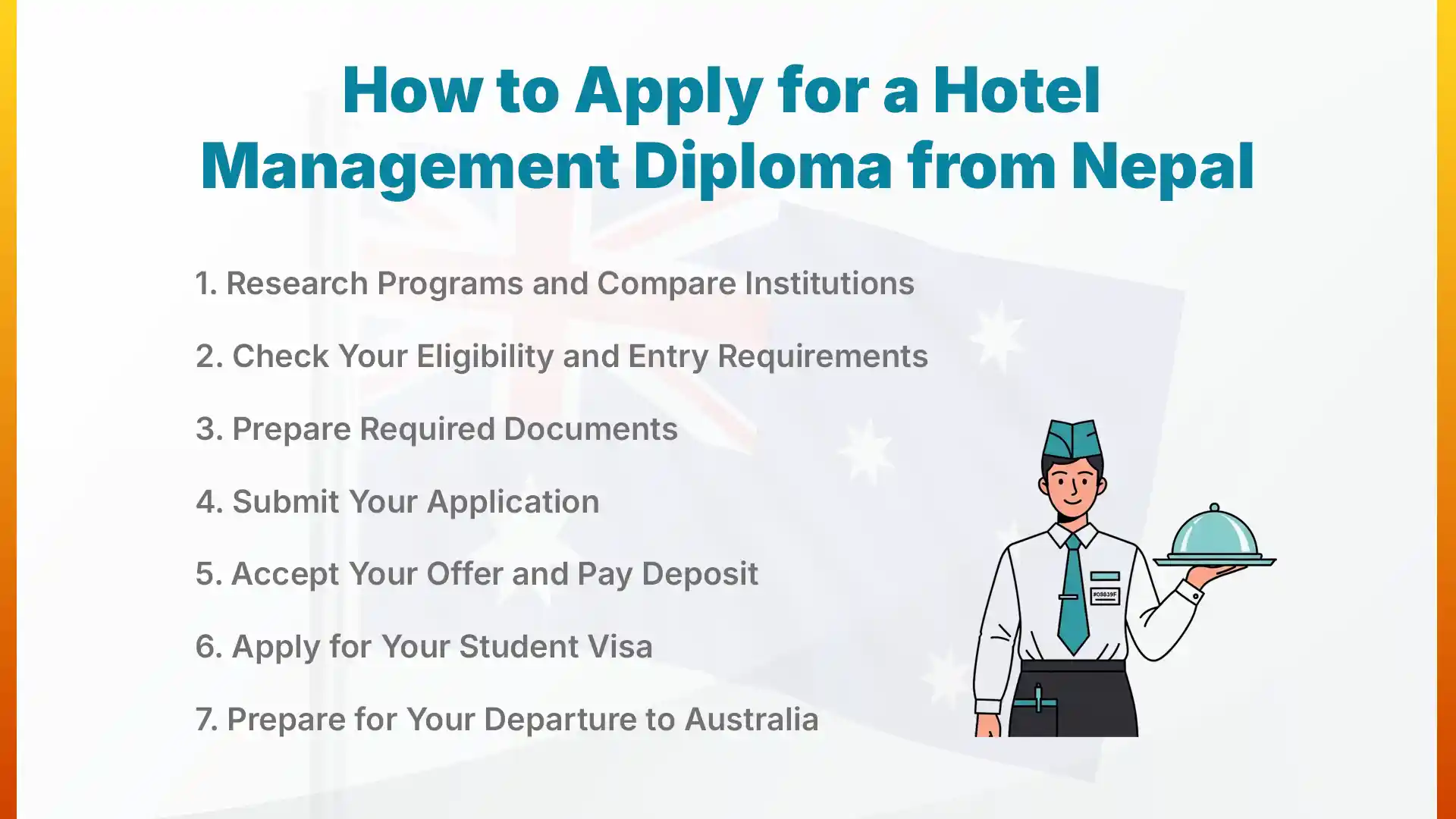
1. Research Programs and Compare Institutions
Start by comparing diploma courses in Australia, looking at course content, fees, locations, and pathway options. Consider factors like campus facilities, industry connections, and graduate employment rates.
2. Check Your Eligibility and Entry Requirements
Carefully review the academic and English language requirements for each institution. Most diploma programs require completion of +2 and an IELTS or equivalent test score. If your English score is slightly lower, consider enrolling in a pathway or English preparation program. Confirming eligibility early helps you avoid delays or rejections later.
3. Prepare Required Documents
Begin collecting all necessary documents well in advance to avoid last-minute stress. This usually includes academic transcripts, certificates, English test results, a valid passport, SOP for Australia, and financial proof. Make sure all documents are clear, updated, and properly scanned. Having everything ready speeds up your application process significantly.
4. Submit Your Application
Apply directly through the institution’s website or with the help of a trusted education consultancy. Fill in your details carefully and double-check before submission. Some colleges may charge a small application fee, so be prepared for that. Once submitted, keep track of your application status and emails regularly.
5. Accept Your Offer and Pay Deposit
If your application is successful, you will receive a Letter of Offer from the institution. Read all conditions carefully before signing the acceptance. Pay the required tuition deposit within the deadline to secure your seat. After this, you will receive your Confirmation of Enrolment (CoE), which is essential for your visa.
6. Apply for Your Student Visa
With your CoE ready, begin your student visa application online through the official portal. Prepare financial documents, health insurance, and your Genuine Student statement. Ensure all details are accurate and consistent with your application. A well-prepared visa file increases your chances of approval.
7. Prepare for Your Departure to Australia
Once your visa is approved, start planning your travel arrangements. Book your flight early and arrange temporary accommodation for your arrival. Organize your finances, including forex or international cards for initial expenses. Being well-prepared ensures a smooth transition to your new student life in Australia.
Intake Dates and Application Deadlines
Australian institutions usually offer two main intakes: February/March and July, along with some additional intakes later in the year, each with recommended application deadlines a few months in advance. Applying early (typically 3–5 months before your intake) improves your chances of securing a seat and completing visa processing on time. Now, let’s look at the intake timelines and deadlines in detail.
Intake Name | Course Start (2026) | 2026 Recommended Application Deadline |
| Semester 1 / Fall | Feb / Sept | October – January (previous year). For Sept 2026, apply by Jan 2026 for equal consideration. |
| Semester 2 / Winter | July / Jan | March – June. For July 2026, apply by April. For Jan 2027, start by June 2026. |
| Additional / Summer | May / Nov / Oct | August – September. Typically 4-5 months before the course start date. |
Applying early gives you the best chance of securing your preferred course and allows adequate time for visa processing.
Conclusion
Studying a diploma in hospitality or hotel management in Australia is a smart and practical choice. Now that you’ve reached the end of this article, you have a clear idea of what it takes to plan your journey to diploma education in Australia.
If you’re someone who dreams of working in hotels, travelling the world, or building a global career, this path can truly open doors. It may feel confusing at first, but with the right guidance and early planning, everything becomes much easier. Many students from Nepal start just like you and succeed.
So, instead of waiting or overthinking, take the first small step today. Explore your options, ask questions, and get the right support. The sooner you begin, the closer you move toward your dream.