Diploma in Culinary Arts in Canada: Colleges, Fees & Career Scope

Jun 08, 2026

Canada is one of the world's most exciting destinations for culinary education, with a thriving food culture, a booming hospitality industry, and some of the most professionally respected culinary programs available anywhere.
For Nepalese students who want to build a career in professional kitchens, restaurant management, or the global food industry, a diploma in culinary arts in Canada offers hands-on training, industry placement experience, and a direct pathway into one of the most in-demand sectors in the country. Nepalese students who are still exploring their options can start by reading about studying in Canada before committing to a specific program.
In this blog
What Is a Diploma in Culinary Arts in Canada?
A diploma in culinary arts in Canada is a 1- to 2-year practical training program offered at colleges and culinary institutes across the country. Depending on the institution, the credential may be called a diploma, an advanced diploma, or a certificate in culinary arts or culinary management. The distinction matters: a certificate is typically 6 to 12 months, a diploma is 1 to 2 years, and an advanced diploma includes broader management and hospitality components alongside kitchen training.
The curriculum combines classroom instruction with extensive hands-on kitchen laboratory hours, and most programs include a mandatory industry co-op or work placement term. Core subjects covered include:
Professional cooking techniques and cuisine styles
Baking, pastry, and dessert arts
Kitchen management and operations
Food safety, sanitation, and nutrition
Menu planning and cost control
Introduction to hospitality and food service management
Graduates are prepared for entry-level and supervisory roles in professional kitchens, hotels, resorts, catering companies, and food service organizations across Canada and internationally. For students interested in comparing culinary pathways across countries, it is also worth exploring the Diploma in Culinary Arts in Australia before making a final decision.
Why Study Culinary Arts in Canada?
Canada is one of the best destinations to study culinary arts because of its high demand for trained chefs, world-class kitchen training facilities, strong co-op placements, affordable tuition compared to the USA and UK, and a clear PR pathway through culinary occupations after graduation. This is a significant part of why Nepalese students choose Canada for hospitality and culinary programs.
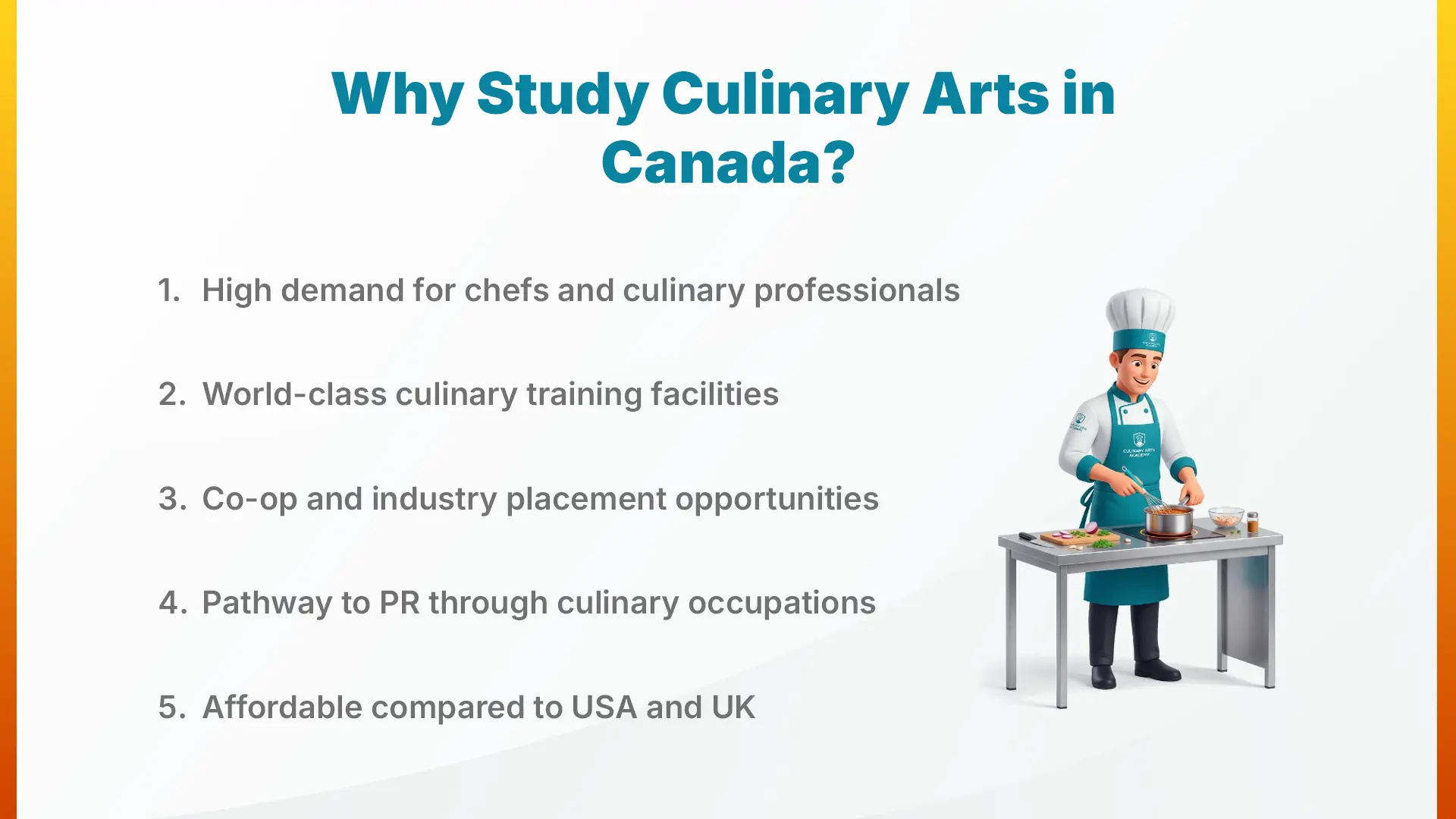
1. High Demand for Chefs and Culinary Professionals
Canada's food service and hospitality sector is one of the country's largest employers, and the shortage of trained culinary professionals is well-documented across all provinces. Hotels, restaurants, resorts, and catering companies consistently struggle to fill skilled kitchen roles, making culinary diploma graduates among the most readily employable international students in Canada.
2. World-Class Culinary Training Facilities
Canadian culinary colleges invest heavily in professional-grade kitchen laboratories, bakery facilities, and restaurant simulation environments where students train under experienced chef-instructors. Institutions like George Brown College and SAIT operate award-winning teaching restaurants that serve real customers, giving students a level of real-world kitchen pressure that prepares them for professional practice from day one.
3. Co-op and Industry Placement Opportunities
Most Canadian culinary diploma programs include a mandatory co-op or industry placement term where students work in professional kitchens, hotel food and beverage departments, or catering organizations as a credit-bearing component of their program. These placements build professional networks, develop supervisory skills, and often lead directly to post-graduation job offers.
4. Pathway to PR Through Culinary Occupations
Cooks and chefs are listed as in-demand occupations under Canada's immigration system, and culinary diploma graduates with Canadian work experience are well-positioned to apply for permanent residency through Express Entry and several provincial nominee programs. This makes a culinary diploma in Canada not just a career investment but also a practical immigration pathway for Nepalese students.
5. Affordable Compared to USA and UK
Culinary diploma programs in Canada are significantly more affordable than equivalent programs at leading culinary institutes in the USA and the UK, particularly when the shorter program duration and strong co-op earning potential are factored into the total cost calculation.
Which Are the Top Colleges for Culinary Arts in Canada?
The top colleges for a diploma in culinary arts in Canada include George Brown College, Humber College, SAIT, Vancouver Community College, and Algonquin College, each offering industry-connected programs with strong kitchen training facilities and employer networks across the Canadian food service sector.
College | Location | Program | Duration |
|---|---|---|---|
| George Brown College | Toronto, Ontario | Culinary Arts Diploma | 1 – 2 years |
| Humber College | Toronto, Ontario | Culinary Management Diploma | 2 years |
| SAIT | Calgary, Alberta | Culinary Arts Diploma | 1 – 2 years |
| Vancouver Community College (VCC) | Vancouver, BC | Culinary Arts Certificate / Diploma | 1 – 2 years |
| Algonquin College | Ottawa, Ontario | Culinary Arts Diploma | 2 years |
What Are the Admission Requirements?
The admission requirements for a diploma in culinary arts in Canada include completion of grade 12 or plus two, English language proficiency through IELTS, TOEFL, or PTE; a personal motivation letter; and financial documentation for the study permit.
1. Academic Requirements
Applicants must have completed Grade 12 or Plus Two with satisfactory overall results. There are no specific prerequisite subjects for most culinary programs, though a background in home economics, food science, or hospitality is advantageous.
2. English Language Requirements
IELTS Academic: minimum overall score of 6.0, with no band below 5.5
TOEFL iBT: minimum score of 71 to 80
PTE Academic: minimum score of 53 to 58
Nepalese students who need to strengthen their English score can enroll in IELTS preparation classes before applying.
3. Personal Statement / Motivation Letter
Most culinary programs require a short personal statement or motivation letter explaining your passion for food, any relevant cooking or hospitality experience, and your career goals in the culinary industry.
4. Financial Proof and Visa Documentation
For the Canadian Study Permit, students must demonstrate sufficient funds to cover tuition and living expenses for at least the first year. Know beforehand what the requirements are to study in Canada from Nepal for a higher chance of visa approval.
How to Apply for a Culinary Arts Diploma in Canada?
Applying for a diploma in culinary arts in Canada involves five steps: researching and shortlisting colleges, preparing your documents, submitting your application, writing your motivation letter and applying for your study permit. It is worth knowing the Canada September intake deadlines early to avoid missing the application window for your preferred college.
Step 1: Research and Shortlist Colleges
Compare culinary programs based on duration, location, tuition fees, and whether co-op placement is included. Shortlist 2 to 3 colleges that match your budget and career goals.
Step 2: Prepare Your Documents
Gather your Plus Two transcripts, IELTS or TOEFL scores, valid passport, and motivation letter before applying. Having everything ready in advance avoids last-minute delays.
Step 3: Submit Your Application
Apply directly through the college's online portal. If you are applying to an Ontario college such as George Brown, Humber, or Algonquin, use the OCAS application platform.
Step 4: Write Your Motivation Letter
Your motivation letter should explain why you want to study culinary arts, any cooking or food-related experience you have, and your career goals after graduation. Follow the SOP format for Canada to structure it correctly.
Step 5: Apply for Your Study Permit
Once you receive your offer letter from the college, apply for your Canadian study permit through the IRCC online portal. Submit your offer letter, proof of funds, valid passport, and biometrics to complete the application.
How Much Does It Cost to Study Culinary Arts in Canada?
A Diploma in Culinary Arts in Canada costs between CAD 8,000 and CAD 22,000 (approximately NPR 720,000 to NPR 1,980,000) per year in tuition for international students, depending on the institution and program level. The total cost to study in Canada depends on which college you choose and where you choose.
College | Annual Tuition (CAD) | Annual Tuition (NPR approx.) |
|---|---|---|
| Algonquin College | CAD 8,000 – CAD 12,000 | NPR 720,000 – NPR 1,080,000 |
| VCC | CAD 10,000 – CAD 14,000 | NPR 900,000 – NPR 1,260,000 |
| SAIT | CAD 12,000 – CAD 16,000 | NPR 1,080,000 – NPR 1,440,000 |
| Humber College | CAD 14,000 – CAD 18,000 | NPR 1,260,000 – NPR 1,620,000 |
| George Brown College | CAD 16,000 – CAD 22,000 | NPR 1,440,000 – NPR 1,980,000 |
Monthly living expenses in Canada range from CAD 900 to CAD 2,000 depending on the city, with Toronto and Vancouver sitting at the higher end and Calgary and Ottawa being more affordable. Many Nepalese students take up part-time jobs in Canada during their studies to offset living costs. Taking tuition and living expenses together, Nepalese students should budget approximately CAD 22,000 to CAD 40,000 per year in total.
What Scholarships Are Available?
Several scholarships are available for Nepalese students pursuing a diploma in culinary arts in Canada, though options are more limited than for bachelor's degree programs.
George Brown College International Student Scholarship: a merit-based partial tuition award for high-achieving incoming international students
Humber College International Entrance Scholarship: partial tuition award for eligible international applicants with strong academic records
SAIT International Student Awards: merit-based scholarships for students entering diploma programs at SAIT
Culinary Industry Bursaries: Several provincial culinary and hospitality associations offer small bursaries for students entering culinary training programs
Tips to improve your chances:
Apply as early as possible; most awards are assessed at the time of admission
Contact the international student office of your chosen college directly to ask about available awards not listed publicly
Highlight any relevant food, hospitality, or community service experience in your application
What Jobs Can You Get After a Culinary Arts Diploma in Canada?
Graduates with a diploma in culinary arts from Canada can work as a chef de partie, pastry chef, kitchen manager, food and beverage supervisor, and catering manager across hotels, restaurants, resorts, and catering companies in Canada and internationally.

1. Chef de Partie
A chef de partie manages a specific section of a professional kitchen, such as the grill, sauce, or pastry station, and is responsible for the quality and consistency of dishes produced in their section. This is the most common entry-level management role for culinary diploma graduates in hotel and fine dining kitchens.
2. Pastry Chef
A pastry chef specializes in the design and production of desserts, baked goods, confections, and pastry items for restaurants, hotels, bakeries, and catering companies. Pastry specialization is one of the most in-demand and creatively rewarding career paths within professional culinary practice.
3. Kitchen Manager
A kitchen manager oversees the full operational and logistical functions of a professional kitchen, including staff scheduling, food cost control, inventory management, and compliance with food safety regulations. This is a natural progression role for culinary graduates with strong organizational and leadership skills.
4. Food and Beverage Supervisor
A food and beverage supervisor manages the service and operational coordination between the kitchen and front-of-house teams in hotels, resorts, and large restaurant groups. This role suits graduates who want to develop both culinary and hospitality management skills.
5. Catering Manager
A catering manager plans and oversees food production and service for large-scale events, corporate catering contracts, and institutional food service operations. This is a high-demand role in Canada's active events, corporate, and healthcare catering sectors.
What Is the Salary and Scope After Culinary Arts in Canada?
The salary and career scope after a diploma in culinary arts in Canada are strong and growing, with consistent demand for trained culinary professionals across all provinces and a clear pathway from graduation to permanent residency through the post-graduation work permit. Culinary arts is recognized as one of the best courses in Canada for Nepalese students who want a practical, employment-focused diploma with a genuine immigration advantage.
1. Salary Range After Graduation
Entry-level culinary graduates in Canada earn between CAD 35,000 and CAD 48,000 per year, rising to CAD 48,000 to CAD 65,000 at mid-level, and CAD 65,000 to CAD 95,000 or more for senior and head chef positions.
Experience Level | Annual Salary (CAD) | Annual Salary (NPR approx.) |
|---|---|---|
| Entry-Level (0–2 years) | CAD 35,000 – CAD 48,000 | NPR 3,150,000 – NPR 4,320,000 |
| Mid-Level (2–5 years) | CAD 48,000 – CAD 65,000 | NPR 4,320,000 – NPR 5,850,000 |
| Senior / Head Chef (5+ years) | CAD 65,000 – CAD 95,000+ | NPR 5,850,000 – NPR 8,550,000+ |
2. PGWP Pathway
After completing a diploma of one year or longer at a designated learning institution in Canada, international graduates are eligible for the Post-Graduation Work Permit (PGWP), which allows full-time work in Canada for a period equivalent to the length of their program, up to a maximum of three years for programs of two years or more.
3. PR Pathway
Cooks (NOC 63200) and chefs (NOC 62200) are recognized skilled occupations under Canada's immigration system. Culinary diploma graduates who gain Canadian work experience through the PGWP can apply for permanent residency through Express Entry's Canadian Experience Class or through Provincial Nominee Programs in British Columbia, Alberta, Ontario, and Atlantic Canada, all of which actively support experienced culinary professionals.
Canadian culinary credentials are also respected by employers in the UAE, Singapore, the UK, Australia, and across the cruise line and luxury resort industries globally, giving Nepalese graduates genuine international career flexibility beyond Canada.
Conclusion
A diploma in culinary arts in Canada offers Nepalese students a practical, affordable, and professionally respected pathway into one of the world's most dynamic and in-demand industries. With world-class training facilities, strong co-op integration, consistent employer demand, competitive salaries, and a clear pathway to permanent residency through culinary occupations, Canada is one of the most strategically sound destinations for Nepalese students who are serious about building a career in professional cookery and food service management.
Interested in studying culinary arts in Canada? Contact SAS Education Consultancy for a free counseling session and let us help you find the right college, prepare your application, and navigate the study permit process with confidence.