Dental Diploma Courses in Canada: Eligibility, Fees, Colleges & Careers

Jun 10, 2026
Have you ever thought about working in healthcare, but don't want to spend many years studying to become a doctor or dentist? If yes, dental diploma courses in Canada could be exactly what you're looking for.
These programs are becoming increasingly popular among Nepalese students because they are practical, career-focused, and can be completed in a shorter time than many traditional degrees.
But there are so many universities providing all these diploma programs in Canada.
Which dental diploma course offers the best career opportunities?
Should you study Dental Assisting, Dental Hygiene, or Dental Technology? And what are the admission requirements?
Don't worry, we've got you covered. In this guide, you'll learn about the best dental diploma courses in Canada, eligibility requirements, costs, career prospects, and everything else you need to make an informed decision.
In this blog
What Are Dental Diploma Courses in Canada?
Dental diploma courses in Canada are career-focused clinical programs lasting one to three years that train you to work as an assistant, hygienist, or technician. These practical courses are offered by public colleges and skip long research papers to focus entirely on real patient care.
Dental Diploma vs a University Bachelor's Degree in Canada
Before choosing your path, it is important to see how these programs compare side by side. While a university bachelor's degree in Canada offers deep academic theory, a dental diploma in Canada focus entirely on getting you job-ready quickly and affordably.
Dental Diploma in Canada | University Bachelor's Degree in Canada |
|---|---|
| Learning by doing. Focuses on real patient care and practical clinic skills. | Learning from books. Focuses on deep scientific research and long classroom lectures. |
| Short-term commitment of only 1 to 3 years. | Long-term commitment of 4 to 5 years of study. |
| Much cheaper tuition fees that are easier for Nepalese families to pay. | Very expensive tuition fees that can cause a high financial burden. |
| Easy language requirement (IELTS of 6.0 to 6.5 overall). | Stricter entry criteria (often requiring 6.5 to 7.0 or more IELTS score). |
| Lets you work immediately as a licensed clinical assistant or hygienist. | Prepares you to apply for a Doctor of Dental Surgery (DDS) to become a dentist. |
Why Study Dental Diploma Courses in Canada?
Studying a dental diploma in Canada offers Nepalese students fast-track entry into a high-paying healthcare market with lower tuition costs and excellent PR pathways. These programs are much shorter than university degrees and focus directly on the clinical skills employers are looking for right now. Let us look at the biggest benefits of choosing this path after your plus two exams.
- Urgent Hiring Demands: Over 82% of Canadian dental clinics are desperately hiring right now
- 90% Graduate Placement: You can finish school and get hired within three months.
- 1% Industry Unemployment: Absolute job security backed by hands-on clinical training.
- Priority PR Draws: Express Entry runs special visa draws specifically for healthcare roles, so you automatically increase your chances.
What Are the Types of Dental Diploma Courses in Canada?
The main types of dental diploma courses in Canada include Dental Assisting, Dental Hygiene, Dental Technology, and Denturism programs. Each of these courses targets a specific clinical role and gets you ready for your provincial licensing exams quickly. Let us break down what you will study in each program to help you find your perfect match.
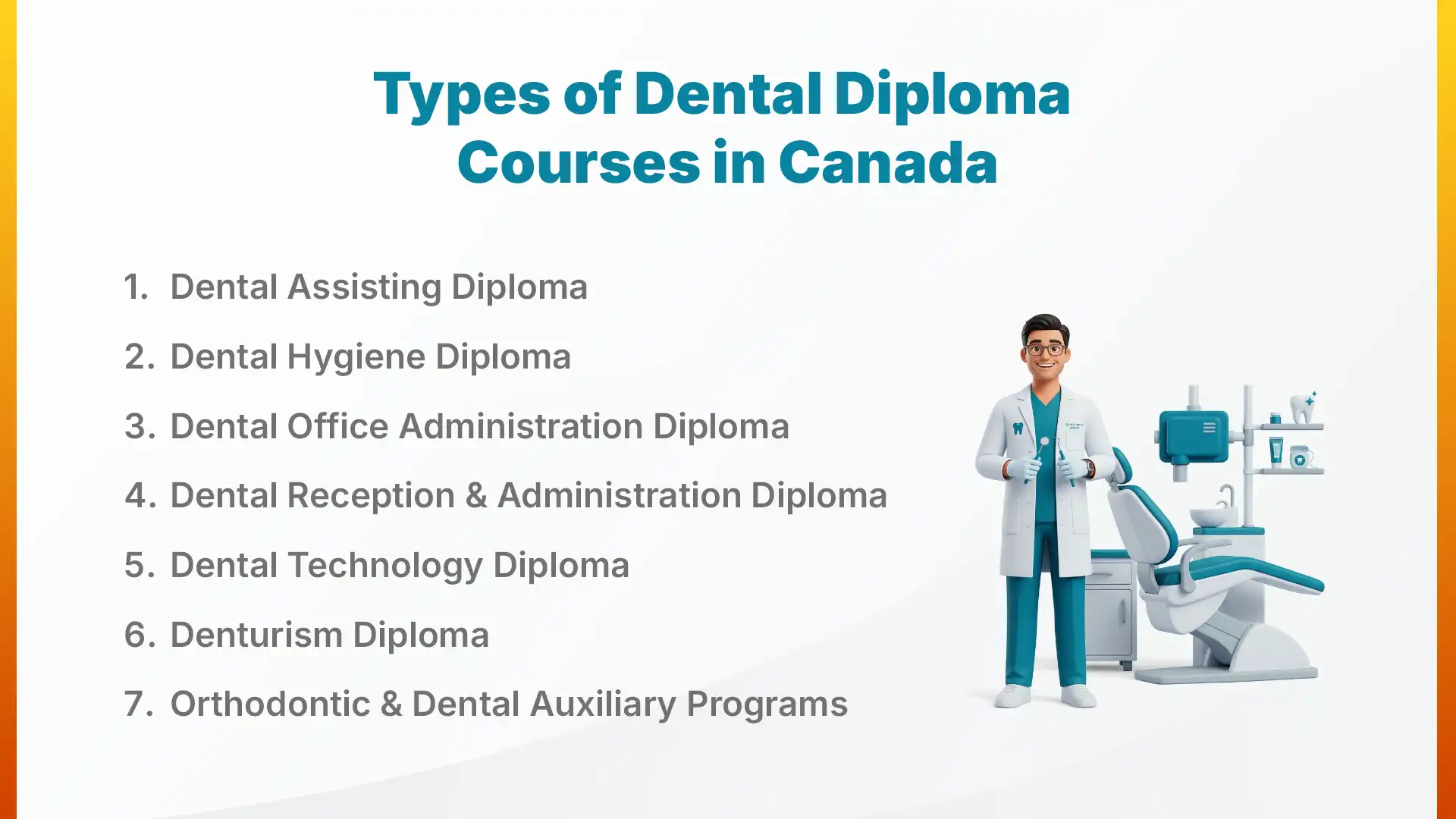
1. Dental Assisting Diploma (Level I & II)
This fast-paced, one-year program teaches you to prepare patients, take clear X-rays, and sterilize clinic tools. You will work directly next to licensed dentists during complex surgical operations in real Canadian offices. Consequently, this intense practice gets you completely ready for your NDAEB licensing exams. Thus, choose this path if you want to graduate quickly and start earning money immediately.
Key Subjects:
- Dental Radiography
- Clinical Chairside Assisting
- Dental Materials
- Infection Control
2. Dental Hygiene Diploma
This highly competitive two-to-three-year program trains you to clean teeth, perform oral exams, and apply protective dental sealants. You will practice directly on real community patients inside your college's state-of-the-art simulation clinic. As a result, you will gain the deep clinical confidence needed to clear your NDHCE national board tests. Therefore, this is the perfect choice if you want high professional independence and an outstanding hourly wage.
Key Subjects:
- Periodontics
- Oral Anatomy
- Clinical Hygiene Practice
- Community Oral Health
3. Dental Office Administration Diploma
This specialized one-year program focuses on the essential business operations that keep a Canadian dental clinic running smoothly. You will master electronic health records, process complex insurance claims, and manage daily patient appointment schedules. Because of this administrative focus, you will avoid doing physical clinical procedures on patients. Consequently, this is an excellent match if you want a reliable desk job inside a quiet healthcare environment.
Key Subjects:
- Dental Office Procedures
- Medical Billing Software
- Dental Terminology
- Client Relations
4. Dental Technology Diploma
This creative three-year technical program teaches you to design and build custom dental crowns, bridges, and orthodontic braces. You will work inside high-tech laboratories utilizing advanced CAD/CAM software and 3D printing machines. Through this hands-on design process, you will turn raw dental metals and ceramics into life-changing medical devices. Thus, you should select this path if you love technical art, detail-oriented crafts, and modern software design.
Key Subjects:
- Dental Prosthetics
- Orthodontic Appliances
- Dental Metallurgy
- 3D Dental Design
Which Top Colleges Offer Dental Diploma Courses in Canada?
The top colleges offering dental diploma courses in Canada are George Brown College, Fanshawe College, Georgian College, and Vancouver Community College. These public Designated Learning Institutions (DLIs) provide state-of-the-art dental clinics and are fully eligible for post-study work permits. Let us explore the best institutions where you can apply today.
College Name | Province | Key Advantage / Feature |
|---|---|---|
| George Brown College | Ontario | Huge campus clinic in downtown Toronto for hands-on practice with real clients. |
| Fanshawe College | Ontario | Incredible Dental Assisting courses boasting a graduate employment rate over 90%. |
| Georgian College | Ontario | Famous for state-of-the-art dental simulation labs in a welcoming environment. |
| Vancouver Community College | British Columbia | Highly respected and accredited dental hygiene streams on the beautiful west coast. |
| Saskatchewan Polytechnic | Saskatchewan | Lower living costs combined with highly accessible provincial nomination PR pathways. |
What Are the Eligibility Requirements for Dental Diploma Courses in Canada?
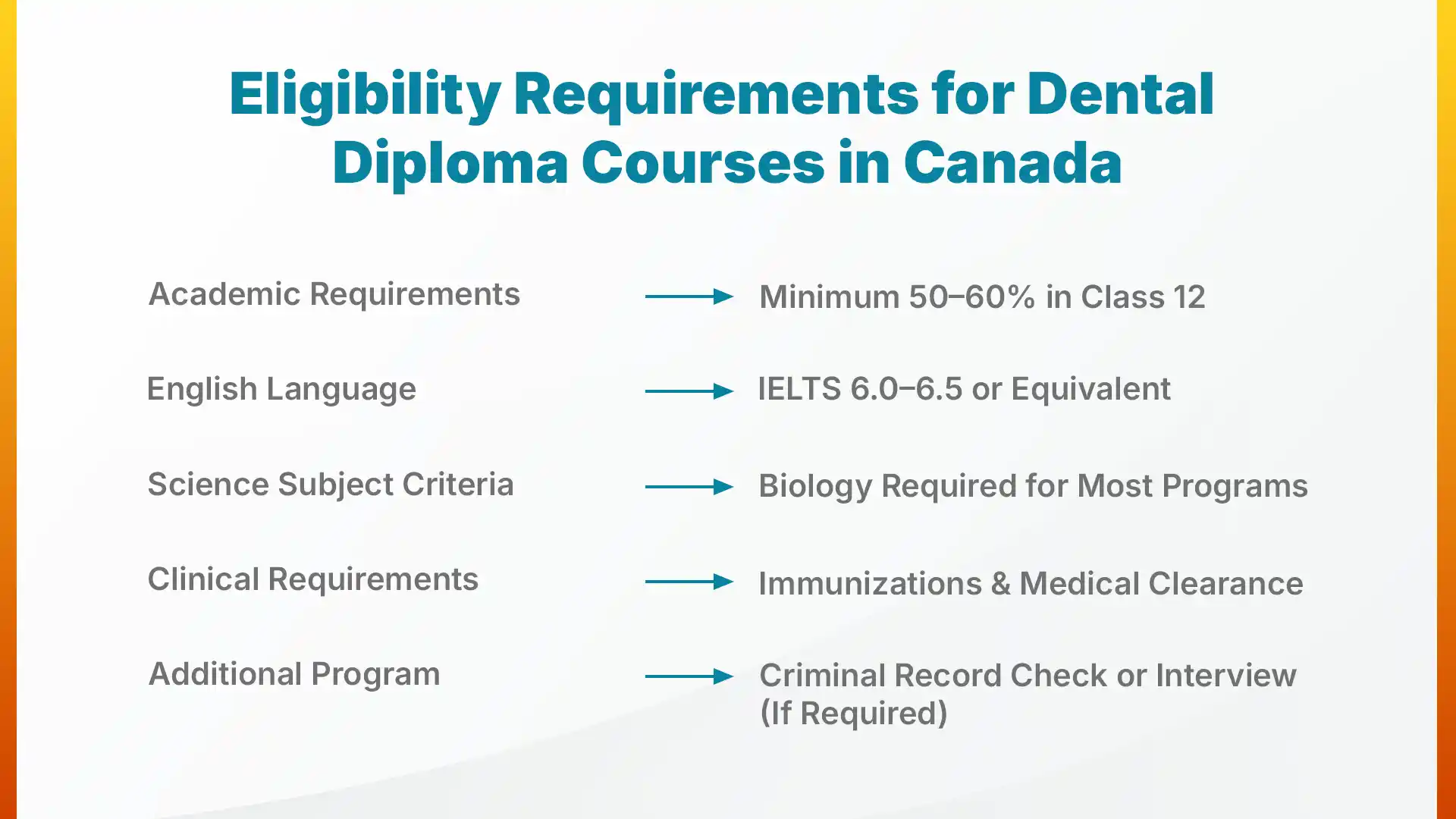
The entry requirements for dental diplomas in Canada include a Class 12 score of 50-60%, an IELTS band of 6.0-6.5, and science subjects. You must also submit medical immunizations and pass a basic clean record check before entering the college clinic. Let us go through the exact academic and physical prerequisites you will need to prepare.
1. Academic Requirements
You need to pass your Class 12 (+2) exams from the NEB board with at least a 50% to 60% aggregate score. This basic score is important to prove that you are ready for college-level dental science study.
2. English Language Requirements
You will need an IELTS academic score of 6.0 to 6.5 (or a PTE score of 54 to 60), depending on your course. Since dental care requires talking to real patients, colleges need to make sure you can communicate clearly in English.
3. Science Background
You must have studied Biology and Chemistry in high school and scored passing marks in both subjects. Dental work involves a lot of science, including human biology and chemical mixtures used for fillings. Thus, having this background prepares you to handle the challenging college workload easily.
4. Medical Clearances
You must submit your immunization records (like Hepatitis B and Tetanus) before starting your college clinical placements. These records prove that you are protected against infectious diseases while working in the student clinic.
5. Criminal Record Check
You must show a clean police clearance certificate from Nepal because public safety is key in Canadian healthcare. Dental clinics operate on trust and treat patients of all ages, including children and older adults.
Overall, the requirements to study in Canada for a dental diploma are quite manageable, especially for students with a science background and good English skills.
6. What Documents Are Required for Dental Diploma Admission in Canada?
The documents required for dental diploma admission in Canada are:
Academic Mark sheets and Character Certificates (Class 10 and 12).
Valid English Test Report (IELTS or PTE score sheet).
A clean, colored scan of your passport's main pages.
A customized Statement of Purpose (SOP for Canada) written in your own words.
One or two Recommendation Letters from your high school science teachers.
An updated resume showing any healthcare volunteer work.
How Do You Apply for Dental Diploma Courses in Canada?
The admission process for a dental diploma in Canada involves choosing a public college, submitting your high school transcripts, and applying for your study permit. You must plan your intake dates early and pay your first-year tuition to secure your official Letter of Acceptance. Let us walk through the step-by-step roadmap to make your application completely stress-free.
1. Select Your Diploma Course
First, pick the specific dental path, like assisting, hygiene, or laboratory technology, that fits your goals. Make sure to choose a program at a public college that has post-study work permit (PGWP) eligibility. This initial decision shapes your entire career path, so take your time and choose carefully.
2. Submit Applications
Next, apply online directly through the college portal or system hubs like OntarioColleges. You will need to pay an application fee of around 100 to 150 Canadian dollars. Then, upload clean, scanned copies of your SEE and Class 12 NEB academic transcripts along with your IELTS or PTE scorecard.
3. Get Your Offer Letter from a College
After applying, wait for the college admissions team to review your file, which usually takes four to eight weeks. If you meet all of their requirements, you will receive an official Letter of Acceptance (LOA). Be sure to check the offer letter carefully for any conditions you must meet before registration.
4. Pay Your Tuition
Once you accept the offer, you must pay your first-year tuition fee to secure your seat. You will need to take your official offer letter to the Ministry of Education in Kathmandu to get your No Objection Certificate (NOC). Finally, visit an authorized commercial bank in Nepal to process the bank wire transfer and save your payment receipt.
5. Apply for Your Student Visa
Lastly, gather your financial documents and open your Guaranteed Investment Certificate (GIC) of 20,635 Canadian dollars with a bank like CIBC or Scotiabank. You must also pass an upfront medical exam from an approved doctor.
Once ready, upload your GIC receipt, paid tuition receipt, academic certificates, and a custom Statement of Purpose (SOP) to the IRCC online portal to complete your Canadian student visa application.
What Is the Cost of Studying Dental Diploma Courses in Canada?
The average cost of a dental diploma in Canada ranges from 15,000 to 34,000 CAD per year, depending on the course you select. Clinical programs like hygiene have higher lab fees, while administrative courses are much cheaper. Let us break down the total budget for studying in Canada, including tuition, books, and living expenses:
Expense Category | Average Cost per Year (CAD) | Simple Explanation |
|---|---|---|
| Dental Assisting Tuition | 15,000 – 19,000 | Lower tuition, usually takes 1 year to finish. |
| Dental Hygiene Tuition | 25,000 – 34,000 | Higher cost due to specialized dental clinic equipment. |
| Living Expenses | 20,635 | Government minimum required for food and room rent. |
| Dental Instruments Kit | 2,500 – 5,000 | One-time cost for custom clinical tools and uniforms. |
| Health Insurance | 600 – 1,000 | Compulsory emergency health coverage for students. |
Are There Scholarships for Dental Diploma Students in Canada?
International students can apply for entrance scholarships, merit-based college grants, and small bursaries ranging from 1,000 to 3,000 CAD to reduce their dental diploma costs. These financial awards are given to students with excellent academic records or top IELTS scores during their study. Let us look at how you can claim these funds and make your education more affordable.
- Entrance Awards: Many colleges automatically give you $1,000 to $2,000 if your Class 12 aggregate score is very high.
- IELTS Excellence Awards: A few colleges reward students who score an overall 7.5 or above on their language test.
- In-Course Merit Scholarships: If you maintain top grades during your first semester in Canada, you can apply for college-specific cash bursaries.
What Are the Career Opportunities After a Dental Diploma in Canada?
Graduating from a dental diploma program in Canada opens immediate job roles like a certified dental assistant, registered hygienist, or dental laboratory technician. Since dental care is a growing sector, most graduates find full-time positions in local clinics within six months. Let us look at the exciting roles you can step into right after graduation.
- Dental Assistant (Level II): Help the dentist during surgeries, take X-rays, and organize patient files.
- Dental Hygienist: Work independently to scale teeth, remove plaque, and provide oral health advice.
- Dental Lab Tech: Work inside laboratory settings designing crowns, dentures, and dental implants.
- Dental Office Administrator: Manage the front desk, schedule patient visits, and process payments.
What Is the Average Salary After a Dental Diploma in Canada?
The average salary after a dental diploma in Canada ranges between 45,000 and 95,000 CAD per year, depending on your licensed role and province. Dental hygienists earn the highest wages, while administrative assistants provide a stable starting point. Let us view the exact hourly and yearly salary breakdown for each professional role.
Dental Professional Job Role | Average Hourly Wage | Average Annual Salary (CAD) |
|---|---|---|
| Dental Assistant (Level II) | $27.00 per hour | $48,000 – $62,000 |
| Dental Hygienist | $42.00 per hour | $72,000 – $95,000 |
| Dental Office Administrator | $23.00 per hour | $42,000 – $55,000 |
| Dental Lab Technician | $28.00 per hour | $50,000 – $70,000 |
| Licensed Denturist | $35.00 per hour | $65,000 – $90,000 |
Is a Dental Diploma in Canada Worth It?
A dental diploma in Canada is highly worth it because it offers a quick pathway to high-paying jobs and permanent residency without a four-year university commitment. You get to work directly with patients and build a stable life in a secure healthcare sector. Let us look at the final pros and cons to see if this fits your goals.
The Pros:
- You can start earning a great salary in just one to two years.
- The healthcare industry is incredibly stable and has strong job security.
- It offers excellent, high-priority pathways to Canadian PR.
The Cons:
- You must pass difficult national licensing tests after graduating.
- The clinical study routine can be mentally and physically tiring.
Conclusion
Dental diploma courses in Canada are a great option if you want a career that is practical, respected, and in demand. They offer hands-on training, great job opportunities, and a faster route into the healthcare field compared to many traditional degree programs.
If you're a student in Nepal wondering what comes next after +2, you're not alone. Many students want a career with real growth but struggle to find the right path. The good news is that with the right course, proper planning, and a little preparation, studying in Canada can become much more achievable than it seems.
Now, the next step is yours. Take some time to explore the programs that interest you, check the requirements, and start preparing early. The sooner you begin, the closer you'll be to turning your plans into reality.