BSc Nursing in the USA from Nepal: Fees & Program Structure

May 28, 2026
The United States has one of the most advanced healthcare systems in the world, and its nursing programs reflect that standard at every level. For international students, including those from Nepal, a Bachelor of Science in Nursing (BSN) from a US university is one of the most valuable and globally respected qualifications available in the healthcare field. With world-ranked universities, cutting-edge simulation facilities, direct hospital exposure, and strong post-graduation work pathways, the USA offers a nursing education that is difficult to match anywhere else. Nepalese students who are still weighing their options can explore studying in the USA before committing to a specific program.
In this guide, we cover everything a Nepalese student needs to know about pursuing a BSc in nursing in the USA, from top universities and admission requirements to tuition costs, scholarships, career opportunities, and salary prospects.
In this blog
What Is a BSc in Nursing in the USA?
A Bachelor of Science in Nursing (BSN) is a four-year undergraduate degree that prepares students for licensure as a Registered Nurse (RN) through a rigorous combination of academic coursework, laboratory training, and supervised clinical practice. It is the most widely recognized entry-level nursing qualification in the United States and is increasingly preferred by hospitals and healthcare employers over shorter associate-level programs.
The curriculum covers anatomy and physiology, microbiology, pharmacology, pathophysiology, mental health nursing, community and public health, pediatric care, adult medical-surgical nursing, evidence-based practice, and nursing leadership. Students typically spend the first two years building their foundational sciences and then move into clinical rotations from the third year onward, gaining hands-on experience across multiple healthcare settings.
Upon completing the degree, graduates are eligible to sit the NCLEX-RN, the national licensing examination that qualifies them to practice as registered nurses in the United States. A US NCLEX-RN qualification is also recognized in Canada, Australia, the United Kingdom, and several Gulf countries, making it a genuinely global credential.
Why Study BSc Nursing in the USA for International Students?
Study BSc Nursing in the USA because it offers globally recognized degrees, world-class clinical training in some of the most advanced hospitals on earth, one of the highest nursing salary scales in the world, and clear work authorization pathways through OPT and H-1B visa programs. For Nepalese students who want a healthcare career with strong financial returns and international mobility, the USA provides an unmatched combination of education quality and career opportunity.
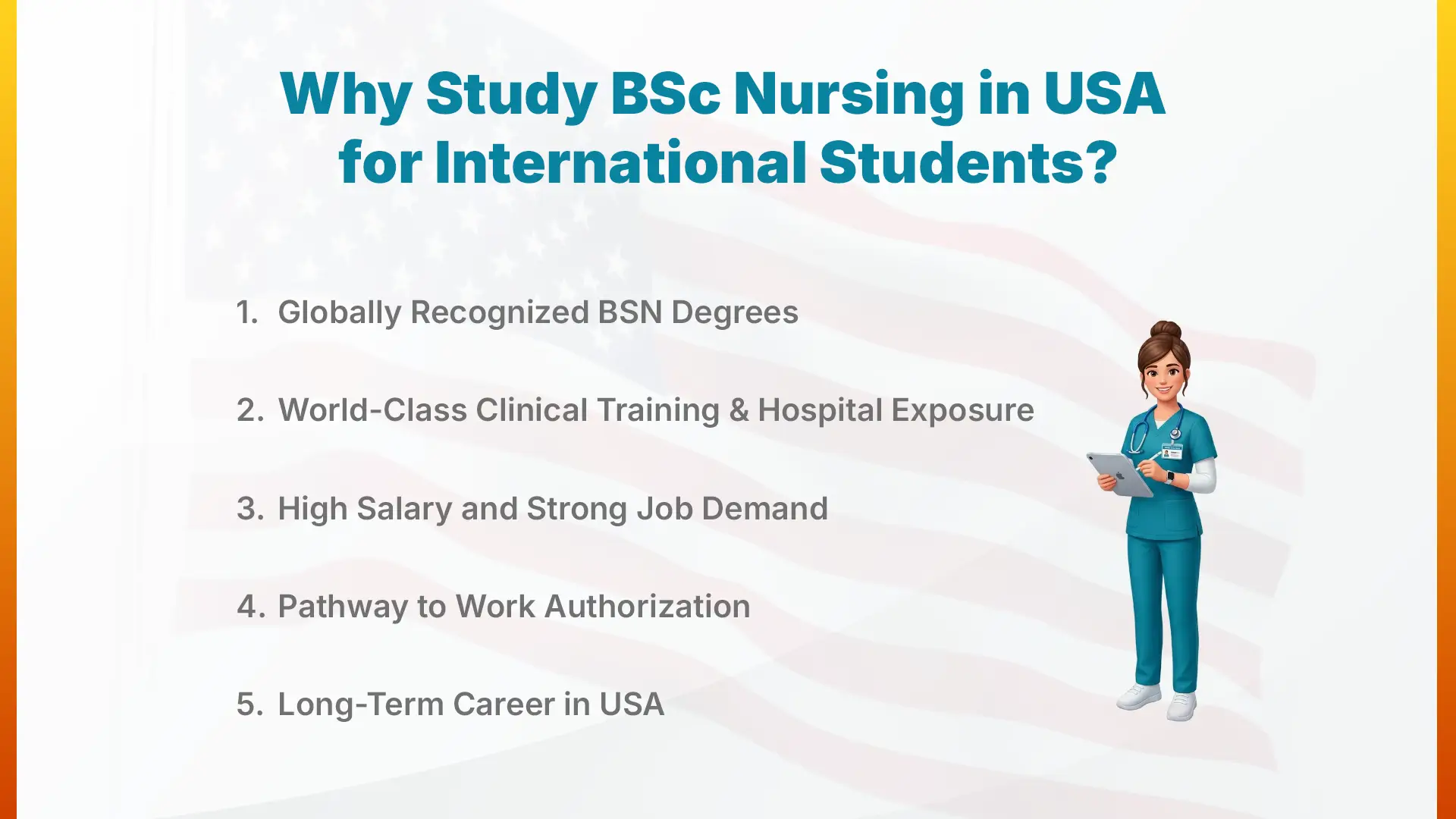
1. Globally Recognized BSN Degrees
A BSN from a US-accredited university is recognized by nursing regulatory bodies across North America, the UK, Australia, New Zealand, and the Gulf region. For Nepalese graduates, this means a US nursing degree opens doors not just in America but across multiple high-income countries, providing career flexibility that few other qualifications can match.
2. World-Class Clinical Training and Hospital Exposure
US nursing programs place students in clinical rotations at some of the most advanced teaching hospitals in the world. Students gain hands-on experience across emergency care, intensive care, pediatrics, surgical wards, and community health settings, often within the same university-affiliated hospital network. This level of clinical exposure prepares graduates to enter the workforce with confidence and competence from day one.
3. High Salary and Strong Job Demand
The United States faces a well-documented and growing nursing shortage driven by an aging population, healthcare expansion, and workforce retirements. The Bureau of Labor Statistics projects that employment of registered nurses will grow significantly over the coming decade, making it one of the most in-demand professions in the country. For international graduates who secure work authorization, the salary potential is among the highest for any nursing qualification globally.
4. Pathway to Work Authorization
International students who complete a BSN in the USA are eligible for Optional Practical Training (OPT), which allows them to work in the United States for up to 12 months after graduation in a role directly related to their field of study. Nursing graduates can use this period to gain US clinical experience and pursue employer sponsorship for an H-1B work visa, which provides a longer-term pathway to working and living in the United States.
5. Long-Term Career in USA
Registered nurses are consistently included on the US Department of Labor's list of high-demand occupations, and many states actively sponsor skilled nurses for permanent residency.
For Nepalese students with a long-term goal of building a career in the United States, a BSN is one of the most practical routes available and a big part of why Nepalese students choose the USA over other destinations.
Top Universities for BSc Nursing in USA
The top universities for BSc Nursing in the USA include Johns Hopkins University, University of Pennsylvania, Duke University, University of Washington, New York University, and University of Michigan, each offering CCNE-accredited programs, strong clinical networks, and dedicated pathways for international students. Choosing the right university depends on your academic profile, preferred location, budget, and career goals.
1. Johns Hopkins University
Johns Hopkins School of Nursing in Baltimore is consistently ranked as the number one nursing school in the United States. Its BSN program is research-intensive and clinically rigorous, with placements across the Johns Hopkins Hospital system, one of the most respected academic medical centers in the world. The program attracts students and faculty from across the globe and produces graduates who are highly sought after by top healthcare employers.
2. University of Pennsylvania
The University of Pennsylvania's School of Nursing in Philadelphia is one of the oldest and most distinguished nursing schools in the country. Penn Nursing's BSN program emphasizes leadership, evidence-based practice, and global health, and students benefit from clinical placements at Penn Medicine, a world-class academic health system. Penn is particularly strong for students interested in research and advanced nursing practice.
3. Duke University
Duke University School of Nursing in Durham, North Carolina, offers a rigorous BSN program with a strong focus on interdisciplinary healthcare education. Students work alongside medical, pharmacy, and public health students in shared clinical environments, preparing them for the collaborative nature of modern healthcare practice. Duke's location in the Research Triangle also provides exceptional exposure to healthcare innovation and biotechnology.
4. University of Washington
The University of Washington School of Nursing in Seattle is one of the leading nursing schools on the West Coast and has a particularly strong reputation in community health, global health, and rural nursing. Its BSN program integrates classroom learning with clinical rotations across the UW Medicine hospital network and affiliated community health organizations. The University of Washington is also one of the more affordable options for international students among top-ranked US nursing schools.
5. New York University (NYU)
NYU's Rory Meyers College of Nursing in New York City offers a well-regarded BSN program with the added advantage of being located in one of the world's most diverse and medically complex urban environments.
Students gain clinical experience across New York City's vast network of public and private hospitals, giving them exposure to a wider range of patient populations and health conditions than almost any other program in the country. Students who want to explore more options in the city can look at the top universities in New York for international students
6. University of Michigan
The University of Michigan School of Nursing in Ann Arbor offers a strong BSN program with a focus on patient-centered care, health equity, and evidence-based practice. Michigan's nursing graduates are known for their clinical competence and critical thinking skills, and the university's strong alumni network provides excellent career support for both domestic and international graduates.
Nepalese students who want a broader view before shortlisting can explore the best universities in the USA for international students.
Eligibility and Admission Requirements for BSc Nursing in USA
The eligibility and admission requirements for BSc Nursing in the USA include completion of Grade 12 or Plus Two with a strong science background, English language proficiency through IELTS or TOEFL, a personal statement, letters of recommendation, and medical and financial documentation. Meeting these requirements thoroughly is essential for securing admission at a reputable US university for nursing.
1. Academic Requirements
Applicants must have completed Grade 12 or Plus Two with strong results, particularly in biology, chemistry, and mathematics. Most US nursing schools require a minimum GPA equivalent to around 3.0 on a 4.0 scale, though competitive programs like Johns Hopkins and Penn typically admit students with significantly higher academic profiles. Some universities also require prerequisite science courses to be completed before or during the first year of the program.
2. English Language Requirements
All BSN programs in the USA are taught in English, and international applicants must demonstrate proficiency through an approved language test. Standard requirements are the following:
IELTS Academic: minimum overall score of 6.5 to 7.0, with no individual band below 6.0
TOEFL iBT: minimum score of 80 to 100, depending on the university
PTE Academic: minimum score of 58 to 65
Nursing programs tend to set higher language thresholds than many other undergraduate disciplines because of the critical role communication plays in patient safety and clinical care. Nepalese students who need to improve their score before applying can enroll in IELTS preparation classes to build the band they need.
3. Personal Statement and Letters of Recommendation
Most universities require a personal statement explaining your motivation for nursing, your academic background, any healthcare or volunteer experience, and your long-term career goals. Two to three letters of recommendation from teachers or supervisors who can speak to your academic ability and character are also typically required.
4. Medical Fitness and Financial Proof
Many US nursing programs require incoming students to submit immunization records and undergo a health screening before beginning clinical placements. A criminal background check is also required at most institutions. For the F-1 student visa application, students must provide financial documentation demonstrating they can cover the full cost of their studies and living expenses for at least the first year.
How to Apply for a BSc in Nursing in the USA?
The admission process for a BSc in nursing in the USA involves six steps: researching and shortlisting universities, preparing your documents, submitting your application, writing your personal statement and securing reference letters, receiving your offer letter, and applying for the F-1 student visa. Approaching each step with proper preparation well in advance of deadlines gives Nepalese students the best chance of a successful outcome.
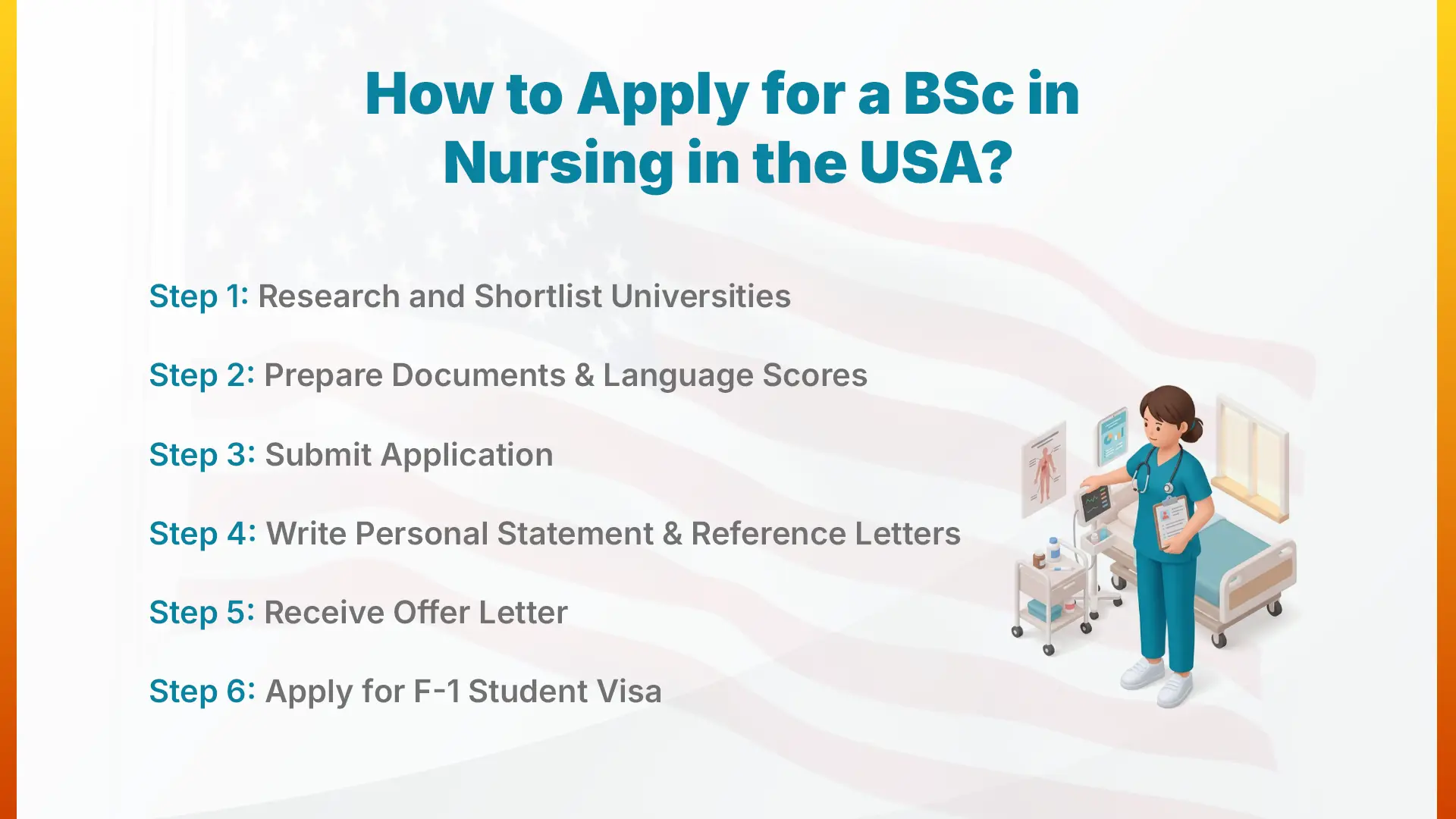
Step 1: Research and Shortlist Universities
Compare programs based on your academic profile, ranking, clinical placement quality, tuition fees, and scholarship availability. Shortlist three to five universities to give yourself multiple options.
Step 2: Prepare Documents and Language Scores
Gather your Plus Two transcripts, mark sheets, school leaving certificate, and character certificate. Book your IELTS or TOEFL exam early so your scores are ready before application deadlines, which typically fall between November and January for September intake.
Step 3: Submit Application
Most US universities accept applications through their own online portals or through the Common App platform. Pay close attention to individual program deadlines, as nursing programs often have earlier cutoffs than general undergraduate admissions.
Step 4: Write Personal Statement and Reference Letters
Your personal statement should clearly articulate why you want to study nursing, what experiences have shaped that decision, and what you plan to do with your degree. Request reference letters from science teachers or supervisors with enough notice for them to write a strong, considered recommendation.
Nepalese students can follow the SOP format for US universities to understand exactly what admissions panels look for.
Step 5: Receive Offer Letter
The university will issue a conditional or unconditional offer after reviewing your application. Conditional offers typically require final Plus Two results or proof of English language scores meeting the minimum threshold.
Step 6: Apply for F-1 Student Visa
Once you have accepted your offer and received your I-20 form from the university, you can apply for the F-1 student visa through the US embassy. This involves paying the SEVIS fee, completing the DS-160 application form, and attending a visa interview. Having clear financial documentation and a well-prepared interview response significantly improves your chances of approval.
Having your F-1 visa documents ready before the interview significantly improves your chances of approval.
Cost of Studying BSc Nursing in USA for International Students
The cost of studying BSc Nursing in the USA for international students generally ranges from USD 30,000 to USD 60,000 (approximately NPR 4,000,000 to NPR 8,000,000) per year in tuition fees, depending on the university and state. When combined with accommodation, food, health insurance, and other living expenses, Nepalese students should budget approximately USD 45,000 to USD 75,000 (approximately NPR 6,000,000 to NPR 10,000,000) per year in total. While the USA is more expensive than Canada or South Korea, the salary potential and career outcomes justify the investment for students who plan strategically.
While the cost to study in USA is higher than Canada or South Korea, the salary potential and career outcomes justify the investment for students who plan strategically
1. Tuition Fees
Tuition fees for international students in BSc nursing programs in the USA vary significantly depending on whether the university is publicly or privately funded. Public universities receive state government subsidies, which keeps tuition lower even for international students, while private universities charge higher fees that reflect their smaller class sizes, research investment, and institutional reputation. As a general rule, both public and private options in the USA deliver strong clinical training and NCLEX-RN preparation, so choosing between them comes down to budget, location, and program fit rather than quality alone.
University Type | Annual Tuition (USD) | Annual Tuition (NPR approx.) |
|---|---|---|
| Public Universities | USD 20,000 – USD 35,000 | NPR 2,700,000 – NPR 4,700,000 |
| Private Universities | USD 40,000 – USD 60,000 | NPR 5,400,000 – NPR 8,100,000 |
Public universities such as the University of Washington and University of Michigan offer significantly lower tuition for international students than private institutions like Johns Hopkins or Penn while still maintaining world-class program quality.
2. Living Expenses
Monthly living expenses in the USA vary significantly by city. In New York City, students should budget USD 2,500 to USD 3,500 per month for accommodation, food, and transportation. In smaller university cities such as Ann Arbor or Durham, monthly costs typically range from USD 1,500 to USD 2,500. On-campus accommodation and shared housing are the most cost-effective options for international students. Many Nepalese students also take up part-time jobs in the USA during their studies to manage living expenses and build early US work experience
3. Total Estimated Cost
For a standard four-year BSN degree, the total estimated cost including tuition and living expenses ranges from USD 180,000 to USD 300,000 (approximately NPR 24,000,000 to NPR 40,000,000). This makes early scholarship applications and financial planning essential for most Nepalese students.
Scholarships for BSc Nursing in USA for International Students
Scholarships for BSc Nursing in the USA include university-specific merit awards, nursing and healthcare field scholarships, and external foundation grants available to international students. While fully funded scholarships in the USA for international undergraduate students are limited compared to countries like South Korea or Australia, partial scholarships and tuition waivers from universities can significantly reduce the overall cost of the degree.
1. University-Specific Scholarships
Most top nursing schools offer merit-based international student scholarships to high-achieving applicants. These include:
NYU Meyers Global Scholars Award
University of Michigan International Student Scholarship
Duke University Karsh International Scholarship
University of Washington Global Excellence Scholarship
These awards typically range from USD 5,000 to USD 25,000 per year and are awarded based on academic achievement, leadership, and the strength of the application.
2. Nursing and Healthcare Field Scholarships
Several external organizations offer scholarships specifically for nursing students in the USA, including:
Health Resources and Services Administration (HRSA) scholarships for students committing to work in underserved communities after graduation
American Association of Colleges of Nursing (AACN) scholarships for undergraduate nursing students
Foundation of the National Student Nurses Association (FNSNA) scholarships open to enrolled BSN students
3. Tips to Increase Scholarship Chances
Apply as early as possible; most scholarship deadlines fall before the main admissions window
Maintain the highest possible Plus Two GPA, particularly in science subjects
Include healthcare volunteer experience or any clinical exposure in your application
Write a focused and honest personal statement that clearly connects your background to your nursing goals
Apply to multiple scholarships simultaneously rather than waiting for one outcome at a time
Career and Scope After a BSc in Nursing in USA
Graduates with a BSc in nursing from a US university can pursue careers as registered nurses, pediatric nurses, public health nurses, and travel nurses across a wide range of healthcare settings, with some of the highest nursing salaries in the world. The USA's ongoing nursing shortage means that qualified BSN graduates are in immediate and consistent demand, and international graduates who secure work authorization through OPT have strong prospects for long-term employment and career growth. Some of the key career roles are:
1.Registered Nurse (RN)
is the core outcome of a BSN degree. RNs work across hospitals, clinics, long-term care facilities, schools, and community health settings, managing patient care, administering medications, coordinating treatment plans, and supporting families through the healthcare process.
2. Pediatric Nurse
specializes in the care of children from birth through adolescence. This is a highly rewarding and consistently in-demand specialization across children's hospitals and pediatric wards throughout the USA.
3. Public Health Nurse
works outside hospital environments in government agencies, community health centers, and outreach programs, focusing on disease prevention, vaccination, and health promotion for vulnerable populations.
4. Travel Nurse
is a uniquely American nursing career path in which RNs take short-term contract assignments at hospitals across different states, often earning significantly higher pay than permanent staff nurses. Travel nursing is particularly accessible for BSN graduates with one to two years of clinical experience.
5. Average Salary After BSc in Nursing in USA
The salary after a BSc in nursing in the USA depends on experience level, specialization, employer type, and state of practice. Entry-level graduates start with competitive salaries that grow steadily with clinical experience, and nurses who move into specialized roles or high-demand states see significantly higher earning potential. For Nepalese students, even an entry-level RN salary in the USA converts to a figure that far exceeds what is achievable in most other destinations, making the initial investment in a US nursing degree financially worthwhile over the long term.
Experience Level | Annual Salary (USD) | Annual Salary (NPR approx.) |
|---|---|---|
| Entry-Level RN | USD 60,000 – USD 75,000 | NPR 8,100,000 – NPR 10,100,000 |
| Mid-Level RN (2–5 years) | USD 75,000 – USD 100,000 | NPR 10,100,000 – NPR 13,500,000 |
| Senior RN / Specialist | USD 100,000 – USD 130,000+ | NPR 13,500,000 – NPR 17,500,000+ |
States such as California, New York, Massachusetts, and Washington consistently offer the highest nursing salaries in the country.
6. OPT and H-1B Work Pathways
After completing their BSN, international graduates can apply for Optional Practical Training (OPT), allowing up to 12 months of full-time work in the USA in a nursing-related role. During this period, graduates can build US clinical experience and seek employer sponsorship for an H-1B work visa, which provides up to six years of work authorization.
Registered nurses are also frequently sponsored for EB-3 employment-based green cards by US hospitals facing staffing shortages, making nursing one of the most accessible pathways to long-term US residency for internationally trained healthcare workers.
7. Global Career Opportunities
A US BSN and NCLEX-RN registration are recognized in Canada, the United Kingdom, Australia, New Zealand, Ireland, and Gulf Cooperation Council (GCC) countries. For Nepalese graduates who may wish to explore opportunities beyond the USA at some point in their careers, a US nursing qualification is one of the most portable and widely respected credentials available in the global healthcare market.
Conclusion
The USA offers Nepalese students an exceptional combination of academic prestige, clinical training quality, earning potential, and career mobility through a Bachelor of Science in Nursing. With world-ranked universities, direct access to some of the most advanced hospitals on earth, strong post-graduation work pathways, and nursing salaries that rank among the highest globally, a BSN from a US university is a qualification that creates opportunities far beyond America's borders.
The demand for nurses in the USA is real, the pathways are clear, and the investment pays off. For Nepalese students who are serious about building a long-term career in nursing, the USA deserves serious consideration alongside Canada and Australia.
Interested in studying BSc Nursing in the USA? Contact SAS Education Consultancy for a free counseling session and let us help you find the right university, apply for scholarships, and navigate the F-1 visa process with confidence.