Best Bachelor's Degree in UK For International Students

Feb 24, 2026

Ever wondered why thousands of students pack their bags every year and fly to the UK for their undergraduate studies? Is it just the prestige, or is there something deeper, faster degrees, better career outcomes, global exposure? Choosing the right bachelor’s program abroad isn’t just about a fancy university name. It’s about return on investment, job security, visa pathways, and honestly, not regretting your decision three years later.
In this blog, we’ll break down everything you need to know about choosing the right bachelor’s degree as an international student planning to study in UK. From the best career-focused courses and eligibility requirements to tuition fees, living costs, top universities, and common mistakes students make, we’ll cover it all in a simple, practical, no-fluff way. By the end, you won’t just understand your options, you’ll have real clarity on which direction actually makes the most sense for you.
In this blog
Why UK is a Smart Choice for Your Bachelor’s Degree?
The UK is a smart choice because it offers world-class education, shorter degree duration, strong post-study work opportunities, and global career recognition.
Now, let’s be honest, studying abroad is expensive. So if you’re investing time, money, and probably your parents’ life savings (no pressure, right?), the country you choose must give you real value. The UK stands out because its education system is practical, industry-connected, and globally respected. You don’t just graduate with a degree; you graduate with credibility. And that makes a big difference when you step into the job market.
1. Globally Recognised Universities
The UK is home to some of the most respected universities in the world, and that reputation carries serious weight in the global job market. A bachelor’s degree from the UK is recognized across Europe, Asia, the Middle East, and beyond, which means your qualification travels well. Many universities rank consistently in global rankings, reflecting strong academic standards and modern research facilities. More importantly, UK institutions focus heavily on analytical thinking and practical application rather than rote learning. Employers value that skill set. So when you graduate, you’re not just holding a degree, you’re holding international credibility.
2. 3-Year Undergraduate Programs (Faster ROI)
One major advantage of pursuing a bachelor's degree in the UK is the standard 3-year duration, which saves both time and money compared to 4-year systems in other countries. That’s one less year of tuition fees, accommodation costs, and daily living expenses. Financially, that difference is significant. Academically, UK programs are intensive and focused, cutting out unnecessary general subjects and diving straight into specialization. This means you graduate earlier and enter the workforce sooner. And entering the job market one year earlier? That’s a smart return on investment.
3. Graduate Route (Post-Study Work Visa)
The UK’s Graduate Route allows international students to stay and work in the country for up to 2 years after completing their bachelor’s degree. The biggest advantage is that you don’t need a job offer to apply, which removes a lot of pressure immediately after graduation. During this period, you can work full-time in most sectors and gain valuable UK work experience. This local experience strengthens your CV and improves your chances of securing long-term skilled employment. Many students use this opportunity as a pathway toward sponsored work visas. In short, you’re given time to build your career instead of rushing home.
4. Multicultural Student Environment
The UK welcomes students from over 150 countries, creating a diverse and dynamic campus environment. In classrooms, you’ll interact with peers from different cultural and academic backgrounds, which enhances learning through varied perspectives. Universities are well-equipped to support international students through orientation programs, career services, and student societies. Living in such a multicultural society helps you develop adaptability and cross-cultural communication skills, traits highly valued by global employers. Beyond academics, this diversity makes it easier to feel included and supported. It’s education combined with global exposure.
5. High Employability Rate
UK universities strongly emphasize employability, integrating internships, placement years, and live industry projects into many bachelor's programs. Career services departments actively assist students with CV building, interview preparation, and networking opportunities. Major industries such as finance, healthcare, engineering, and technology regularly recruit graduates from UK institutions. Cities like London, Manchester, and Birmingham offer broad employment opportunities across sectors. The education system is structured not just to teach theory, but to prepare students for real-world professional environments. That’s why UK graduates often transition smoothly into competitive job markets.
What are the Best Bachelor Courses in the UK for International Students?
The best bachelor's courses in the UK for international students are those with strong global demand, good career outcomes, and clear post-study work opportunities.
In reality, the “best” course isn’t the one your cousin recommended on Facebook; it’s the one that matches your skills, budget, and long-term plan (job, further study, or staying back on the Graduate Route). The UK offers career-focused degrees that are widely recognised and often professionally accredited, which boosts employability. Many programs also include placements, labs, or industry projects, so you’re not just collecting notes, you’re collecting experience. Below are the most popular, high-value options international students usually go for.
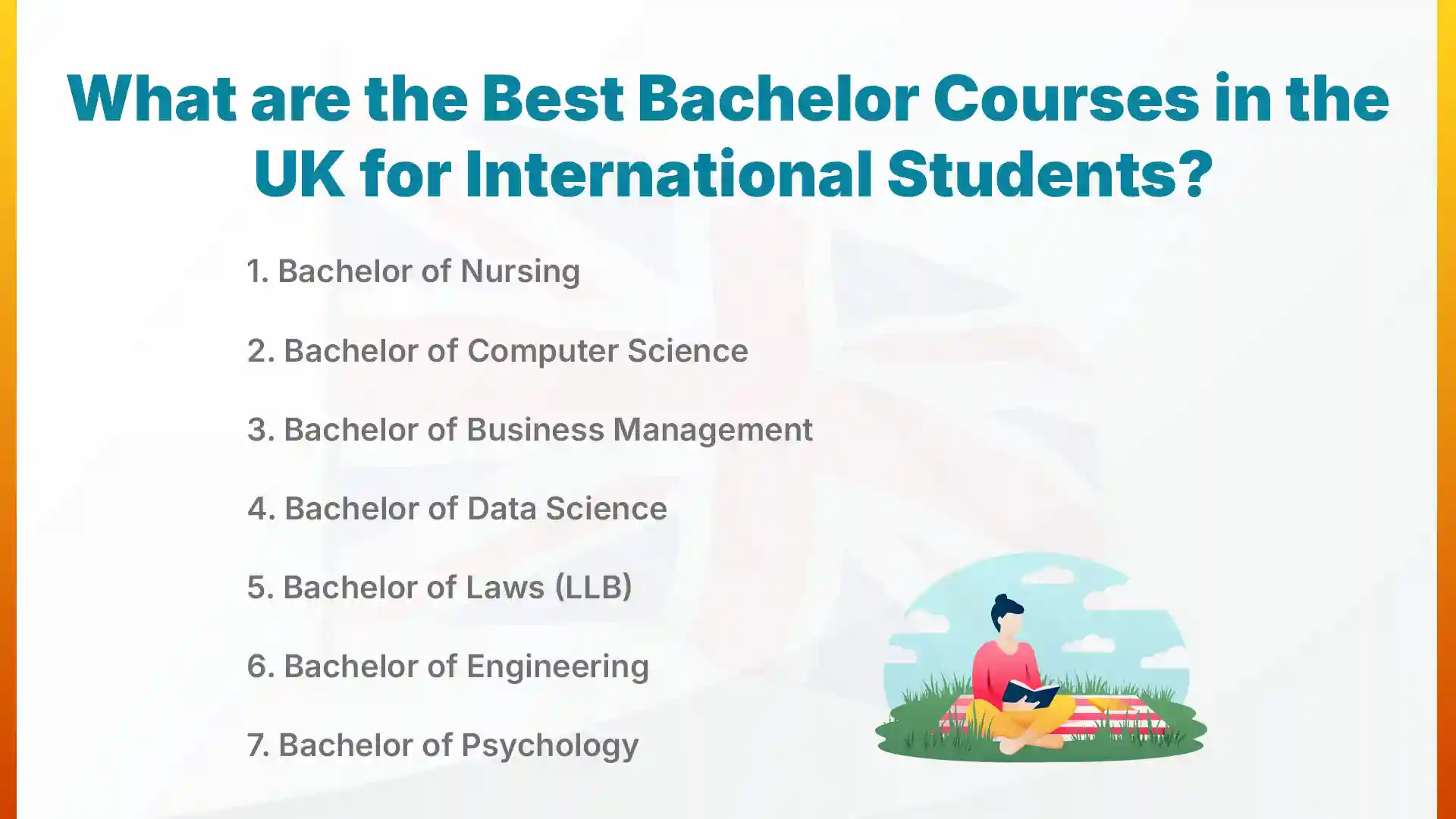
1. Bachelor of Nursing (BSc Nursing)
A Nursing degree in the UK is one of the most job-secure options because healthcare never goes out of demand, and people get sick in every economy, sadly. UK nursing programs are heavily practical, involving clinical placements in hospitals and community settings, not just classroom theory. You typically choose a field like Adult Nursing, Mental Health Nursing, Children’s Nursing, or Learning Disability Nursing, depending on the university. Many courses follow professional standards and are designed to meet registration requirements with the Nursing and Midwifery Council (NMC), which adds serious credibility. Expect modules like anatomy, patient care, pharmacology, and clinical decision-making, plus real-world training. If you want stability, clear career pathways, and strong employability, this one is hard to beat.
2. Bachelor of Computer Science (BSc Computer Science)
If you like problem-solving and don’t mind staring at screens for long hours (like the rest of us), Computer Science in the UK can be a golden ticket. The degree typically covers programming (Python/Java/C++), algorithms, databases, software engineering, and systems design, basically the building blocks of tech. Many universities offering IT courses in UK also provide specialised pathways like Cybersecurity, Artificial Intelligence, or Software Development under the same program umbrella. You’ll often work on real projects, team-based coding assignments, and sometimes even industry-linked hackathons or internships. The UK tech job market is strong, and with the Graduate Route, international students get time to build experience after graduation. This course is ideal if you want versatility, because tech jobs exist in every industry now.
3. Bachelor of Business Management (BA/BSc Business Management)
Business Management is popular because it’s flexible, you can go into marketing, HR, finance, sales, entrepreneurship, and even tech management later. BBA in UK typically covers core subjects like management principles, organisational behaviour, business strategy, economics, accounting basics, and leadership skills. Many universities also include case studies, group presentations, simulations, and sometimes placement opportunities that make the degree more practical. You can often tailor the course with electives like Digital Marketing, International Business, Finance, or Supply Chain Management. It’s a strong choice if you’re not 100% sure about one career path yet, but still want solid employability. Just one warning: don’t pick it only because it sounds “safe” — pick it because you’re genuinely interested in business.
4. Bachelor of Data Science (BSc Data Science / Analytics)
Data Science is one of the fastest-growing fields, and UK universities are investing heavily in it because companies are obsessed with data now (they want to know what you’ll buy before you know). This degree usually combines statistics, programming, data visualisation, machine learning basics, and database handling. You’ll often work with tools like Python, R, SQL, and platforms for data analysis, plus projects where you clean and interpret real datasets. Some programs also include business analytics and decision-making modules, which make graduates useful across industries—not just tech. Data Science is especially attractive for international students because it aligns well with UK skill-shortage trends in tech and analytics. If you like numbers, logic, and patterns, this course can pay off big.
5. Bachelor of Laws (LLB)
An LLB in the UK is globally respected because UK law has influenced legal systems in many countries, especially Commonwealth nations. The degree usually covers foundational modules like Contract Law, Criminal Law, Tort Law, Constitutional Law, and Legal Skills—basically the core of legal education. UK law degrees build strong analytical writing, argumentation, and critical thinking, which is why LLB graduates also do well in corporate and policy careers. Some universities offer specialisations like International Law, Commercial Law, or Human Rights Law as optional pathways. However, becoming a solicitor or barrister in the UK involves additional steps after the degree, so this isn’t a “graduate and done” situation. Still, if you want a degree with prestige and intellectual strength, LLB is a serious contender.
6. Bachelor of Engineering (BEng / MEng)
Engineering in the UK is a strong option because it’s practical, respected, and linked directly to industries like construction, manufacturing, automotive, renewable energy, and technology. You can choose from fields such as Civil Engineering, Mechanical Engineering, Electrical & Electronic Engineering, or even Aerospace, depending on the university. The program usually includes lab work, design projects, mathematics, physics-based problem solving, and sometimes industry placements. Many UK engineering degrees are aligned with professional accreditation standards (depending on the institution and program), which helps if you later aim for chartered status. It’s challenging, yes, but it’s also a career that remains in demand worldwide. If you like building, designing, and solving technical problems, engineering is worth the grind.
7. Bachelor of Psychology (BSc Psychology)
Psychology is more than “reading minds” (sadly), it’s the scientific study of behaviour, mental processes, and human development. In the UK, psychology degrees typically cover cognitive psychology, developmental psychology, biological psychology, social psychology, and research methods with statistics. A big part of the course is learning how to design studies, analyse data, and understand human behaviour using evidence, not guesses. Many students choose psychology because it opens pathways into mental health, counselling, HR, education, research, and even marketing/consumer behaviour. If you want to become a practising psychologist, you’ll usually need further postgraduate training, so think long-term. But as a bachelor’s degree, it’s versatile and highly relevant in today’s world, where mental health is finally getting the attention it deserves.
Eligibility Requirements for a Bachelor’s Degree in the UK
To apply for a bachelor’s degree in the UK, international students must meet academic qualifications, English language standards, and visa-related criteria. UK universities follow structured admission systems, so eligibility is not random or “maybe you’ll get in”, it’s clearly defined. However, requirements vary depending on the university, course competitiveness, and your academic background. Strong grades, valid English test scores, and properly documented academic history play a crucial role. If your foundation is solid, the process becomes much smoother.
1. Academic Requirements After +2 / High School
For most UK universities, completing +2 or high school (equivalent to A-levels or 12th grade) is mandatory for undergraduate admission. The minimum GPA requirement usually ranges between 2.8 to 3.5 on a 4.0 scale, depending on the course and the institution's competitiveness. Highly ranked universities or technical programs like Engineering, Computer Science, or Nursing often demand stronger academic performance.
Subject prerequisites also matter a lot. For example, Engineering programs typically require Mathematics and Physics, while Nursing may require a Biology or Health Sciences background. Business programs are more flexible, but still prefer students with Mathematics or Economics. If you don’t meet subject requirements, some universities offer foundation or pathway programs to bridge the gap. Simply put, your academic stream in high school should align with the bachelor’s program you choose.
2. IELTS / PTE / UKVI Requirements
English language proficiency is mandatory because all bachelor's programs are taught in English. Most UK universities require an IELTS overall score between 6.0 to 6.5, with no band less than 5.5 or 6.0 in each module. For competitive programs like Law, Nursing, or Psychology, the requirement may go up to 7.0 overall.
If you’re taking PTE Academic, score requirements typically range between 50 to 65, depending on the course. Some institutions specifically require IELTS UKVI for visa purposes, especially if you are entering through a pathway program. If you’re exploring options to study in UK without Ilets, check whether the university accepts alternative English tests or prior English-medium education as proof of proficiency. Course-specific variations are common. For example, healthcare programs often demand higher speaking and writing scores due to professional standards. Always check the exact requirements on the university’s official website before applying; small differences can matter a lot.
3. Gap Year Rules and Acceptance in the UK
The UK is generally flexible when it comes to study gaps, but you must justify the reason clearly. A gap of 1-2 years after high school is usually acceptable without major complications, especially if you were preparing for exams, working, or gaining relevant experience. Longer gaps may still be considered, but strong documentation becomes essential.
Work experience during the gap period can actually strengthen your application, particularly if it relates to your chosen field. For example, healthcare volunteering supports Nursing applications, while IT internships support Computer Science applicants. The key is transparency. Universities and visa officers want to see a logical academic progression, not unexplained time gaps. If you can explain your journey clearly, a gap year is not necessarily a problem.
What is the Duration of a Bachelor's Degree in the UK?
The standard duration of a bachelor’s degree in the UK is three years, but it can extend to four years depending on location and program structure. In most parts of the UK, undergraduate degrees are designed to be intensive and focused, which is why they’re shorter than in many other countries. However, certain programs include placement years or follow different academic frameworks, especially in Scotland. The duration ultimately depends on where you study and whether you choose an additional industry placement. So yes, it’s usually three years, but not always.
1. Standard 3-Year Undergraduate Degrees
In England, Wales, and Northern Ireland, most bachelor’s degrees follow a three-year structure. The first year typically builds foundational knowledge, the second year develops core specialisation, and the final year focuses on advanced topics and major projects or dissertations. Because the UK education system doesn’t usually include broad general education subjects, students dive directly into their chosen field from day one. This makes the program academically concentrated and career-oriented. For international students, this shorter duration means lower tuition and living costs compared to four-year systems. It’s efficient, structured, and designed to get you workforce-ready faster.
2. 4-Year Programs with Placement Year
Some UK universities offer four-year programs that include a placement year, commonly known as “sandwich courses.” In this structure, students complete two academic years, then spend one year working in the industry, and return for the final academic year. The placement year is usually paid and provides real-world professional experience relevant to your degree. This option is especially popular in Business, Engineering, Computer Science, and Marketing programs. It strengthens your CV significantly because employers value UK work experience. Although it extends your study period by one year, the practical exposure often improves employability and long-term career prospects.
3. 4-Year Programs in Scotland
In Scotland, most bachelor’s degrees are structured as four-year programs due to a slightly different education system. The first year is often broader, allowing students to explore related subjects before specialising in later years. This approach offers more academic flexibility and interdisciplinary exposure compared to the rest of the UK. From the second year onward, the program becomes more focused on the chosen major. While it adds an extra year of study, it also provides deeper academic development and maturity in the subject area. For students who prefer a gradual specialisation approach, Scotland’s system can be a strong option.
Total Cost of Studying Bachelors Degree in UK
Studying a bachelor's degree in the UK typically costs international students between £10,000 and £38,000+ per year in tuition fees, with living expenses adding around £1,000–£1,500 per month. The total cost depends heavily on two major factors: your course and your city. London is noticeably more expensive than other UK cities, and programs like Medicine, Engineering, and laboratory-based STEM courses usually cost more than Arts or Humanities degrees. Apart from tuition and rent, you must also budget for visa fees, health surcharge, flights, and study materials. Let’s break it down clearly so you don’t get surprised halfway through your academic journey.
1. Tuition Fees by Course Type
Tuition fees for international students vary depending on the field of study and university ranking. For most undergraduate programs, fees range between £10,000 and £38,000+ annually. STEM programs such as Engineering, Computer Science, and laboratory-based sciences usually fall between £15,000 and £30,000 per year due to lab facilities and technical resources. Medicine and clinical programs can exceed £35,000 per year. Business & Management degrees typically range from £14,000 to £25,000 annually, depending on the institution. Arts & Humanities programs are generally more affordable, often between £10,000 and £20,000 per year. Prestigious universities may charge higher fees, but they often offer strong industry connections and global recognition.
2. Living Expenses in Major UK Cities
Living costs depend significantly on the city you choose. On average, international students spend around £1,142 per month on accommodation, food, transport, and utilities—but in London, this can easily exceed £1,400 per month. London is the most expensive city, with private studios or accommodation often costing £848-£1,000+ per month. In comparison, cities like Manchester and Birmingham are more affordable, where average monthly student accommodation can range around £664 or slightly higher, depending on location.
Accommodation types also impact your budget. On-campus halls typically cost around £166 per week, offering convenience and utilities included. Private accommodations or shared houses may range between £554-£750 per month, depending on the city and property type. Sharing with other students significantly reduces overall costs, which many international students prefer.
3. Health Insurance and NHS Surcharge
International students studying in the UK must pay the Immigration Health Surcharge (IHS) as part of their visa application. This allows access to the UK’s National Health Service (NHS) during your stay. The IHS fee is calculated annually and is paid upfront for the duration of your visa. Once paid, you can access public healthcare services similarly to UK residents, though some services, like prescriptions, may still have small additional charges. This surcharge is mandatory and non-negotiable, so it must be included in your financial planning before applying for your student visa.
4. Other Costs (Visa, Flight, Study Materials)
Apart from tuition and living expenses, there are additional costs that students often underestimate. The UK student visa fee must be paid during the application, and this is separate from the Immigration Health Surcharge. Travel costs vary depending on your home country, but international return flights can range from a few hundred to over a thousand pounds. Books, study materials, software subscriptions, and equipment (like laptops for technical courses) can add several hundred pounds annually. It’s wise to keep an emergency buffer fund as well, because unexpected expenses always show up when you least expect them.
Best Universities in UK for Bachelor Programs
The UK is home to some of the world’s most prestigious universities, offering high academic standards and strong career outcomes for undergraduate students. Choosing the right university matters just as much as choosing the right course, because rankings, research quality, industry links, and student support systems all influence your experience. Some institutions are known for research excellence, while others stand out for affordability and international student support. Let’s look at the key categories.
1. Russell Group Universities
Russell Group universities are known for their high research rankings and academic reputation. These institutions focus heavily on research output, innovation, and global collaborations, which enhances the quality of teaching and resources available to students. Admission into Russell Group universities is competitive, often requiring strong academic grades and higher English language scores. They are particularly popular for fields like Engineering, Law, Medicine, and Business. Graduating from such universities can strengthen your CV due to their global recognition and employer trust.
2. Top UK Universities for International Students
Many UK universities outside the Russell Group are excellent choices for international students due to affordable tuition fees and strong student support services. These institutions often have high visa success rates because of well-structured admission processes and compliance systems. They provide dedicated international offices, career counselling, and academic assistance programs. Some also offer scholarships or flexible entry requirements, making them accessible without compromising education quality. For many students, these universities provide the right balance between cost, quality, and career prospects.
How to Choose the Right Bachelor’s Degree in UK?
The right bachelor’s degree in the UK is the one that aligns with your long-term career goals, financial capacity, and plans, not just what sounds impressive. Choosing a degree is not about copying trends or following friends. It’s about strategy. You’re investing three to four years of your life (and a significant amount of money), so the decision must balance passion, employability, and practicality. The UK offers hundreds of undergraduate options, but clarity about your goals makes the choice easier. Let’s break down the key factors you should seriously consider.
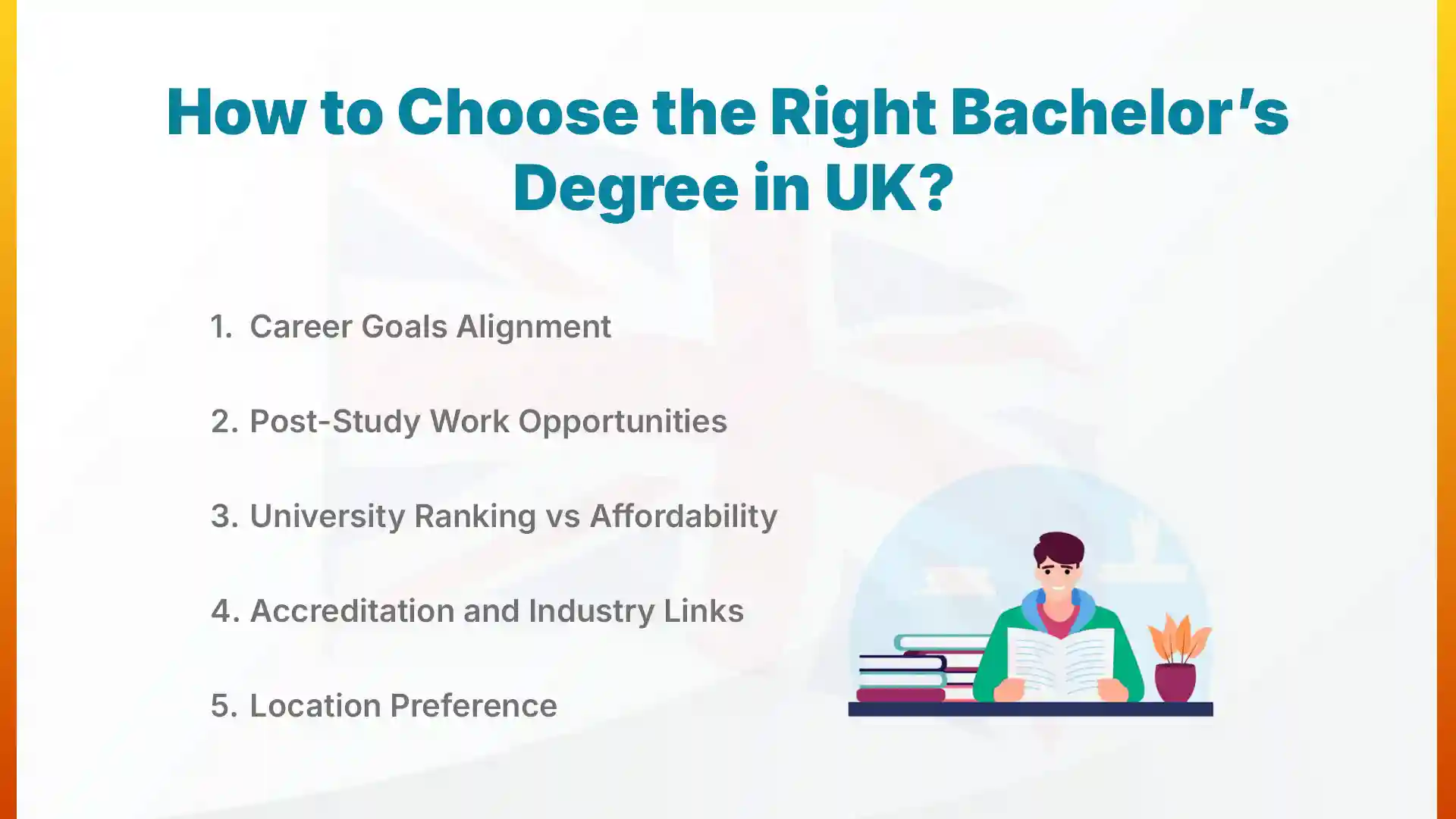
1. Career Goals Alignment
Your chosen degree should directly support your long-term career plans. If you want to work in healthcare, Nursing or Health Sciences makes sense, not Business just because it’s “popular.” Look at the job market demand both in the UK and in your home country. Research potential salaries, growth prospects, and required qualifications in your field. A degree aligned with your strengths and interests will also keep you motivated during challenging academic years. Passion plus practicality, that’s the sweet spot.
2. Post-Study Work Opportunities
Before finalising your course, check how it connects with post-study employment pathways. Some fields, like STEM, healthcare, and data-related programs, have stronger job demand in the UK job market. While studying, exploring part-time jobs in UK can also help you gain local work experience and build employer connections. The Graduate Route allows you to stay for two years after completing your degree, so choose a course that gives you real employment potential during that period. Research whether the industry has skill shortages or sponsorship-friendly employers. A strategic course choice increases your chances of transitioning to long-term work visas. Think beyond graduation day.
3. University Ranking vs Affordability
High-ranking universities offer global prestige, but they often come with higher tuition fees and competitive entry requirements. On the other hand, mid-ranked universities may provide strong teaching quality at a more affordable cost. It’s important to balance reputation with financial sustainability. Ask yourself: Will the extra cost significantly improve your career outcome? Sometimes paying more is worth it, sometimes it’s not. Choose wisely, not emotionally.
4. Accreditation and Industry Links
Professional accreditation can significantly enhance the value of your degree. Courses in Engineering, Nursing, Business, and Law often have accreditation from recognised industry bodies, which improves employability. Universities with strong industry partnerships may offer placement years, internships, or live projects. These connections help you gain real-world experience before graduation. Employers value practical exposure as much as academic knowledge. So always check if the course is professionally recognised and industry-connected.
5. Location Preference
Location affects both your lifestyle and your budget. Studying in London offers networking advantages and access to large industries, but it comes with higher living costs. Cities like Manchester, Birmingham, or Leeds may be more affordable while still offering strong career opportunities. Climate, cultural environment, and part-time job availability also vary by location. Consider where you’ll feel comfortable living for several years. Because honestly, happiness matters too.
Common Mistakes International Students Should Avoid
Studying in the UK is a big investment, and small mistakes can lead to big consequences. Many international students focus only on getting an offer letter and forget to think long-term. From poor course selection to rushed applications, these errors can affect visa approval, career outcomes, and even financial stability. The good news? Most of these mistakes are avoidable with proper research and planning. Let’s go through the most common ones so you don’t repeat them.
1. Choosing Only Based on Low Tuition Fees
It’s tempting to choose a university just because it’s cheaper. Everyone wants to save money, that’s understandable. But low tuition doesn’t always mean better value. Sometimes, cheaper programs lack strong industry connections, accreditation, or career support services. You might save £2,000 per year but lose long-term employability advantages. Instead of looking only at fees, evaluate graduate outcomes, course quality, and university reputation. Education is an investment, not just an expense.
2. Ignoring Graduate Route Opportunities
Many students focus only on admission and forget about what happens after graduation. The UK Graduate Route allows you to stay and work for two years after completing your degree, but your course choice should align with job market demand. If your field has limited employment opportunities, staying back may become difficult. Research industries with strong hiring trends and skill shortages. Planning for post-study work from day one increases your chances of long-term career success. Don’t think short-term, think strategically.
3. Applying Without Checking Course Accreditation
Professional accreditation matters more than most students realise. Fields like Nursing, Engineering, and Law often require accredited degrees for professional registration. If your course lacks proper recognition, you may face challenges when applying for jobs or licensing. Some employers specifically prefer graduates from accredited programs. Always verify whether the course meets industry standards before applying. A few minutes of research can save years of regret.
4. Submitting Incomplete Documents
Incomplete or incorrect documents are one of the most common reasons for delays and visa complications. Missing transcripts, unclear financial proof, incorrect personal statements, or outdated English test scores can create unnecessary problems. Universities and visa authorities follow strict procedures, and small errors can lead to rejection. Double-check every document before submission. Attention to detail is critical during the application process. Rushing paperwork rarely ends well.
5. Applying Too Late
Timing plays a huge role in successful admission and visa approval. Applying late reduces your course options, limits scholarship opportunities, and increases visa processing stress. Popular programs often fill up months before deadlines. Late applications also leave little room to fix documentation issues if something goes wrong. Ideally, start preparing at least 8-12 months before your intended intake. Early planning gives you flexibility and peace of mind.
Which is the Best Education Consultancy to Study Bachelor’s in UK?
SAS Education Consultancy is one of the best education consultancies to study a bachelor’s in the UK because of its personalised guidance, transparent process, and strong university network. They provide step-by-step support, from course selection and university applications to visa documentation and interview preparation. What makes them stand out is their focus on matching students with the right program based on career goals, not just pushing random offers. Their experience with UK admissions and visa procedures increases application accuracy and reduces common mistakes. For students who want clarity, proper counselling, and reliable support, SAS Education Consultancy is a trusted choice.
Conclusion
Choosing the right bachelor’s degree in the UK is more than just selecting a course—it’s about shaping your future with intention. From understanding tuition fees and living costs to evaluating university reputation and post-study work opportunities, every decision plays a role in your long-term success. The UK offers globally recognised education, shorter degree durations, and strong employability pathways, making it a smart destination for international students who plan carefully.
Take your time to research, align your course with your career goals, and avoid common mistakes like applying late or ignoring accreditation. With the right strategy and proper guidance, your journey toward earning a bachelor's degree in the UK can become a life-changing investment, not just academically, but professionally and personally as well.