BBA in UK for Nepalese Students: Study & Career Guide

Dec 01, 2025

Studying business abroad has never been more rewarding, and the UK is leading that transformation. In 2024 alone, British universities saw a surge in international business enrolments, driven by their strong industry links and globally respected teaching approach. For anyone dreaming of a global business career, the UK offers a chance to learn with confidence and build real skills that employers value.
If you’re planning your first international degree, studying BBA in the UK can open doors to strong career opportunities in finance, marketing, management, and more. Many Nepalese students are drawn to the UK because of its practical teaching style, diverse classrooms, and degrees that are accepted all over the world.
In this blog, you’ll get a simple and complete guide to everything that matters. Top business colleges, fees, requirements, jobs, salaries, and the exact steps to apply for a UK student visa from Nepal. By the end, you’ll know exactly how to begin your BBA journey in the UK.
In this blog
What is a BBA Course in the UK?
A Bachelor of Business Administration (BBA) in the UK is designed to help students understand how modern businesses work. The course blends theory with practical learning, so you learn how to apply it in real situations. Through group projects, presentations, and industry-focused modules, you begin building key skills in leadership, communication, problem-solving, and decision-making. For many Nepalese students, this balance makes the UK’s BBA one of the most trusted and job-ready business degrees available today.
Duration & Intake for BBA in the UK
Most BBA programs in the UK run for three years, with an optional fourth-year placement for students who want professional experience. Major intakes in the UK usually open in September. Some universities also offer January or May entries. The teaching style is interactive. You can expect seminars, workshops, case studies, and real business scenarios rather than just textbook learning. This approach helps students gain confidence and adapt quickly to global workplace expectations.
Popular BBA Specializations
UK universities offer a wide range of specializations, giving you the freedom to focus on the area that fits your interests and long-term plans. Each pathway is designed to build practical skills that employers look for, while also helping you understand real business challenges.
Some popular options include:
- Finance – Learn how money moves in global markets, manage budgets, and understand investment strategies.
- Marketing – Explore branding, consumer behavior, digital marketing, and creative campaign planning.
- Human Resource Management (HRM) – Develop skills in recruitment, training, employee relations, and workplace leadership.
- Entrepreneurship – Build the mindset and tools needed to start and manage your own business or join innovative startups.
- International Business – Understand global trade, cross-cultural management, and how companies expand across borders.
These specializations help you tailor your BBA toward roles in global companies, fast-growing industries, or even your own entrepreneurial journey in the future.
Why Study BBA in the UK as a Nepalese Student?
Studying BBA in the UK gives you a strong, practical, and globally valued foundation in business that can guide your future confidently. You learn from real industry cases, experienced teachers, and a system that focuses on building skills you can use right away. This combination helps you stand out in the job market and prepares you for opportunities in the UK and around the world.
1. Globally Recognized Degrees
UK business degrees are respected all over the world, which makes your qualification stand out no matter where you choose to work later. Many top UK universities rank highly for business and management, and employers know that graduates from these programs are trained to think clearly, lead teams, and solve problems. For Nepalese students, this recognition becomes a big advantage when applying for jobs or further studies abroad.
2. Practical, Industry-Focused Teaching
A British BBA degree is built around real-life learning. You don’t only study theories, you work on case studies, group projects, presentations, and sometimes even live business challenges. Many universities also offer placement years or internships, giving you a chance to gain UK work experience before graduating. This hands-on approach helps you understand how businesses actually operate and makes you job-ready from day one.
3. Supportive Environment for International Students
UK universities are known for their friendly and diverse campuses, with students from many different countries studying together. This makes it easier for students to adapt and feel at home while studying in the UK from Nepal. You get access to academic support, career guidance, and counselling services whenever you need help. Smaller class sizes also mean teachers can give more personal attention, which builds confidence along the way.
4. Post-Study Work Opportunities
After completing your BBA, the UK’s Graduate Route lets you stay back and work for up to two years. This gives you time to explore different roles, gain experience, and build a strong CV. Cities like London, Manchester, and Birmingham offer many opportunities in finance, marketing, HR, and management. For many students from Nepal, this chance to work abroad becomes a major turning point in their careers.
Eligibility Requirements for BBA in the UK
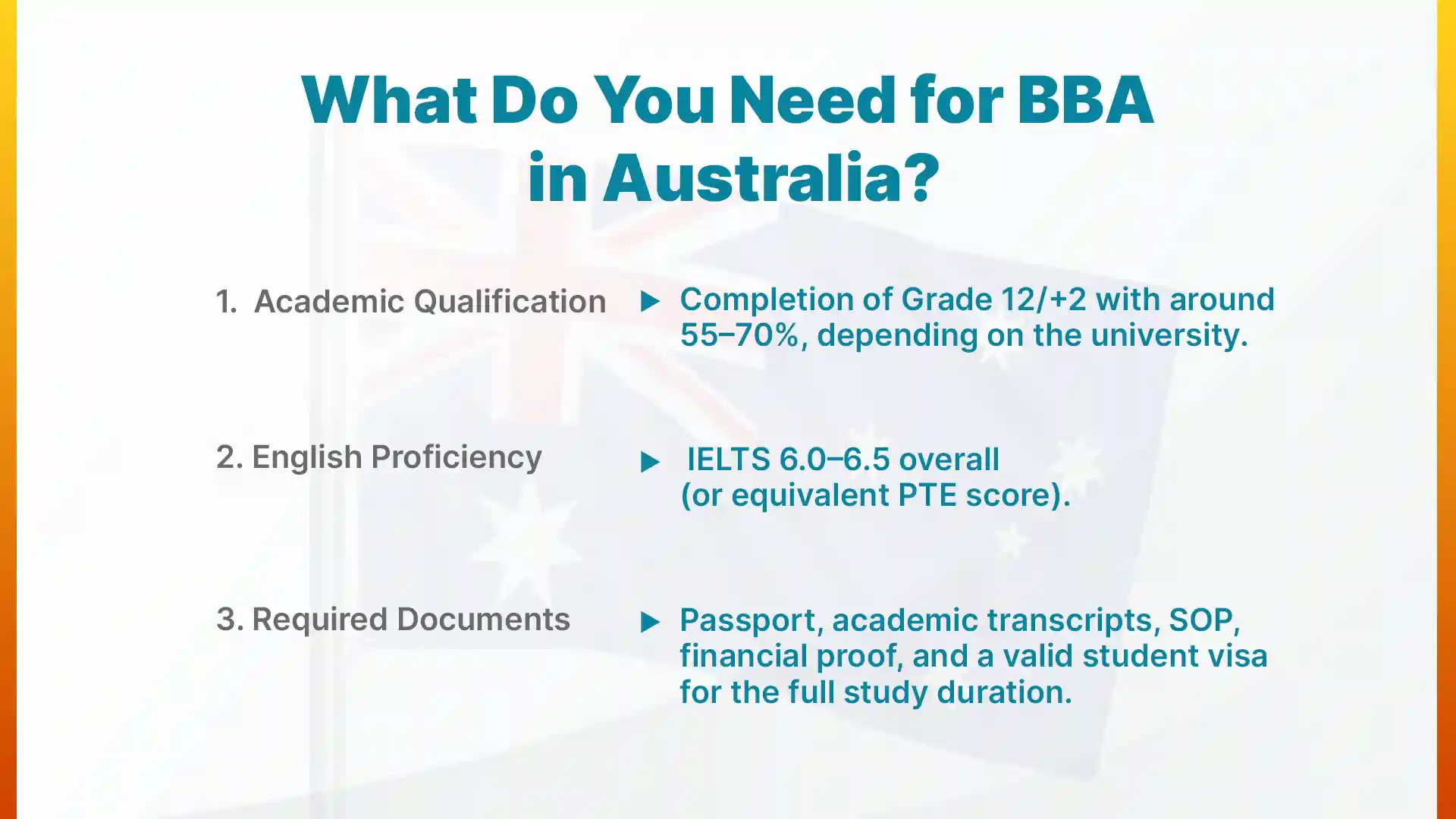
To study BBA in the UK, you must complete Grade 12 or +2 with a good overall score, usually around 60–70% depending on the university. You also need to meet English requirements through tests like IELTS or PTE, and most universities ask for an IELTS score of about 6.0 overall with no band below 5.5. Along with this, you must also meet certain financial and document requirements for studying in the UK.
1. Academic Requirements
To apply for a BBA in the UK, you must have completed your higher-secondary education, like +2 (NEB) or A-Levels or an equivalent qualification. Some universities ask for a minimum grade of around 60–70% or a GPA equivalent. If you don’t meet this requirement, many UK universities offer a foundation or preparatory year to help you qualify.
2. English Language Requirements
Because classes are taught in English, you must prove that you are fluent in English. Most UK universities expect an IELTS Academic score of around 6.0 overall with no section lower than 5.5. Some institutions may waive this requirement if you studied in an English-medium school previously, but this depends on the university.
3. Financial Requirements
International students must show proof that they can afford both tuition and living costs while studying in the UK. If you live outside London, you need enough funds to cover at least London's lower living-cost threshold (or the university’s living-cost estimate) plus tuition. This usually means showing bank statements, loan letters, or sponsor documents held for a set period (often 28 days) before your visa application.
4. Supporting Documents
When you apply, you need to prepare academic transcripts and certificates showing your +2 (or equivalent) results. You should also prepare a Statement of Purpose (SOP) explaining why you want to do the BBA. You may also need Letters of Recommendation (LORs), usually from teachers or school authorities, to support your application. A CV helps too, if you have relevant extracurriculars or work experience, especially where competition is high, or the program asks for it.
Top BBA Colleges in UK With Fees
Popular BBA colleges in the UK, like the University of Greenwich, Coventry University, and Middlesex University, London, offer business courses at around £16,800–20,050 per year. These universities provide high-quality business education, industry exposure, and support for international students. Here’s a table of top UK universities offering BBA or business-related undergraduate courses, along with approximate annual tuition fees for international students.
University | Approx. Annual Tuition Fee (International Students) |
| University of Greenwich | £17,500 |
| Coventry University | £16,800 – £20,050 |
| University of West London | £14,500 – £18,000 |
| Middlesex University London | £17,200 |
| University of Northampton | £13,500 – £16,500 |
| University of South Wales | £13,000 – £16,000 |
| University of Manchester | £33,100 |
Note: Tuition fees vary by course specialization, year, and intake. Always check the university’s official website or contact admissions for the most accurate and updated fees.
How Much Does it Cost to Study BBA in the UK?
Studying a BBA in the UK can cost you around £20,000–40,000 per year, including tuition and living expenses, depending on the university and city you choose. Knowing the total cost of studying and living in the UK upfront helps you plan carefully and avoid surprises. With careful planning, even Nepalese students can manage these expenses effectively.
1. Annual Tuition Fees
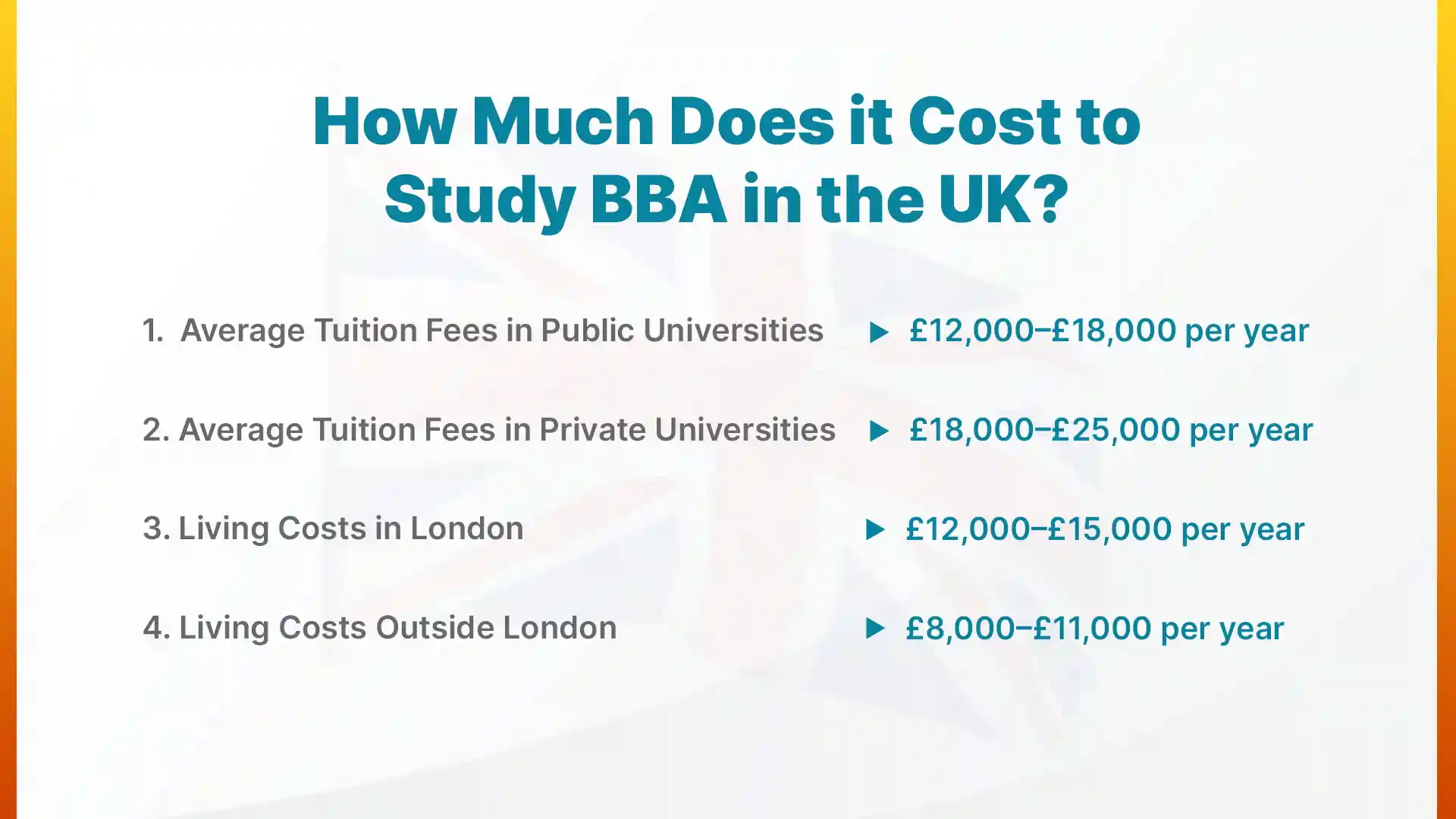
Public universities in the UK usually charge £12,000 – £18,000 per year for an undergraduate business course, while private universities can cost £18,000 – £25,000 per year. This covers your classes, library access, campus facilities, and sometimes student support services. Some universities also charge small administrative fees, so it’s always good to check the total cost when applying.
2. Living Costs
Living costs depend on your city and lifestyle. If you plan to live in London, you’ll need around £12,000 – £15,000 per year. Outside London, around £8,000 – £11,000 per year should cover all your expenses except tuition. Moreover, you can save money by sharing a flat or dorm, cooking your own meals, and using public transport instead of taxis.
3. Scholarships & Financial Aid
Many UK universities offer scholarships for international students. Some are merit-based for academic excellence, while others are need-based. Nepalese students can also look for country-specific awards or funding from UK organizations. Apply early, keep all documents ready, and research multiple options to increase your chances. Scholarships in the UK can significantly reduce tuition costs and sometimes even cover living expenses.
4. Part-Time Job Opportunities to Manage Costs
International students are allowed to work up to 20 hours per week during term time and full-time during holidays. International students in the UK can earn between £800 and £1,000 per month at an average hourly rate of £10-£12. This can help cover living expenses and give you valuable work experience.
Popular student-friendly jobs include campus positions, retail, hospitality, and internships related to your BBA specialisation. Working part-time also helps improve communication skills and build a professional network while studying in the UK.
How to Apply for BBA in the UK from Nepal
To apply for a BBA in the UK from Nepal, you must first complete your +2 level education and have strong academic results. You should then choose a course and university, prepare English proficiency test scores and other required documents. Finally, you will apply to universities, receive an offer, secure a Confirmation of Acceptance for Studies (CAS), and apply for your UK student visa. Here’s a clear roadmap to guide you from shortlisting universities to boarding your flight with confidence.
Step 1 – Shortlist Universities
Start by researching universities that offer BBA programs suited to your interests, budget, and career goals. Look at factors like tuition fees, specializations, location, and rankings. Make a list of 4–6 universities to increase your chances of admission.
Step 2 – Prepare Documents
Gather all the required documents carefully. This usually includes your academic transcripts, Statement of Purpose (SOP), Letters of Recommendation (LORs), and a CV if required. Keeping everything ready in advance saves stress later and ensures a smooth application process.
Step 3 – Meet English Language Criteria
Check the English proficiency requirements of each university. Most BBA programs ask for IELTS (around 6.0), PTE, or TOEFL scores. If needed, prepare in advance and schedule your test early so you meet the deadlines.
Step 4 – Submit Application
Apply directly through the university’s online portal or via UCAS (for programs that accept it). Fill out your details carefully, attach all documents, and double-check for errors before submission. Some universities may charge an application fee.
Step 5 – Receive Offer Letter
Once your application is reviewed, you will receive either a conditional or unconditional offer letter. Conditional offers depend on completing your current studies or meeting language requirements. Accept the offer and follow the university instructions for the next steps.
Step 6 – CAS & Visa Process
After accepting your offer, the university issues a Confirmation of Acceptance for Studies (CAS), which you need for your UK student visa. Prepare your visa documents, proof of funds, and submit your application online. Attend the visa interview if required and wait for approval.
Step 7 – Pre-Departure Preparation
Once your visa is approved, plan your travel and accommodation. Learn about the local culture, student support services, and campus facilities. You can also reach out to student communities or Nepalese student associations for guidance.
If you are confused about starting your UK education, or if you are feeling stuck mid-process, visit an education consultancy in Nepal for reliable guidance. They have earned expertise in study abroad and visa processing through in-depth knowledge, experience, and proven strategies. Talk to a counsellor at SAS Education Consultancy for a smooth and stress-free journey to the UK.
BBA Jobs & Salary in the UK
A BBA degree from a UK university gives you access to many business‑related roles across sectors like finance, marketing, HR, and management. Entry-level salaries are reasonable, and long-term demand for graduates across business services remains strong. However, the job market is competitive, especially for fresh graduates. Success often depends on skills, specialization, and effort (internships, networking, etc.) alongside your degree.
1. Popular Job Roles for BBA Graduates
Completing a BBA in the UK opens the door to a wide range of career opportunities. Many graduates step into roles where they can apply their business knowledge and gain practical experience, such as:
- Business Analyst – analyzing company data and helping managers make smart decisions.
- Marketing Coordinator / Executive – planning campaigns, managing promotions, and building brand visibility.
- Sales Executive / Account Manager – achieving sales targets, managing client relationships, and driving business growth.
- HR Assistant / Junior HR Officer – supporting recruitment, training, and employee engagement.
- Finance or Banking Assistant – handling accounts, banking operations, or financial services, especially for those who specialized in finance.
- Operations / Management Trainee – working in operations, supply chain, or general management roles in companies.
- Entry-level roles in consulting, business services, or administration – supporting projects and processes in global firms or small-medium enterprises (SMEs).
These roles are popular because a BBA equips you with versatile skills in management, communication, and problem-solving, making it easier to work across industries or even start your own business in the future.
2. Average Starting Salary Range for BBA Graduates
Entry‑level business graduates in the UK typically earn around £22,000–£28,000 per year when starting out. Graduates hired by well‑known employers, especially in cities or in competitive sectors, often begin with £25,000–£35,000 per year. For some roles in finance, consulting, or management where demand is higher, salaries may rise above £35,000 and sometimes reach £40,000+ within a few years if you perform well.
3. Industry Demand & Graduate Job Market Outlook
The demand for university‑educated workers in the UK remains strong, especially in business‑related fields. According to a report by Universities UK (UUK), the UK will need over 11 million additional graduates by 2035 to fill new and replacement jobs. Many of these roles will be in business services, like marketing, sales, HR, management, and accounting.
That said, recent data shows the graduate job market is becoming more competitive. A 2025 report found that entry-level job vacancies dropped by about 33% compared with the previous year. This doesn’t mean opportunities are gone; it means you'll need to stand out more.
Employers are looking for graduates who not only have degrees but also strong skills: critical thinking, communication, adaptability, and hands‑on experience. So for you, as someone coming from Nepal, a BBA from a UK university still offers real value. But you may have to take smarter steps. It is smarter to combine your degree with internships, part‑time jobs, or extra skills. Take extra upskilling training. Build a personal portfolio from the beginning. Combined, your smarter steps should improve your chances of getting a good job despite growing competition
Higher Education Options in the UK After BBA
Completing a BBA in the UK doesn’t have to be the end of your academic journey. Many students choose to continue their studies to specialize further, improve career prospects, or aim for higher-level roles. Here are some popular options:
1. Master in Business Analytics Courses
A Master in Business Analytics focuses on using data to make better business decisions. You’ll learn skills in statistics, data visualization, and predictive modeling. This degree is ideal for BBA graduates interested in roles like business analyst, data consultant, or operations manager. UK universities like Imperial College London, UCL, and Warwick offer highly respected programs in this field.
2. Master in International Business in the UK
A Master's in International Business (MIB) prepares you for global business challenges. You study international trade, cross-cultural management, and global strategy. Graduates often pursue careers in multinational corporations, global marketing, or export/import management. Programs are offered by top universities such as the University of Manchester, Aston University, and Durham University.
3. MSc Finance in the UK
For BBA graduates with a finance specialization or strong interest in financial markets, an MSc in Finance is a natural next step. You’ll explore investment analysis, risk management, corporate finance, and banking. This degree opens doors to roles in investment banking, financial consulting, or corporate finance.
4. PhD in Business Administration
A PhD in Business Administration is for those aiming for research, academic, or top-level strategic roles in business. You will conduct original research, publish papers, and contribute new knowledge to management, finance, or entrepreneurship. This is ideal if you want a career as a university professor, researcher, or consultant at global think tanks. Universities like Oxford, Cambridge, and Cranfield offer highly competitive PhD programs in business.
Conclusion
Pursuing a BBA in the UK is synonymous with stepping into a world full of opportunities, global exposure, and career growth. From top universities to practical, industry-focused learning, and pathways into finance, marketing, HR, and international business, the UK equips you with the knowledge and skills to succeed anywhere.
While the journey may feel challenging, it’s completely achievable with proper planning and guidance. Remember, a BBA in the UK opens doors not only to rewarding jobs but also to further studies like Master’s and PhD programs that can take your career to new heights.
With SAS Education Consultancy by your side, you can navigate every step confidently, from shortlisting universities to preparing applications and securing your place abroad. Your dream of studying business in the UK is within reach, and the right study abroad guidance ensures you take each step with clarity, confidence, and excitement for the future.