IT Courses in the UK: Complete Guide for Nepalese Students

Nov 26, 2025

The UK has the fastest-growing tech industry in Europe, creating thousands of new digital jobs every year. In 2024 alone, the UK employed 2.18 million people in the tech sector. This growth makes the country an exciting place for anyone who wants to build a future in IT. With world-class universities, cutting-edge research, and thriving tech ecosystems in cities like London, Manchester, and Edinburgh, the UK offers an exciting environment for aspiring IT professionals.
For Nepalese students, the UK is not just about quality education; it also provides practical learning experiences, industry exposure, and pathways to work experience and even permanent residency. This guide will help you understand the best IT courses in the UK, admission requirements, career opportunities, costs, scholarships, and pathways to work and permanent residency in UK, giving you all the information you need to plan your UK education with confidence.
In this blog
Why Choose the UK for IT Studies?
The UK is a top destination for IT studies because it offers world-class universities, cutting-edge technology programs, and strong industry connections. Students benefit from hands-on learning, research opportunities, and access to tech hubs like London, Manchester, and Edinburgh. Additionally, international students benefit from the UK’s high demand for IT graduates, post-study work visas, and pathways toward long-term career growth and permanent residency.
1. Top IT Universities in the UK
The UK is home to some of the world’s leading institutions for IT and computer science. Universities like the University of Oxford, University of Cambridge, Imperial College London, University of Manchester, and University of Edinburgh consistently rank among the top globally. These universities offer programs in Computer Science, Software Engineering, Artificial Intelligence, Data Science, and other cutting-edge IT fields. Studying at these institutions not only provides high-quality education but also enhances your global career prospects.
2. Hands-On Learning & Industry Connections
UK universities emphasize practical learning. Many programs include lab-based projects, internships, and industry collaborations, allowing students to gain real-world experience while studying. For Nepalese students, this means building a professional network and improving employability before graduation.
3. High Demand for IT Graduates
The UK faces a growing shortage of skilled IT professionals. Fields like software development, cybersecurity, cloud computing, and AI have high demand, making it easier for graduates to find jobs after completing their studies.
4. Graduate Route Visa Advantages
International students who complete bachelor’s or master’s programs in the UK can apply for the 2-year post-study work visa. This allows you to gain UK work experience, which is crucial for building a strong IT career and improving future migration prospects.
5. PR-Friendly Pathways for IT Graduates
The UK offers clear pathways for skilled IT graduates to stay long-term. Through the Skilled Worker Visa, Shortage Occupation List, and tech-sector sponsorship opportunities, you can build your career in the UK and explore permanent residency options.
What Are the Best IT Courses to Study in the UK?
The best IT courses to study in the UK include Computer Science, Artificial Intelligence, Data Science, Software Development, and Cybersecurity. These courses combine theoretical knowledge with practical skills. Choosing a course that matches your interests and career goals ensures better learning, job prospects, and growth opportunities in the UK tech sector. Here’s a closer look at the most popular courses in the UK for IT students from Nepal:
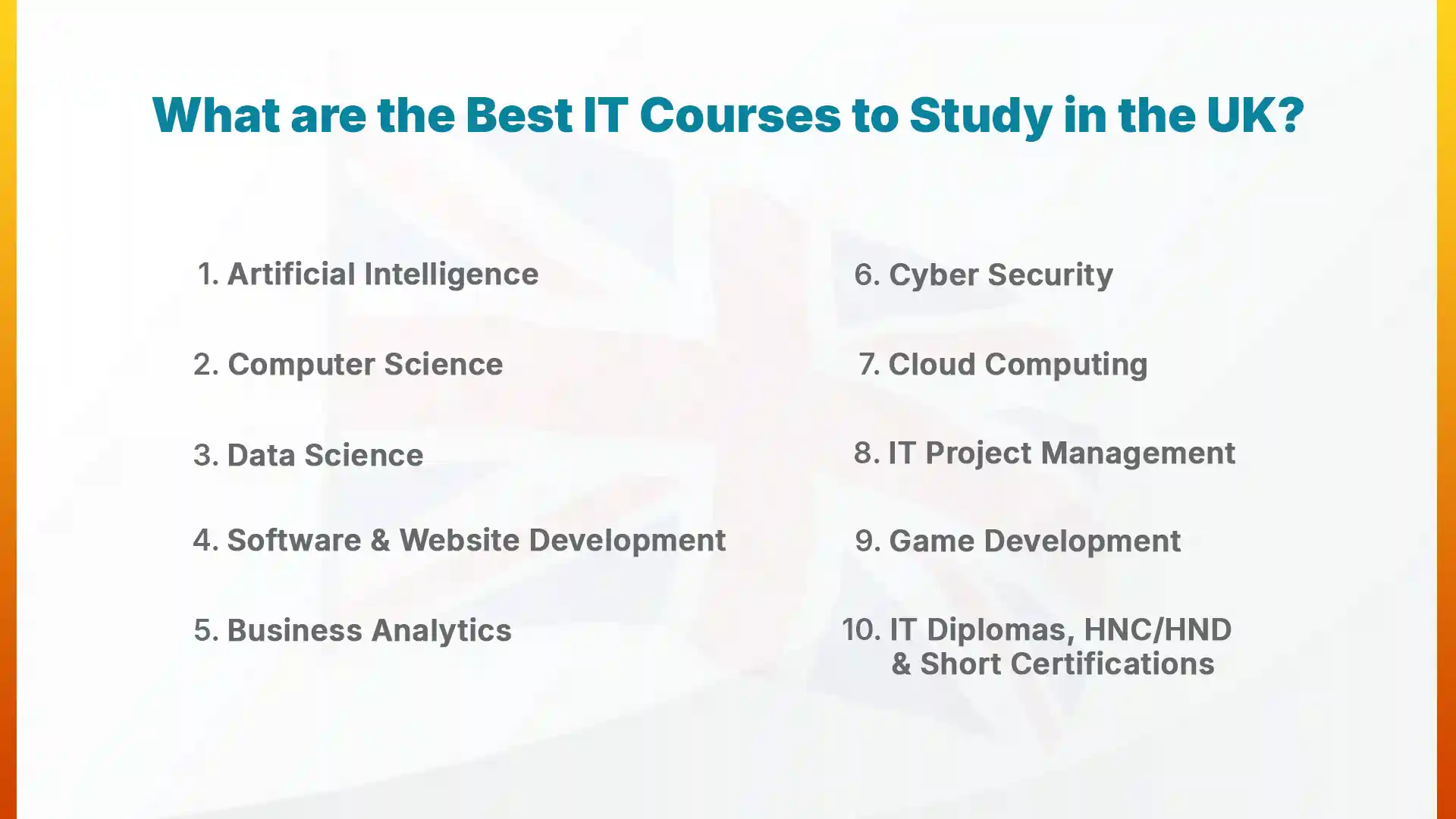
1. Artificial Intelligence (AI)
Artificial Intelligence is one of the fastest-growing fields in technology today. UK programs focus on machine learning, natural language processing, robotics, and intelligent systems. Students work on real-world projects, such as building chatbots, predictive models, or smart automation systems. Many universities also provide access to AI labs and industry tools, giving hands-on experience. Graduates can pursue careers as AI specialists, data scientists, or research engineers. AI courses often include internships or collaborations with tech companies, which helps students gain professional exposure. The skills learned in AI are highly transferable, opening opportunities in finance, healthcare, and software development.
2. Computer Science
Computer Science is a versatile and foundational IT program. UK universities teach programming, algorithms, database management, and software engineering. Students gain problem-solving skills and learn to design efficient systems or applications. Practical labs and group projects help develop teamwork and real-world coding experience. Many programs also introduce emerging areas like cloud computing and cybersecurity. Graduates can work as software developers, system analysts, or IT consultants. With global tech demand rising, computer science offers strong job security and growth opportunities.
3. Data Science
Data Science combines statistics, programming, and analytics to help businesses make data-driven decisions. UK courses focus on big data, predictive modelling, machine learning, and data visualization. Students often work with real datasets from industry partners, which builds practical skills. Graduates can become data analysts, business intelligence professionals, or machine learning engineers. The programs usually include tools like Python, R, SQL, and Tableau, which are widely used in the industry. Demand for data science skills continues to grow across sectors like finance, healthcare, and marketing. Completing a UK degree in data science also helps students explore internships and work placements during their studies.
4. Software & Website Development
Software and Website Development programs teach students how to design, develop, and maintain software applications and websites. UK courses cover programming languages, front-end and back-end development, UI/UX design, and testing. Students learn to build apps, websites, and enterprise software, often through project-based learning. Many programs include internships or collaboration with startups, giving practical exposure. Graduates can work as web developers, software engineers, or app developers. Strong coding skills and project experience help students stand out in the job market. These courses also provide a foundation for further studies in advanced IT fields.
5. Business Analytics
Business Analytics bridges the gap between IT and business decision-making. UK programs teach data analysis, business intelligence, reporting, and statistical modelling. Students learn to interpret data and provide actionable insights for companies. Courses often include real-world projects and internships with UK businesses. Graduates can pursue careers as business analysts, data consultants, or market intelligence specialists. Analytical and technical skills gained here are in high demand across finance, marketing, and logistics. Learning software tools like Excel, Power BI, and SQL enhances employability and practical readiness.
6. Cybersecurity
Cybersecurity programs focus on protecting digital systems and networks from threats. UK courses cover ethical hacking, network security, cryptography, and risk management. Students participate in labs and simulated attacks to gain hands-on experience. Graduates can become cybersecurity analysts, penetration testers, or IT security managers. With cyberattacks increasing worldwide, the demand for skilled professionals is high. Many programs include certifications or industry-recognised tools like Cisco, CompTIA, or AWS security. UK courses also emphasize legal and ethical aspects, ensuring graduates are prepared for global cybersecurity challenges.
7. Cloud Computing
Cloud Computing programs teach students to design, manage, and deploy cloud-based systems. UK courses cover virtualization, distributed systems, cloud infrastructure, and data management. Students often gain hands-on experience with platforms like AWS, Azure, or Google Cloud. Graduates can work as cloud engineers, solutions architects, or IT consultants. Programs also cover security, scalability, and performance optimization for cloud systems. Internships and collaborative projects help students gain practical exposure. Cloud computing skills are in high demand as more companies move operations to the cloud.
8. IT Project Management
IT Project Management programs combine technical IT knowledge with leadership skills. Students learn how to plan, execute, and monitor IT projects. Courses cover resource management, budgeting, risk assessment, and software development methodologies like Agile or Scrum. Graduates can work as project managers, team leads, or IT coordinators. Practical case studies and real-world projects help students develop problem-solving and leadership abilities. These skills are highly valued in both corporate and tech sectors. Completing such a program prepares students for management roles in IT companies worldwide.
9. Game Development
Game Development programs focus on designing, programming, and producing interactive games. Students learn coding, animation, graphics design, and user experience. Many courses include team-based projects to develop full games or simulations. Graduates can work as game designers, developers, or 3D artists. UK programs often offer access to gaming labs, engines, and industry-standard tools. Internship opportunities provide exposure to the gaming and entertainment industries. This field combines creativity and technology, making it ideal for students passionate about both.
10. IT Diplomas, HNC/HND & Short Certifications
For students looking for affordable or fast-track study options, UK colleges offer diplomas, Higher National Certificates (HNC), Higher National Diplomas (HND), and short certifications. These programs provide practical IT skills in areas like programming, networking, or system administration. Many are designed to be completed in 1–2 years and can lead to a bachelor’s degree later. Graduates can start working immediately in junior IT roles or continue their studies at universities. Short certifications are also popular for upskilling in specific technologies. These courses are ideal for students who want to gain skills quickly while keeping costs manageable.
Best IT & Computer Science Universities in the UK
The top UK universities for IT include Imperial College London, University of Oxford, University of Cambridge, UCL, Edinburgh, Manchester, and King’s College London, all highly ranked and respected in technology fields. These institutions not only offer stellar academic programs in computer science, data science, AI, and more, but also provide strong research output, industry links, and global recognition. Moreover, many of these universities support international students with scholarship programs and post-study work visas. Here’s a snapshot of how some of the top 10 UK universities rank in the QS World University Rankings 2026:
UK University | QS World Rank 2026 |
| Imperial College London | 2 |
| University of Oxford | 4 |
| University of Cambridge | 6 |
| UCL (University College London) | 9 |
| King's College London (KCL) | 31 |
| The University of Edinburgh | 34 |
| University of Manchester | 35 |
| University of Bristol | 51 |
| The London School of Economics and Political Science (LSE) | 56 |
What are the Admission Requirements for IT Programs in the UK?
To study an IT program, the admission requirements for the UK include strong academic qualifications, English language proficiency, and program-specific documents. For undergraduate programs, you need a +2 or equivalent with a minimum GPA, while master’s programs require a bachelor’s degree in IT, computer science, or engineering. Additionally, universities may ask for a Statement of Purpose, portfolio, or coding projects to assess your skills and motivation.
1. Academic Requirements for International Students
To study an undergraduate IT program in the UK, you must complete +2 or an equivalent qualification from a recognised board. Most universities look for a minimum GPA or percentage, usually ranging between 55% and 65%, depending on the institution and competitiveness of the course.
If you’re applying for a Master’s degree, you’ll need a bachelor’s in IT, computer science, engineering, or a related field, typically with at least a 2:2 or above. This ensures you have the necessary technical foundation to handle advanced modules. For competitive areas like data analytics or cybersecurity, a stronger academic background gives you an extra edge.
2. English Language Requirements
To meet the English requirement, you can submit scores from IELTS, TOEFL, PTE, or other accepted tests. Most IT programs expect an IELTS score between 6.0 and 6.5 overall, with no band below 5.5. If you fall slightly short, many universities offer pre-sessional English courses that help you qualify without retaking the test. These options give you flexibility and make the admission process less stressful, especially if you're balancing studies and test preparation.
3. Program-Specific Requirements
Program-specific requirements help universities understand your motivation and suitability for IT studies. You will usually need to submit a Statement of Purpose (SOP) explaining why you want to study IT in the UK and how the course fits into your goals. Some universities may also ask for a portfolio, simple coding projects, or proof of technical experience, especially for postgraduate pathways. These additions are not meant to be intimidating; instead, they highlight your interest, curiosity, and hands-on experience in the field.
IT Career Opportunities in the UK for International Students
International students find strong IT career opportunities in the UK because the country actively hires skilled tech graduates across multiple industries. Companies in finance, healthcare, e-commerce, and government frequently recruit graduates who can work with software, data, cybersecurity, and cloud tools. You also benefit from the Graduate Route Visa, which lets you stay and gain practical experience after completing your studies. With this support, you can build a stable career, move into higher-paying roles, and explore long-term pathways in the UK job market.
1. Most In-Demand IT Roles
The most in-demand IT roles in the UK include software developers, cybersecurity analysts, data scientists, cloud engineers, and AI specialists. These roles stay highly sought after because companies rely on technology to run operations, protect information, and make data-driven decisions. Software developers remain essential as organisations build apps, websites, and digital tools. Cybersecurity analysts are needed to defend systems from rising online threats. Data scientists support strategic planning by analysing trends and creating insights. Cloud engineers help businesses shift to platforms like AWS, Azure, and Google Cloud. AI specialists are becoming even more important as companies move toward automation and smart systems.
2. Part-Time & Placement Opportunities
Part-time and placement opportunities for IT students in the UK give you a real chance to build experience while studying. These roles help you understand workplace expectations and develop practical skills that employers value. Many students start with IT support, assisting with troubleshooting and basic technical tasks. Others join teams as junior developers, contributing to smaller coding assignments. QA assistant roles help you learn software testing and quality control. Helpdesk jobs are also common, especially in universities, retail chains, and local companies. Placement years and internships provide full-time experience that strengthens your CV and often leads to graduate job offers.
3. Average Salary of IT Engineer in the UK
The average salary of an IT engineer in the UK ranges from £28,000 to £80,000+, depending on experience and specialisation. Entry-level engineers usually begin with salaries between £28,000 and £35,000, giving you a solid starting point after graduation. As you gain skills and workplace exposure, mid-level engineers often earn between £40,000 and £55,000. Senior-level professionals with expertise in cybersecurity, cloud systems, or AI can make £60,000 to £80,000 or even higher in major tech hubs like London. These salary bands show how quickly your earnings can grow as you advance in the UK tech sector.
How Much Does It Cost to Study IT in the UK?
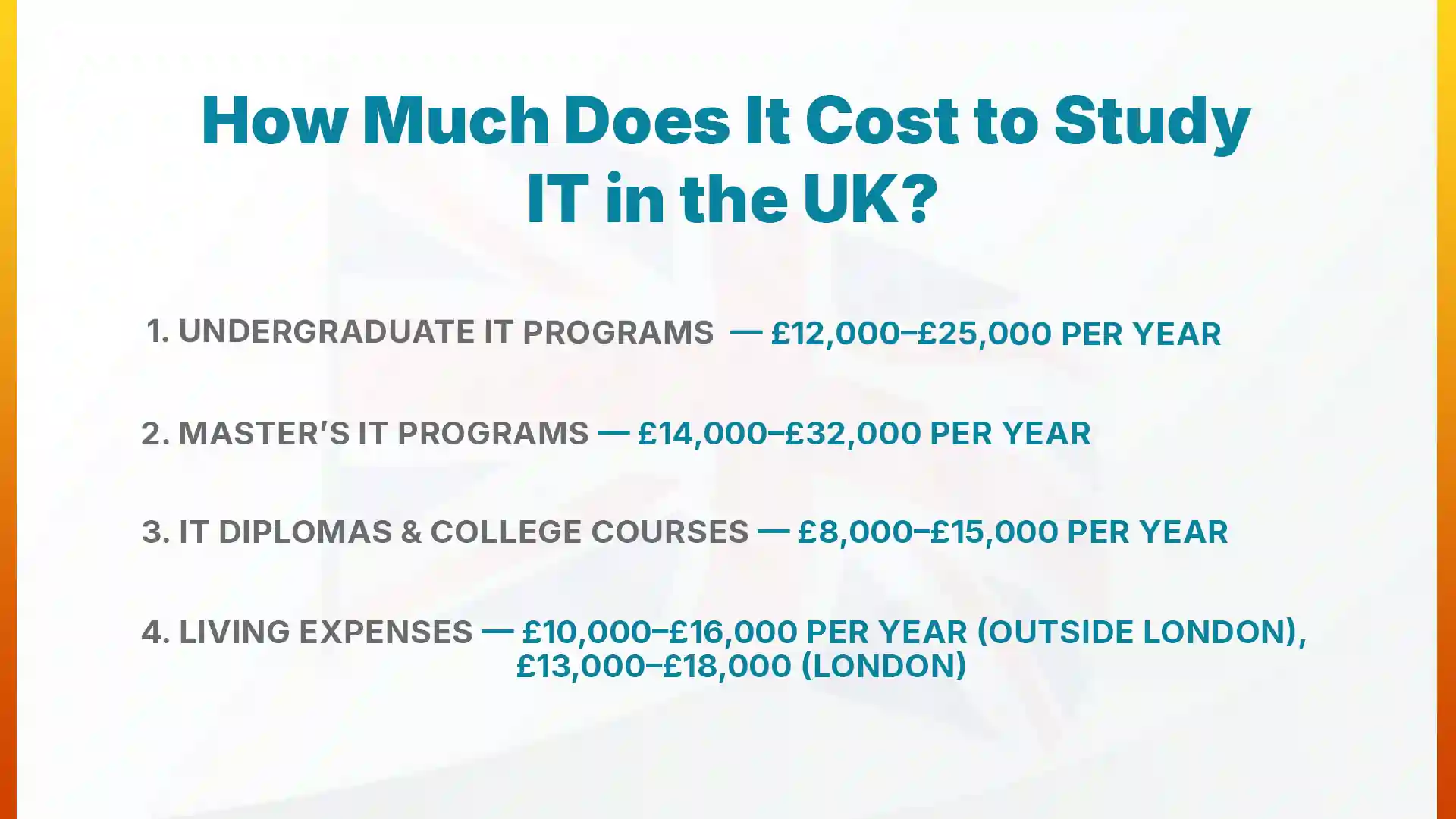
Studying IT in the UK costs anywhere between £8,000 and £32,000 per year, depending on the level of study and the type of institution you choose. These costs cover your tuition fees, while your living expenses depend on where you stay and how you manage your daily spending. When planning your budget, it’s helpful to understand the fee range for each program so you can choose an option that fits your goals and financial comfort.
1. Undergraduate IT Program Fees
Undergraduate IT programs in the UK usually cost between £12,000 and £25,000 per year, depending on the university’s ranking and facilities. Higher-ranked universities may charge more because they offer advanced labs, experienced faculty, and better industry placements. Many students prefer mid-range universities as they provide quality education at a more affordable price. Since bachelor’s degrees run for three years, you should calculate your total cost based on the full duration of study. Scholarships are available, too, which can lower your expenses significantly.
2. Master’s IT Program Fees
Master’s programs in IT typically range from £14,000 to £32,000 per year because they are more specialised and intensive. Courses like data science, cybersecurity, and AI often fall on the higher end of this range due to their strong demand and technical depth. These programs are usually one year long, making them a cost-effective option for many Nepalese students compared to other countries. Additionally, universities often provide alumni discounts or merit-based scholarships that make postgraduate study more affordable.
3. IT Diplomas & College Courses Tuition Fees
IT diplomas and college-level courses usually cost £8,000 to £15,000 per year, offering a budget-friendly choice for students looking for practical skills. These programs are shorter and more hands-on, making them suitable for those who want to enter the job market quickly. Many colleges also offer flexible timetables, which can help you balance studies with part-time work. Because the fees are lower, these courses are a great starting point if you want to explore IT before committing to a full degree.
4. Living Expenses in the UK for International Students
Living expenses for IT students in the UK depend on the city you choose. Outside London, you’ll typically spend £10,000 to £16,000 per year, which covers accommodation, food, transport, and basic personal costs. In London, however, the cost rises to £13,000 to £18,000 per year because rent and daily expenses are higher. Choosing student housing, cooking at home, and using public transport can help you control your budget. With careful planning, you can manage your lifestyle comfortably in any part of the UK.
Scholarships for IT Students in the UK
Scholarships in the UK help reduce your study costs and make high-quality education more accessible for international students. These financial supports come from universities as well as the government and external organisations, giving you multiple chances to ease your financial burden. Whether you are applying for a bachelor’s, master’s, or diploma program, exploring these scholarships early can help you plan your education wisely.
1. University-Specific Scholarships
University-specific scholarships are the easiest and most common form of financial aid for IT students in the UK. These include merit-based scholarships, which reward strong academic performance, departmental awards from IT or Computer Science faculties, and international student scholarships designed to support global applicants. Many universities offer automatic discounts based on your grades, meaning you don’t need a separate application. Others may require a personal statement, CV, or recommendation letter. These scholarships can reduce your tuition fees by £2,000 to £10,000, depending on the institution and the course.
2. Government & External Scholarships
Government and external scholarships provide high-value funding for talented international students pursuing IT degrees in the UK. Popular options include Chevening Scholarships, which cover full tuition and living expenses for postgraduate students with leadership potential. The Commonwealth Scholarships support students from developing nations, including Nepal, offering full financial support for master’s and PhD studies. Additionally, GREAT Scholarships provide partial funding through partnerships between UK universities and the British Council. These opportunities are competitive but life-changing, giving you access to world-class education with minimal financial stress.
Pathways to PR in the UK Through IT Education
Studying IT in the UK gives you a strong foundation for future PR opportunities because the country consistently needs skilled tech professionals. With the right job role, work experience, and qualifications, international students can build a competitive profile for long-term migration. Understanding how each step connects will help you plan ahead and make smarter decisions throughout your study journey.
Which IT Jobs are in Demand in the UK?
The most in-demand IT jobs in the UK include software engineers, systems analysts, cloud engineers, and AI specialists. These roles appear frequently on the UK Shortage Occupation List because companies urgently need talent in these areas. Software engineers are continually sought after as every industry depends on new digital systems. Systems analysts and cloud engineers support digital transformation, making them essential to business operations. AI specialists are also rising in demand due to increased use of automation and machine learning. Choosing one of these fields strengthens your employability and supports your PR pathway.
Average Salary of IT Professionals in the UK
In the UK, many IT professionals earn somewhere around £35,000–£50,000 per year, with software developers often sitting close to or slightly above this range, depending on skills and location. Entry-level roles such as IT support or junior technicians commonly start in the mid‑£20,000s per year. With several years of experience or specialist skills, salaries can rise into the £50,000–£70,000+ bracket, especially in development or senior infrastructure roles. IT salaries are usually higher in London and major cities compared to the rest of the UK.
Graduate Route & Work Experience
The UK Graduate Route helps IT students gain work experience after completing their studies by offering a 2-year post-study work visa. This pathway lets you work full-time in any IT-related role, allowing you to build local experience and improve your CV. Many students use this period to secure skilled roles that qualify for long-term visas. Because employers prefer candidates with UK work history, the Graduate Route becomes a major stepping stone. This experience also helps you meet the salary thresholds and sponsorship criteria needed for Skilled Worker visas.
Conclusion
Choosing the right IT course and university in the UK is the first step toward a rewarding career in technology. By carefully comparing programs, understanding admission requirements, and exploring scholarships, you can make informed decisions that fit both your academic and financial goals. The UK offers strong career prospects, practical learning opportunities, and pathways to gain work experience and even permanent residency.
With proper guidance, the process of selecting courses, applying to universities, and managing visas becomes simpler and less stressful. For Nepalese students, working with experienced UK education consultants in Nepal can make the journey smoother and increase your chances of success. Taking that first step today could set you on the path to an exciting IT career and long-term opportunities in the UK.