Bachelor of Development Studies in Canada: Colleges, Costs, and Career

Jun 15, 2026

Canada is one of the most respected destinations in the world for development studies, with strong programs in international development, global policy, and community development at universities that are directly connected to Canada's active role in international aid, humanitarian work, and multilateral institutions.
For Nepalese students who want to build a career in social change, international organizations, or public policy, a Bachelor of Development Studies in Canada offers a research-grounded, globally relevant education with real career outcomes. Nepalese students who are still exploring their options can start by reading about studying in Canada before committing to a specific program.
In this blog
What Is a Bachelor of Development Studies in Canada?
A Bachelor of Development Studies in Canada is a four-year undergraduate degree focused on understanding and addressing the social, economic, political, and environmental challenges facing communities and nations across the globe. In Canada, this degree is most commonly offered under the titles BA in Development Studies, BA in International Development, or BA in Global Development, depending on the institution. The degree title varies, but the curriculum, professional outcomes, and career pathways are consistent across accredited programs.
After completing the degree, graduates are prepared for roles in NGOs, government ministries, international organizations, and social enterprises working on issues from poverty reduction and climate adaptation to education access and health equity. Students interested in related pathways can study for a master's in Canada for postgraduate options in the field.
Why Study Development Studies in Canada?
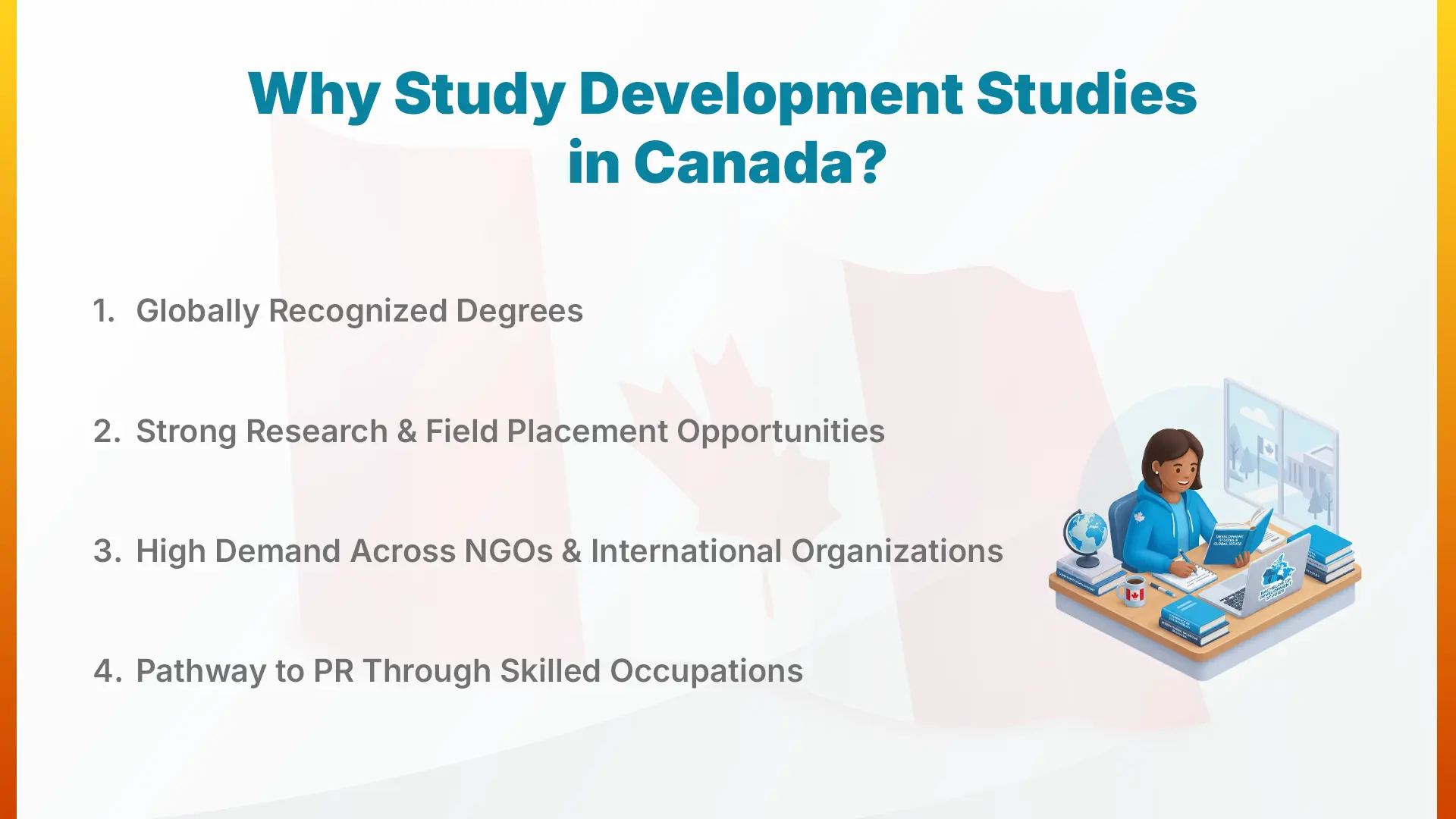
Canada is a strong choice for development studies because of its globally respected programs, research depth, strong NGO and government connections, and clear immigration pathway after graduation. This is a key part of why Nepalese students choose Canada for social science and international development programs.
1. Globally Recognized Degrees
Canadian development studies degrees are recognized by international employers, including the United Nations, World Bank, USAID, UNICEF, and major international NGOs. For Nepalese graduates, a Canadian development studies credential is a qualification that opens doors in international development organizations across South Asia, Africa, and globally.
2. Strong Research and Field Placement Opportunities
Most Canadian development studies programs include mandatory community-based research, international fieldwork components, or structured placements with NGOs and government agencies. These opportunities give students direct exposure to development practice and allow them to build professional networks before graduation.
3. High Demand Across NGOs and International Organizations
Canada is home to hundreds of internationally active NGOs; government aid agencies, including Global Affairs Canada; and multilateral organization offices. This creates a strong and active employment market for development studies graduates within Canada, as well as strong alumni networks in international organizations globally.
4. Pathway to PR Through Skilled Occupations
Social workers, policy analysts, and community development officers are recognized as skilled workers under Canada's immigration system. After completing a Bachelor of Development Studies and gaining Canadian work experience through the post-graduation work permit, Nepalese graduates are well-positioned to apply for permanent residency through Express Entry and provincial nominee programs.
Which Are the Top Universities for Development Studies in Canada?
The top universities for a Bachelor of Development Studies in Canada include the University of Toronto, McGill University, the University of British Columbia, Dalhousie University, and Carleton University, all offering strong international development programs with active research centers and industry connections.
University | Location | Program | Known For |
|---|---|---|---|
| University of Toronto | Toronto, Ontario | BA in International Development | UN Connections, Global Civil Society, Munk School of Global Affairs |
| McGill University | Montreal, Quebec | BA in International Development | Political Economy, Social Inequality, Environmental Development |
| University of British Columbia | Vancouver, British Columbia | BA in Global Development and Social Justice | Asia-Pacific Networks, Community-Based Research, Field Placement |
| Dalhousie University | Halifax, Nova Scotia | BA in International Development Studies | Critical Development Theory, Gender and Development, Community Engagement |
| Carleton University | Ottawa, Ontario | BA in Development Studies | Global Affairs Canada Proximity, International NGOs, Multilateral Organizations |
These may be some of the top institutions in the country, but the best university for you depends on your academic goals, preferred location, budget, and lifestyle. If a university matches your personal and educational preferences, then it can be considered the best university in Canada for your needs.
What Are the Admission Requirements?
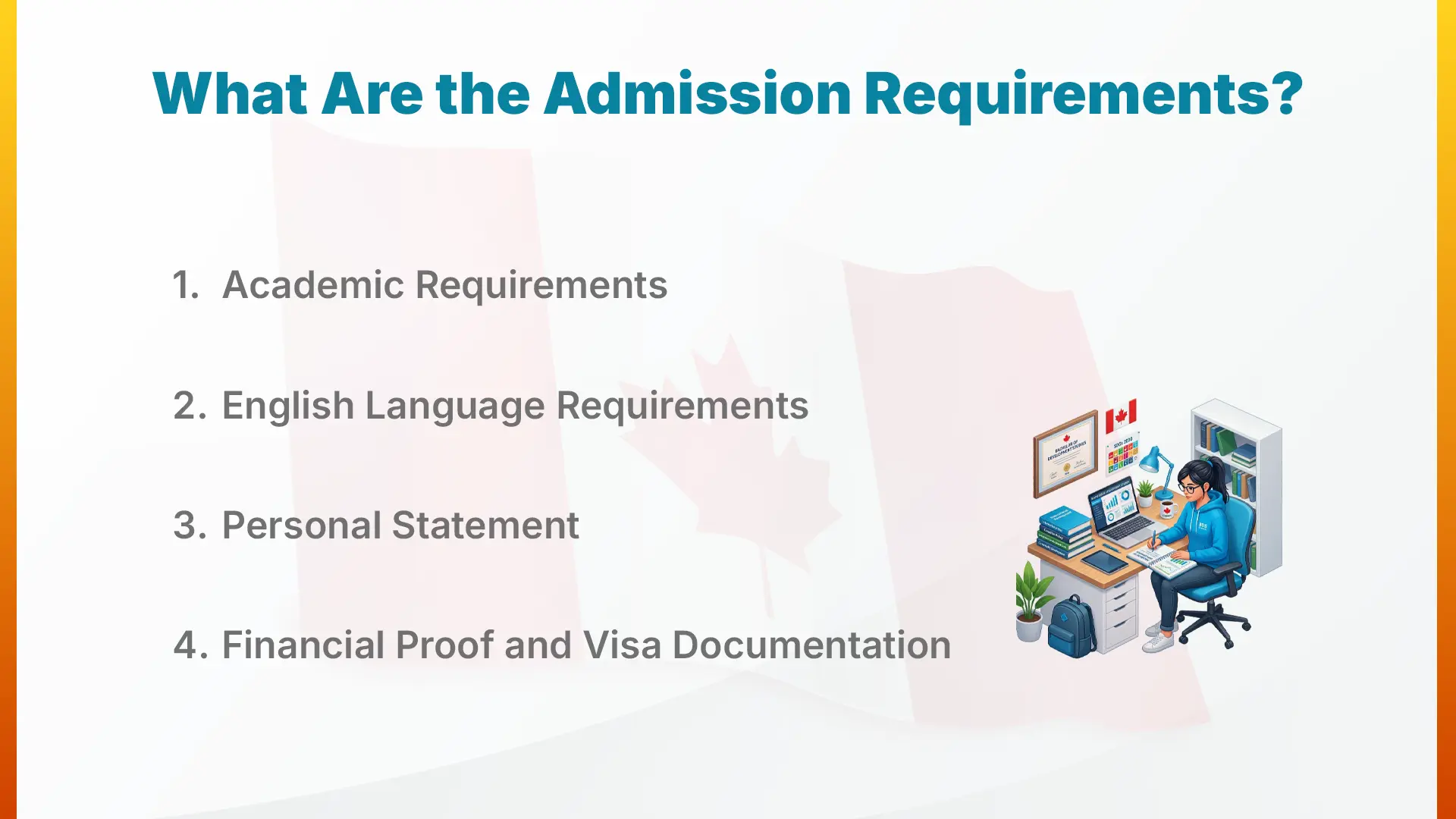
The admission requirements for a Bachelor of Development Studies in Canada include completion of Grade 12 or Plus Two, English language proficiency, a personal statement, and financial documentation for the study permit.
1. Academic Requirements
Applicants must have completed Grade 12 or Plus Two with satisfactory overall results, typically a minimum of 65% to 75%. A background in social studies, economics, geography, or humanities is advantageous for most development studies programs.
2. English Language Requirements
All Bachelor of Development Studies programs in Canada are taught in English, and international applicants must demonstrate proficiency through an approved language test. The minimum scores required are outlined in the table below.
Test | Minimum Score |
|---|---|
| IELTS Academic | 6.5 Overall, No Band Below 6.0 |
| TOEFL iBT | 86 – 95 (Depending on University) |
| PTE Academic | 58 – 65 |
Nepalese students who need to strengthen their English score can enroll in IELTS preparation classes before applying.
3. Personal Statement
Your personal statement should explain your motivation for studying development studies, any relevant community, volunteer, or research experience, and your long-term career goals in the international development field. Nepalese students can follow the SOP format for Canada to structure their statement effectively.
4. Financial Proof and Visa Documentation
For the Canadian Study Permit, students must provide financial documentation demonstrating sufficient funds for at least the first year. The requirements to study in Canada from Nepal are strict, so students are advised to prepare all the necessary documents prior to applying.
How to Apply for a Bachelor of Development Studies in Canada?
Applying for a bachelor of development studies in Canada involves five steps, from shortlisting universities to securing your study permit. Checking the Canada September intake deadlines early is essential to avoid missing the application window.
Step 1: Research and Shortlist Universities
Compare programs based on curriculum focus, research opportunities, location, tuition fees, and scholarship availability. Shortlist three to five universities that match your academic profile and career goals.
Step 2: Prepare Documents and Language Scores
Gather your Plus Two transcripts, IELTS or TOEFL scores, valid passport, and financial documents. Begin drafting your personal statement alongside document preparation.
Step 3: Submit Application Through University or OUAC Portal
Most Canadian universities accept online applications through their own portals. Ontario universities use the OUAC system. Apply early as development studies programs at competitive universities fill quickly.
Step 4: Write Your Personal Statement
Your statement should be specific about why you want to study development, what experiences have shaped that interest, and what kind of development professional you aim to become.
Step 5: Apply for Canada Study Permit
Once you receive your offer letter, apply for your study permit through the IRCC portal using your acceptance letter, financial documents, valid passport, and biometrics.
How Much Does It Cost to Study Development Studies in Canada?
A Bachelor of Development Studies in Canada costs between CAD 18,000 and CAD 35,000 (approximately NPR 1,620,000 to NPR 3,150,000) per year in tuition for international students, depending on the university and province. The cost to study in Canada differs by the student's choice of university and the city where they live.
University | Annual Tuition (CAD) | Annual Tuition (NPR approx.) |
|---|---|---|
| Dalhousie University | CAD 18,000 – CAD 22,000 | NPR 1,620,000 – NPR 1,980,000 |
| Carleton University | CAD 22,000 – CAD 26,000 | NPR 1,980,000 – NPR 2,340,000 |
| McGill University | CAD 24,000 – CAD 28,000 | NPR 2,160,000 – NPR 2,520,000 |
| University of British Columbia | CAD 28,000 – CAD 32,000 | NPR 2,520,000 – NPR 2,880,000 |
| University of Toronto | CAD 30,000 – CAD 35,000 | NPR 2,700,000 – NPR 3,150,000 |
Monthly living expenses in Canada range from CAD 900 to CAD 2,200 depending on the city, with Toronto and Vancouver at the higher end and Halifax and Ottawa being more affordable. Many Nepalese students take up part-time jobs in Canada during their studies to offset living costs.
Taking tuition and living expenses together, Nepalese students should budget approximately CAD 28,000 to CAD 50,000 per year in total.
What Scholarships Are Available?
Several scholarships are available for Nepalese students pursuing a Bachelor of Development Studies in Canada. They are Canadian government scholarships, university-specific scholarships, and other external development funding.
1. Canadian Government Scholarships
The Canadian government does not offer widely available fully funded undergraduate scholarships for international students, but several provincial programs support international students who commit to working in specific regions or sectors after graduation. Students should research provincial bursaries in Atlantic Canada, Manitoba, and Saskatchewan, where support is most accessible.
2. University-Specific Scholarships
UBC International Major Entrance Scholarship: up to CAD 80,000 over four years for exceptional international undergraduate students
University of Toronto International Scholarship: merit-based partial tuition award for outstanding incoming international students
Carleton University Entrance Scholarships: merit-based awards for strong academic profiles entering undergraduate programs
McGill University Entrance Scholarships: partial tuition awards for high-achieving international students
3. External Development and Social Science Funding
Several foundations and international development organizations offer scholarships specifically for students pursuing development studies in Canada, including awards from the International Development Research Centre (IDRC), the Aga Khan Foundation, and various civil society networks that prioritize students from developing countries, including Nepal.
What Jobs Can You Get After a Bachelor of Development Studies in Canada?
Graduates with a Bachelor of Development Studies from Canada can pursue a wide range of meaningful and impactful career roles across the public, NGO, and international sectors.
International Development Officer: designs and manages development programs for NGOs, bilateral aid agencies, and multilateral organizations working in low- and middle-income countries
Policy Analyst: researches and evaluates social, economic, and environmental policies for government ministries, think tanks, and international organizations
Community Development Worker: works directly with communities to identify needs, mobilize resources, and implement programs addressing poverty, health, and social inclusion
Program Manager (NGO): oversees the planning, implementation, monitoring, and evaluation of development programs for national and international NGOs
Research and Advocacy Officer: conducts research and leads advocacy campaigns on global development issues, including human rights, gender equality, and climate justice
What Is the Salary and Scope After Development Studies in Canada?
Entry-level development studies graduates in Canada earn between CAD 40,000 and CAD 55,000 per year, rising to CAD 55,000 to CAD 75,000 at mid-level, and CAD 75,000 to CAD 110,000 or more for senior program managers and policy directors. Development studies is one of the best courses in Canada for Nepalese students who want a career that combines professional purpose with long-term immigration advantage.
Experience Level | Annual Salary (CAD) | Annual Salary (NPR approx.) |
|---|---|---|
| Entry-Level (0–2 years) | CAD 40,000 – CAD 55,000 | NPR 3,600,000 – NPR 4,950,000 |
| Mid-Level (2–5 years) | CAD 55,000 – CAD 75,000 | NPR 4,950,000 – NPR 6,750,000 |
| Senior Level (5+ years) | CAD 75,000 – CAD 110,000+ | NPR 6,750,000 – NPR 9,900,000+ |
After completing their degree, international graduates can apply for the Post-Graduation Work Permit (PGWP), which allows full-time work in Canada for up to three years in any role, including development, policy, and NGO positions. Many Nepalese graduates use this period to gain Canadian work experience in community organizations, government agencies, or international NGO offices before applying for permanent residency.
Policy analysts, social workers, and community development officers qualify for permanent residency through Express Entry's Canadian Experience Class and several Provincial Nominee Programs in British Columbia, Ontario, and Atlantic Canada that actively support skilled social sector workers.
Conclusion
Canada offers Nepalese students an outstanding combination of development education quality, research depth, NGO and government industry connections, and a clear pathway from graduation to permanent residency. For students who want to dedicate their career to social change, international development, or public policy, a Bachelor of Development Studies from Canada is one of the most professionally meaningful and strategically sound choices available.
Interested in studying development studies in Canada? Contact SAS Education Consultancy for a free counseling session, and let us help you find the right university, prepare your application, and navigate the study permit process with confidence.