Bachelor of Data Science in the UK: Guide for Nepalese Students

May 26, 2026

Data science has emerged as one of the most sought-after fields in the global job market, and the United Kingdom stands at the forefront of delivering world-class education in this discipline. For Nepalese students looking to build a future in technology, analytics, and artificial intelligence, pursuing a Bachelor of Data Science in the UK offers an unmatched combination of academic excellence, industry exposure, and international career opportunities. With globally ranked universities, cutting-edge research facilities, and a thriving tech ecosystem, the UK has become one of the most preferred destinations for Nepalese students aspiring to enter the data-driven world.
In this blog on Bachelor of Data Science in the UK, we will cover everything a Nepalese student needs to know before making this important decision. You will learn about the top universities, eligibility criteria, admission process, costs, scholarships, and career opportunities available after completing the degree. We will also explore the best cities for data science students and the skills required to build a successful career in this field. By the end, you will have a complete and clear picture of why studying data science in the UK could be the most transformative step in your academic and professional journey.
In this blog
What Is a Bachelor of Data Science?
A Bachelor of Data Science is an undergraduate degree program that combines mathematics, statistics, computer science, and analytical thinking to equip students with the skills needed to collect, process, and interpret large volumes of data. It is a highly practical and interdisciplinary field that prepares graduates to solve real-world problems using data-driven approaches. The degree typically spans three to four years and covers a wide range of subjects that build both technical and analytical capabilities.
Key subjects included in a Bachelor of Data Science program typically cover statistics and probability, Python and R programming, artificial intelligence, machine learning, data visualization, database management, and big data technologies. These subjects are designed to give students a strong theoretical foundation while also developing hands-on technical skills through projects, internships, and lab work.
Why Study a Bachelor of Data Science in the UK?
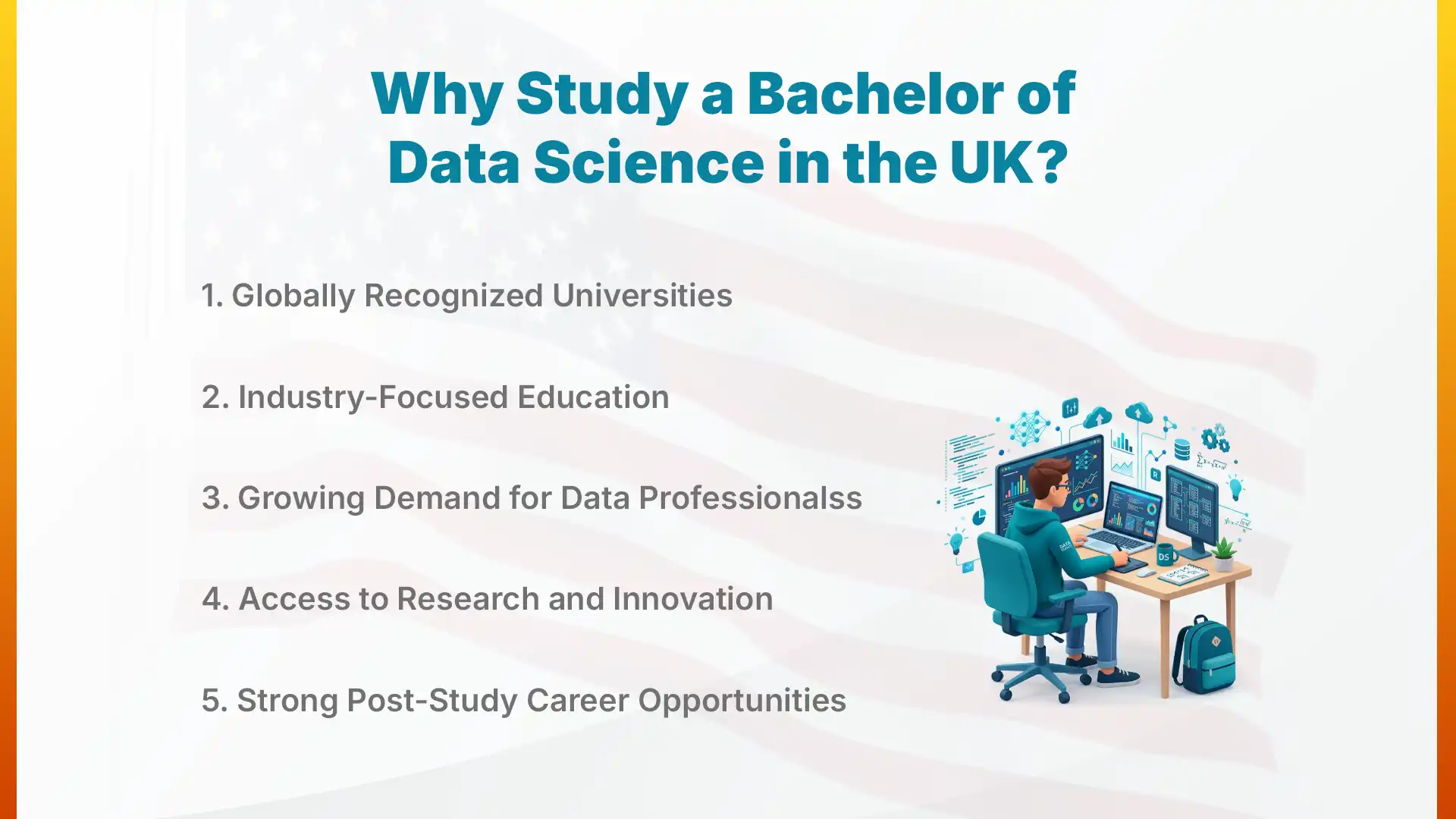
Study for a Bachelor of Data Science in the UK because it offers some of the most globally recognized universities at an affordable price. From academic prestige to post-study work opportunities, the UK combines quality education with real-world relevance in a way that few countries can match. Here are the key reasons why the UK stands out as a top destination for data science education.
1. Globally Recognized Universities
The UK is home to some of the world's most prestigious universities, many of which consistently rank among the top institutions globally for computer science and data science programs. A degree from a UK university carries significant weight with employers across industries worldwide, and Nepalese students can explore the top 10 best UK universities for international students to find the right fit for their academic goals. For Nepalese students, this recognition opens doors not just in the UK but in countries across Asia, Europe, North America, and beyond. The academic credibility of a UK degree is one of its strongest long-term advantages.
2. Industry-Focused Education
UK universities design their data science programs with a strong emphasis on industry relevance. Curriculum is regularly updated to reflect current market demands, and many programs include industry placements, live projects, and collaboration with technology companies. Students graduate with not just theoretical knowledge but also practical experience that employers value immediately. This industry-first approach ensures that Nepalese graduates are job-ready from the moment they complete their degree.
3. Growing Demand for Data Professionals
The demand for skilled data professionals in the UK has grown dramatically in recent years and shows no signs of slowing down. Businesses across finance, healthcare, retail, government, and technology are investing heavily in data infrastructure and analytics capabilities. This demand creates a strong job market for data science graduates, with entry-level roles offering competitive salaries and clear career progression paths. For Nepalese students, entering this market with a UK degree is a significant career advantage.
4. Access to Research and Innovation
The UK is a global leader in research and innovation, particularly in areas like artificial intelligence, machine learning, and big data. Studying at a UK university gives students access to cutting-edge research facilities, world-class faculty, and collaborative projects with industry and government partners. Many programs encourage students to contribute to ongoing research from their first year, which deepens understanding and builds a strong academic profile. This exposure to innovation sets UK-educated data scientists apart in the global job market.
5. Strong Post-Study Career Opportunities
The UK's Graduate Route visa allows international students, including Nepalese graduates, to stay and work in the UK for up to two years after completing their degree. This post-study work opportunity gives graduates valuable time to gain professional experience, build a network, and transition into full-time employment. Combined with the strong demand for data science professionals in the UK job market, this makes the country one of the most practical destinations for students who want to build an international career immediately after graduation.
Top Universities for Bachelor of Data Science in the UK
The UK is home to some of the best universities in the world for a bachelor of data science, including the University of Edinburgh, the University of Manchester, King's College London, the University of Southampton, the University of Warwick, the University of Leeds, and the University of Birmingham. Each of these institutions offers world-class faculty, cutting-edge research facilities, and strong industry connections. Choosing the right university depends on your academic profile, career goals, budget, and preferred location. Here are the top universities Nepalese students should consider for a Bachelor of Data Science in the UK.
1. University of Edinburgh
The University of Edinburgh is one of the UK's most prestigious institutions and has a particularly strong reputation in computer science, data science, and artificial intelligence. The data science programs here are deeply research-oriented, giving students access to some of the leading minds in the field. Edinburgh's strong industry connections and vibrant tech community make it an excellent environment for students looking to combine academic excellence with practical exposure. The university also offers excellent support services for international students.
2. University of Manchester
The University of Manchester is known for its strong industry partnerships and data science curriculum that closely reflects real-world business needs. The program emphasizes applied learning, with students working on data projects in collaboration with companies from a range of sectors. Manchester's growing reputation as a major tech hub outside London makes it a highly attractive destination for data science students. The city also offers a more affordable cost of living compared to London, which is an important consideration for Nepalese students.
3. King's College London
King's College London offers strong technology and analytics programs within a world-class research environment. Located in the heart of London, students benefit from unparalleled access to the city's thriving financial, tech, and healthcare sectors, all of which are major employers of data science graduates. The program integrates practical data analysis with theoretical foundations in mathematics and computing. King's also has strong links with leading technology companies, providing students with networking and placement opportunities throughout their studies.
4. University of Southampton
The University of Southampton has a strong reputation for artificial intelligence and machine learning research, making it an ideal choice for data science students interested in these specializations. The program combines rigorous academic training with exposure to real-world data challenges through collaborative projects and industry partnerships. Southampton's research facilities are among the best in the country, and students regularly have the opportunity to contribute to innovative projects in areas like healthcare data, cybersecurity, and autonomous systems.
5. University of Warwick
The University of Warwick has a strong STEM reputation and offers data science programs that are highly regarded by employers across the UK and internationally. Warwick's emphasis on quantitative analysis, mathematical modeling, and computational thinking prepares graduates for a wide range of data-driven careers. The university has strong links with business and industry, and its campus environment fosters academic excellence and innovation. Warwick graduates consistently perform well in graduate employment surveys, making it a smart investment for Nepalese students.
6. University of Leeds
The University of Leeds takes a practical learning approach to data science education, ensuring that students graduate with hands-on experience alongside strong theoretical knowledge. The program includes data projects, lab sessions, and opportunities for industry placements that help students build real-world skills. Leeds is also a highly international city with a strong student community, which makes it a welcoming and affordable destination for Nepalese students. The university's career support services are well-regarded and actively help students find graduate employment.
7. University of Birmingham
The University of Birmingham offers strong research and employability support for data science students, with a curriculum that covers the full spectrum of modern data science techniques and tools. The university has a dedicated careers service and strong industry connections that help students transition smoothly into the job market after graduation. Birmingham is one of the UK's most diverse and affordable cities, making it a popular choice for international students. The program's emphasis on employability ensures that graduates leave with both technical skills and the professional confidence to succeed.
What Are the Eligibility Criteria for a Bachelor of Data Science in the UK?
The eligibility criteria for a Bachelor of Data Science in the UK include completion of Grade 12 or Plus Two with a background in mathematics, computer science, or science, along with meeting the English language requirements through IELTS, TOEFL, or PTE. Most universities also require a statement of purpose, letters of recommendation, a valid passport, and financial evidence as part of the application. Meeting these criteria is essential for securing admission to a reputable UK university for data science. Here is a complete breakdown of all the eligibility requirements Nepalese students need to fulfill before applying.
1. Academic Requirements
To be eligible for a bachelor of data science in the UK, students must have completed their grade 12 or equivalent qualification, commonly referred to as Plus Two in Nepal. Most universities prefer students who have studied mathematics, computer science, or science at the secondary level, as these subjects provide the foundational knowledge needed for a data science degree. Strong GPA scores are generally expected, with most universities setting a minimum academic standard equivalent to a UK A-level grade of BBB or above, though entry requirements vary by institution. Students with strong mathematics and science backgrounds are typically at an advantage during the admissions process.
2. English Language Requirements
Since the medium of instruction at UK universities is English, Nepalese students are required to demonstrate English language proficiency through standardized tests. The most commonly accepted tests and their typical minimum score requirements are as follows. IELTS Academic requires a minimum overall score of 6.0 to 6.5 with no individual band below 5.5. TOEFL iBT requires a minimum score of around 80 to 90, depending on the university. PTE Academic requires a minimum score of 56 to 65. Some universities also accept Duolingo English Test scores, though this varies by institution. Students should check the specific language requirements of each university they apply to before registering for a test.
IELTS is the most widely accepted English language test for UK university admissions, and Nepalese students can find the best IELTS preparation classes in Nepal to prepare effectively before applying.
What Is the Admission Process for a Bachelor of Data Science in the UK?
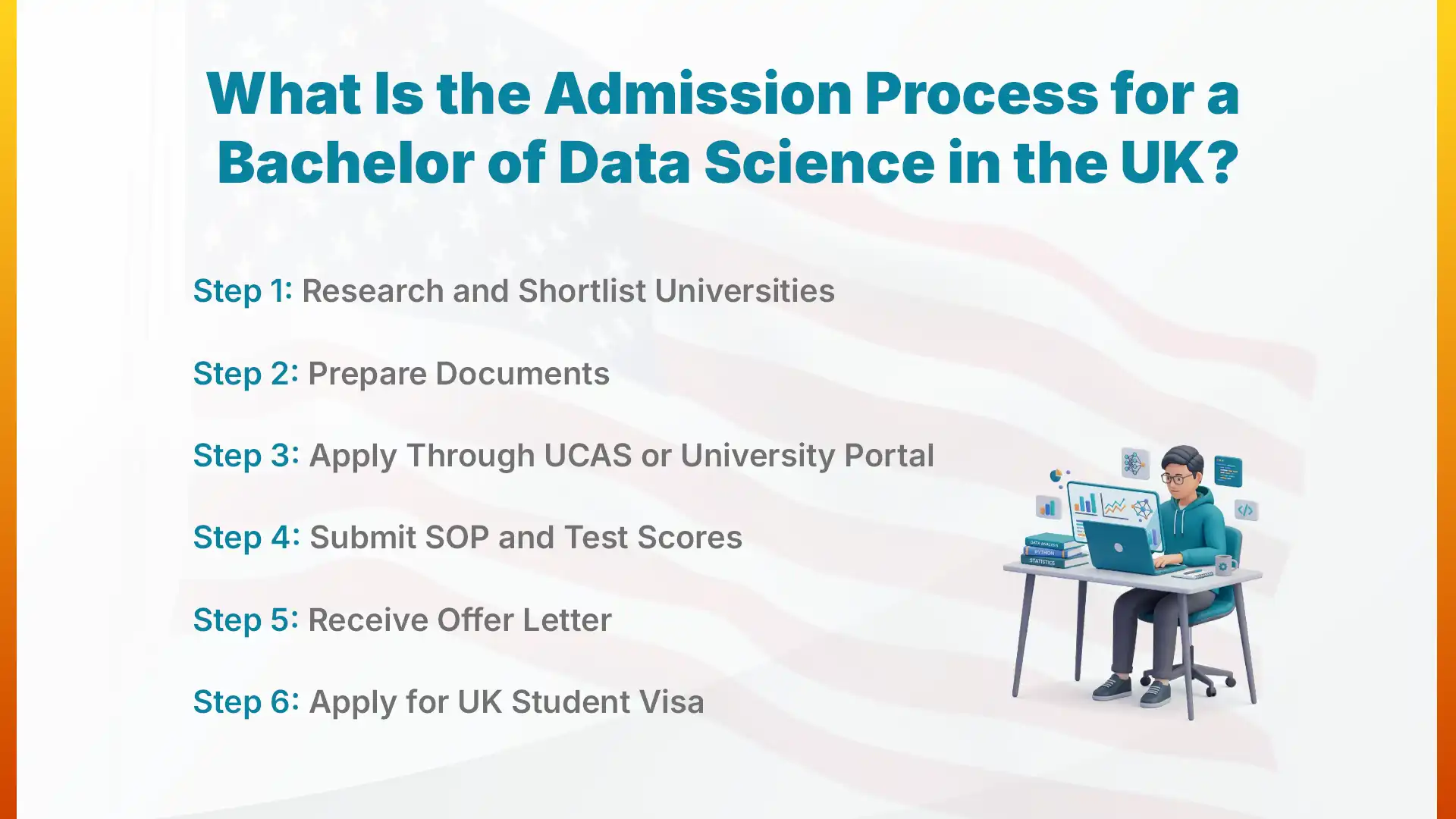
The admission process for a Bachelor of Data Science in the UK involves six key steps: researching and shortlisting universities, preparing your documents, applying through UCAS or the university portal, submitting your SOP and test scores, receiving your offer letter, and applying for your UK Student Visa. The process is structured and straightforward when approached with proper planning and preparation well in advance of application deadlines. Nepalese students typically follow these six steps to successfully secure admission at a UK university.
Step 1: Research and Shortlist Universities
Begin by researching universities that offer data science programs aligned with your academic profile, career goals, and budget. Consider factors such as university rankings, course content, location, tuition fees, and scholarship availability. Shortlist three to five universities to maximize your chances of receiving an offer.
Step 2: Prepare Documents
Gather all required documents well in advance of application deadlines. This includes your academic transcripts, English language test scores, Statement of Purpose, Letters of Recommendation, passport copy, and financial documents. Ensuring all documents are complete and accurate at this stage avoids delays later in the process.
Step 3: Apply Through UCAS or University Portal
Most undergraduate applications for UK universities are submitted through UCAS, the UK's centralized university admissions system. Some universities may also accept direct applications through their own portals. Submit your application carefully, ensuring all information is accurate and all required documents are attached.
Step 4: Submit SOP and Test Scores
Your Statement of Purpose is one of the most important parts of your application and should clearly explain why you want to study data science, why you have chosen the specific university, and what your long-term career goals are. Submit your English language test scores and any other required assessments at this stage.
Step 5: Receive Offer Letter
After reviewing your application, the university will issue either a conditional or unconditional offer letter. A conditional offer means you need to meet certain academic or language requirements before the offer is confirmed. An unconditional offer means you have already met all requirements and your place is secured.
Step 6: Apply for UK Student Visa
Once you have accepted an offer and received your CAS (Confirmation of Acceptance for Studies) letter from the university, you can apply for a UK Student Visa. This involves submitting your visa application online, paying the visa fee and immigration health surcharge, and attending a biometric appointment. Ensure you apply for your visa well in advance of your course start date.
Documents Required for Data Science Admission in the UK
Having all required documents prepared and organized is critical for a smooth application process. The following documents are typically required for admission to a Bachelor of Data Science program in the UK.
Academic transcripts from Grade 10 and Grade 12 showing your complete academic record are essential. A valid passport copy that remains valid throughout your intended study period is required for both the university application and visa process. Your Statement of Purpose should be a well-written personal document explaining your academic background, motivations, and career aspirations. Letters of Recommendation from at least two academic referees who can speak to your abilities and potential are required by most universities.
Most UK universities require Nepalese students to submit a statement of purpose explaining their motivations, academic background, and career goals, and reading a complete guide on how to write an SOP for a UK university can significantly strengthen your application.
Official English language test score reports from IELTS or PTE must be submitted directly from the testing body in many cases. A resume or CV highlighting relevant academic achievements, projects, or extracurricular activities may be required depending on the university. Financial documents demonstrating sufficient funds to cover tuition fees and living expenses for at least the first year of study are required for both the university application and the UK visa. Passport-sized photographs meeting UK visa specifications are also required as part of the visa application process.
Cost of Studying Bachelor of Data Science in the UK
The cost of studying for a Bachelor of Data Science in the UK for Nepali students generally ranges from £12,000 to £35,530 per year, depending on the university's prestige and program structure. With additional costs for rent, food, and transportation, the figure goes up from the average.
1. Tuition Fees
Tuition fees for a Bachelor of Data Science at UK universities typically range from GBP 15,000 to GBP 30,000 per year for international students. The exact fee depends on the university, program structure, and whether the course includes a placement year. Students should check the specific tuition fee for each university during the research phase to plan their finances accurately, and reviewing the cost of studying in the UK for Nepali students provides a complete breakdown of all expenses to expect.
2. Accommodation Costs
Accommodation is one of the largest living expenses for students in the UK. On-campus student halls typically cost between GBP 600 and GBP 1,200 per month depending on the city and room type. Private accommodation may cost slightly more in cities like London but can be more affordable in cities like Leeds, Manchester, and Birmingham. Many universities offer international student accommodation packages that help simplify the process for new arrivals.
3. Food and Transportation Expenses
Monthly food expenses typically range from GBP 200 to GBP 400 depending on eating habits and location. Transportation costs vary by city, with monthly bus or rail passes generally costing between GBP 50 and GBP 150. Students living near campus or in cities with good public transport can manage transportation costs effectively. Cooking at home rather than dining out is one of the most effective ways for Nepalese students to manage food expenses.
4. Health Surcharge and Miscellaneous Costs
International students in the UK are required to pay the Immigration Health Surcharge as part of their visa application, which currently amounts to GBP 776 per year of study. This surcharge grants access to the UK's National Health Service during the period of study. Additional miscellaneous costs including study materials, communication, clothing, and entertainment typically range from GBP 100 to GBP 300 per month.
Taking all these components together, Nepalese students should budget approximately GBP 25,000 to GBP 45,000 per year to cover tuition fees, accommodation, food, transportation, health surcharge, and other living expenses. The total estimated cost for a three-year bachelor's degree ranges from GBP 75,000 to GBP 135,000 depending on the university and city of study.
Scholarships for Bachelor of Data Science in the UK
Scholarships for a Bachelor of Data Science in the UK include merit-based scholarships, need-based scholarships, GREAT Scholarships, and university-specific international excellence awards that can significantly reduce the financial burden for Nepalese students. The high cost of studying in the UK makes scholarships an important consideration, and several opportunities are available at both the institutional and national levels. Here is a complete breakdown of the scholarships Nepalese students can apply for when pursuing a Bachelor of Data Science in the UK.
1. Merit-Based Scholarships
Many UK universities offer merit-based scholarships to high-achieving international students based on their academic performance. These scholarships are typically awarded automatically or through a separate application process and can cover a partial or full reduction of tuition fees. Students with strong academic records and high GPA scores from their Grade 12 examinations are the most likely candidates for merit-based awards.
2. Need-Based Scholarships
Some universities offer financial assistance to international students who can demonstrate genuine financial need. These scholarships are designed to make UK education accessible to students from developing countries who may not otherwise be able to afford the full cost of study. Nepalese students applying for need-based scholarships must typically submit detailed financial documentation as part of the application.
3. University-Specific Scholarships
Several specific scholarship programs are worth researching for Nepalese students. The GREAT Scholarships program, offered in partnership with UK universities and the British Council, provides partial scholarships to students from Nepal for undergraduate and postgraduate study. Many universities also offer their own international excellence scholarships, early application discounts, and alumni referral programs. Students are encouraged to check the scholarship pages of their shortlisted universities carefully and apply early, and reviewing available scholarships to study in the UK from Nepal gives a strong head start in securing financial support
Best Cities in the UK for Data Science Students
London is the leading city for data science students, offering the highest concentration of job opportunities and hosting major tech hubs like Tech City, the Alan Turing Institute, and top universities such as UCL, Imperial College London, and the London School of Economics.
Choosing the right city depends on your priorities, including career opportunities, cost of living, and university preference, and reviewing the best cities in the UK for international students can help you make a more informed decision.
1. London
London is the UK's technology and financial capital and offers unparalleled networking and career opportunities for data science students. The city is home to thousands of technology companies, financial institutions, and startups that actively recruit data science graduates. However, London is also the most expensive city in the UK, with higher accommodation and living costs than anywhere else in the country. Students who choose London benefit from an incredibly diverse, dynamic, and internationally connected environment that can accelerate career growth significantly.
2. Manchester
Manchester has grown rapidly into one of the UK's most important technology hubs and offers a strong job market for data science graduates at a significantly lower cost of living than London. The city has a large student population, excellent transport links, and a thriving startup ecosystem. Many national and international companies have established significant operations in Manchester, creating strong graduate recruitment opportunities. For Nepalese students seeking a balance between opportunity and affordability, Manchester is one of the best choices in the UK.
3. Edinburgh
Edinburgh offers a strong university environment and a growing technology sector that makes it an attractive destination for data science students. The city is known for its high quality of life, safety, and vibrant cultural scene. Edinburgh's universities have strong research programs in AI and data science, and the city's proximity to Scotland's growing fintech and healthcare sectors creates meaningful career opportunities. The cost of living is moderate compared to London, and the city has a welcoming international student community.
4. Birmingham
Birmingham is the UK's second-largest city and has a rapidly growing technology sector that is increasingly attracting data science talent. The city is home to several major universities with strong data science programs and benefits from good transport connections to London and other major cities. Birmingham offers one of the most affordable living costs among major UK cities, which is a significant advantage for Nepalese students managing their budgets. The city's diverse population and international community make it a comfortable and welcoming place to live and study.
5. Leeds
Leeds is a student-friendly city with a strong university environment and a growing digital and data economy. The city's relatively low cost of living, vibrant social scene, and strong graduate employment outcomes make it a popular choice for international students. Leeds has a growing cluster of technology and data companies, and the university's industry connections help students access internships and graduate opportunities. For Nepalese students looking for a high-quality education in an affordable and welcoming city, Leeds is an excellent option.
Course Curriculum for Bachelor of Data Science in the UK
Undergraduate data science degrees in the UK typically follow a structure that integrates mathematics, statistics, computer science, and domain applications. The curriculum is designed to provide a strong quantitative foundation in the first year, followed by specialized technical skills and real-world project work in subsequent years.
Python programming is one of the foundational skills taught in virtually every data science program, covering everything from basic syntax to advanced data manipulation and analysis libraries. R programming complements Python as a statistical computing language widely used in research and industry for data analysis and visualization.
Statistics and probability provide the mathematical foundation for understanding data patterns, distributions, and inferential reasoning. Database systems cover the design, querying, and management of structured and unstructured databases using SQL and NoSQL technologies.
Machine learning introduces students to supervised and unsupervised learning algorithms, model evaluation, and predictive analytics. Artificial intelligence explores the broader field of intelligent systems, including neural networks, natural language processing, and computer vision. Data analytics focuses on the practical interpretation and communication of data insights for business decision-making.
Big data covers the tools and technologies used to process and analyze extremely large datasets, including platforms like Hadoop and Spark. Cloud computing introduces students to cloud-based data infrastructure and services from providers like AWS, Google Cloud, and Microsoft Azure. Capstone Projects in the final year allow students to apply everything they have learned to a real-world data challenge, often in collaboration with an industry partner.
How Long Does a Bachelor of Data Science in the UK Take?
A standard Bachelor of Data Science in the UK takes three years to complete for most international students. Some universities offer a four-year program that includes either a foundation year for students who need additional academic preparation or a placement year where students spend a full year working in industry before returning to complete their final year.
The placement year option is particularly valuable for data science students, as it provides genuine professional experience, builds a strong CV, and often leads directly to graduate job offers from the placement employer.
The degree is structured around credit-based modules, with students typically required to earn 120 credits per year and 360 credits in total to complete the degree. Elective modules allow students to specialize in areas of particular interest such as machine learning, business analytics, or healthcare data. Internship and project opportunities are embedded in many programs, giving students practical exposure throughout the course rather than only in the final year.
Career Opportunities After a Bachelor of Data Science in the UK
Graduates with a bachelor of data science in the UK typically secure roles such as data scientist, machine learning engineer, big data analyst, business intelligence analyst, and data engineer.
1. Data Analyst
Data analysts are responsible for collecting, cleaning, and interpreting data to help organizations make informed business decisions. This is one of the most accessible entry-level roles for fresh data science graduates and is available across virtually every industry.
2. Data Scientist
Data scientists work on more complex analytical challenges, building predictive models and statistical frameworks that drive strategic business outcomes. This role typically requires stronger programming and machine learning skills and offers higher salary potential than entry-level analyst roles.
3. Machine Learning Engineer
Machine learning engineers design and deploy machine learning models and algorithms in production environments. This is one of the most technically demanding and highly paid roles in the data science field, with strong demand in technology, finance, and healthcare.
4. Business Intelligence Analyst
Business intelligence analysts focus on transforming data into actionable insights using visualization tools and reporting systems. This role bridges the gap between technical data analysis and business strategy, making it ideal for graduates who enjoy both technical work and stakeholder communication.
5. Data Engineer
Data engineers build and maintain the data pipelines, infrastructure, and storage systems that allow data scientists and analysts to do their work. This is a highly technical role with strong demand and excellent salary potential, particularly in large technology and financial organizations.
6. AI Specialist
AI specialists work on the development and application of artificial intelligence technologies, including natural language processing, computer vision, and autonomous systems. This is one of the fastest-growing and highest-paying specializations within the broader data science field.
Salary After a Bachelor of Data Science in the UK.
Entry-level data science roles in the UK typically offer salaries ranging from GBP 25,000 to GBP 40,000 per year for fresh graduates. Mid-level roles for professionals with two to four years of experience typically pay between GBP 45,000 and GBP 70,000 per year. Senior data scientists and machine learning engineers with five or more years of experience can earn GBP 80,000 to GBP 120,000 or more annually, particularly in London and at major technology companies.
Salary varies significantly by city, with London offering the highest pay scales, followed by Manchester, Edinburgh, and Birmingham. Company size and sector also play a major role, with technology firms, financial institutions, and management consultancies typically paying more than public sector or smaller organizations. The factors that most significantly affect salary include technical skills and programming proficiency, internship and work experience gained during the degree, relevant certifications in tools like AWS, Google Cloud, or Microsoft Azure, and the ability to communicate data insights effectively to non-technical stakeholders.
Skills Required for a Successful Data Science Career
A successful data science career requires a blend of technical proficiency, analytical rigor, and soft skills to translate complex data into business value. The most critical technical foundation includes programming (primarily Python and SQL), statistics, and machine learning algorithms.
Programming skills in Python and R are foundational requirements for any data science role, and proficiency in SQL for database querying is equally important. Statistical analysis capabilities, including hypothesis testing, regression analysis, and probability theory, are essential for interpreting data accurately.
Problem-solving ability is highly valued, as data scientists are expected to approach complex, ambiguous challenges with structured analytical thinking. Communication skills are critical because data insights are only valuable if they can be clearly explained to business stakeholders who may not have a technical background.
Data visualization skills using tools like Tableau, Power BI, or Matplotlib allow data scientists to present findings in compelling and accessible formats. Machine learning knowledge, including familiarity with common algorithms and frameworks like TensorFlow and Scikit-learn, is increasingly expected even at the entry level. Team collaboration is also important, as data science projects typically involve working across multidisciplinary teams, including engineers, product managers, and business analysts.
Conclusion
The United Kingdom offers Nepalese students one of the strongest environments in the world for pursuing a Bachelor of Data Science. With globally ranked universities, industry-focused programs, post-study work opportunities, and a thriving job market for data professionals, the UK combines academic excellence with practical career outcomes in a way that few other destinations can match. From the research-driven environment of Edinburgh to the career-rich ecosystem of London and the affordable student life of Leeds and Manchester, there is a UK city and university that fits every profile and budget.
For Nepalese students willing to invest in their education and commit to building strong technical and analytical skills, a data science degree from a UK university is one of the most rewarding and future-ready qualifications available.
Contact SAS Education Consultancy today for a free counseling session. Let us help you find the right university, secure the best scholarship, and navigate the visa process with confidence.