How to Decide Which Country to Study After +2: 2026 Guide

May 06, 2026

For most of us in Nepal, studying abroad isn't just about getting a degree; it’s about a fresh start and a better future.
But it’s also incredibly confusing. One cousin says Australia is the best, while your friend is packing for Canada, and your parents are worried about the budget. You might feel like you’re just following the crowd without knowing if it's right for you.
That is exactly why I’ve written this guide. We’re going to stop the guesswork and look at the facts. By the time you finish reading, you’ll know exactly how to decide which country to study after +2. Make the choice that fits your dreams and your bank account.
In this blog
Why Choosing the Right Country After +2 Matters
Your country choice affects your course options, budget, visa success, work rights, and future career. Picking the wrong place can lead to high debt or a degree that doesn’t help you get a job back home or abroad. This decision is essentially the foundation of your adult life, so we need to get it right.
- Affects your total education budget.
- Determines your future career growth.
- Impacts your visa success rate.
- Decides your legal work rights.
- Shapes your long-term migration goals.
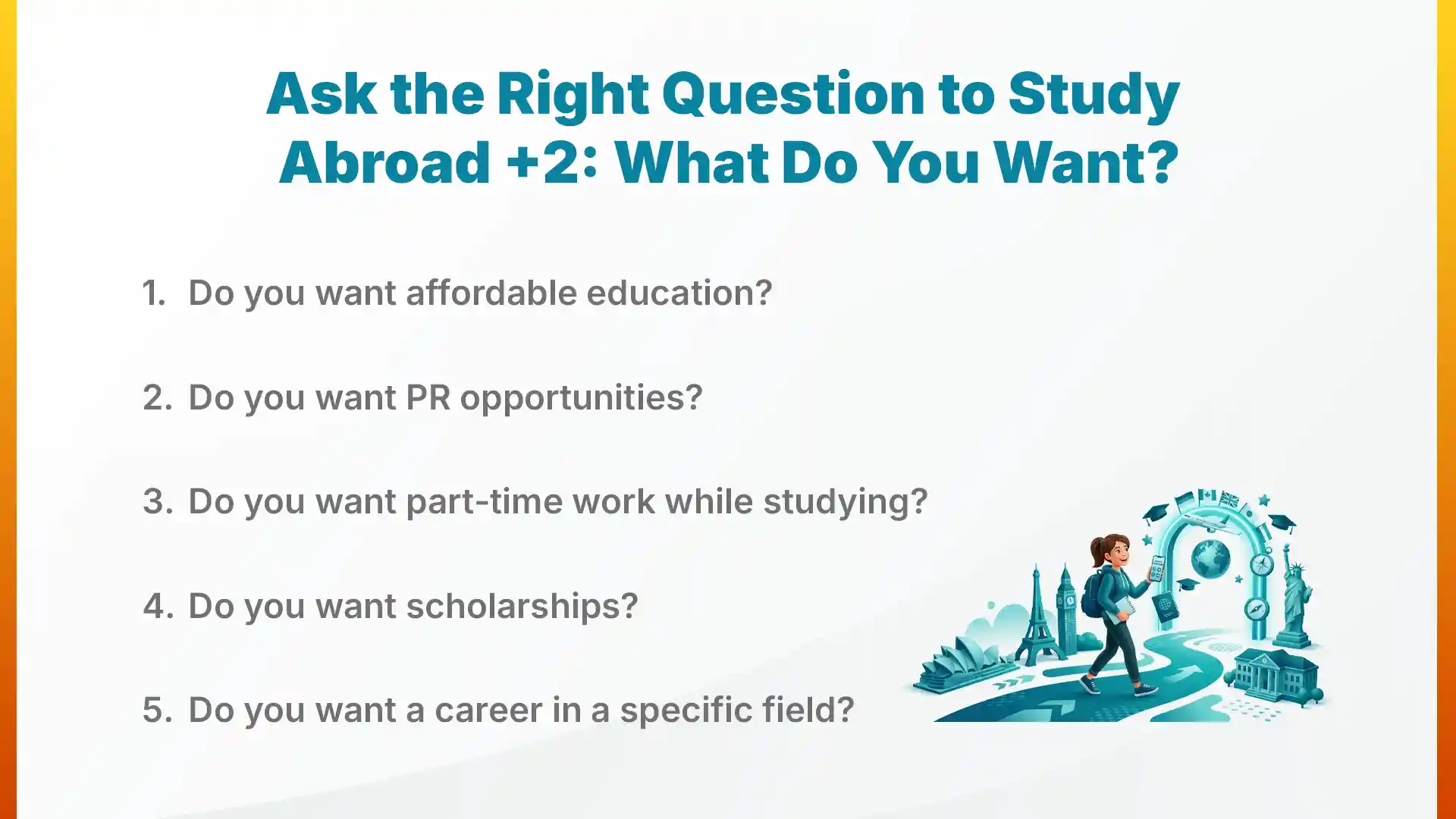
Ask the Right Question to Study Abroad +2: What Do You Want?
Before choosing a country, first decide what you want from studying abroad. Are you looking for the cheapest option, or is a permanent residency (PR) your main goal? Knowing your "why" makes picking the "where" much easier, so let’s break down these common goals:
1. If You Want Affordable Education
If saving money is your top priority, you should look at countries with lower tuition and living costs. Many students think the most popular study destinations are the only options, but affordability often matters more than popularity in the long run. European countries like Germany or Asian destinations like Japan offer world-class degrees for a fraction of the cost of Australia or the USA. Choosing a budget-friendly path helps you avoid the stress of massive student loans.
2. If You Want Scholarships
For high-achieving Nepali students, countries with better scholarship options can make a dream education almost free. While public universities in some countries have low fees, others like the USA are known for offering huge financial aid packages based on your GPA and SAT scores. You should compare scholarship-heavy destinations to see where your hard work pays off the most. Getting a good scholarship means you can focus more on your books and less on your bills.
3. If You Want PR or Long-Term Settlement
Many of us hope to stay back and work after graduation, which is why countries with better post-study work and migration pathways are so popular. Canada and Australia are famous for having clear routes for international students to transition from a study permit to permanent residency. This matters for long-term planning because you don't want to finish a degree only to be told you have to leave immediately. Always check the current migration rules before you sign your offer letter.
4. If You Want Strong Career Opportunities
If your main goal is to land a high-paying job in a global company, you need a country with a strong job market for international graduates. You should match your country with your career goals, like choosing to study in the USA for Tech or Switzerland for Hospitality. Some countries have specific industries that are booming, and being in the right place at the right time is a huge advantage. A great degree is only useful if there are companies nearby looking to hire people with your skills.
5. If You Want Safer and Easier Student Life
For many students leaving home for the first time after class 12, student support, safety, and cultural adjustment are the most important factors. Moving to a country where people are friendly and the environment is safe makes the transition much less scary for younger students. Countries like New Zealand or certain parts of Europe are known for being very welcoming to international teenagers. Feeling safe and supported allows you to perform better in your classes and enjoy your new life.
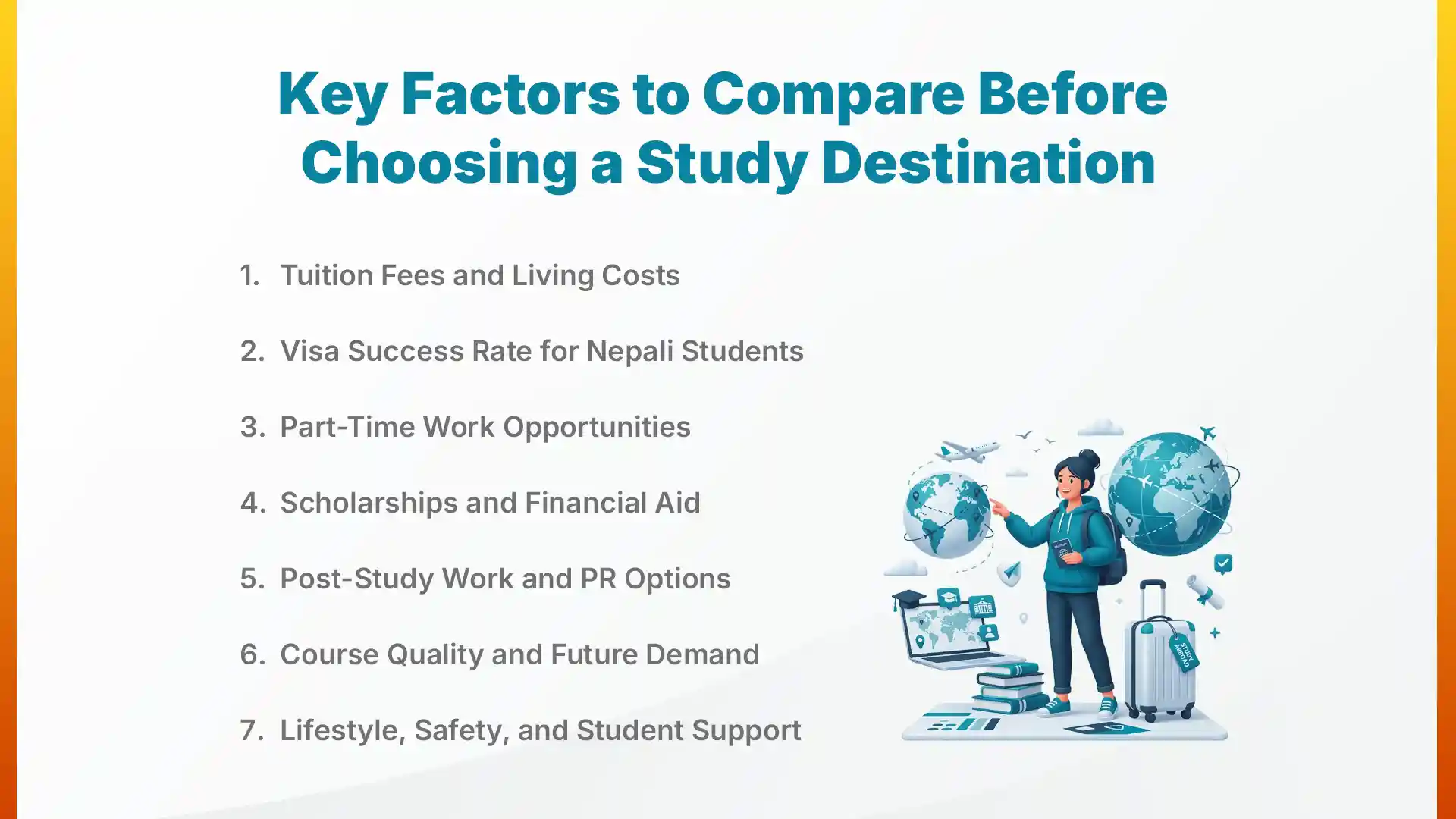
Key Factors to Compare Before Choosing a Study Destination
To make a smart choice, you need to look at specific factors like costs, visa chances, and work rules. Comparing these details side-by-side will show you which country actually fits your profile. Let’s look at the most important things you should keep in mind.
1. Tuition Fees and Living Costs
The biggest hurdle for most Nepali families is the total cost, which includes both tuition and the daily cost of living. You need to calculate the full amount for all years of your study, not just the first semester. Some countries have high fees but low living costs, while others might be the opposite. Being realistic about your family's financial situation will prevent unnecessary stress later on.
Note: Figures are estimates based on 2026 data. Exchange rates and lifestyle choices can significantly impact these totals.
2. Visa Success Rate for Nepali Students
You could have an admission letter from a top university, but it won't matter if your visa gets rejected. Visa success rates for Nepali students can change every year based on government policies in the destination country. It is important to research which countries are currently "open" and welcoming to students from Nepal. A high visa success rate gives you more confidence that your time and effort won't be wasted.
3. Part-Time Work Opportunities
Most students need to work part-time to cover their basic expenses like rent and groceries. You should check how many hours you are legally allowed to work and what the minimum wage is in that country. While you shouldn't rely on part-time work to pay your tuition, it is a great way to gain experience and stay independent. Knowing the local job market for students will help you plan your monthly budget.
4. Scholarships and Financial Aid
Don't just look at the sticker price of a university; look at how much financial aid they give to international students. Many universities offer "merit-based" scholarships for students with high marks or "need-based" aid for those with lower incomes. Researching these options early can save you lakhs of rupees over the course of your degree. Always check the application deadlines for scholarships, as they often close very early.
5. Post-Study Work and PR Options
If you plan to stay abroad after your degree, you must look at the Post-Study Work (PSW) rights. Some countries give you two or three years to find a job after you graduate, while others might give you very little time. This period is your best chance to gain international work experience and apply for permanent residency. Understanding these rules early helps you choose a course that is in high demand in that specific country.
6. Course Quality and Future Demand
There is no point in going abroad for a degree that won't be useful in the future. You should check if the course you are choosing has high demand in the global job market for the next decade. Technology, healthcare, and green energy are some areas that are growing rapidly everywhere. Make sure the university is well-ranked and recognized so your degree is respected by employers worldwide.
7. Lifestyle, Safety, and Student Support
Your life abroad isn't just about studying; it’s about where you will be living every single day. Look into the climate, the food, and how safe the cities are for international students. Some countries have great support systems that help you find housing and deal with homesickness. A place where you feel comfortable and happy will help you stay focused on your studies and succeed.
Which Country Is Best After +2? (Country-by-Country Comparison)
There is no single "best" country for everyone because it depends on what you need. Countries like Australia, Canada, the UK, and the USA each offer different advantages. However, certain countries are better for specific types of students. Let’s look at the most popular choices for Nepali students today.
1. Australia
Australia is currently the top choice for many because it offers a great balance of study and work life. It is best for part-time work, post-study work, and a lifestyle that feels very comfortable for international students. If you are interested in Business, IT, Nursing, or Hospitality, Australia is a fantastic destination. While the initial cost can be higher, the strong long-term value and PR pathways make it worth the investment.
2. Canada
Canada is widely considered the best for PR-focused students who want clear career opportunities after graduation. It is a very welcoming country for students interested in Business, IT, Healthcare, or Engineering. The process of studying in Canada can be competitive, especially with recent changes in rules, but it remains very rewarding for hardworking students. If you can handle the cold winters, the quality of life and multicultural environment are hard to beat.
3. UK
The UK is perfect for students who want to finish their degrees quickly and enter the workforce sooner. Most bachelor's degrees in the UK are three years long, which saves you an entire year of tuition and living costs compared to other countries. It is a world leader in Business, Law, Finance, and Healthcare education. Even though the living costs in cities like London can be high, the "fast-track" nature of their degrees is a big plus.
4. USA
The USA is the best choice if you are looking for big scholarships, academic flexibility, and the world's top-ranked universities. It is especially strong for STEM (Science, Technology, Engineering, and Math), Business, and Research-based courses. While the US visa application process and interview is more personal and competitive, the opportunities available there are unmatched. It’s a great place for ambitious students who want to be at the center of global innovation.
5. Germany
Germany is the best destination for students who want a high-quality education without the high price tag. Most public universities have little to no tuition fees, making it excellent for Engineering and technical students. However, you must be prepared to learn the German language and adapt to a very different culture. If you are disciplined and love technology, Germany offers a very stable and affordable path to a great career.
6. Japan
Japan is becoming a favorite for Nepali students who want affordable education, advanced technology, and a disciplined lifestyle. It is a great option for those interested in IT, Engineering, or Hospitality. Since the cost of living is manageable and there are many part-time jobs, it’s very popular for budget-conscious students. You will need to learn the language, but the cultural experience and safety are incredible.
7. South Korea
South Korea is a rising star for students who love technology, design, and a modern, fast-paced student life. They offer many scholarships for international students, especially in fields like IT, Media, and Business. It provides strong value for ambitious students who want to be part of one of the world's most innovative economies. Like Japan, learning the language will open many more doors for your career there.
What are the Best Courses to Study Abroad After +2?
After +2, your choice of course is as important as choosing the country. Fields like IT, Nursing, Engineering, Accounting, Finance, Hospitality, Psychology, Social Work, and Graphic Design all lead to very different career paths, so choosing based on interest and demand is key. Let’s look at the best courses to study after class 12 depending on what you studied in school.
1. Best Courses After +2 for Science Students
Science students usually perform best in Nursing, IT, and Engineering because these courses are skill-based and globally required. They lead to clear career paths in healthcare, technology, and infrastructure. Most developed countries actively hire graduates from these fields, making job opportunities more stable and predictable.
2. Best Courses for Management Students
For Management students with high school qualification, Accounting, Finance, and Hospitality are practical choices. These courses directly connect with business, banking, and service industries, which exist in every country. They also offer flexible career options, from office jobs to international hotel chains, depending on your interest and skills.
3. Best for Humanities Students
Humanities students can choose Psychology, Social Work, or Graphic Design. These fields focus on people, communication, and creativity. While they may start slower, they are growing steadily with demand in mental health services, digital media, NGOs, and design-related industries worldwide.
4. Best for Global Job Demand
Nursing and IT stand out as the strongest global demand fields after +2. Countries like Australia, Canada, and the UK actively need professionals in these areas. This leads to better job security, easier employment after graduation, and stronger chances for long-term stay options.
How to Go Abroad After 12th in Nepal (Step-by-Step)?
You can go abroad after 12th in Nepal by choosing your course, selecting a suitable country, and applying to universities that match your academic profile. After that, you need to prepare documents like academic certificates, IELTS or other language scores, and financial proof for your visa application.
Let’s break down the full step-by-step process so you can clearly understand how each stage works and avoid common mistakes.
Step 1: Decide Your Goal
First, sit down and decide what matters most: Is it your budget, a specific career, moving permanently, or getting a scholarship? Knowing your goal helps you filter out the countries that won't work for you. Don't let your friends decide this for you; it's your life.
Step 2: Choose the Right Course
Once you know your goal, pick a course that matches your interests and will be in demand for the next 10 years. Don't just pick "Business" because it sounds easy; choose something you actually want to learn. A course you enjoy will lead to better grades and a better job.
Step 3: Shortlist Countries
Now, compare 3–5 countries that offer your chosen course and fit your budget and goals. Look at their visa rules and work rights for Nepali students specifically. By narrowing it down to a few options, you can focus your research and make a better final choice.
Step 4: Check Entry Requirements
Every country and university has different requirements for GPA and English tests like IELTS, PTE, or TOEFL. Make sure your academic profile matches what they are looking for before you spend money on application fees. If your scores are a bit low, look for universities that offer foundation or pathway programs.
Prepare for Your Dream IELTS Score
Step 5: Compare Cost and Scholarships
Do a deep dive into the real budget, including health insurance, airfare, and visa fees. Look for any scholarships you might qualify for and check their deadlines. Knowing the real number will help your parents plan the finances without any scary surprises later.
Step 6: Apply to Universities
Apply to at least three universities: one "dream" school, one "realistic" school, and one "safe" school where you are sure to get in. Having multiple options gives you leverage and a backup plan. Make sure all your documents, like your SOP and transcripts, are ready and professional.
Step 7: Prepare Visa and Financial Documents
This is the most critical step because your financial documents decide your visa outcome. You need to show that you have enough money to cover your studies and living costs according to the embassy's rules. Being honest and organized here is the key to getting that visa stamp.
Step 8: Plan Your Next 5 Years
Don't just think about getting the visa; think about what happens after you land. Research the city you’ll be living in, look for student accommodation, and understand the local laws. Planning ahead for your graduation and job search will put you miles ahead of other students.
Common Mistakes Students Make When Choosing a Country
Even the smartest students can make mistakes if they aren't careful. Avoiding these common traps will save you time, money, and a lot of heartaches. Let’s make sure you don't fall into these habits.
1. Choosing Based on Trends or Peer Pressure
Just because everyone is going to one country doesn't mean it’s the best fit for your specific course or budget. You might see a lot of people heading to Australia or Canada, but that doesn't mean those countries have the best program for your interests. Following the crowd can lead to high competition and a lifestyle that you might not actually enjoy. Always pick a destination based on your own research rather than what is currently popular on social media.
2. Wrong Order of Decision-Making
Never pick a country first and then try to find a course just to get there; it often leads to dropping out or career failure. Your education is the main reason you are going abroad, so the subject you study should be the most important factor. If you pick a country first, you might end up in a course that doesn't interest you or one that has no job prospects. Start with the course that matches your skills, then find the country that offers the best version of it.
3. Ignoring Financial and Visa Reality
Being unrealistic about your budget or your GPA will only lead to visa rejections and wasted years. Every country has strict rules about how much money you need to show in your bank account before they grant you a visa. If you apply to a country that is way beyond your family's reach, you risk a rejection that stays on your record forever. It is much better to choose an affordable country where you can comfortably finish your degree without financial stress.
4. Overlooking Long-Term Study and Career Outcomes
Don't just focus on the first year of your degree; think about whether you can get a job or stay back after the degree is over. Some countries have great universities but very strict rules about working after graduation. You want to make sure your investment pays off by giving you a chance to earn back your tuition fees through a global career. Always look at the post-study work rights and the demand for your specific course in that country.
5. Ignoring Personal Fit and Adaptation
Relying entirely on what a consultancy says without doing your own research is a recipe for disaster. While experts can help, they don't know your personality or how well you handle different climates or cultures. You are the one who will be living there for three or four years, so you need to feel comfortable in the environment. Spend time watching videos, reading student blogs, and understanding the culture of your chosen country before you make the final jump.
Conclusion
At the end of the day, the best country after +2 is the one that matches your personal goals, your family’s budget, and your future dreams. There is no perfect destination that works for everyone, but there is definitely a right one for you. Don’t let the pressure of social media or what your neighbors say push you into a decision you aren't ready for.
We know it feels like a lot of pressure right now, but remember that this is the start of an amazing adventure. Take a deep breath, do your research, and choose with clarity rather than fear.
You’ve worked hard to finish school, and you deserve a future that makes you excited to wake up every morning.
If you need help narrowing down your options, start by making a list of your top three priorities today. Visit any of the top 10 education consultancies and see what they suggest. Your future self will thank you for taking the time to get this right!