Study in Europe From Nepal: Complete Guide for 2026

Nov 21, 2025

Studying in Europe from Nepal has become a top trend in 2026, and it’s easy to see why. Students want a place where education is affordable, the environment is safe, and the degree actually helps them build a strong career. Europe offers all three. Many countries here provide world-class universities, reasonable tuition fees, and a lifestyle that feels welcoming to international students. On top of that, the cultural exposure, travel opportunities, and vibrant campus life make learning more exciting.
However, planning to study abroad can feel overwhelming without proper guidance. In this guide, you’ll find everything you need to know. Explore the best countries, popular courses, eligibility requirements, step-by-step application process, scholarships, costs, part-time work rules, and more. If studying in Europe is your dream, this guide will take you through every stage clearly and confidently.
In this blog
Why Study in Europe?
Affordable education and living costs, high-quality programs, and safe living environments are top reasons for studying in Europe. Many countries provide 100% English-taught courses, strong post-study work opportunities, and options for part-time jobs during studies. Europe gives students a solid foundation for both career and personal growth with the following perks:
1. Affordable and Low Tuition Fees
Many European countries keep education affordable and accessible for international students. Public universities in Germany, Norway, and France offer very low or even zero tuition fees. Even the paid education in European countries is still far lower than in Australia, the UK, or the USA.
2. 100% English-Taught Programs
Europe offers thousands of bachelor’s and master’s programs fully taught in English. You don’t need to worry about learning a new language before you study. From science to business to technology, you’ll find courses designed for international students, with professors and classmates from all over the world.
3. High Visa Success Rate Countries
Many European nations follow clear rules and fair evaluation. Countries like Finland, France, Germany, and Poland have strong visa approval records for Nepali students. Visa fees are lower, too. You just need to prepare your documents properly, and you’re set to acquire a world-class education!
4. Part-Time Work Options for Students
On average, you can work 20 hours per week during your studies in any European country. The exact minimum wage and working hours may vary by country. However, all countries let you work legally to help you cover living costs, learn new skills, and understand the work culture.
5. Post-Study Work Opportunities
After graduating, several European countries offer job search visas or extended permits. These post-study opportunities let you stay there and build your career for a few more years. Germany provides up to 18 months, the Netherlands gives a full orientation year, and Italy and Finland also offer pathways to stay legally and work. This makes Europe not just a study destination but a long-term growth opportunity.
Best European Countries for Nepali Students (2026 List)
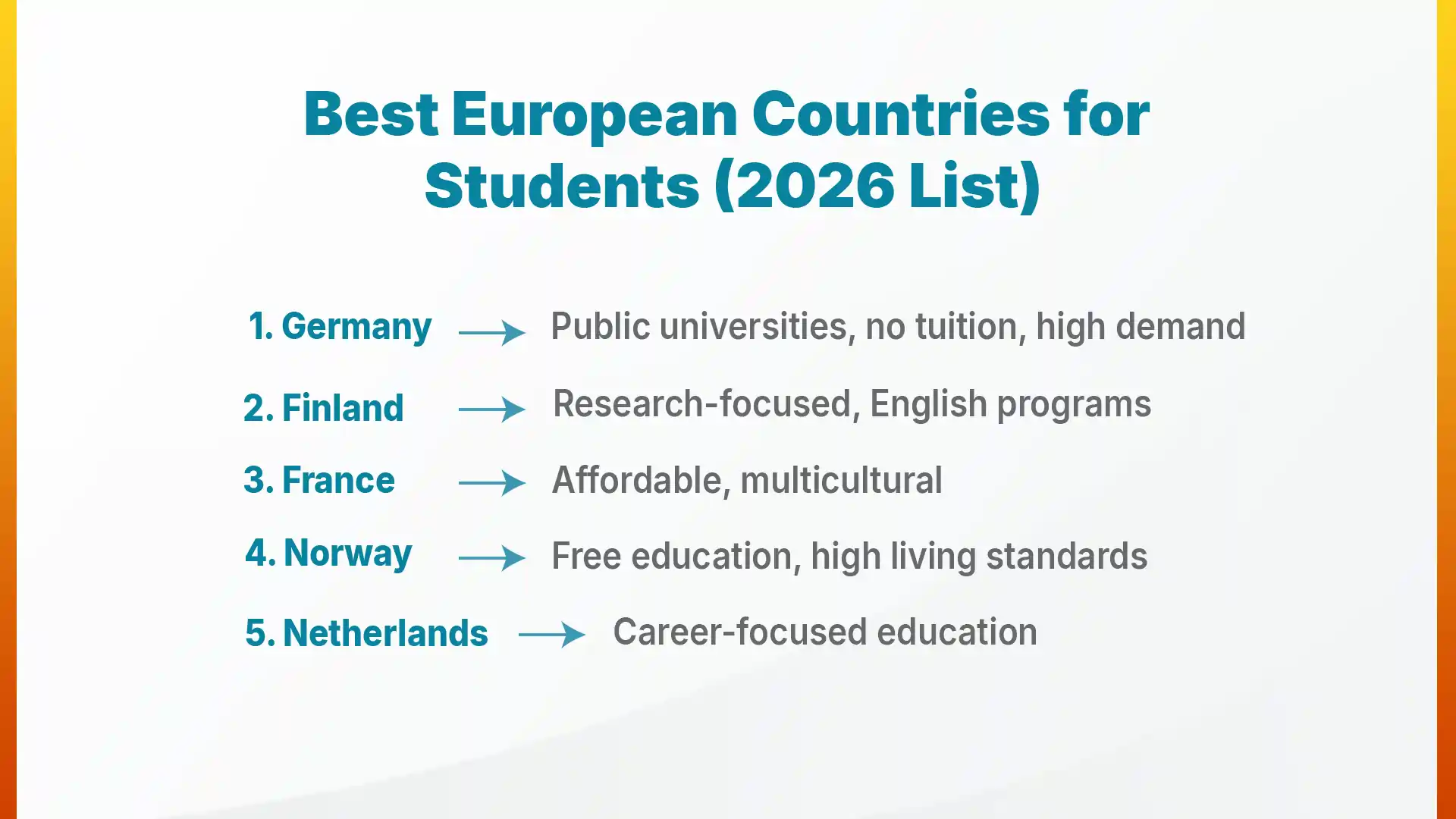
The best European countries for Nepali students in 2026 include Germany, France, Finland, and the Netherlands. These countries are popular due to low or no tuition fees, high-quality education, and a wide range of English-taught programs. Here’s a closer look at the top choices for 2026:
1. Germany
Germany remains a top favourite because it combines world-class education with almost zero tuition fees at public universities. Students appreciate how practical and industry-linked the teaching style is, especially in engineering, IT, automotive, and research fields. The country is also known for its strong job market and stable economy, which gives graduates real confidence about their future. Germany also offers an 18-month job-search visa, allowing students to stay and build a career after their studies. The lifestyle is safe, organised, and filled with opportunities.
2. Finland
Finland attracts students who love innovation, technology, and research-driven learning. Its universities are known for their modern teaching methods, open communication style, and supportive environment. Nepali students like Finland because it feels peaceful, equal, and student-friendly.
Most programs, even advanced ones, are offered in 100% English, which makes life easier for international learners. Finland also offers straightforward visa rules, and graduates get generous post-study residence options.
3. France
France blends quality education with accessible tuition fees, especially at public institutions. France is strong in business, hospitality, fashion, technology, and research, giving students many pathways to grow. Nepali students also love how multicultural the environment is. Moreover, France allows students to work part-time and offers affordable housing support through the CAF system. The country also has a vibrant lifestyle, making it both academically and culturally rewarding.
4. Norway
Norway stands out because public universities do not charge tuition fees, even for international students. This makes it one of the most cost-effective places to study high-quality programs. Students love Norway’s peaceful environment, strong safety record, and high living standards.
Norway’s teaching style focuses on independence, critical thinking, and practical learning. While living costs are higher, the quality of life and long-term opportunities often balance it out. For students who want a calm, nature-rich, and academically strong destination, Norway is an excellent choice.
5. Netherlands
Nepali students are increasingly choosing the Netherlands because of its modern, career-oriented curriculum. Universities here prepare you for real jobs through internships, projects, and industry collaborations. Fields like engineering, logistics, IT, agriculture, and business are especially strong. A major advantage of studying in the Netherlands is its Orientation Year (ZOEKJAAR), a full year after graduation to search for a job and settle into your career. The Netherlands also offers excellent English programs, friendly cities, and easy travel across Europe.
6. Italy
Italy is admired for its affordable education, beautiful cities, and rich cultural background. Nepali students enjoy the warm environment and the reasonable cost of living compared to many Western European countries. Italy shines in fields like business, arts, architecture, fashion, and design. Italy is generous with regional scholarships that can cover tuition, accommodation, and even living expenses.
7. Poland
Poland appeals to students who want a comfortable balance between cost and quality. Tuition fees are lower than in most European countries, and living expenses are very manageable. Nepali students find Poland welcoming, safe, and easier to adjust to. Programs in IT, nursing, engineering, and business are popular, and many universities offer strong international support services. The overall lifestyle is simple, friendly, and ideal for first-time travellers.
8. Spain
Spain attracts students who want a sunny, relaxed, and joyful environment while still pursuing a solid degree. Tuition fees are affordable, and living costs vary depending on the city, giving students flexibility. Spain is strong in tourism, hospitality, business, arts, and sports sciences. Students love the social culture, friendly locals, and exciting student life. The comfortable climate adds to its advantages, making the experience enjoyable throughout the year.
Popular Courses for Nepali Students in Europe
IT & Computer Science, Engineering, Healthcare & Nursing, Business, Hospitality & Tourism are the most popular courses for Nepali students in Europe. These fields are in high demand globally and offer strong career prospects after graduation. European universities also provide specialised programs, research opportunities, and practical training. Here’s a closer look at the fields that are most in demand.
1. IT & Computer Science
Europe has one of the strongest tech ecosystems in the world. Countries like Germany, Finland, the Netherlands, and Poland are known for their innovation hubs, IT parks, and digital startups. The scope is massive, especially in software development, cybersecurity, cloud computing, and mobile applications. Many European tech cities, such as Berlin and Helsinki, regularly collaborate with global companies, giving graduates a huge advantage when they enter the job market.
2. Engineering
Engineering is a top choice for Nepali students, and Europe is one of the best places to study it. Germany is famous for engineering, while Norway, Italy, and France also offer strong programs in mechanical, civil, electrical, and automotive fields. European universities focus on practical learning through workshops, labs, and industry projects. As an Engineering student in Europe, you will experience working in robotics, smart cities, sustainable energy, and climate engineering.
3. Healthcare & Nursing
Europe needs skilled healthcare professionals, and the demand is only rising. As a result, this creates great job opportunities for international students. In particular, nursing, public health, physiotherapy, and medical programs provide training in modern hospitals, clinics, and research labs. Among these countries, Finland, Poland, and Germany are popular for their structured programs, safe work environment, and clear career paths.
4. Business & Management
European business schools are well-regarded for programs emphasising digital skills, sustainability, and theoretical knowledge with real-world practice. Moreover, students can specialise in finance, marketing, HR, supply chain, or entrepreneurship. Cities like Paris, Amsterdam, Milan, Berlin, and Warsaw offer internships and connections with multinational companies.
6. Hospitality & Tourism
Europe’s tourism and hospitality industry is world-class, which makes it a great field to study. Spain, France, and Italy have top-ranked schools and access to hotels, resorts, airlines, and events. Through these programs, students gain real-world experience, improve communication skills, and prepare for a globally portable career in tourism and hospitality.
7. Data Science & AI
Europe is a leader in AI, machine learning, and data research. For instance, the Netherlands, Germany, and Finland host major labs and research centres where students work on real projects. Companies across technology, healthcare, and finance hire graduates, and in addition, Europe emphasises ethical AI and sustainable digital practices.
8. Agriculture & Forestry
Europe is strong in sustainable farming, modern food technology, and environmental management. Students get hands-on experience with tools, climate research, and green innovation projects. Norway, Finland, and Germany lead in forestry, while Italy and the Netherlands excel in modern agriculture and food science, offering long-term career opportunities for those passionate about nature and sustainability.
Eligibility Requirements (General for All European Countries)
Before planning your journey to Europe, it helps to understand the basic requirements that most countries expect from international students. These guidelines are simple, predictable, and designed to make sure you’re ready for academic life abroad. Here’s a clear breakdown to help you prepare with confidence.
1. Academic Requirements
For bachelor’s programs, students generally have to complete +2 with scores that meet the university’s requirement. Some courses, especially in science or technical fields, may require specific subjects. For master’s programs, a recognised bachelor’s degree in a related field is needed, and relevant internships or work experience can strengthen your application. For PhD or research programs, universities focus on prior research, thesis, or publications, so a strong academic background helps you stand out.
2. English Requirements (IELTS, PTE)
Most European universities require proof of English proficiency, usually through tests like IELTS, PTE, or TOEFL. For bachelor’s programs, the expected scores are generally IELTS 5.5–6.5, while master’s programs often require IELTS 6.0–7.0 or equivalent PTE scores.
Some universities may accept an English-medium education certificate from Nepali students, but this depends on the country and the institution, so having a valid test score is always the safest way to strengthen your application.
Here’s a summary of academic and test requirements for studying in Europe for Nepalese students:
Program Level | Academic Requirement | English Requirement |
| Bachelor’s | Completed +2; some courses may need specific subjects | IELTS 5.5–6.5 or PTE; some accept English-medium certificate |
| Master’s | Recognized bachelor’s in a related field; internships help | IELTS 6.0–7.0 or PTE; English-medium certificate may be accepted |
| PhD / Research | Strong academic background; research, thesis, or publications | IELTS 6.5–7.5 or PTE; may be waived if prior study was in English |
3. Accepted Gaps to Study in Europe
Europe is generally flexible with study gaps, as long as they are explained honestly. If you were working, preparing for tests, running a business, or dealing with personal or medical responsibilities, it is usually acceptable. The key is to show that your time was spent productively and aligns with your future study plans.
4. Financial requirements
Most European countries require proof that you can support your studies and living expenses for at least one year. This usually includes:
- Bank balance showing required funds
- Bank statements (generally 6 months)
- Proof of income (salary, business, agriculture, rent, etc.)
- Sponsor documents, if applicable
The amount varies from country to country, but staying transparent and well-organised makes your visa process much smoother.
5. Document Preparation Checklist for Your European Education
Here’s a simple checklist of documents you’ll generally need while applying for European colleges, universities, and a student visa:
- Valid passport
- Academic transcripts (+2, bachelor's, master’s)
- Degree certificates
- English test score (IELTS, PTE, etc.)
- Updated CV
- Statement of Purpose (SOP)
- Letters of Recommendation (if required)
- Passport-sized photos
- Bank statements and financial documents
- Income source proofs
- Police clearance (some countries)
- Medical reports (if required)
- Application or visa form
Having these documents ready early saves you from last-minute stress and increases your success rate.
Steps to Study in Europe From Nepal in 2026
To study in Europe from Nepal, start by choosing the right country and course, followed by shortlisting universities that fit your goals. Next, prepare documents, apply to programs, arrange finances, and secure a student visa. Below is a clear, action-oriented plan you can follow from the first idea to landing in Europe. Treat this as a complete guide you can follow confidently.
Step 1: Country and Course Selection
Start by shortlisting 3–5 countries you are interested in and 2–3 courses you would like to pursue in each. Consider tuition fees, living costs, language of instruction, and post-study work opportunities. Germany and the Netherlands are great for post-study work options, Finland is perfect for research and technology, and Norway or public German universities are ideal if low tuition is a priority. Creating a simple list with reasons for each choice will give clarity and help you focus on realistic options.
Step 2: University Shortlisting
Next, choose 2–3 universities in each selected country. Aim for a mix of one “reach,” one “good fit,” and one “safe” university. Check intake months, fees, program structure, and entry requirements. Pay attention to whether the program needs an English test, portfolio, or subject-specific marks. Organising brochures, official websites, and application deadlines in folders or bookmarks will make this process smoother.
Step 3: Prepare Required Documents
Collect all essential documents early to avoid last-minute stress. This includes passport, academic transcripts, SOP, CV, LORs, English test scores, and bank statements. In Germany, the Netherlands, and Finland, universities expect clear transcripts and a focused SOP. In Italy, Spain, and Poland, scanned copies are often accepted initially, but physical copies should be ready. Also prepare two strong LORs, an SOP emphasising your academic and career goals, and a concise one-page CV to present your profile professionally.
Step 4: Apply to the Universities
Submit applications through official university portals or Common Application systems. Pay attention to deadlines and application fees. Processing usually takes 4–12 weeks for master’s programs and may vary for bachelor’s programs. Keep track of your submissions and confirmations to avoid missing deadlines.
Step 5: Receive Offer Letter (Conditional vs Unconditional)
When you receive an offer, read it carefully. A conditional offer requires you to meet certain requirements, like English test scores or document legalisation, while an unconditional offer confirms your acceptance. Save the email and PDF, note deadlines for acceptance and deposits, and take immediate action to complete any pending conditions.
Step 6: Arrange Financial Documents
Prepare proof of funds required by both the university and the country’s visa office. This may include a blocked account, bank guarantee, or sponsor documents showing 3–6 months of bank history. Germany often requires a blocked account for the first year, while Italy and some other countries specify an annual minimum amount to prove subsistence. Contact your bank early for certified statements and sponsor affidavits to meet these requirements accurately.
Step 7: Apply for a Student Visa
Book an appointment at the country’s embassy, consulate, or partner visa centre. Submit your documents, pay fees, and attend biometrics if required. Be honest, concise, and consistent during the interview. Explain your study plan, financial situation, and intentions after graduation. Start the process 8–12 weeks before your planned travel. Countries like Finland, Germany, and the Netherlands have clear post-study pathways, so showing awareness of these opportunities can strengthen your application.
Step 8: Travel, Accommodation & Arrival Process
Once your visa is issued, book your flight and arrange initial accommodation, either in university dorms or private student housing. Plan airport pickup and registration with local authorities, which is mandatory in many countries, within a few days of arrival. Keep original documents with you, including the offer letter, visa, passport, and proof of funds. Joining university international student groups can help you navigate your first days smoothly.
Final Checklist Before You Move
Confirm visa and travel dates, keep originals and certified copies of degrees and transcripts, set up a small emergency fund, purchase short-term travel and health insurance, and learn basic local phrases along with student services contacts. Following these steps carefully will make the entire process manageable, predictable, and successful.
Financial Requirements for Studying in Europe
To study in Europe, students must plan for tuition, living costs, and visa financial proof, usually covering at least one year of expenses. This can come from your savings, a sponsor, or your parents, usually shown with 3–6 months of bank statements. Having clear and enough financial proof helps make your visa process easier.
1. Annual Tuition and Living Costs to Study in Europe (2026)
Tuition and living costs vary by country, with Germany and Norway having very low or no tuition, while the Netherlands and Italy are more expensive. Living costs are usually €700–€1,400 per month, depending on the city. Total yearly costs can range from about €8,400 to over €31,000.
Country | Tuition Fees (€ per year) | Living Costs (€ per year) | Estimated Annual Total (€ per year) |
| Germany | 0–3,000 (public, region-based) | 10,800–18,000 | 10,800–18,000 |
| Finland | 5,000–13,000 | 8,400–18,000 | 13,400–31,000 |
| France | 2,700–3,700 | 10,800–18,000 | 13,500–21,700 |
| Norway | 0–500 (public) | 12,000–13,000 | 12,000–13,500 |
| Netherlands | 10,000–25,000 | 13,000–17,000 | 23,000–42,000 |
| Italy | 1,000–7,000 | 8,400–14,400 | 9,400–21,400 |
| Poland | 2,000–6,000 | 5,400–9,600 | 7,400–15,600 |
| Spain | 750–6,000 | 10,000–13,000 | 10,750–19,000 |
2. Blocked Account (Germany)
Germany requires students to show proof of sufficient funds through a blocked account, which typically holds around €11,000–€12,000 for one year. These funds cannot be withdrawn all at once. Instead, the money is released little by little each month to pay for living costs. It’s important to open this account early to make the visa process easier.
3. General Bank Balance Requirement
Most European countries require evidence that you can support yourself financially for at least one year. The recommended amount generally ranges from €10,000–15,000, depending on the tuition and living costs of your chosen country. Proof can come from personal savings, sponsor funds, or parental support, and embassies typically want 3–6 months of bank statements and income documents to approve the visa.
4. Affordable Options for Nepali Students
For students who want to balance cost with quality, countries like Germany, Poland, Italy, and Spain are excellent choices. Germany and Norway are unbeatable for tuition-free public universities, while Poland offers very low living costs. Finland and France are slightly higher but often provide scholarships and grants for international students. Selecting an affordable country allows you to focus more on studies, internships, and career development rather than worrying about expenses.
Scholarships Available for Nepali Students
Nepali students can access several scholarships to study in Europe, including Erasmus+, DAAD (Germany), Eiffel (France), Finland Government Scholarships, Italy regional scholarships, and Poland’s NAWA program. These scholarships help cover tuition fees, living costs, or both, making European education more affordable. They also add prestige to your profile and improve your chances of securing post-study opportunities.
1. Erasmus+
Erasmus+ is one of the most popular scholarship programs in Europe. It supports international students across multiple countries for bachelor’s, master’s, and short-term study programs. It covers tuition fees partially as well as fully and may also provide a monthly stipend for living expenses. The program emphasises mobility, allowing students to study in more than one European country during the program.
2. DAAD Scholarship (Germany)
Germany’s DAAD Scholarship is ideal for students interested in research, technology, and higher studies. It covers tuition, monthly allowances, travel costs, and health insurance. Applicants with strong academic records, research experience, and a clear study plan are highly favoured. Germany’s low tuition fees combined with DAAD funding make this one of the most attractive options for Nepali students.
3. Eiffel Scholarship (France)
The Eiffel Scholarship is designed for master’s and PhD students who demonstrate academic excellence and leadership potential. It covers tuition fees, monthly allowances, and sometimes accommodation costs. France’s multicultural environment and strong post-study employment opportunities make this scholarship even more valuable.
4. Finland Government Scholarship
Many Finnish universities offer government-backed scholarships for international students, covering either full or partial tuition fees. Finland’s focus on research, technology, and sustainable development makes these programs highly relevant for students seeking global career opportunities.
5. Italy Regional Scholarships
Various Italian regions provide scholarships to attract international students. These scholarships may cover tuition, accommodation, or both. Students applying to arts, design, business, or hospitality programs often find Italy’s regional scholarships very supportive, especially in smaller cities with lower living costs.
6. Poland NAWA Scholarship
Poland offers the NAWA Scholarship for international students pursuing bachelor’s, master’s, or doctoral studies. It includes tuition fee waivers and monthly allowances, making Poland a very affordable destination. The scholarship is especially attractive for students looking for budget-friendly, quality education in Europe.
Scholarships can significantly reduce financial pressure and make studying in Europe more achievable for Nepali students. Combining scholarships with affordable countries and careful planning of living costs ensures that students can focus on academics and career development without unnecessary stress.
Part-Time Jobs in Europe for Nepali Students
Nepali students in Europe can work part-time, usually 10–20 hours per week during semesters and full-time during breaks. Common jobs include cafes, restaurants, retail, tutoring, university assistant roles, or internships related to their field of study. Part-time work helps cover living costs and can also strengthen a student’s CV for future career opportunities.
1. Allowed Working Hours
Most European countries allow international students to work part-time alongside their studies, but limits vary:
- Germany, Finland, Netherlands: 20 hours per week during the semester; full-time during holidays.
- France, Italy, Spain, Poland: 10–20 hours per week during semesters; some countries allow full-time work in summer or semester breaks.
Following these limits is important to maintain a work-study balance. Overworking can affect your visa status, may even cause your termination.
2. Average Salary (Country-wise)
Generally, international students earn around €9–12 per hour. Part-time salaries vary by country, industry, and experience level:
Country | Average Part-Time Salary (€/hour) |
| Germany | €10–€12 |
| Netherlands | €12–€15 |
| Finland | €10–€13 |
| France | €9–€12 |
| Italy & Spain | €7–€10 |
| Poland | €5–€8 |
While part-time jobs are unlikely to cover full tuition, they can significantly reduce monthly living expenses.
3. Common Student Jobs in Europe
In Europe, students often take part-time jobs in cafes, restaurants, and retail, or take roles as research or library assistants at their university. Tutoring or teaching language classes is also popular, and many students pursue internships related to their field of study, especially in IT, business, or engineering. Choosing a job connected to your course can further strengthen your CV and improve your chances of post-study employment.
4. Legal Rules & Warnings
Working beyond permitted hours or without proper authorisation can jeopardise your visa. Always check your student permit and country-specific regulations before accepting a job. Ensure your employer knows you are an international student and follows local tax rules.
Post-Study Work Visa (PSW) Opportunities
Many European countries offer post-study work visa opportunities for international students. Germany, Finland, Italy, and the Netherlands provide options to stay and work for 12–18 months after graduation. These programs help graduates gain practical experience, improve career prospects, and, in some cases, qualify for permanent residency. Each country has its own rules, so knowing them helps students plan their careers effectively.
1. Germany – 18-Month Job Search Visa
Germany offers an 18-month residence permit for graduates to look for a job related to their field of study. This gives students ample time to explore opportunities in engineering, IT, research, business, and more. To maximise your chances, prepare a professional CV, brush up on German language basics if required, and leverage university career services for networking.
2. Finland – Work Permit Pathway
In Finland, graduates can apply for a residence permit to seek employment or start a business after completing a degree. The initial permit can be granted for up to 12 months, giving enough time to secure a job in sectors like IT, engineering, healthcare, or research. Strong language skills, networking, and internship experience during studies greatly improve employability.
3. Italy – One-Year Job Search
Italy provides one year for graduates to find employment. While the job market is competitive, sectors like arts, design, business, and hospitality offer promising opportunities. Having connections with professors, completing internships, and knowing Italian basics can make a significant difference.
4. Netherlands – Orientation Year (Zoekjaar)
The Netherlands has an Orientation Year permit for international graduates, allowing them to work full-time for up to 12 months after completing their degree. This is especially useful for students in technology, business, and engineering fields. The permit does not require a prior job offer, giving flexibility to explore the market.
5. Permanent Residency (PR) Opportunities
Some European countries, like Germany, the Netherlands, and Finland, offer pathways to permanent residency after post-study work experience. Typically, graduates need to work for a few years on a valid residence permit, pay taxes, and integrate into society. If you are aiming for PR in the long term, the key is to plan early. Choose the right country, build professional networks, and gain relevant work experience in a strategic location.
Mistakes Nepali Students Must Avoid While Studying in Europe
Common mistakes Nepali students should avoid include applying without proper research, submitting incomplete or fake documents, and choosing the wrong course or country for their goals. These little yet common pitfalls can delay applications, increase costs, or even jeopardise visas. The following are the most frequently occurring problems that you should avoid to save time, money, and unnecessary stress:
1. Applying Without Research
Choosing a course or country without proper research is a common mistake. Tuition, living costs, language, and post-study opportunities vary widely. Selecting a program based on friends’ experiences or social media trends often leads to disappointment. Always check official university websites, program details, and visa regulations before making decisions.
2. Not Preparing SOP Properly
The Statement of Purpose (SOP) is one of the most critical documents in your application. A generic or weak SOP can reduce your chances of admission and scholarships. Focus on your academic background, career goals, and why the specific program and country are right for you. Tailor each SOP to the university and program.
3. Using Fake Financial Documents
Submitting forged bank statements or sponsor letters is a serious offence and can lead to visa rejection or even future bans. Always provide authentic and verifiable financial proof. Embassies cross-check bank statements, and any discrepancy can cause delays or refusals.
4. Wrong Course-Country Selection
Not every country offers the same quality or opportunities for every course. For example, Germany excels in engineering and research, while Italy and Spain are strong in arts, hospitality, and business programs. Choosing the wrong country for your field can limit internships, post-study work, and career growth.
5. Last-Minute Application
Starting the process too late is a common problem. Visa processing, university applications, scholarship deadlines, and document preparation all take time. Begin at least 8–12 months before your intended start date to ensure smooth submission, document verification, and visa approval.
Avoiding these mistakes allows Nepali students to approach their study abroad journey strategically, saving stress, time, and resources. With proper planning, preparation, and guidance, studying in Europe can be a smooth, rewarding experience.
Conclusion
Europe is a strong, affordable, and career-focused choice for Nepali students in 2026. With high-quality education, numerous English-taught programs, and opportunities for part-time work and post-study employment, it provides the perfect environment to grow academically and professionally. Countries like Germany, Finland, and the Netherlands combine low tuition, safe living conditions, and clear pathways to work after graduation. On the other hand, Italy, Spain, and Poland offer budget-friendly options with rich cultural experiences.
Careful planning, from selecting the right country and course, preparing documents accurately, to understanding financial requirements, can make the entire process smooth and predictable. Scholarships, part-time work, and smart financial planning further reduce the burden, allowing students to focus on learning and career-building.
If you are ready to take the next step toward studying in Europe, working with a reputable education consultancy in Nepal can help you navigate the process efficiently, maximise your chances of acceptance, and make your European education dream a reality.