Study Nursing in South Korea: Courses, Universities, Requirements & Career 2026

May 20, 2026
For many Nepali students, studying nursing in South Korea is about building a respected healthcare career in one of Asia's most advanced medical systems. Yet the path can feel overwhelming at first. Questions about courses, Korean language requirements, licensing exams, and career options often leave students unsure where to begin. This uncertainty can slowly turn a clear ambition into hesitation.
South Korea offers globally recognized nursing education, hands-on clinical training in modern hospitals, and real career pathways after graduation. However, without the right information, it is easy to miss critical details or make costly mistakes along the way.
This guide is designed to give you clarity. It breaks down nursing courses in South Korea, entry requirements, costs, scholarships, licensing, and career options in simple terms. By the end, you will know exactly how to plan your journey and move forward to study nursing in South Korea with confidence.
In this blog
Why Choose Nursing in South Korea?
Nursing in South Korea is a strong choice if you want quality education, real clinical experience, and long-term career stability in Asia's most dynamic healthcare market. The country offers a clear study-to-work pathway, affordable tuition compared to Western destinations, and growing demand for trained nursing professionals. Below are the key reasons why Nepali students are choosing South Korea for nursing education.
1. Globally Recognized Degrees at Affordable Costs
South Korea's nursing degrees are internationally respected and recognized by healthcare employers across Asia, the Middle East, and beyond. Unlike the UK or Australia, where tuition fees can be significantly higher, South Korean universities offer quality nursing programs at a much more manageable cost for Nepali families. This combination of academic credibility and financial accessibility makes South Korea one of the smartest study destinations available right now.
2. Advanced Healthcare System and Hands-On Clinical Training
South Korea's healthcare system is consistently ranked among the best in Asia for its technological advancement, efficiency, and patient care standards. As a nursing student, you do not just study theory in classrooms; you train inside real hospitals alongside experienced medical professionals from early in your program. This practical clinical exposure builds the skills and confidence employers look for and gives you a clear advantage when you enter the job market after graduation.
3. Scholarships, Part-Time Work, and Career Pathways
Studying nursing in South Korea also comes with practical financial and career advantages. International students are legally permitted to work part-time during their studies, helping manage day-to-day expenses without relying entirely on funds from home. Competitive scholarships are open to Nepali students every year. And after graduation, South Korea's expanding healthcare sector offers real employment and post-study work possibilities for qualified nursing graduates.
Types of Nursing Courses in South Korea for International Students
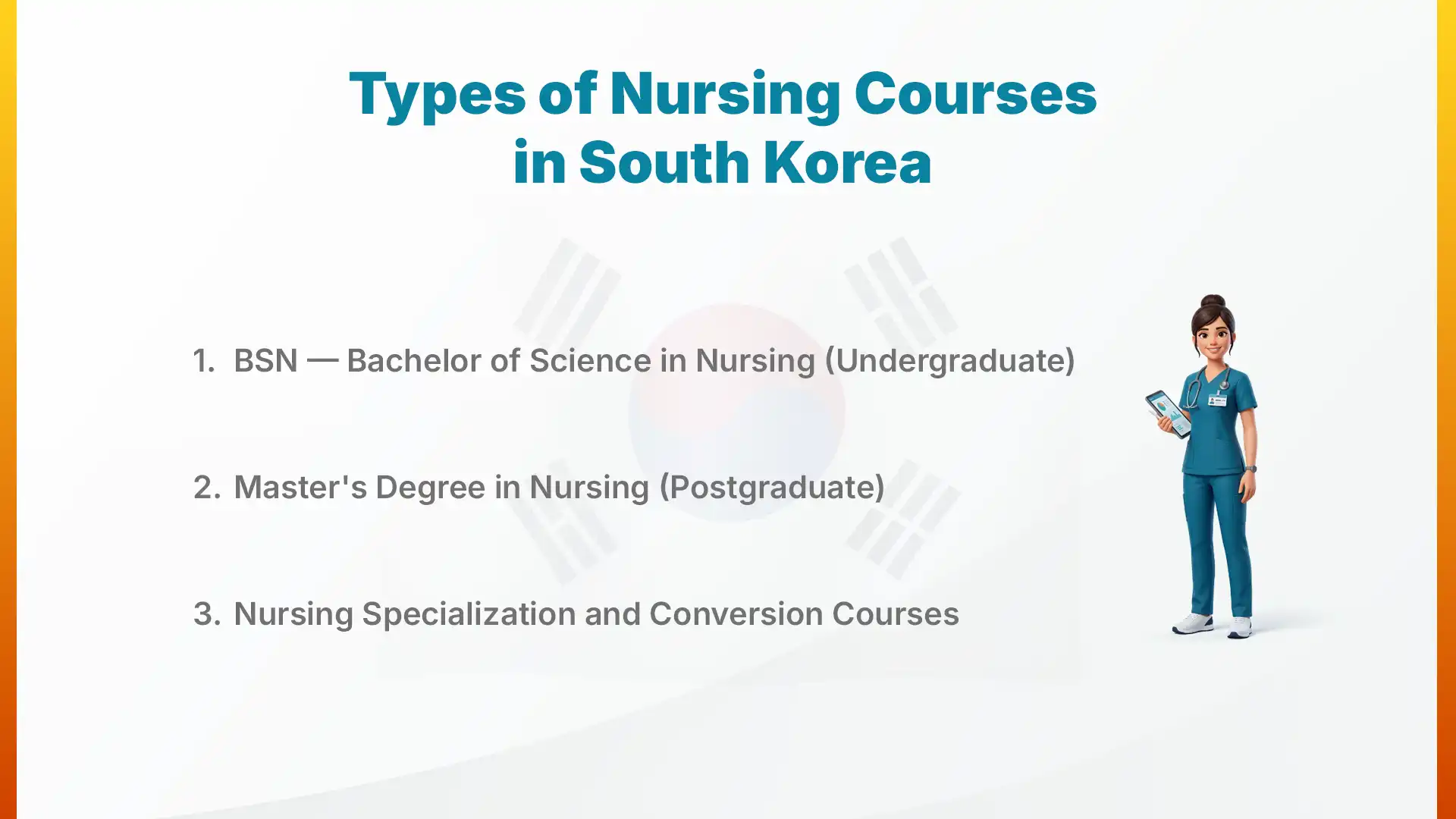
Nursing courses in South Korea for international students include BSN undergraduate programs, master's postgraduate degrees, and specialized conversion courses. BSN programs typically take four years and include structured clinical placements in South Korean hospitals, while master's programs focus on advanced specializations like adult nursing, pediatric nursing, or nursing leadership. The most common starting point for Nepali +2 graduates is the undergraduate BSN degree.
1. BSN: Bachelor of Science in Nursing (Undergraduate)
The BSN in South Korea typically takes four years to complete. The program is divided between classroom study and practical clinical training, where you learn core subjects including patient care, anatomy, pharmacology, nursing ethics, and clinical skills. This balance helps you understand both the theory and the real-world demands of nursing practice.
A significant part of the program involves clinical placements in accredited South Korean hospitals. You work under the supervision of licensed nursing professionals in real healthcare settings, gaining direct patient care experience. This hands-on training is one of the most valuable aspects of nursing education in South Korea.
Eligibility for BSN in South Korea
To apply, you typically need to have completed a +2 or equivalent with a science background, usually including biology as a core subject. Language proficiency, either TOPIK for Korean-medium programs or IELTS/TOEFL for English-medium programs, is also required. Specific grade thresholds vary by university, so always confirm requirements directly with your chosen institution.
This program is ideal if you want to build your nursing career from a strong academic foundation. It suits students who are committed to patient care and want a direct pathway into South Korea's healthcare system.
2. Master's Degree in Nursing (Postgraduate)
A master's degree in nursing in South Korea is designed for students who already hold a bachelor's degree in nursing or a related healthcare field and want to advance into specialized or leadership roles. Programs typically take one to two years to complete, depending on the university and course structure. The focus is on advanced clinical practice, nursing research, and healthcare management.
Popular specializations include adult nursing, pediatric nursing, mental health nursing, community health nursing, and nursing leadership and administration. These specializations prepare you for higher-responsibility roles in hospitals and healthcare organizations. Choosing the right specialization helps you target better career opportunities and long-term professional growth.
Eligibility for Master's in Nursing in South Korea
To apply, you need a recognized bachelor's degree in nursing or a closely related healthcare field. Most universities also require relevant clinical work experience and proof of language proficiency. Requirements vary significantly between institutions, so verify each program's specific criteria carefully before submitting your application.
3. Nursing Specialization and Conversion Courses
Nursing specialization and conversion courses in South Korea are designed for healthcare professionals who want to upgrade their qualifications, change their area of clinical focus, or align existing credentials with South Korean nursing standards. These courses are shorter than full degree programs and focus on targeted, practical training.
Conversion courses are particularly suitable for Nepali nurses who already hold a nursing qualification from Nepal and want to practice in South Korea without starting an entire degree over again. Many of these programs include structured clinical placements, helping you adapt quickly to South Korea's healthcare environment. This is an efficient option for experienced nurses seeking faster career progression or a move into high-demand nursing roles.
Top Nursing Universities in South Korea
South Korea has a wide range of universities offering nursing degrees, with institutions spread across major cities including Seoul, Busan, and Gwangju. Choosing the right nursing university in South Korea is a critical decision that directly affects the quality of your clinical training, your licensing eligibility, and your career options after graduation. Below are the most recognized institutions for nursing education in South Korea.
Always verify that your chosen university and nursing program are officially recognized by South Korea's Ministry of Education and the Korean Nurses Association before applying.
1. Seoul National University
Seoul National University (SNU) is South Korea's most prestigious public university, and its College of Nursing is nationally recognized for academic excellence and research output. Located in Seoul, SNU benefits from strong connections with leading teaching hospitals, giving nursing students access to exceptional clinical training environments. It is a benchmark institution for any Nepali student aiming for the highest standard of nursing education available in South Korea.
2. Yonsei University
Yonsei University is one of South Korea's top private universities with a well-established nursing program known for academic rigor and clinical depth. The university operates its own Severance Hospital, one of South Korea's largest and most advanced medical centers, giving nursing students direct access to real clinical settings as part of their program. Yonsei also supports international students through dedicated admissions programs and English-assisted coursework in select areas.
3. Ewha Womans University
Ewha Womans University in Seoul is one of Asia's most respected institutions for women's education, and its College of Nursing is nationally recognized for producing highly competent graduates. The university places a strong emphasis on patient-centered care, community health, and nursing research. For female Nepali students, Ewha offers a supportive academic environment, strong clinical programs, and a well-connected international student community.
4. Kyung Hee University
Kyung Hee University is a well-established institution in Seoul with a College of Nursing known for integrating both modern and holistic approaches to healthcare. It is recognized for its focus on comprehensive patient care and its international outlook. The university's affiliated medical centers provide structured clinical training placements throughout the nursing program, ensuring students gain real-world experience before graduation.
5. Chonnam National University
Chonnam National University, located in Gwangju, is one of South Korea's leading regional universities and a strong option for students seeking quality nursing education outside of Seoul. Its nursing program is nationally respected and affiliated with Chonnam National University Hospital, providing solid clinical training opportunities. Studying in Gwangju also means lower living costs compared to Seoul, making it a practical and affordable choice for Nepali students managing a tight budget.
Requirements to Study Nursing in South Korea
To study nursing in South Korea, you must meet specific academic, language, and documentation requirements set by individual universities and South Korea's Ministry of Education. These requirements ensure you are prepared for both the academic demands and the clinical training involved in a nursing program. Below is a clear breakdown of what you need to apply to South Korea for your nursing degree:
1. Academic Qualifications
For BSN programs, you must have completed +2 or a high school diploma with a science background, typically including biology as a core subject. For master's programs, a recognized bachelor's degree in nursing or a related healthcare field is required. Meeting the minimum academic criteria is essential for your application to be considered by any South Korean university.
Course Level | Minimum Academic Requirement |
|---|---|
| BSN (Bachelor's) | Completion of +2 (NEB or equivalent) with science subjects including Biology |
| Master's in Nursing | Recognized Bachelor's degree in Nursing or related healthcare field |
| Conversion/Specialization | Existing nursing qualification from a recognized institution |
Note: Specific GPA or percentage requirements vary between universities. Always confirm the exact entry requirements directly with your chosen institution before applying.
2. Language Requirements TOPIK, IELTS, or TOEFL?
You must demonstrate language proficiency, as nursing involves direct patient communication and clinical documentation. Most nursing programs in South Korea are taught in Korean, so a strong TOPIK score is essential for most undergraduate programs. Some universities offer English-medium or partially English-medium programs that require IELTS or TOEFL scores instead.
For Korean-medium programs: TOPIK Level 3 or above is generally required. Some universities may require Level 4 or higher for clinical nursing programs.
For English-medium programs: IELTS or TOEFL scores are required. Exact score thresholds vary by institution. To study or work in nursing in South Korea, the typical English proficiency requirement is an IELTS score of 5.5 to 6.5 for undergraduate and graduate programs, and 6.5 to 7.0 for top-tier universities like Seoul National University
Starting your language preparation as early as possible, ideally at least one year before your intended application, gives you a significant advantage during the admissions process and makes daily life in South Korea significantly easier.
3. Documents Required for Admission
Start collecting your documents early; the preparation takes more time than most students expect. Here is a standard checklist of what is typically required:
- Academic transcripts and certificates (Grade 10, 11, and 12 or equivalent)
- Valid passport with sufficient remaining validity
- Language proficiency test results (TOPIK or IELTS/TOEFL)
- Statement of Purpose (SOP)
- Letters of Recommendation (LOR) from teachers or academic supervisors
- Updated CV or Resume
- Financial sponsorship documents proving sufficient funds
- Completed university application form
- Medical certificate or health clearance (required by some universities)
Cost of Studying Nursing in South Korea
The cost of studying nursing in South Korea includes tuition fees, living expenses, and additional costs like clinical materials and licensing exam fees. Tuition for BSN programs generally ranges from NPR 400,000 to NPR 800,000 per year, while monthly living costs typically fall between NPR 60,000 and NPR 130,000. Understanding the costs of your Korean education helps you plan your budget before exploring scholarships and funding options. Let us break it down step by step.
1. Tuition Fees by Course Level
Tuition fees vary depending on the university, program level, and whether the institution is public or private. Compared to Western destinations, South Korea offers a significantly more affordable option for Nepali students without compromising on education quality.
Course Level | Estimated Annual Tuition (KRW) | Approximate NPR Equivalent |
|---|---|---|
| BSN (Bachelor's) | 4,000,000 – 8,000,000 KRW | NPR 4,00,000 – 8,00,000 |
| Master's in Nursing | 5,000,000 – 10,000,000 KRW | NPR 5,00,000 – 10,00,000 |
| Conversion/Specialization | 3,000,000 – 6,000,000 KRW | NPR 3,00,000 – 6,00,000 |
Important: These are estimated ranges only. Always confirm exact tuition fees directly with your chosen university. Exchange rates fluctuate; use these figures for general planning purposes only.
2. Living Expenses in South Korea for Nepali Students
Living costs in South Korea for international students include accommodation, food, transport, and personal spending. In major cities like Seoul, expenses tend to be higher, while regional cities like Gwangju or Busan offer a more affordable lifestyle. Planning for everyday expenses ensures you can focus on your studies without ongoing financial stress.
Expense Category | Estimated Monthly Cost (KRW) |
|---|---|
| Accommodation (Shared/Dormitory) | 200,000 – 500,000 KRW |
| Food and Groceries | 200,000 – 400,000 KRW |
| Transportation | 50,000 – 100,000 KRW |
| Utilities and Internet | 50,000 – 100,000 KRW |
| Personal and Miscellaneous | 100,000 – 200,000 KRW |
| Total Estimated Monthly | 600,000 – 1,300,000 KRW |
3. Additional Costs to Plan For
Beyond tuition and living costs, nursing students should budget for additional program-specific expenses. These include nursing uniforms and clinical equipment; laboratory and training materials; Korean language course fees if you need to improve your TOPIK level before admission; and the Korean Nursing Licensing Examination (KNLE) registration fee after graduation. Planning for these costs before you leave Nepal will prevent financial surprises and allow you to focus fully on your program from day one.
Scholarships for Nursing Students in South Korea
Studying nursing in South Korea can be made significantly more affordable through scholarships and funding programs available to international students. These include government-funded programs cover full tuition and living costs, as well as university merit scholarships and Nepal-based funding options. Exploring these scholarship opportunities in South Korea early can make a meaningful difference to your overall financial plan.
1. Government Scholarships
South Korea offers several government-funded scholarships for international students, including Nepali students. These can help with tuition fees, living costs, travel, and other study expenses. They are highly competitive, so check the latest requirements and prepare your application early.
2. University Merit Scholarships
Most South Korean universities offer their own merit-based scholarships for international nursing students. These typically provide a partial reduction in tuition fees based on academic performance and are often assessed automatically when you submit your application. The specific amounts and eligibility criteria vary by institution, so check the international admissions page of each university you are shortlisting and note the scholarship deadlines alongside your admission timelines.
3. Other Funding Options From Nepal
There are also funding options worth exploring from within Nepal. Check with Nepal's Ministry of Education and relevant government bodies for any bilateral education agreements or scholarship programs between Nepal and South Korea. Some Nepali banks and financial institutions offer education loans specifically for overseas study. Contact the Korean Embassy in Kathmandu for updated guidance on funding opportunities available to Nepali students heading to South Korea.
How to Become a Nurse in South Korea: Korean Nursing License Explained
To work as a nurse in South Korea, all graduates, including international students, must obtain the Korean nursing license by passing the Korean Nursing Licensing Examination (KNLE). This is a mandatory requirement regulated by the Korean Nurses Association (KNA) and applies to every nursing graduate who wishes to practice professionally in any South Korean healthcare setting.
1. What Is the Korean Nursing License?
The Korean nursing license is the official professional credential issued by the Korean Nurses Association (KNA) that authorizes a person to practice as a registered nurse in South Korea. Without this license, you cannot work as a nurse in any South Korean hospital, clinic, or healthcare facility regardless of your degree or country of origin. Obtaining this license is therefore one of the most important goals of your nursing education in South Korea.
2. Korean Nursing Licensing Examination (KNLE)
The KNLE is a national licensing examination that evaluates a nursing graduate's clinical knowledge, decision-making ability, and competency to practice safely as a registered nurse in South Korea. The examination is conducted in Korean, which is a key reason why Korean language proficiency is critical for nursing students, not just for daily life but for their professional future in South Korea.
The KNLE covers subjects including nursing fundamentals, adult nursing, pediatric nursing, maternal nursing, mental health nursing, community health nursing, and nursing management. Graduates must pass this examination before they can be formally registered. Preparation for the KNLE should begin well before your graduation date, and your language proficiency in Korean will play a direct role in your ability to succeed.
3. Registration Process for International Graduates
To register, you must submit your nursing qualifications to the Korean Nurses Association for review before being permitted to sit the KNLE. Required documents typically include your nursing degree certificate, academic transcripts, proof of clinical training hours, Korean language proficiency documentation, and identity documents. Once your qualifications are verified and approved, you can sit the KNLE and, upon passing, receive full nursing registration in South Korea.
Since requirements and processes can change, always refer to the official Korean Nurses Association website or contact the Korean Embassy in Kathmandu for the most current and accurate information before beginning your registration process.
How to Apply for Nursing Courses in South Korea in 2026
Applying for nursing courses in South Korea is straightforward if you follow the correct steps and start early. A clear, organized approach helps you avoid missed deadlines, incomplete applications, and unnecessary delays. Here is a step-by-step guide for Nepali students.
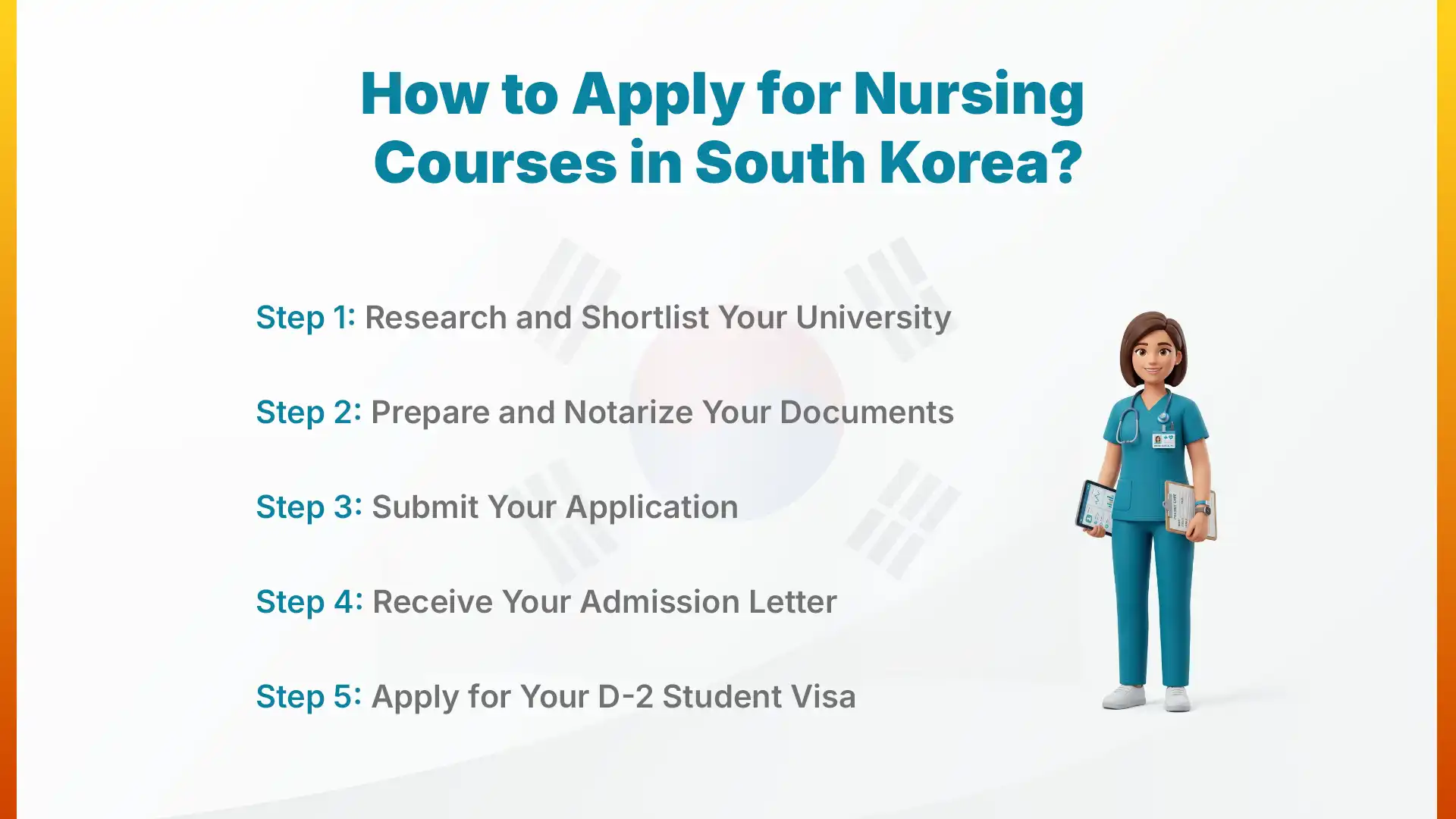
Step 1: Research and Shortlist Your University
Identify universities offering KNA-recognized nursing programs within your budget. Consider city, program language, clinical facilities, and available scholarships before finalizing your shortlist.
Step 2: Prepare and Notarize Your Documents
Gather academic transcripts, a passport, language test results, an SOP for South Korea, and letters of recommendation. Documents in Nepali must be officially translated and notarized. Start this process early, as it takes longer than expected.
Step 3: Submit Your Application
Apply through the university's official portal or a registered education consultant. Applying to more than one institution increases your chances of receiving a strong offer.
Step 4: Receive Your Admission Letter.
If successful, you will receive a letter of acceptance. Read all conditions carefully before confirming your place and responding to the university.
Step 5: Apply for Your D-2 Student Visa
Once you have your admission letter, begin your D-2 student visa for South Korea application at the Embassy of the Republic of Korea in Kathmandu. Confirm the current document checklist directly with the embassy before submitting.
Career Opportunities After Studying Nursing in South Korea
Completing a nursing degree in South Korea opens up a wide range of career paths in both public and private healthcare. You graduate with the clinical skills, academic credentials, and licensing eligibility is needed to work in hospitals, clinics, and community health settings across South Korea and internationally. South Korea's healthcare sector also offers strong opportunities for professional growth and specialization over time.
1. Job Roles After Graduation
As a registered nurse in South Korea, you can work across a variety of clinical and non-clinical roles. Common positions include:
- Registered Nurse in hospital wards and outpatient departments
- Pediatric Nurse or Maternal and Child Health Nurse
- Mental Health Nurse
- Community Health Nurse
- Clinical Research Nurse
- Nurse Educator or Academic Instructor
- Healthcare Administrator or Nursing Manager
With experience and further specialization, graduates can progress into senior clinical roles, nursing leadership positions, or advanced practice nursing, each offering greater responsibility and earning potential.
2. Salary of Nurses in South Korea
Salary figures for nurses in South Korea vary depending on your role, specialization, employer, city, and level of experience. Entry-level registered nurses in South Korean hospitals generally receive competitive starting salaries relative to the local cost of living, particularly in major cities like Seoul and Busan. As you gain experience and move into mid-level or senior nursing roles, your earning potential grows significantly, especially within large hospital networks or specialized clinical units. For verified and current salary data, refer to South Korea's official labor statistics or reputable employment platforms operating in the country.
3. Employment Outlook for International Graduates
South Korea's healthcare sector is expanding steadily, driven by an aging population, rising healthcare demand, and significant government investment in medical infrastructure. This growth creates consistent demand for trained nursing professionals, including international graduates who have completed their studies and obtained the Korean nursing license. Graduates who combine strong clinical skills with Korean language proficiency are well positioned to secure employment in South Korea's competitive but rewarding healthcare job market.
Nepali Nurse in South Korea: Career Path and Life
Many Nepali students are choosing South Korea to gain advanced nursing training, better career opportunities, and international experience at a more accessible cost than Western destinations. The journey typically starts with completing a BSN from a recognized South Korean university, followed by passing the KNLE and obtaining official nursing registration. From there, nurses can begin working in South Korean hospitals or healthcare facilities, building skills and professional experience in one of Asia's most advanced medical environments.
1. Journey From Nepal to South Korea
Most Nepali nursing students begin by securing admission to a recognized BSN program at a South Korean university, having completed their NEB +2 with a science background. After completing the degree and passing the KNLE, they apply for nursing registration with the Korean Nurses Association and explore work visa options for professional employment. Careful planning, including early TOPIK preparation, scholarship applications, and guidance from a verified consultancy, can make the transition from Nepal to South Korea significantly smoother.
2. Daily Work Life in South Korean Hospitals
Once employed, Nepali nurses in South Korea work in hospital wards, specialized clinical units, and outpatient settings, managing patient care, administering treatments, and collaborating closely with doctors and other healthcare professionals. Daily shifts can be demanding, but the exposure to advanced medical technology and high patient care standards builds professional skills and confidence rapidly. South Korean hospitals are known for their discipline and efficiency, creating an environment that continuously challenges nurses to grow.
3. Long-Term Stay and Settlement Options
Nurses who build a strong professional record in South Korea may have pathways toward longer-term residency, depending on their visa category, length of employment, and compliance with immigration requirements. Visa options such as the E-7 work visa may be available after graduation depending on your employment situation and current immigration regulations. Visa rules are subject to change, so always refer to the official Korea Immigration Service website or contact the Korean Embassy in Kathmandu for the most current and accurate information.
Can International Students Work in South Korea After Nursing?
After completing your nursing degree in South Korea, you can legally work while gaining professional experience and planning your long-term career. South Korea provides visa pathways for international graduates in healthcare, making it possible to transition from student life into professional nursing work without immediately leaving the country.
1. Part-Time Work Rights During Studies
International students in South Korea are generally permitted to work up to 20 hours per week during term time and unlimited hours during official vacation periods. This allows nursing students to earn supplementary income and manage day-to-day living expenses without depending entirely on funds from home. Since regulations on part-time work for students in Korea can change, always verify the current rules with the Korea Immigration Service before taking on any employment to protect your student visa status.
2. Post-Study Work Visa Options
After completing your nursing degree and obtaining your Korean nursing license, certain visa categories may allow you to remain in South Korea for professional employment. The E-7 (Specially Designated Activities) visa may be applicable depending on your job role and employer. Since visa regulations are updated periodically, always consult the Korea Immigration Service or a verified immigration advisor for the most current eligibility criteria before making post-graduation plans.
3. Long-Term Work and Residency Pathways
Nurses who build a consistent professional record in South Korea may have pathways toward longer-term residency over time. Maintaining compliance with immigration requirements, specializing in high-demand nursing areas, and building strong employer relationships all contribute positively to your long-term prospects in South Korea. For accurate information on residency pathways for nursing professionals, always refer to the official Korea Immigration Service website or contact the Korean Embassy in Kathmandu directly.
Common Mistakes to Avoid
Pursuing a nursing career in South Korea is a significant investment of time, money, and effort, and certain missteps can derail your plans entirely. Many Nepali students face setbacks not because they lack qualifications, but because of avoidable oversights in planning and preparation. From choosing an unrecognized program to missing critical deadlines or falling victim to fraudulent consultants, these mistakes can cost you years of progress. The path to becoming a licensed nurse in South Korea involves multiple interconnected requirements: language proficiency, accredited education, proper documentation, and licensure, and a gap in any one of these areas can have serious consequences. Taking the time to educate yourself on these common pitfalls will help you make informed decisions, protect your investment, and stay on track toward a successful nursing career in Korea. Understanding what to watch out for before you begin is just as important as knowing the right steps to take.
- Choosing a nursing program without verifying recognition by the Korean Nurses Association (KNA)
- Underestimating Korean language requirements and leaving TOPIK preparation too late
- Missing scholarship application deadlines
- Not understanding the KNLE licensing requirement before planning your post-graduation career
- Trusting unverified or fraudulent education consultants in Nepal
- Submitting incomplete or poorly prepared application documents
- Ignoring the additional costs of clinical materials and licensing exam fees
By carefully following the steps in this guide and avoiding these common mistakes, you can move through the application process confidently and begin your nursing journey in South Korea on the right foot.
Conclusion
Choosing to study nursing in South Korea can be a life-changing decision for Nepali students who want a globally respected qualification, real clinical training, and genuine career opportunities all at a cost that makes sense for Nepali families. From hands-on hospital training and generous scholarships to licensing pathways and long-term career growth, South Korea offers everything you need to build a successful nursing career in Asia and beyond.
Take time to understand the nursing courses, universities, costs, scholarship options, and KNLE requirements before you apply. Whether your goal is a BSN, a master's degree, or a conversion course, South Korea provides a clear and well-supported pathway from study to professional practice.
Your dream of becoming a skilled nurse in South Korea is within reach. Take the first step today: research your preferred programs and begin your TOPIK preparation, and if you are ready to take the next step, contact SAS Education Consultancy for expert guidance on your South Korea application, from college selection to visa support.