Bachelor of Architecture in South Korea: Your Gateway to Global Design

Jun 10, 2026

South Korea is one of Asia's most exciting destinations for architecture education, with a rapidly evolving urban landscape, world-class design institutions, and some of the most affordable yet internationally respected architecture programs available to Nepalese students.
For those who want a rigorous five-year professional degree in a country that takes design seriously, a bachelor of architecture in South Korea offers a genuinely compelling combination of creative training, technical depth, and career opportunity. Nepalese students who are exploring their options can start by reading about studying in South Korea before committing to a specific program.
In this blog
What Is a Bachelor of Architecture in South Korea?
A Bachelor of Architecture in South Korea is a five-year professional undergraduate degree that leads directly to eligibility for architectural licensing in Korea and recognition under international mutual recognition agreements. Depending on the institution, the degree may be offered as a bachelor of architecture or a bachelor of architectural engineering; the former focuses on design and spatial thinking, while the latter places stronger emphasis on structural systems, building technology, and construction engineering.
The degree is accredited by the Korea Architectural Accrediting Board (KAAB), which is recognized internationally and is the Korean equivalent of RIBA in the UK or CACB in Canada. KAAB accreditation ensures that the program meets the professional standards required for graduates to pursue architectural licensure both in Korea and in countries that maintain mutual recognition agreements with KAAB.
Why Study Architecture in South Korea?
South Korea is one of the best destinations to study architecture because of its globally recognized degrees, significantly affordable tuition compared to Western countries, world-class design studios set within one of Asia's most architecturally dynamic urban environments, and generous scholarship opportunities.
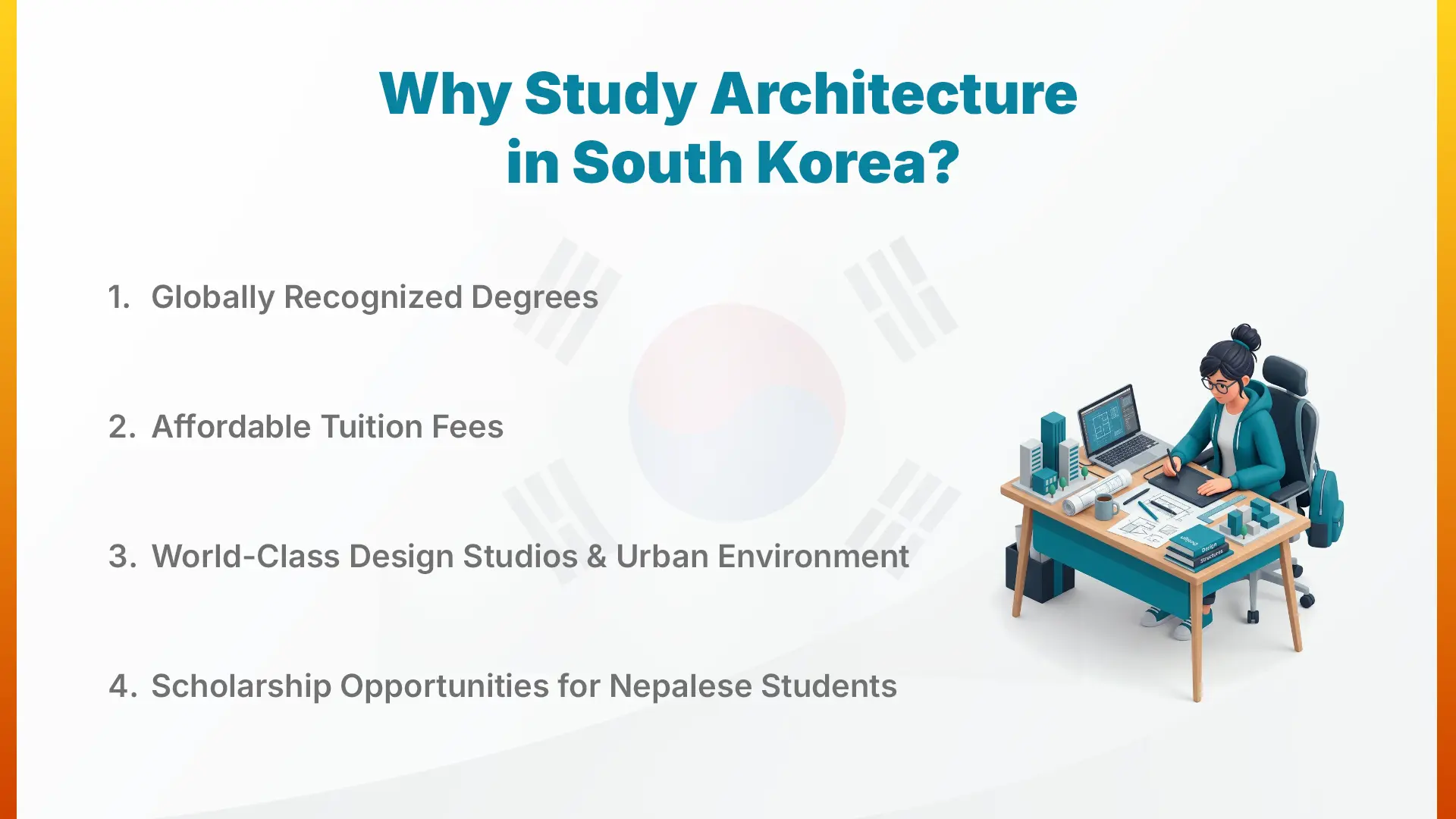
1. Globally Recognized Degrees
Architecture degrees accredited by KAAB are recognized under mutual recognition agreements with architectural bodies in the USA, UK, Australia, Canada, and several other countries. For Nepalese graduates, a KAAB-accredited degree from a Korean university is a professionally credible qualification that is recognized by employers and licensing bodies across major international architecture markets.
2. Affordable Tuition Fees
Tuition fees for architecture programs in South Korea are significantly lower than equivalent programs in the UK, USA, and Australia, particularly at national universities where government subsidies further reduce costs for international students. Combined with Korea's relatively affordable cost of living compared to Western study destinations, South Korea offers exceptional value for Nepalese students investing in a five-year professional architecture degree.
3. World-Class Design Studios and Urban Environment
South Korean architecture schools are equipped with cutting-edge design studios, digital fabrication laboratories, and BIM (Building Information Modeling) facilities. Cities like Seoul, Busan, and Incheon are themselves living laboratories of contemporary architecture, from the futuristic Dongdaemun Design Plaza to Songdo's smart city infrastructure, providing architecture students with daily exposure to innovative design at an urban scale.
4. Scholarship Opportunities for Nepalese Students
South Korea offers several significant scholarship programs for international students, including the prestigious Global Korea Scholarship (GKS), which is one of the most generous fully funded scholarship programs available to Nepalese students in any country. These scholarships in South Korea are one of the most financially accessible study destinations for Nepalese architecture students with strong academic profiles.
Which Are the Top Universities for Architecture in South Korea?
The top universities for a Bachelor of Architecture in South Korea include Seoul National University, Yonsei University, Korea University, Hanyang University, and Hongik University, all offering KAAB-accredited programs with strong studio facilities, research output, and industry connections across Korea's active design and construction sector. Research which are the best universities in South Korea for you before fully committing to one university.
University | Location | Known For | KAAB Status |
|---|---|---|---|
| Seoul National University (SNU) | Seoul | Research, Public Architecture, Urban Design | KAAB Accredited |
| Yonsei University | Seoul | Design Innovation, Sustainable Architecture | KAAB Accredited |
| Korea University | Seoul | Architectural Engineering, Technical Design | KAAB Accredited |
| Hanyang University | Seoul / Ansan | Construction Technology, BIM, Industry Links | KAAB Accredited |
| Hongik University | Seoul | Creative Design, Arts-Integrated Architecture | KAAB Accredited |
Seoul National University is the most prestigious option for architecture in Korea. Hongik University is particularly well-regarded for its creative and design-forward studio culture and is a popular choice among international students with strong artistic profiles.
What Are the Admission Requirements?
The admission requirements for a bachelor of architecture in South Korea include strong Plus Two results, a design portfolio, language proficiency in English or Korean, a personal statement, and financial documentation for the D-2 student visa.
1. Academic Requirements
Applicants must have completed Grade 12 or Plus Two with strong overall results, typically a minimum of 60% to 75% overall. A background in mathematics, physics, or visual arts is advantageous. Most universities also require a certified translation of Nepalese academic documents.
2. Portfolio Requirements
A design portfolio is required by most Korean architecture programs and should demonstrate the following:
Creative ability in drawing, spatial thinking, and visual communication
15 to 25 pages of original artwork, sketches, photography, or design work
Evidence of design sensibility and three-dimensional thinking
Architectural drawings are not required; any creative medium is acceptable
3. English / Korean Language Requirements
Most Korean universities offer architecture programs in Korean, though a growing number of institutions, particularly Yonsei and Korea University, offer English-medium tracks or bilingual programs. Language requirements vary accordingly:
Language | Requirement |
|---|---|
| Korean (TOPIK) | TOPIK Level 3 or above for Korean-medium programs |
| English (IELTS) | 6.0 to 6.5 for English-medium programs |
| English (TOEFL iBT) | 80 to 90 for English-medium programs |
Nepalese students who need to prepare their English score can enroll in IELTS preparation classes before applying.
4. Personal Statement
Your personal statement should explain your motivation for studying architecture, your creative background, and your career goals after graduation. Nepalese students can follow the SOP format for South Korea to structure their statement effectively.
5. Financial Proof and Visa Documentation
For the South Korea D-2 Student Visa, students must provide financial documentation demonstrating sufficient funds to cover tuition and living expenses. Research beforehand what the requirements are to study in South Korea to make sure you have all the necessary documents.
How to Apply for a Bachelor of Architecture in South Korea?
Applying for a Bachelor of Architecture in South Korea involves five straightforward steps. Checking the intakes in South Korea early is essential, as most universities accept students for the March intake with applications opening between September and January.
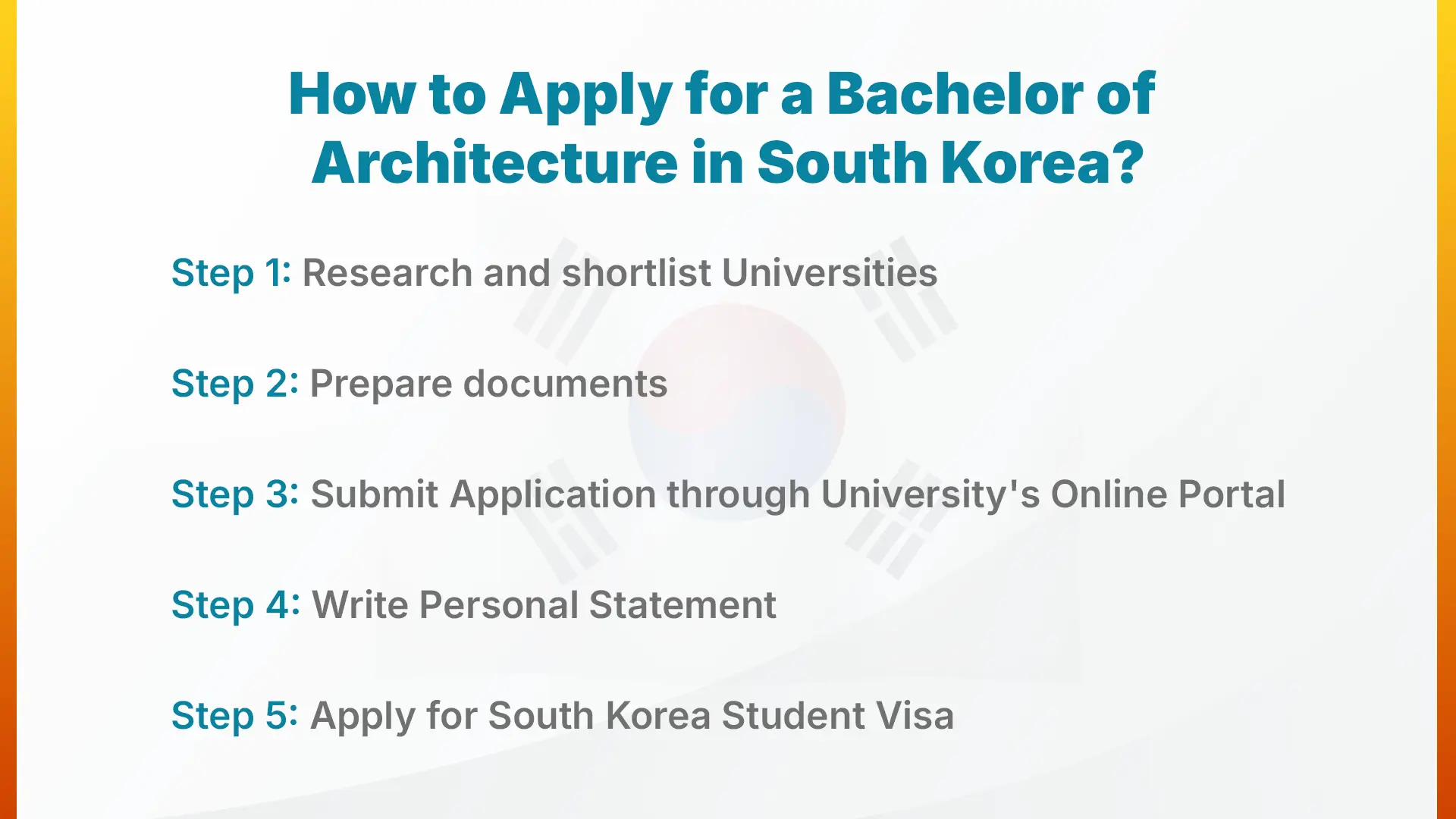
Step 1: Research and Shortlist Universities
Compare architecture programs based on KAAB accreditation, language of instruction, tuition fees, scholarship availability, and location. Shortlist three to five universities that match your academic profile and budget.
Step 2: Prepare Documents and Portfolio
Gather your Plus Two transcripts, passport, language test scores, and financial documents. Begin curating your design portfolio early, as it is one of the most important and time-consuming components of your application.
Step 3: Submit Application Through University's Online Portal
Apply directly through each university's online application portal, as South Korea does not have a centralized application system. Most universities open applications between September and January for the March intake.
Step 4: Write Your Personal Statement
Your personal statement should explain your motivation for studying architecture, your creative background, and your career goals. Keep it specific to your design interests and the program you are applying to.
Step 5: Apply for South Korea Student Visa (D-2)
Once you receive your offer letter, apply for the D-2 Student Visa at the Korean Embassy in Kathmandu using your offer letter, financial documents, valid passport, and health certificate.
How Much Does It Cost to Study Architecture in South Korea?
A Bachelor of Architecture in South Korea costs between KRW 3,000,000 and KRW 9,000,000 (approximately NPR 280,000 to NPR 840,000) per semester in tuition for international students, depending on the institution and whether it is a national or private university. The total cost to study in South Korea is different for different universities and different cities. Hence, research before which university and which city are best for you. Some of the popular universities are listed below.
University | Annual Tuition (KRW) | Annual Tuition (NPR approx.) |
|---|---|---|
| Seoul National University | KRW 6,000,000 – KRW 8,000,000 | NPR 560,000 – NPR 747,000 |
| Hanyang University | KRW 8,000,000 – KRW 10,000,000 | NPR 747,000 – NPR 934,000 |
| Korea University | KRW 9,000,000 – KRW 12,000,000 | NPR 840,000 – NPR 1,120,000 |
| Yonsei University | KRW 10,000,000 – KRW 13,000,000 | NPR 934,000 – NPR 1,214,000 |
| Hongik University | KRW 10,000,000 – KRW 14,000,000 | NPR 934,000 – NPR 1,307,000 |
Monthly living expenses in South Korea range from KRW 500,000 to KRW 1,200,000 (approximately NPR 47,000 to NPR 112,000) depending on the city, with Seoul being the most expensive and smaller university cities being considerably more affordable.
Many Nepalese students also take up part-time jobs in South Korea during their studies to offset living costs. Taking tuition and living expenses together, Nepalese students should budget approximately KRW 14,000,000 to KRW 27,000,000 (approximately NPR 1,307,000 to NPR 2,521,000) per year in total.
What Scholarships Are Available?
Several strong scholarship programs are available for Nepalese students pursuing a Bachelor of Architecture in South Korea, making it one of the most financially accessible study destinations in Asia.
University President Scholarships: Most Korean universities offer merit-based partial to full tuition waivers for high-achieving international students at the time of admission
KOICA Scholarships: Korea International Cooperation Agency scholarships supporting students from developing countries, including Nepal in technical and design fields
Korean Government Excellence Scholarships: additional government-funded awards for students in priority fields including architecture and urban design
What Jobs Can You Get After a Bachelor of Architecture in South Korea?
Graduates with a bachelor of architecture from South Korea can pursue a range of professional roles across Korea's active construction, urban development, and design sectors, as well as internationally.
An architectural assistant / junior architect works under a licensed architect on design development, documentation, and client presentations in Korean or international architectural practices
Urban designers work on the planning and spatial design of cities, neighborhoods, and public spaces for government bodies, planning agencies, and private developers
BIM Specialist applies Building Information Modeling skills to manage digital design and construction workflows is one of the most in-demand and well-compensated technical roles in Korean architecture firms
Architectural technologists specialize in construction detailing, building systems, and regulatory compliance within architectural practices and construction companies
What Is the Salary and Scope After Architecture in South Korea?
Entry-level architecture graduates in South Korea earn between KRW 30,000,000 and KRW 40,000,000 (approximately NPR 2,802,000 to NPR 3,736,000) per year, rising to KRW 40,000,000 to KRW 60,000,000 (approximately NPR 3,736,000 to NPR 5,604,000) at mid-level, and KRW 60,000,000 to KRW 90,000,000 or more (approximately NPR 5,604,000 to NPR 8,406,000+) for senior and licensed architect positions.
Architecture is one of the best courses in South Korea for Nepalese students who want a technically demanding career with strong regional and global career flexibility.
Experience Level | Annual Salary (KRW) | Annual Salary (NPR approx.) |
|---|---|---|
| Entry-Level (0–2 years) | KRW 30,000,000 – KRW 40,000,000 | NPR 2,802,000 – NPR 3,736,000 |
| Mid-Level (2–5 years) | KRW 40,000,000 – KRW 60,000,000 | NPR 3,736,000 – NPR 5,604,000 |
| Senior / Licensed Architect (5+ yrs) | KRW 60,000,000 – KRW 90,000,000+ | NPR 5,604,000 – NPR 8,406,000+ |
After completing a five-year bachelor of architecture, international graduates in South Korea can apply for a D-10 job seeker visa, which allows up to 6 months of stay to search for employment, followed by an E-7 skilled worker visa once a qualified architectural employer is secured. The E-7 visa can be renewed, and after 5 years of continuous residence under eligible visa categories, graduates may apply for F-5 permanent residency in South Korea, though the process requires consistent employment and integration requirements.
South Korean architecture graduates are well-regarded by employers across East and Southeast Asia, the Middle East, and internationally, as Korean construction companies and design firms, including large conglomerates such as Samsung C&T, Hyundai Engineering, and POSCO, operate major projects globally and actively recruit Korean-trained architects and engineering graduates.
Conclusion
South Korea offers Nepalese students an outstanding and underexplored combination of KAAB-accredited design education, affordable tuition, world-class urban learning environments, and generous scholarship opportunities. For students serious about architecture who want a globally respected qualification at a fraction of the cost of Western alternatives, a Bachelor of Architecture from South Korea is one of the most strategically valuable choices available.
Interested in studying architecture in South Korea? Contact SAS Education Consultancy for a free counseling session, and let us help you find the right university, prepare your portfolio and application, and navigate the D-2 student visa process with confidence.