Study Law in South Korea: Programs, Fees & Career Scope

Jun 17, 2026

South Korea is rapidly emerging as one of Asia's most respected destinations for legal education, with world-ranked universities, a modernized law school system, and a growing demand for internationally trained legal professionals across its expanding corporate, technology, and trade sectors.
For Nepalese students who want a rigorous legal education at a fraction of the cost of Western alternatives with strong scholarship support and a clear career pathway, studying law in South Korea is an increasingly compelling option. Nepalese students who are exploring their options can start by reading about studying in South Korea before committing to a specific program.
In this blog
Can You Study Law in South Korea as an International Student?
Yes. South Korea offers both undergraduate and graduate law programs open to international students, and the legal education system has undergone significant modernization since 2009, when South Korea introduced a US-style professional law school system alongside its traditional undergraduate LLB programs. Under the reformed system, 25 accredited law schools now offer the Juris Doctor (JD) as the primary pathway to becoming a licensed attorney in Korea, with the undergraduate LLB now serving mainly as a foundation for further legal study or non-practitioner legal careers.
For Nepalese students, the most practical entry points are the undergraduate LLB directly after Plus Two, or the LLM for students who already hold an LLB from Nepal. The JD pathway requires a completed bachelor's degree and is primarily designed for Korean domestic students, though some programs accept international applicants.
What Are the Law Programs Available in South Korea?
South Korea offers four law-related program pathways for international students, ranging from an undergraduate LLB to a postgraduate LLM.
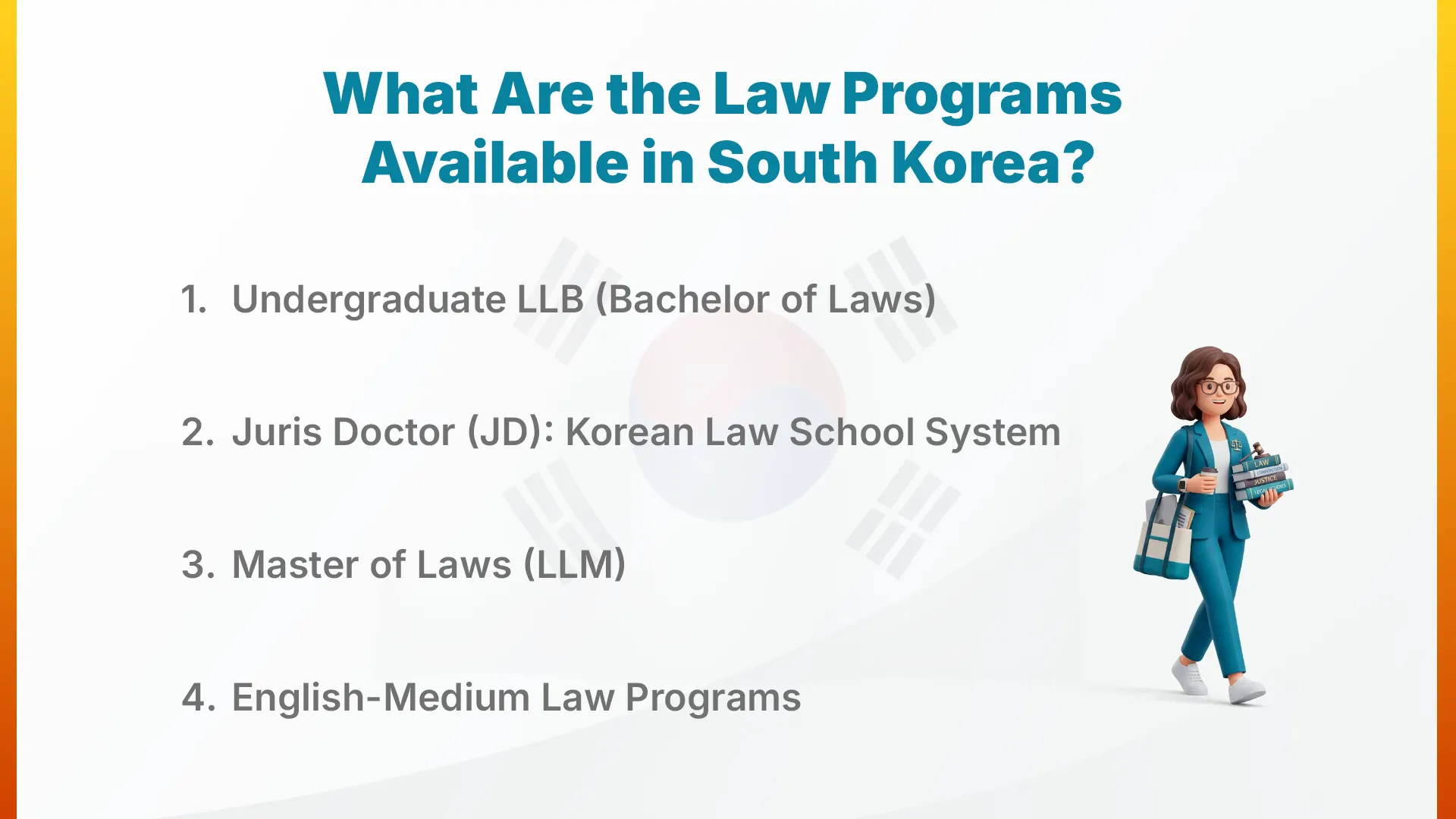
1. Undergraduate LLB (Bachelor of Laws)
Duration: 4 years
Entry requirement: Grade 12 / Plus Two
Language: Primarily Korean; limited English-medium options available
Career outcome: Legal researcher, corporate compliance officer, paralegal, foundation for LLM
2. Juris Doctor (JD) Korean Law School System
Duration: 3 years
Entry requirement: Bachelor's degree in any field + LSAT or Korean LEET exam
Language: Primarily Korean
Career outcome: Licensed attorney in South Korea after passing the Korean Bar Examination
Key point: International applicants are accepted at select schools; Korean language proficiency is essential
3. Master of Laws (LLM)
Duration: 1 to 2 years
Entry requirement: LLB or equivalent from a recognized institution
Language: Korean or English depending on program
Career outcome: Senior legal researcher, international law specialist, corporate counsel, academic
Key point: Nepalese students with an LLB from Nepal can apply directly; it's the fastest pathway to a Korean law qualification
4. English-Medium Law Programs
Duration: Varies by program
Offered at: Seoul National University, Yonsei University, Korea University
Key point: A growing number of Korean universities offer LLM and postgraduate law courses in English, making South Korea more accessible for Nepalese students without Korean language proficiency
How Long Does It Take to Study Law in South Korea?
For Nepalese students starting from Plus Two, the LLB takes 4 years and opens the door to an LLM or JD. Students with an existing LLB from Nepal can complete an LLM in South Korea in 1 to 2 years, the most direct and time-efficient pathway available.
Program | Duration | Entry Requirement |
|---|---|---|
| Undergraduate LLB | 4 Years | Grade 12 / Plus Two |
| Juris Doctor (JD) | 3 Years | Bachelor's Degree + LEET/LSAT |
| Master of Laws (LLM) | 1 to 2 Years | LLB or Equivalent |
| Full Pathway (LLB + JD) | 7 Years | Grade 12 / Plus Two |
What Are the Top Law Schools in South Korea?
The top universities to study law in South Korea include Seoul National University, Yonsei University, Korea University, Sungkyunkwan University, and Hanyang University, all offering accredited law programs with strong faculty, research output, and employer connections across Korea's active legal and corporate sectors. The best universities in South Korea for any students are the ones that align perfectly with their budget, career goals, and academic needs.
University | Location | Program | Known For |
|---|---|---|---|
| Seoul National University | Seoul | LLB, JD, LLM | Korea's Top-Ranked Law School; Constitutional, International, and Commercial Law |
| Yonsei University | Seoul | LLB, JD, LLM | Strong English-Medium LLM Options; International Law and Human Rights |
| Korea University | Seoul | LLB, JD, LLM | Business Law, Trade Law, Corporate Compliance |
| Sungkyunkwan University | Seoul | LLB, LLM | Technology Law, Intellectual Property, Samsung Industry Connections |
| Hanyang University | Seoul | LLB, JD, LLM | Construction Law, Engineering Law, Strong Industry Links |
Seoul National University is South Korea's most prestigious law school. Yonsei University is the strongest option for Nepalese students who want English-medium LLM programs with an international law focus.
What Are the Admission Requirements?
The admission requirements to study law in South Korea include academic qualifications, language proficiency in Korean or English depending on the program, a personal statement, and financial documentation for the D-2 Student Visa.
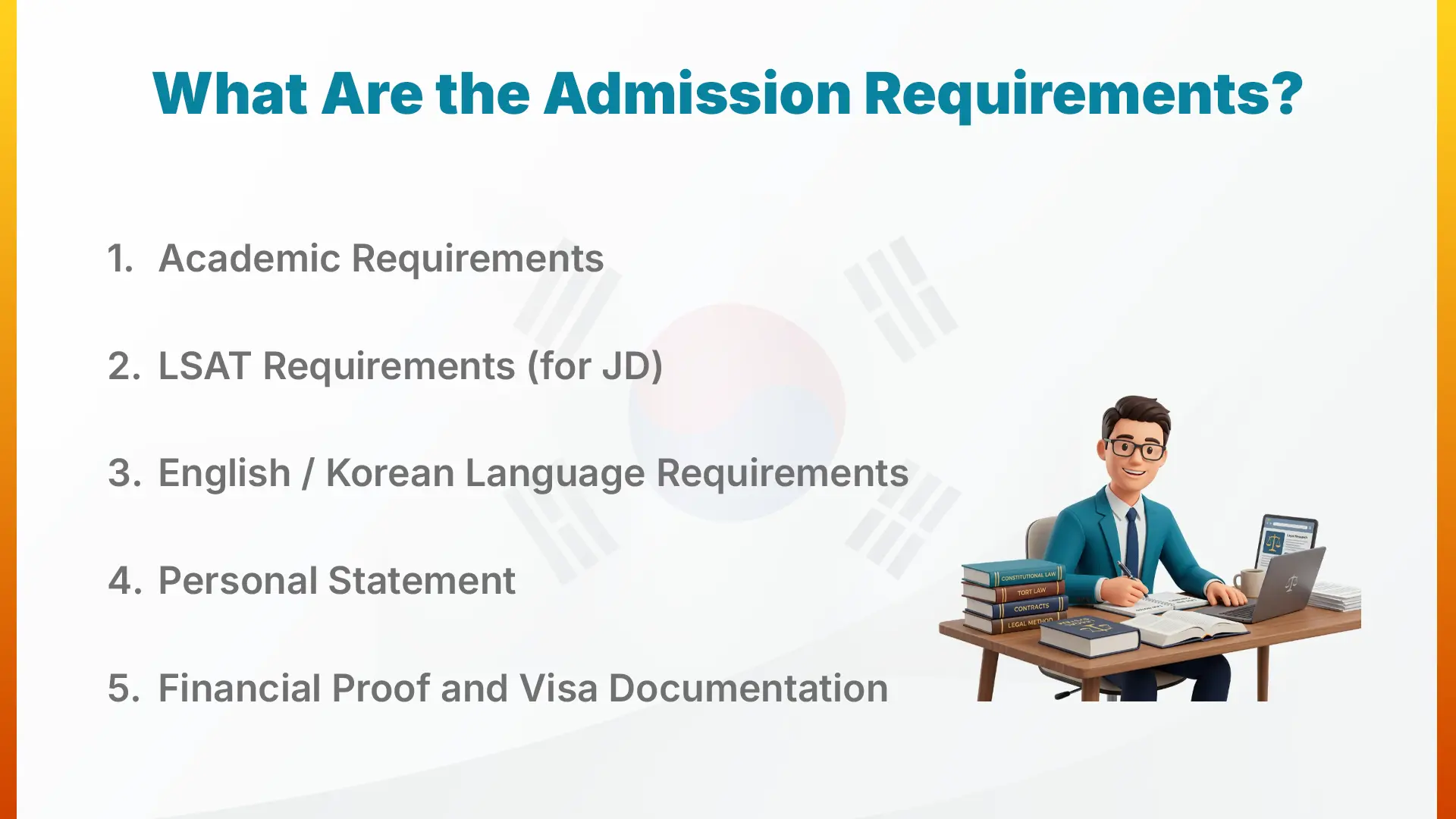
1. Academic Requirements
For the LLB, applicants need Grade 12 or Plus Two with satisfactory results, typically 65% or above. For the JD, a completed bachelor's degree with a strong GPA is required. For the LLM, an LLB or equivalent with strong academic standing is required. Certified translations of Nepalese academic documents are required at all levels.
2. LSAT Requirements (for JD)
The JD in South Korea requires the Korean LEET (Legal Education Eligibility Test) for domestic applicants. Some schools accept the international LSAT for foreign applicants. Most top JD programs expect LSAT scores of 155 or above from international applicants.
3. English / Korean Language Requirements
Language requirements vary by program and university. Korean-medium programs require TOPIK Level 4 or 5, while English-medium LLM programs require IELTS 6.5 or TOEFL iBT 90 or above.
Program | Language | Requirement |
|---|---|---|
| LLB (Korean-medium) | Korean | TOPIK Level 4 or Above |
| JD (Korean-medium) | Korean | TOPIK Level 5 or Above |
| LLM (English-medium) | English | IELTS 6.5 or TOEFL iBT 90+ |
| LLM (Korean-medium) | Korean | TOPIK Level 4 or Above |
Nepalese students preparing for the English requirement can enroll in IELTS preparation classes to reach their target score before applying.
4. Personal Statement
Your personal statement should explain your motivation for studying law in South Korea, your legal interests, any relevant experience, and your career goals. Nepalese students can follow the SOP format for South Korea to structure their statement effectively.
5. Financial Proof and Visa Documentation
For the D-2 Student Visa, students must provide financial documentation and enrollment confirmation. Be ready for all the requirements to study in South Korea to increase the visa approval rate.
How Much Does It Cost to Study Law in South Korea?
Studying law in South Korea costs between KRW 6,000,000 and KRW 15,000,000 (approximately NPR 560,000 to NPR 1,400,000) per year in tuition, making it significantly more affordable than equivalent programs in the USA, UK, or Australia. The total cost to study in South Korea varies by location and university, so choosing the location and university according to the student's budget is the overall smarter choice.
Program | Annual Tuition (KRW) | Annual Tuition (NPR approx.) |
|---|---|---|
| Undergraduate LLB | KRW 6,000,000 – KRW 9,000,000 | NPR 560,000 – NPR 840,000 |
| Juris Doctor (JD) | KRW 10,000,000 – KRW 15,000,000 | NPR 934,000 – NPR 1,400,000 |
| Master of Laws (LLM) | KRW 8,000,000 – KRW 13,000,000 | NPR 747,000 – NPR 1,214,000 |
Monthly living expenses in South Korea range from KRW 600,000 to KRW 1,200,000 (approximately NPR 56,000 to NPR 112,000) depending on the city. Many Nepalese students take up part-time jobs in South Korea during their studies to offset living costs.
Taking tuition and living expenses together, Nepalese students should budget approximately KRW 14,000,000 to KRW 28,000,000 (approximately NPR 1,307,000 to NPR 2,615,000) per year in total.
What Scholarships Are Available?
Several strong scholarship programs support Nepalese students studying law in South Korea. Students can research several scholarships in South Korea to know which scholarship they are eligible for. Some of the scholarships are:
University President Scholarships: Most Korean universities offer merit-based partial to full tuition waivers for high-achieving international students at the time of admission
KOICA Scholarships: Korea International Cooperation Agency awards supporting students from developing countries, including Nepal in law and governance fields
Korean Government LLMScholarships: additional government-funded awards specifically supporting postgraduate students in law and international studies
What Jobs Can You Get After Studying Law in South Korea?
Graduates with a law qualification from South Korea can pursue a range of professional roles across Korean and international legal markets.
Licensed Attorney (Korea): represents clients and provides legal counsel after passing the Korean Bar Examination; this is the primary outcome of the JD pathway
Corporate Legal Counsel: provides in-house legal advice to Korean conglomerates (chaebols), multinational corporations, and technology companies on contracts, compliance, and regulatory matters
International Trade Lawyer: specializes in trade law, WTO regulations, and cross-border commercial disputes; high demand given Korea's active role in global trade
Legal Researcher / Academic: conducts legal research at universities, think tanks, and government institutions; accessible for LLM graduates without Bar Examination requirements
A compliance officer: manages regulatory compliance for Korean corporations and financial institutions; it is one of the most in-demand and accessible roles for international law graduates
What Is the Salary and Scope After Law in South Korea?
Entry-level law graduates in South Korea earn between KRW 35,000,000 and KRW 50,000,000 per year, rising to KRW 50,000,000 to KRW 80,000,000 at mid-level and KRW 80,000,000 or more for senior attorneys and partners. Law is one of the best courses in South Korea for Nepalese students who want a prestigious career with strong regional career scope.
Experience Level | Annual Salary (KRW) | Annual Salary (NPR approx.) |
|---|---|---|
| Entry-Level (0–2 Years) | KRW 35,000,000 – KRW 50,000,000 | NPR 3,269,000 – NPR 4,670,000 |
| Mid-Level (2–5 Years) | KRW 50,000,000 – KRW 80,000,000 | NPR 4,670,000 – NPR 7,471,000 |
| Senior Attorney (5+ Years) | KRW 80,000,000 – KRW 150,000,000+ | NPR 7,471,000 – NPR 14,011,000+ |
After completing a law degree, international graduates in South Korea can apply for a D-10 Job Seeker Visa, allowing up to 6 months to secure employment, followed by an E-7 Skilled Worker Visa once a qualified legal employer is confirmed. After 5 years of continuous eligible residence in South Korea, graduates may apply for F-5 permanent residency, subject to meeting employment and integration requirements.
Conclusion
South Korea offers Nepalese students an affordable, rigorous, and internationally respected legal education pathway from the undergraduate LLB through to the JD and LLM, backed by strong scholarship support and a growing demand for legal professionals across Korea's corporate and international sectors. For students with an existing LLB from Nepal, the Korean LLM is one of the most time-efficient and cost-effective routes to a globally recognized postgraduate law qualification available in Asia.
Interested in studying law in South Korea? Contact SAS Education Consultancy for a free counseling session and let us help you find the right program, prepare a strong application, and navigate the D-2 Student Visa process with confidence.