Study Law in USA: JD, LLM & Paralegal Programs

Jun 16, 2026
The United States is home to the world's most prestigious law schools and one of the most dynamic legal markets on earth. For Nepalese students who want to build a career in law at the highest international level, studying law in the USA opens doors to corporate firms, international organizations, human rights practice, and global policy institutions that few other legal qualifications can match.
This guide covers every pathway from paralegal certificates to the Juris Doctor and Master of Laws so Nepalese students can identify the right entry point for their background and career goals. Nepalese students exploring their options can start by reading about studying in the USA before committing to a specific program.
In this blog
Can You Study Law at an Undergraduate Level in the USA?
Yes, but not as a direct professional law degree. Like Canada, the USA does not offer law as a four-year undergraduate first degree. The professional law qualification in the USA is the Juris Doctor (JD), a three-year graduate-level degree that requires applicants to first complete a bachelor's degree in any subject before applying. This means the full pathway from Plus Two to becoming a licensed attorney in the USA typically takes seven years: three or four years for the undergraduate degree followed by three years for the JD.
For Nepalese students who want to enter the legal field more quickly, paralegal certificate and associate degree programs are available at community colleges and universities at the undergraduate entry level, completing in 1 to 2 years. These programs prepare graduates for roles as paralegals and legal assistants in law firms and corporate legal departments without requiring a JD. Nepalese students with an existing LLB holders from Nepal are also eligible to apply directly for the LLM, making it the fastest route to a US law qualification for those who are already law graduates.
What Are the Law Programs Available in the USA?
The USA offers four law-related program pathways for international students, each suited to a different qualification level and career goal. Nepalese students should choose based on their current qualification, timeline, and target career.
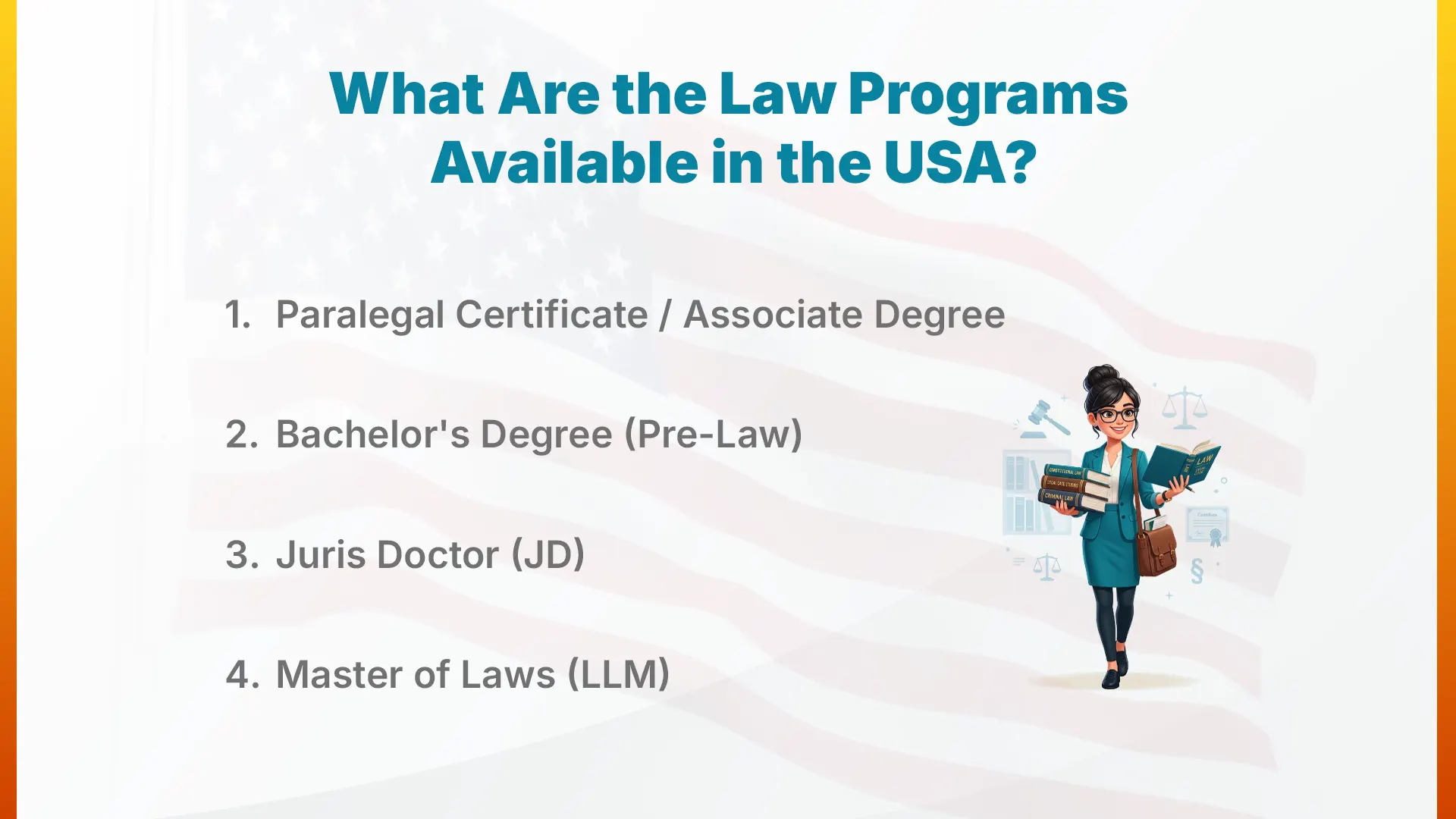
1. Paralegal Certificate / Associate Degree
Duration: 1 to 2 years
Entry requirement: Grade 12 / Plus Two
Offered at: Community colleges and universities nationwide
Career outcome: Paralegal, legal assistant, law clerk
Key point: Does not lead to attorney licensure but provides direct entry into legal support roles in law firms and corporate legal departments
2. Bachelor's Degree (Pre-Law)
Duration: 3 to 4 years
Entry requirement: Grade 12 / Plus Two
Offered at: All major US universities
Career outcome: Pre-law foundation required for JD admission
Key point: Any undergraduate major is accepted; popular pre-law majors include political science, philosophy, economics, and criminal justice
3. Juris Doctor (JD)
Duration: 3 years
Entry requirement: Bachelor's degree + LSAT score
Offered at: Harvard, Yale, Columbia, NYU, University of Chicago, and 200+ accredited law schools
Career outcome: Licensed attorney, corporate counsel, public defender, judge
Key point: JD graduates must pass the Bar Examination in their state to practice law in the USA
4. Master of Laws (LLM)
Duration: 1 year
Entry requirement: LLB or JD from a recognized institution
Offered at: Harvard, NYU, Georgetown, Columbia, and many others
Career outcome: Senior legal counsel, international law specialist, academic researcher
Key point: Nepalese students with an LLB from Nepal are eligible to apply directly for the LLM, the fastest pathway to a US law qualification for existing law graduates
How Long Does It Take to Study Law in the USA?
The time it takes to study law in the USA depends entirely on your current qualification level and the program you are entering. For Nepalese students starting from Plus Two, the full pathway to becoming a licensed attorney in the USA takes 6 to 7 years. Students with an existing LLB from Nepal can complete a US LLM in just 1 year.
Program | Duration | Entry Requirement |
|---|---|---|
| Paralegal Certificate / Associate Degree | 1 to 2 Years | Grade 12 / Plus Two |
| Undergraduate Pre-Law Degree | 3 to 4 Years | Grade 12 / Plus Two |
| Juris Doctor (JD) | 3 Years | Bachelor's Degree + LSAT |
| Master of Laws (LLM) | 1 Year | LLB or JD |
| Full Pathway (Undergrad + JD) | 6 to 7 Years | Grade 12 / Plus Two |
Which Are the Top Universities to Study Law in the USA?
The top universities to study law in the USA include Harvard, Yale, Columbia, NYU, and Georgetown, all offering JD and LLM programs that are globally recognized by the most prestigious law firms, courts, and international organizations. The best universities in the USA for any students is the one that align perfectly with their budget, career goals, and academic needs
University | Location | Program | Known For |
|---|---|---|---|
| Harvard Law School | Cambridge, MA | JD, LLM, SJD | Consistently Ranked World's Top Law School; All Practice Areas |
| Yale Law School | New Haven, CT | JD, LLM | Smallest and Most Selective; Public Interest and Constitutional Law |
| Columbia Law School | New York, NY | JD, LLM | Corporate Law, International Law, Proximity to Wall Street Firms |
| NYU School of Law | New York, NY | JD, LLM | Tax Law, International Law, Largest LLM Program in the USA |
| Georgetown University Law Center | Washington, D.C. | JD, LLM | Public Interest Law, International Law, Proximity to US Government |
Harvard and Yale are the most globally prestigious US law schools. Columbia and NYU are the strongest options for Nepalese students targeting corporate law and international practice. Georgetown is the best choice for students interested in public policy and government law.
What Are the Admission Requirements?
The admission requirements to study law in the USA include academic qualifications, LSAT scores for JD programs, English language proficiency, a personal statement, and financial documentation for the F-1 Student Visa, and they vary significantly depending on whether you are applying for a paralegal certificate, a JD, or an LLM.
1. Academic Requirements
For paralegal programs, applicants need Grade 12 or Plus Two with satisfactory results. For the JD, a completed bachelor's degree with a strong GPA is required. Top law schools expect a GPA of 3.5 to 3.9 out of 4.0. For the LLM, an LLB or equivalent from a recognized institution with strong academic standing is required. Harvard and Yale LLM programs are extremely competitive and typically admit students with exceptional academic records.
2. LSAT Requirements
The LSAT is mandatory for JD admission at all ABA-accredited US law schools. Top schools expect scores of 170 to 174 (Harvard, Yale, and Columbia), while mid-tier schools accept scores of 155 to 165. The LSAT is not required for LLM admission at most schools.
3. English Language Requirements
US law schools require a minimum IELTS score of 7.0 overall with no band below 6.5, a TOEFL iBT score of 100 to 110, or a PTE Academic score of 68 to 75 depending on the institution.
Test | Minimum Score |
|---|---|
| IELTS Academic | 7.0 Overall, No Band Below 6.5 |
| TOEFL iBT | 100 to 110 Depending on University |
| PTE Academic | 68 to 75 |
Nepalese students who need to strengthen their English score can enroll in IELTS preparation classes before applying.
4. Personal Statement and References
US law school applications require a detailed personal statement explaining your motivation for studying law, relevant experiences, and specific legal interests. Two to three reference letters from academic or professional supervisors are required. Nepalese students can follow the SOP format for USA to structure their statement effectively.
5. Financial Proof and F-1 Visa Documentation
For the US F-1 Student Visa, students must demonstrate sufficient funds to cover full tuition and living expenses. Students are advised to prepare all the documents needed for F-1 visa to ensure that their visa approval rate increases.
How Much Does It Cost to Study Law in the USA?
Studying law in the USA is expensive, with JD tuition at top schools reaching USD 70,000 or more per year. However, the salary outcomes for US law graduates, particularly from top-tier schools, are among the highest of any professional degree globally. The cost to study in the USA completely decreases if students can gain a scholarship during their studies.
Program | Annual Tuition (USD) | Annual Tuition (NPR approx.) |
|---|---|---|
| Paralegal Certificate | USD 8,000 – USD 20,000 | NPR 1,080,000 – NPR 2,700,000 |
| Undergraduate Pre-Law Degree | USD 20,000 – USD 55,000 | NPR 2,700,000 – NPR 7,425,000 |
| Juris Doctor (JD) | USD 45,000 – USD 72,000 | NPR 6,075,000 – NPR 9,720,000 |
| Master of Laws (LLM) | USD 40,000 – USD 65,000 | NPR 5,400,000 – NPR 8,775,000 |
Monthly living expenses in the USA range from USD 1,500 to USD 3,500 depending on the city, with New York, Boston, and Washington D.C. being the most expensive. Many Nepalese students take up part-time jobs in the USA during their studies to offset living costs, though on-campus work is restricted to 20 hours per week on the F-1 visa.
Taking tuition and living expenses together, Nepalese students should budget approximately USD 65,000 to USD 100,000 per year in total for a JD program at a top US law school.
What Scholarships Are Available to Study Law in the USA?
Several scholarships are available for international students to study law in the USA, ranging from law school merit awards and need-based grants to external fellowships from legal foundations and public interest organizations.
Harvard Law School Public Service Venture Fund: supports JD students committed to public interest law and social justice careers with grants and fellowships
NYU School of Law Root-Tilden-Kern Scholarship: a full-tuition merit scholarship for JD students who demonstrate commitment to public service law
Fulbright Foreign Student Program: fully funded postgraduate award covering tuition and living allowance for LLM and graduate study in the USA; one of the most accessible fully funded awards for Nepalese applicants
Law School Merit Scholarships: Most ABA-accredited law schools offer partial tuition merit awards for high-achieving JD and LLM applicants; awards at less competitive schools can reach 50% to 100% tuition reduction
What Jobs Can You Get After Studying Law in the USA?
Graduates with a US law qualification can pursue high-impact and high-earning careers across private practice, government, corporations, and international organizations.
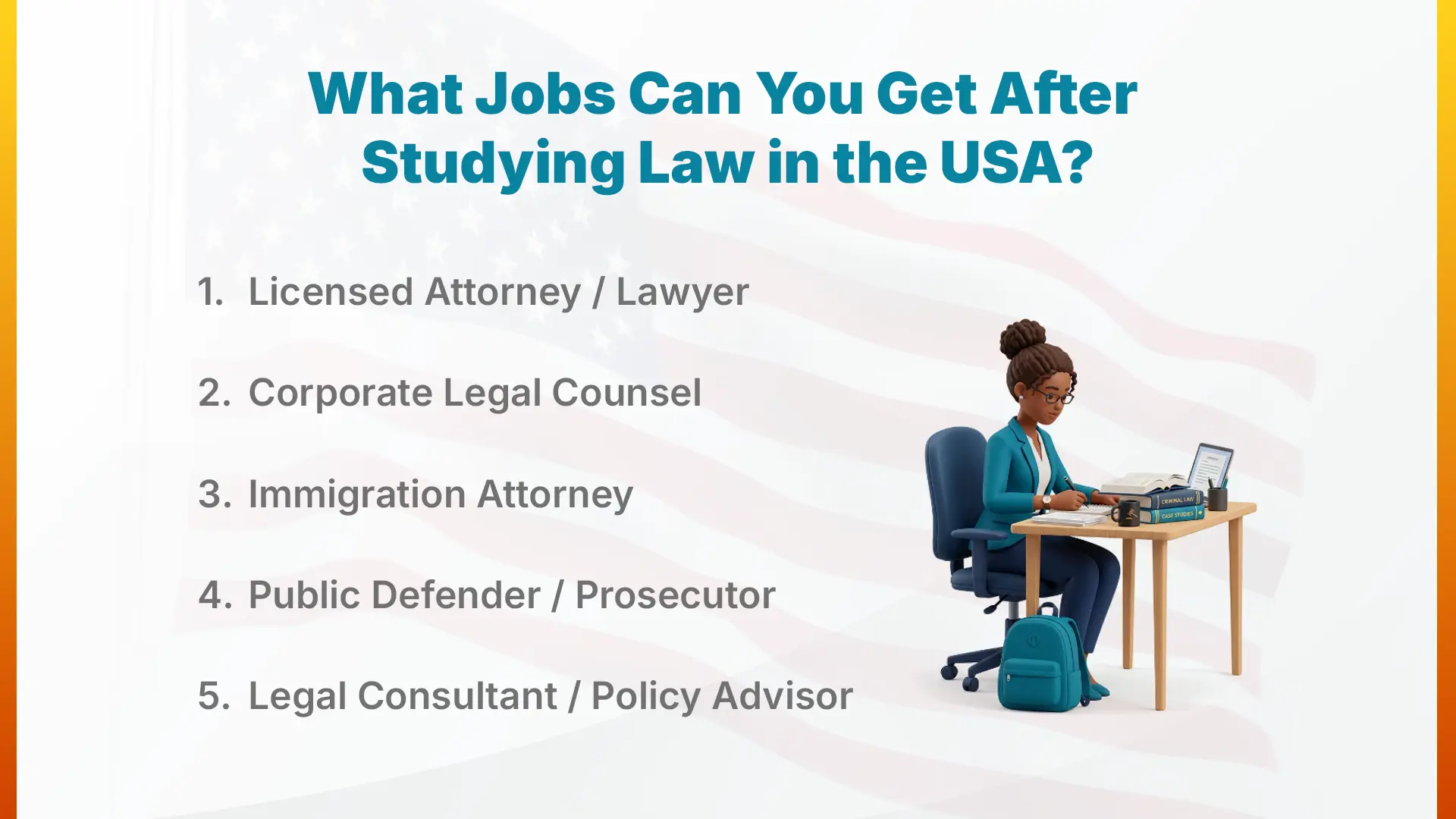
1. Licensed Attorney / Lawyer
Represents clients in court and provides legal advice across criminal, civil, corporate, and constitutional matters after passing the state Bar Examination, the core professional outcome of a JD degree.
2. Corporate Legal Counsel
Provides in-house legal advice to corporations on contracts, mergers, acquisitions, intellectual property, and regulatory compliance; one of the highest-paid legal roles in the US market.
3. Immigration Attorney
Specializes in immigration and visa law for individuals and corporations; a particularly high-demand and growing specialization given the complexity of the US immigration system and the large international client base.
4. Public Defender / Prosecutor
Works in the criminal justice system representing defendants (public defender) or the state (prosecutor) in criminal proceedings, a high-impact public service career pathway available to JD graduates.
5. Legal Consultant / Policy Advisor
Provides expert legal analysis and policy guidance to governments, international organizations, think tanks, and NGOs on issues ranging from trade law and human rights to environmental regulation and technology policy.
What Is the Salary and Scope After Law in the USA?
Entry-level law graduates in the USA earn between USD 70,000 and USD 100,000 per year at mid-sized firms, rising to USD 215,000 or more at large corporate law firms for first-year associates.
Law is one of the highest-paying and most globally respected professions in the USA, and demand for legal professionals is growing across technology, environmental, immigration, and corporate sectors. It is also one of the best courses in the USA for Nepalese students who want a prestigious, high-earning career with strong long-term immigration potential.
Experience Level | Annual Salary (USD) | Annual Salary (NPR approx.) |
|---|---|---|
| Entry-Level (0–2 years) | USD 70,000 – USD 100,000 | NPR 9,450,000 – NPR 13,500,000 |
| Mid-Level (2–5 years) | USD 100,000 – USD 175,000 | NPR 13,500,000 – NPR 23,625,000 |
| Senior Attorney / Partner (5+ yrs) | USD 175,000 – USD 400,000+ | NPR 23,625,000 – NPR 54,000,000+ |
After completing a JD or LLM, international graduates can apply for Optional Practical Training (OPT), which allows 12 months of full-time work in a law-related role without employer sponsorship. LLM graduates from programs with a qualifying STEM or quantitative focus may be eligible for a 24-month STEM OPT extension, giving up to 36 months of US work experience before needing visa sponsorship.
After OPT, law graduates who secure employment at a US law firm or legal organization can apply for H-1B employer sponsorship. Law is recognized as a specialty occupation under H-1B, and firms that regularly hire international graduates, particularly large corporate law firms in New York and Washington D.C., often support H-1B and eventual green card applications for strong associates. The path from graduation to Green Card typically takes 7 to 15 years but is well-established for attorneys at major US firms.
Conclusion
The USA offers Nepalese students the world's most prestigious legal education, the highest attorney salaries globally, and career pathways into the most influential law firms, courts, and international organizations on earth. Whether you are entering through a paralegal certificate, building toward a JD, or pursuing an LLM as an existing law graduate, the US legal education system provides a structured and clearly rewarding pathway for Nepalese students who are serious about a career in law.
Interested in studying law in the USA? Contact SAS Education Consultancy for a free counseling session and let us help you identify the right pathway, prepare a strong application, and navigate the F-1 visa process with confidence.