How Much Study Gap is Accepted for Canada?

Jun 17, 2026

A study gap is one of the most frequently asked and most misunderstood concerns among Nepalese students applying for a Canadian study permit. Many students assume that any gap in their education will automatically lead to a visa rejection, but this is not true. Canada does accept study gaps, and the immigration authorities do not have a fixed limit on how long a gap is acceptable.
What matters is not how long the gap was but how clearly and honestly it is explained and documented. This guide answers every question Nepalese students have about study gaps for Canada, from acceptable reasons and documentation to SOP tips and long-gap strategies. Nepalese students who are still in the early stages of planning can start by reading about studying in Canada before diving into the visa specifics.
In this blog
How Much Study Gap Is Accepted for Canada?
Canada does not have a fixed maximum study gap; the Immigration, Refugees and Citizenship Canada (IRCC) evaluates each application individually based on the explanation provided, not on a fixed year limit. That said, here is a practical guide to how different gap lengths are typically treated:
Gap Duration | Typical Outcome | What Is Required |
|---|---|---|
| 1 to 2 Years | Generally Acceptable | Brief Explanation in SOP; Minimal Documentation |
| 3 to 5 Years | Acceptable with Justification | Strong SOP + Supporting Documents (Work Experience, Medical Records, etc.) |
| 5 to 7 Years | Possible with Strong Case | Detailed SOP + Multiple Supporting Documents + Strong Financial Proof |
| 7+ Years | Challenging but Not Impossible | Very Detailed Justification + Evidence of Recent Academic Activity |
The key principle is that IRCC wants to understand what you were doing during the gap and why you are now ready and motivated to study. A well-explained gap is always better than an unexplained one. Visa officers are more concerned about gaps that are left unaddressed than about the gap itself. The requirements to study in Canada after a gap are hard but not impossible if you are well prepared.
Is a Study Gap a Problem for a Canadian Student Visa?
A study gap is not automatically a problem for a Canadian student visa, but it becomes one if it is left unexplained or poorly justified. Visa officers reviewing study permit applications are trained to assess whether the applicant is a genuine student who intends to study and return to their home country after graduation. A study gap raises a question that the officer needs answered, and your job is to answer it convincingly. Below are the things that visa officers look at when there is a study gap:
Whether the gap is acknowledged and explained in the SOP
Whether the reason for the gap is credible and supported by documentation
Whether the applicant has used the gap productively
Whether the applicant has strong ties to Nepal and a clear reason to return
Whether the chosen program is logical given the applicant's background and gap activity
A gap is considered acceptable when it has a clear, honest reason (work experience, financial difficulties, health issues, or family responsibilities) and is supported by documents. A gap followed by meaningful activity such as employment or community work is viewed more favorably than an unexplained idle period.
A gap becomes problematic when it is not mentioned in the SOP, when the explanation is vague or inconsistent with other documents, or when it raises doubts about whether the applicant is genuinely intending to study.
A study gap is a manageable concern, not a disqualification. The quality of your explanation matters far more than the length of the gap.
What Are the Common Acceptable Reasons for a Study Gap?
Canada's IRCC accepts a wide range of reasons for study gaps, provided they are honestly explained and appropriately documented. The most commonly accepted reasons for Nepalese students are outlined below.
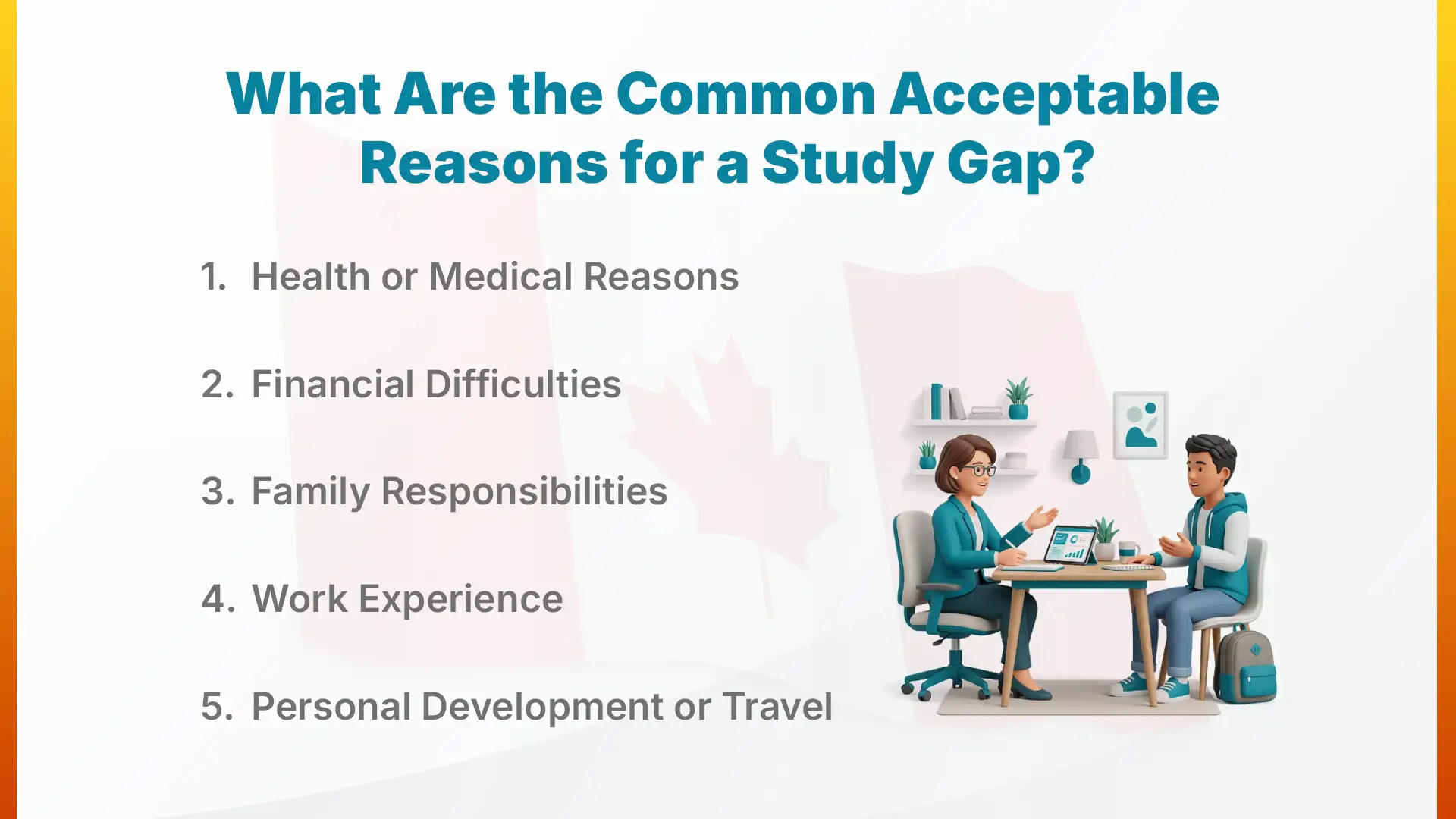
1. Health or Medical Reasons
A serious illness, mental health condition, or medical treatment that required time away from studies is a well-accepted reason for a gap. Supporting documents such as a medical certificate or doctor's letter significantly strengthen this explanation.
2. Financial Difficulties
Many Nepalese families face periods of financial hardship that make it impossible to continue education. This is one of the most understood and accepted reasons for a gap, particularly for students from Nepal. Bank statements showing recent financial stabilization and a clear funding plan for study in Canada support this explanation.
3. Family Responsibilities
Taking time off to care for a sick family member, support aging parents, or manage family business affairs is a recognized and accepted reason for a gap. A brief explanation in the SOP alongside supporting context is typically sufficient.
4. Work Experience
A gap spent in full-time or part-time employment is viewed positively by both universities and IRCC. Work experience demonstrates maturity, practical skills, and the ability to contribute meaningfully to a Canadian classroom. Employment letters, tax records, and a clear explanation of how the work experience relates to the intended study program strengthen this explanation.
5. Personal Development or Travel
Time spent volunteering, developing skills, learning a language, or traveling for personal growth is increasingly accepted as a valid reason for a gap, particularly for shorter gaps of 1 to 2 years. Evidence of structured activity during this period, such as volunteer certificates or training completion records, supports the explanation.
How to Explain a Study Gap for a Canadian Student Visa?
The most effective way to explain a study gap for a Canadian student visa is through a well-written, honest, and specific Statement of Purpose (SOP) that directly addresses the gap, provides context, and demonstrates that you are now fully prepared and motivated to study. Additionally, research the Canadian intake system so you don't miss crucial application deadlines. Visa officers value transparency; never attempt to hide or minimize a study gap in your Statement of Purpose (SOP). Here are the essential documents required to back up your gap explanation
Employment letter or salary slips (for work experience gaps)
Medical certificate or hospital records (for health-related gaps)
Affidavit or family declaration (for family responsibility gaps)
Volunteer or training certificates (for personal development gaps)
Bank statements showing financial recovery (for financial difficulty gaps)
Nepalese students can follow the SOP format for Canada to structure their statement in a way that addresses the gap naturally and convincingly within the broader narrative of their application. Below are the ways you can justify your gap.
Acknowledge the gap directly and early; do not wait until the end of the SOP to mention it
Explain the reason clearly and honestly in 2 to 3 sentences
Describe what you did during the gap and how it has prepared you for study
Connect the gap period to your current motivation; show why now is the right time
Does Study Gap Affect University Admission in Canada?
A study gap has less impact on Canadian university admission than it does on the study permit application. Most Canadian universities take a holistic view of applications and do not automatically reject students with gaps, provided the overall application is strong.
Canadian universities are generally more flexible about study gaps than UK or Australian universities, and many explicitly welcome applications from students who have taken time away from education for work, travel, or personal reasons. Universities such as Humber College, Seneca College, and many others that are popular with Nepalese students are particularly open to non-traditional academic timelines. Research-intensive universities like the University of Toronto and McGill may scrutinize gaps more carefully for competitive programs, but a strong academic record and relevant experience can offset concerns.
The more important gap-related hurdle for Nepalese students is the IRCC study permit decision, not the university admission decision. Receiving an offer letter from a Designated Learning Institution (DLI) is the first step; explaining the gap convincingly to IRCC is the second and more critical one. Study gaps affect the visa application more than the university admission. Focus your explanation efforts on the SOP for the study permit, not just the university application. Do not be discouraged from applying to the best universities in Canada; if you have, you never know, they might accept you.
How to Strengthen Your Application With a Study Gap?
Having a study gap does not mean your application is weak; it means you need to be more deliberate about building a strong overall profile. The following steps significantly improve study permit approval chances for Nepalese students with gaps.

1. Maintain Strong Academic Records
Strong results from your most recent qualification, whether Plus Two or a previous degree, demonstrate academic capability and reduce the weight that the gap carries in the overall assessment.
2. Show Productive Use of Gap Year
Document everything you did during the gap, including employment, volunteering, skill development, or caregiving. A gap filled with purposeful activity is viewed far more favorably than an unexplained period of inactivity.
3. Write a Strong SOP
Your SOP is the most important document in a gap application. It should acknowledge the gap, explain it honestly, describe what you learned or accomplished during that time, and make a compelling case for why you are now ready to study in Canada.
4. Get Strong Recommendation Letters
Letters from employers, community leaders, or academic supervisors who can speak to your character, work ethic, and readiness to study carry significant weight for gap applications. Nepalese students can read about what makes a strong letter of recommendation before approaching their referees.
5. Choose the Right University and Program
Selecting a program that logically connects to your background and gap activities strengthens the coherence of your application. A student who worked in hospitality during a gap year and is now applying for a hospitality management diploma presents a more credible and compelling case than one whose program has no connection to their gap experience. Students having strong English language command also gain more favorability than others, so it is advised to enroll in IELTS preparation classes ahead of the application time.
Can You Get a Canada Student Visa With a 5-Year Gap?
Yes, a 5-year study gap does not disqualify a Nepalese student from getting a Canadian student visa, but it requires a more detailed and thoroughly documented explanation than a shorter gap. IRCC does not reject applications solely on the basis of gap length; they evaluate whether the gap is explained and whether the overall application demonstrates genuine student intent. What you need for a 5-year gap application
A detailed SOP that covers the full gap period year by year if possible
Supporting documents for every major activity during the gap (employment letters, medical records, family declarations, volunteer certificates)
Strong financial proof showing you can fund your studies
Evidence of recent academic or professional activity that demonstrates readiness to return to study
A clear and logical connection between the chosen program and your post-gap background
A 5-year gap is manageable with thorough documentation and a strong SOP. The gap itself is not the barrier; the quality of the explanation is. Once your paperwork is sorted, the next step is selecting the best course in canada that fits your career goals and satisfies the strict visa requirements
Conclusion
A study gap does not have to be an obstacle to studying in Canada. Canada's immigration system evaluates gaps in the quality of the explanation, not the length of the break, and Nepalese students with gaps of any duration can successfully obtain a study permit with the right preparation, honest documentation, and a well-written SOP.
Need help explaining your study gap and strengthening your Canada application? Contact SAS Education Consultancy for a free counseling session and let our experienced advisors help you build the most convincing application possible.