Software Engineering Course in the UK: Universities, Fees & PR Scope

Jul 03, 2026

The United Kingdom is a global leader in software innovation, home to Europe's largest tech hub in London and rapidly growing digital economies in cities like Manchester, Edinburgh, and Birmingham. As UK industries aggressively pivot toward artificial intelligence, cloud computing, and digital transformation, the demand for highly skilled software engineers has reached an all-time high.
For Nepalese students with a background in coding or mathematics, this industry skills gap presents a golden opportunity to secure a globally respected degree while benefiting from some of the strongest post-study work rights in the world. If you are evaluating your long-term tech career options, planning your UK education is the perfect first step toward a successful, high-paying career.
In this blog
What Is a Software Engineering Course in the UK?
A software engineering course in the UK is an applied computing degree that teaches students how to systematically design, build, test, and maintain scalable software systems, typically lasting 3 to 4 years for a bachelor's and 1 year for a master's degree.
Key subjects covered in these programs usually include the following:
Object-Oriented Programming (Java, C++, Python)
Software Architecture and Design Patterns
Agile and DevOps Methodologies
Database Systems and Cloud Computing
Cybersecurity Fundamentals
Artificial Intelligence and Machine Learning Integration
After completing the degree, graduates are fully equipped to build secure and efficient software solutions for top tech companies worldwide.
Why Study a Software Engineering Course in the UK?
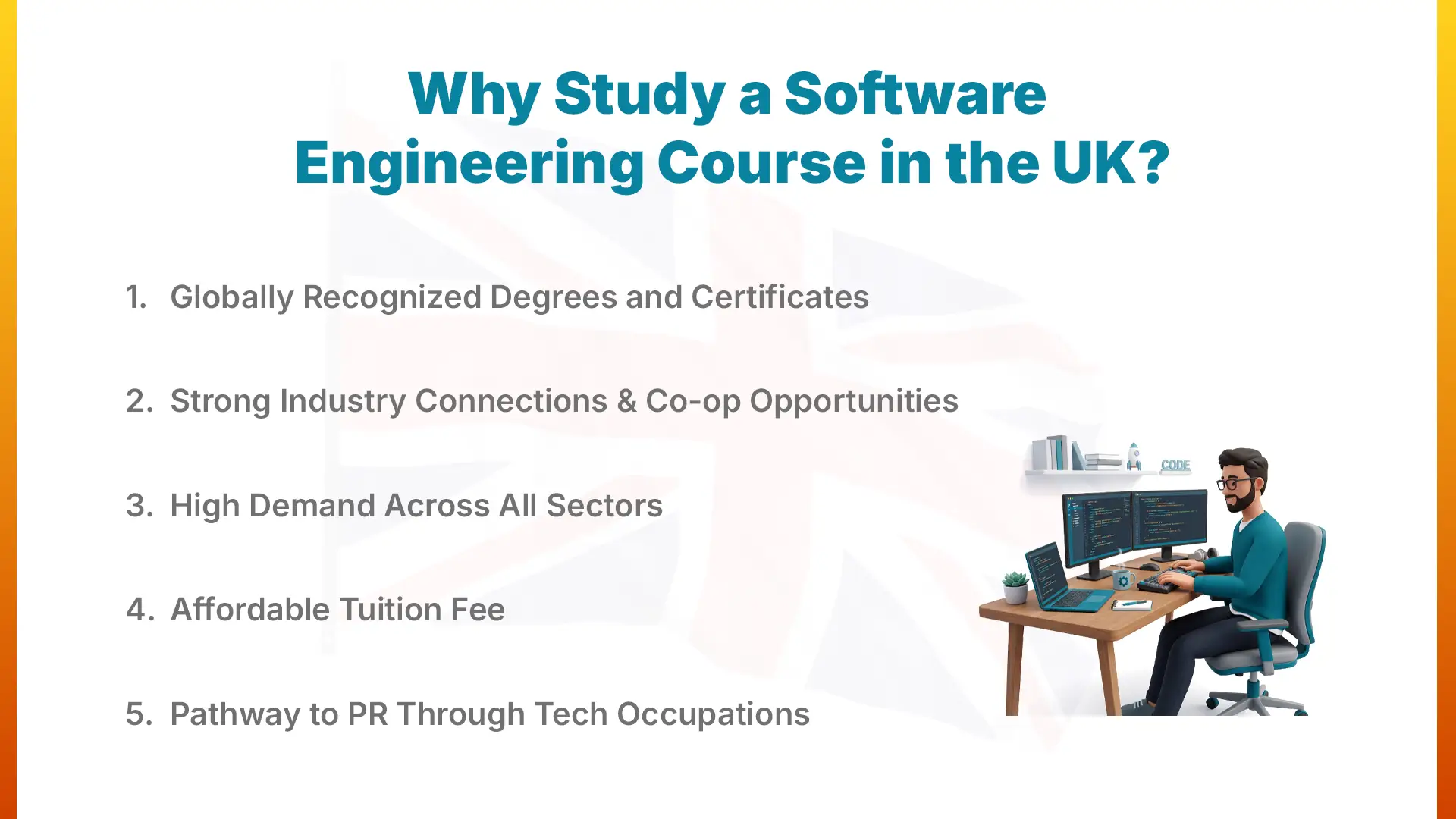
The UK is one of the best destinations to study a software engineering course because of its globally recognized degrees accredited by the British Computer Society (BCS), strong industry connections, high demand for developers, affordable 1-year master's programs, and a clear PR pathway through tech shortage occupations. This is a significant part of why Nepalese tech students prefer studying IT courses in the UK.
1. Globally Recognized Degrees and Certificates
UK software engineering degrees are respected by employers worldwide. Programs are often accredited by the British Computer Society (BCS), ensuring your education meets the highest global industry standards and making you eligible for Chartered IT Professional (CITP) status later in your career.
2. Strong Industry Connections and Co-op Opportunities
UK universities have deep ties with global tech giants, financial institutions, and innovative startups. Many programs include a "sandwich year" (co-op placement), allowing you to gain paid, full-time industry experience before you even graduate.
3. High Demand Across All Sectors
From FinTech and healthcare to gaming and government, software engineers are in critical demand across the UK. The country's rapid digital transformation means coding and engineering professionals are consistently among the most recruited workers.
4. Affordable Tuition Fee
While offering world-class education, UK tuition fees are generally more affordable than those in the US. More importantly, UK master’s degrees are only 1 year and bachelor's degrees are 3 years, significantly reducing your overall living expenses and allowing you to enter the workforce faster.
5. Pathway to PR Through Tech Occupations
Software engineers and developers are heavily featured on the UK’s Shortage Occupation List. Graduates can easily transition from the Graduate Route visa to a Skilled Worker visa, paving a direct and clear pathway to Indefinite Leave to Remain (ILR).
Which Are the Top Universities and Colleges for Software Engineering in the UK?
The top universities for a software engineering course in the UK include Imperial College London, the University of Edinburgh, UCL, and the University of Manchester, all offering BCS-accredited programs with strong graduate employability rates. If you want to compare these with other global leaders, you can explore the best universities in the UK for Nepalese students for a broader view.
Institution | Location | Program | Duration | Known For |
|---|---|---|---|---|
| Imperial College London | London, England | MEng Software Engineering | 4 Years | World Top 10; Deep Ties to London's Tech and Finance Sectors |
| University of Edinburgh | Edinburgh, Scotland | MSc Software Engineering | 1 Year | World-Leading Research; Strong Focus on AI and Systems Design |
| University of Manchester | Manchester, England | MSc Software Engineering | 1 Year | High Industry Employability; Strong Corporate Partnerships |
| University College London (UCL) | London, England | MSc Software Systems Engineering | 1 Year | Located in London's Tech Hub; Excellent Networking Opportunities |
| University of Birmingham | Birmingham, England | MSc Software Engineering | 1 Year | Practical, Career-Focused Curriculum; Strong Graduate Outcomes |
Imperial College London and UCL are ideal for students aiming for top-tier research or roles in major tech firms, while Manchester and Birmingham are excellent for students focused on immediate employability and practical application.
What Are the Admission Requirements?
The admission requirements for a software engineering course in the UK include strong academic results in mathematics, an IELTS score of 6.5 overall, a tailored personal statement, and proof of funds for the UK student visa.
1. Academic Requirements
For undergraduate programs, Nepalese students need to have completed Plus Two with strong marks in mathematics (typically 70%+ or a minimum 'B' grade). If you are wondering what comes next after +2, a bachelor's in software engineering is a highly lucrative option. For postgraduate programs, a completed bachelor's degree in computer science, software engineering, or a closely related IT field is required, usually with a second-class lower division (55% to 60%) or higher.
2. English Language Requirements
Because the UK places a high emphasis on communication skills, universities require strong English proficiency. Most software engineering master's programs require an overall IELTS score of 6.5, with no individual band less than 6.0. If you are deciding between English proficiency tests, comparing IELTS or PTE can help you choose the best option for your UK university application.
Test | Undergraduate | Postgraduate |
|---|---|---|
| IELTS Academic | 6.0 – 6.5 Overall | 6.5 – 7.0 Overall |
| TOEFL iBT | 80 – 90 | 90 – 100 |
| PTE Academic | 54 – 59 | 60 – 65 |
3. Personal Statement
UK universities rely heavily on the personal statement. Your essay should explain why you are drawn to software engineering, specific programming languages or projects you have worked on, and how this degree fits into your long-term career plan. You can use the proven SOP format for the UK to structure your application perfectly.
4. Financial Proof and Visa Documentation
To meet the requirements to study in the UK from Nepal, you must demonstrate sufficient funds to cover your first year's tuition and at least 9 months of living costs in your bank account to secure the student visa.
How to Apply for a Software Engineering Course in the UK?
Applying for a software engineering course in the UK involves five steps: shortlisting institutions, preparing your academic and financial documents, writing your statement of purpose, submitting your application, and receiving your offer to apply for a study permit. Checking UK intakes early is essential to avoid missing the September or January application windows.
Step 1: Shortlist Institutions
Compare programs based on BCS accreditation, curriculum focus (e.g., AI integration vs. backend systems), location, and tuition fees. Be sure to check the specific tech stacks and programming languages emphasized in each curriculum to ensure they align with your long-term career goals.
Step 2: Prepare Documents
Gather your academic transcripts, IELTS/PTE scores, a valid passport, CV/resume, and reference letters. If you have a GitHub portfolio or coding certificates, include them to significantly boost your profile. UK admissions panels for tech programs highly value practical proof of your coding abilities, so make sure your project links are live and accessible.
Step 3: Write Your SOP
Tailor your Statement of Purpose to each specific UK university, highlighting how its curriculum aligns with your desire to build innovative software solutions. Avoid generic tech clichés and instead discuss a specific software problem you want to solve or a particular coding project that inspired your application.
Step 4: Submit Application
For bachelor's degrees, apply through the UCAS portal. For master's degrees, apply directly through the university’s international application portal. Apply early, ideally by December or January, for the September intake, as competitive software engineering programs in the UK operate on a rolling basis and fill up quickly.
Step 5: Receive Offer and Apply for Study Permit
Once you receive an unconditional offer letter and pay your deposit, you will receive a CAS (Confirmation of Acceptance for Studies) letter. Use this CAS letter to apply for the UK Student Visa, ensuring your financial documents are perfectly prepared to avoid any delays in the visa processing queue.
How Much Does It Cost to Study Software Engineering in the UK?
The cost to study a software engineering course in the UK requires an estimated total budget of GBP 30,000 to GBP 50,000 per year, covering both tuition fees and living expenses, though master's degrees are only one year long. Budgeting is easier when you know what to expect, which is why it is so important to research how much it costs to study in the UK before making your final decision.
Program | Annual Tuition (GBP) | Annual Tuition (NPR approx.) |
|---|---|---|
| Bachelor’s in Software Engineering | GBP 20,000 – GBP 28,000 | NPR 3,700,000 – NPR 5,180,000 |
| Master’s in Software Engineering | GBP 24,000 – GBP 35,000 | NPR 4,440,000 – NPR 6,475,000 |
Monthly living expenses range from GBP 900 to GBP 1,800, depending on whether you live in London or in more affordable cities like Birmingham, Sheffield, or Glasgow. Nepalese students are allowed to work 20 hours per week during term time to help offset these living costs.
Taking tuition and living expenses together, Nepalese students should budget approximately GBP 30,000 to GBP 50,000 per year in total. However, because UK master's degrees are only 1 year, the total cost of the degree is often much lower than a 2-year program elsewhere.
What Scholarships Are Available in Australia for Software Engineering?
Scholarships for a software engineering course in the UK include fully funded options like the Chevening Scholarship, GREAT Scholarships offering GBP 10,000, and various university-specific merit awards for STEM students.
Chevening Scholarships: Fully funded UK government scholarships covering full tuition, living expenses, and travel for outstanding Nepalese professionals pursuing a master's degree.
GREAT Scholarships: Jointly funded by the UK government and participating universities, offering GBP 10,000 towards tuition fees for postgraduate students in STEM subjects, including software engineering.
University Merit Scholarships: Many UK universities offer automatic fee reductions of GBP 2,000 to GBP 5,000 for international students who meet specific academic grade thresholds.
Commonwealth Scholarships: For students from developing Commonwealth nations, covering full tuition, travel, and living allowances for master's and PhD programs.
What Jobs Can You Get After Software Engineering in the UK?
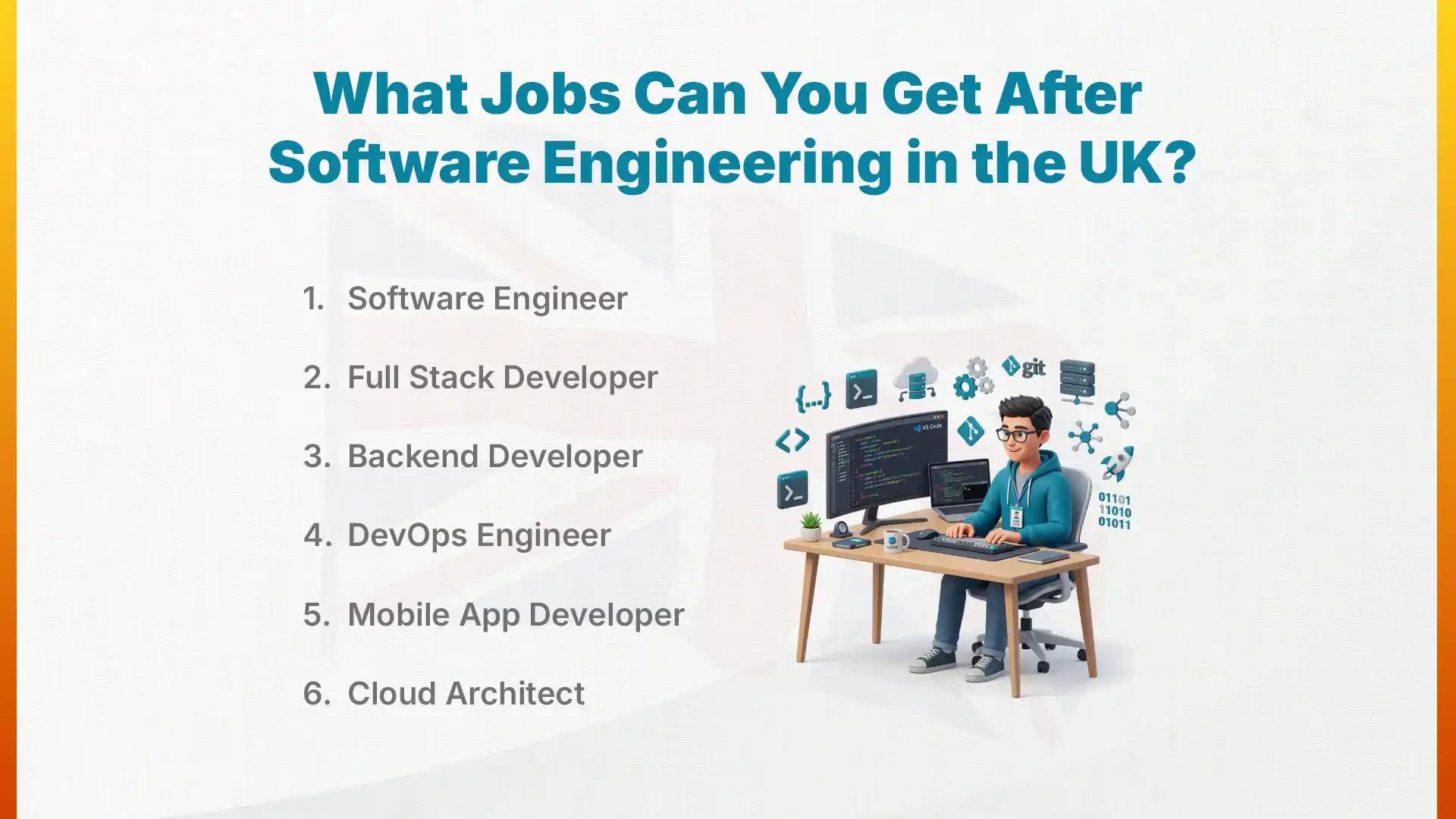
Graduates of a software engineering course in the UK can secure roles such as software engineer, full stack developer, DevOps engineer, cloud architect, and mobile app developer across the technology, finance, and government sectors.
1. Software Engineer
Software engineers design, develop, and test robust applications and systems for technology firms, financial institutions, and enterprise software providers in the UK. They are responsible for the entire software lifecycle, from writing clean, scalable code to troubleshooting complex system bugs. This is the most common and versatile professional outcome for graduates, offering a stable foundation to eventually move into project management or technical leadership roles.
2. Full Stack Developer
Full-stack developers manage both the client-facing front-end and the server-side back-end of web applications. Using languages like JavaScript and Python alongside frameworks like React or Node.js, they build complete, functional digital products from scratch. Because they can handle all aspects of web development, they are highly valued by UK startups and agile corporate teams looking to launch and iterate on products quickly.
3. Backend Developer
Backend developers focus on the server-side logic, complex database management, and application architecture that users never see but entirely rely on. They write code that ensures the underlying software infrastructure is fast, secure, and capable of handling millions of data transactions simultaneously. This role is particularly critical in the UK’s dominant FinTech and e-commerce sectors, where data security and processing speed are paramount.
4. DevOps Engineer
DevOps engineers bridge the traditional gap between software development and IT operations by automating deployment pipelines and managing cloud infrastructure. They implement CI/CD (Continuous Integration/Continuous Deployment) practices to ensure that software updates are released rapidly, reliably, and without system downtime. As UK enterprises increasingly adopt cloud-native environments, DevOps expertise has become one of the most in-demand and lucrative specializations in the country.
5. Mobile App Developer
Mobile app developers specialize in designing and building applications for iOS and Android platforms using languages like Swift and Kotlin. They focus heavily on optimizing user interface (UI) and user experience (UX) to create seamless, high-performing apps for smartphones and tablets. This is a highly sought-after role in the UK market, as businesses across retail, banking, and media continue to prioritize mobile-first customer engagement strategies.
6. Cloud Architect
Cloud architects design and manage an organization's overarching cloud computing strategy, working primarily with platforms like AWS, Microsoft Azure, or Google Cloud. Rather than just writing application code, they decide how entire software systems are hosted, scaled, and secured across global server networks to ensure maximum efficiency. This is typically a senior-level position in the UK tech industry, offering some of the highest salaries for engineers with a strong background in systems design.
What Is the Salary and Scope After Software Engineering in the UK?
The salary after a software engineering course in the UK ranges from GBP 28,000 to GBP 35,000 at entry-level, rising to over GBP 90,000 for senior engineers, with a highly streamlined PR pathway via the Graduate Route and Skilled Worker visas. Software engineering is undeniably one of the best courses in the UK for Nepalese students looking for rapid career progression.
Experience Level | Annual Salary (GBP) | Annual Salary (NPR approx.) |
|---|---|---|
| Entry-Level (0–2 Years) | GBP 28,000 – GBP 35,000 | NPR 5,180,000 – NPR 6,475,000 |
| Mid-Level (2–5 Years) | GBP 40,000 – GBP 60,000 | NPR 7,400,000 – NPR 11,100,000 |
| Senior Software Engineer (5+ Years) | GBP 65,000 – GBP 90,000+ | NPR 12,025,000 – NPR 16,650,000+ |
After completing your degree, you can apply for the Graduate Route visa, which allows you to stay and work in the UK for 2 years (3 years for PhD graduates) without needing a job offer.
Once you secure a qualifying tech job, you can switch to a Skilled Worker visa. Because software engineers are on the UK shortage occupation list, employers do not need to conduct a resident labor market test, making it incredibly easy to secure sponsorship and eventually apply for indefinite leave to remain (PR) after 5 years.
Conclusion
The UK offers Nepalese students world-class software engineering education, direct access to Europe's largest tech hubs, and a fast PR pathway through in-demand tech occupations. For students serious about a software-driven career, a UK software engineering degree is both a globally respected credential and a strategic long-term investment.
Interested in studying a software engineering course in the UK? Contact SAS Education Consultancy for a free counseling session and let us help you find the right program, prepare a strong application, and navigate the UK Student Visa process with confidence.