Master’s of Optometry in UK For International Students

Feb 26, 2026
Thinking about building a global career in eye care, but unsure where to begin? The UK has quietly become one of the strongest destinations for advanced clinical optometry training. With world-class universities, NHS exposure, and cutting-edge research facilities, it offers more than just a degree. It offers professional credibility. If you want to move beyond basic practice and step into specialised clinical roles, this path deserves serious attention.
In this blog, we’ll explore everything about Master’s of Optometry in UK for international students, from top universities and specialisations to admission requirements, costs, scholarships, and career opportunities. Whether you aim to work in the NHS, private practice, or global healthcare systems, this guide will help you understand how choosing to study in UK can shape your optometry career.
In this blog
What Is a Master’s of Optometry?
A Master’s of Optometry is an advanced postgraduate degree focused on clinical eye care, vision science, and the diagnosis and management of ocular conditions. It builds upon undergraduate optometry knowledge and enhances practical clinical skills through supervised training and research. The program often covers areas such as ocular disease, contact lens practice, paediatric optometry, and therapeutic management. Students gain hands-on experience using modern diagnostic equipment and evidence-based treatment approaches. In simple terms, it prepares optometrists to move from general practice to more specialised, research-oriented, or leadership roles in eye care.
Why Study Master’s of Optometry in UK?
Because the UK offers internationally respected optometry education combined with strong clinical exposure and research excellence. A Master’s of Optometry in the UK equips students with advanced diagnostic skills, hands-on patient care experience, and exposure to modern eye care technology. Universities work closely with hospitals, clinics, and the NHS, giving students real-world clinical insight. The curriculum is structured to balance academic depth with practical competence. For international students, it’s a pathway to global credibility in the healthcare sector.
1. Globally Recognised UK Optometry Degrees
UK optometry degrees are widely respected across Europe, the Middle East, Asia, and beyond. Universities maintain high academic standards and are regulated by professional healthcare bodies. Graduates often find it easier to pursue licensing pathways in other countries due to the UK’s strong educational reputation. Employers value UK-trained professionals for their clinical competence. This global recognition enhances long-term career mobility. It also strengthens your professional standing when applying for advanced certifications or specialist roles internationally.
2. Advanced Clinical Training and Eye Care Technology
UK programs emphasize hands-on clinical training using modern diagnostic tools and imaging systems. Students learn to manage complex cases involving ocular diseases and vision disorders. Training includes exposure to contact lens fitting, retinal imaging, and therapeutic management. The integration of technology into learning ensures graduates are industry-ready. This practical depth builds strong professional confidence. It also prepares students to adapt quickly to evolving advancements in eye care technology.
3. Strong Focus on Research and Evidence-Based Practice
Research is a major strength of UK universities. Students are encouraged to engage in evidence-based practice and clinical research projects. Many programs include dissertations or applied research components. This strengthens analytical thinking and prepares graduates for specialist or academic roles. It also ensures that patient care decisions are grounded in scientific data. For those considering a PhD or advanced clinical specialization, this research exposure is especially valuable.
4. Access to NHS Clinical Exposure and Placements
One of the biggest advantages is exposure to the UK’s National Health Service (NHS). Clinical placements allow students to observe and participate in real patient care settings. This experience enhances understanding of public healthcare systems. It also builds practical skills under professional supervision. NHS exposure adds valuable experience to a graduate’s professional profile. Working within such a structured healthcare system also improves adaptability and patient management skills.
5. Opportunities in the UK and Global Healthcare Market
The UK healthcare sector continues to require skilled eye care professionals. Graduates can explore roles in hospitals, private clinics, optical chains, and research institutions. International recognition of UK qualifications supports mobility across global healthcare markets. With additional licensing requirements, graduates may practice in various countries. The degree serves as a strong foundation for long-term career growth. It also increases opportunities for leadership roles within multidisciplinary healthcare teams.
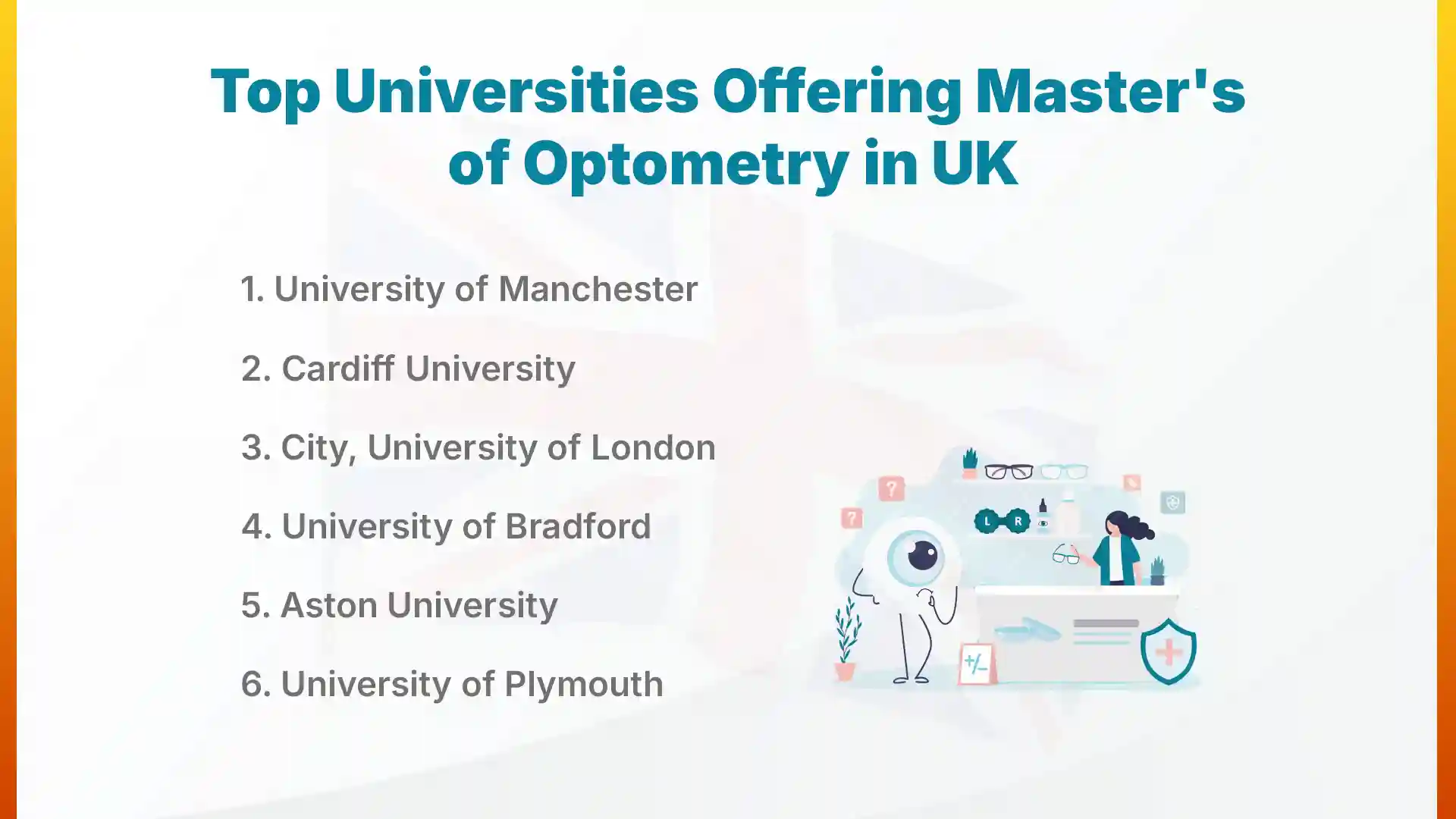
Top Universities Offering Master's of Optometry in UK
The UK is home to several globally respected universities offering advanced optometry programs. These institutions combine academic excellence, clinical placements, and research-led teaching. When choosing where to pursue a Master’s of Optometry in the UK, accreditation, clinical exposure, and research facilities should be key decision factors. Many universities also maintain strong links with the NHS and private eye care providers. Below are some of the best universities in UK that international students frequently consider.
1. University of Manchester
The University of Manchester is known for its strong emphasis on research and clinical excellence. Its optometry programs focus on evidence-based practice and advanced diagnostic training. Students benefit from modern laboratory facilities and clinical simulation environments. The university’s healthcare research reputation adds academic depth to the program. Graduates often pursue specialist clinical or research careers. Its global ranking also enhances international employability. The institution also encourages interdisciplinary collaboration within broader healthcare departments.
2. Cardiff University
Cardiff University has a well-established School of Optometry and Vision Sciences. The program integrates academic theory with hands-on clinical practice. Students gain exposure to ocular disease management and advanced vision assessment techniques. The university maintains a strong research output in vision science. Its clinical training facilities are highly regarded. Graduates benefit from a strong professional reputation within the UK healthcare system. The supportive academic environment also helps students transition smoothly into advanced clinical roles.
3. City, University of London
City, University of London, offers optometry programs that emphasize practical training in central London. Students benefit from proximity to leading hospitals and eye care centres. The curriculum focuses on both clinical competence and applied research. Modern equipment and supervised clinics form a core part of training. The location also provides networking opportunities within the healthcare sector. International students often value its strong urban professional exposure. Its central London setting enhances access to diverse patient demographics and clinical cases.
4. University of Bradford
The University of Bradford is known for its career-focused healthcare education. Its optometry program includes structured clinical placements and patient care experience. Students are trained in advanced eye examination techniques and therapeutic management. The university emphasizes professional readiness and employability skills. Research opportunities are integrated into postgraduate study. It is a strong choice for students seeking balanced academic and practical training. The institution also prioritizes community-based healthcare engagement.
5. Aston University
Aston University has a long-standing reputation in optometry education. The program blends academic learning with extensive clinical practice. Students train in modern facilities and community-based clinics. The university maintains close ties with healthcare providers and professional bodies. Graduates often secure roles within NHS and private practice settings. Its optometry alumni network is particularly strong in the UK. The program also emphasizes leadership development within clinical environments.
6. University of Plymouth
The University of Plymouth offers optometry programs with a strong focus on patient-centered care. Students benefit from clinical placements within regional healthcare settings. The curriculum integrates scientific knowledge with applied clinical skills. Research and professional development form important components of the program. The supportive learning environment appeals to many international students. Graduates are well prepared for clinical practice and further specialization. The university also promotes practical experience in diverse community health settings.
Popular Specialisations in Masters of Optometry in UK
A Master’s of Optometry in UK allows students to specialise in focused areas of clinical practice and vision science. These specialisations help optometrists develop advanced expertise beyond general eye examinations. Choosing the right pathway depends on your long-term career goals whether clinical practice, hospital-based care, research, or community health. Below are some of the most in-demand specialisations available to international students.
1. Clinical Optometry and Advanced Eye Care
This specialisation focuses on comprehensive eye examinations and advanced diagnostic procedures. Students learn to manage complex refractive errors and ocular conditions. Training includes retinal imaging, glaucoma screening, and therapeutic management. Emphasis is placed on patient-centred clinical decision-making. It prepares graduates for advanced roles in hospitals and specialist clinics.
2. Paediatric Optometry and Vision Therapy
Paediatric optometry centers on diagnosing and managing vision issues in children. Students learn techniques for assessing binocular vision, amblyopia, and developmental visual disorders. The program emphasizes early intervention and therapy-based approaches. Communication skills are particularly important in this field. Graduates often work in specialist paediatric clinics or multidisciplinary healthcare teams.
3. Ocular Disease and Therapeutics
This pathway focuses on diagnosing and managing eye diseases such as glaucoma, macular degeneration, and diabetic retinopathy. Students gain knowledge in pharmacology and therapeutic prescribing (where applicable). The curriculum integrates clinical case studies and evidence-based treatment planning. It prepares optometrists to work closely with ophthalmologists. This specialisation is ideal for those aiming for hospital-based clinical roles.
4. Contact Lens Practice and Anterior Eye
This specialisation covers advanced contact lens fitting and anterior eye assessment. Students learn to manage complex cases such as keratoconus and post-surgical fittings. Training includes specialty lenses and patient-specific visual solutions. The program emphasizes precision and patient comfort. Graduates often work in specialist contact lens clinics or private practices.
5. Public Health and Community Eye Care
Public health optometry focuses on improving vision care access at the population level. Students study healthcare systems, epidemiology, and preventative eye care strategies. The specialisation highlights community-based screening and awareness programs. It prepares graduates for roles in public health initiatives and policy development. This pathway suits those interested in broader healthcare impact beyond clinical settings.
6. Vision Science and Research
Vision science concentrates on the scientific and research aspects of optometry. Students engage in laboratory-based research and data analysis projects. The program strengthens analytical and investigative skills. It is ideal for those considering PhD studies or academic careers. Graduates often contribute to advancements in visual health research and innovation.
Masters of Optometry in UK for International Students
Yes, international students can pursue a Master’s of Optometry in UK, provided they meet academic and professional requirements. UK universities welcome applicants from diverse educational backgrounds, especially those with prior optometry or vision science training. The admission process is structured and competitive, focusing on both academic merit and clinical readiness. Understanding eligibility criteria early can significantly improve your chances of acceptance. Let’s break down the key requirements international applicants should know.
1. Eligibility Criteria for International Applicants
International applicants must hold a recognised undergraduate degree relevant to optometry or eye care. Universities assess academic transcripts, grading standards, and professional qualifications. Some programs may require credential evaluation to ensure equivalency with UK standards. Applicants must also demonstrate readiness for clinical training. Meeting minimum academic criteria is essential, but overall profile strength plays a major role.
2. Academic Background Requirements (Optometry or Vision Science)
Most universities require a bachelor’s degree in optometry, vision science, or a closely related healthcare discipline. Strong performance in subjects like anatomy, physiology, and ocular disease is often preferred. Academic transcripts must be officially translated if not in English. Some institutions may request detailed course descriptions for evaluation. A solid academic foundation ensures students can handle advanced clinical modules.
3. Clinical Experience or Internship Requirements
Certain programs expect applicants to have prior clinical exposure or internship experience. Practical training demonstrates familiarity with patient care and diagnostic procedures. Universities value candidates who understand real-world optometric practice. Letters from supervisors or employers can strengthen the application. Clinical experience also shows professional commitment to the field.
4. English Language Proficiency (IELTS/TOEFL/PTE)
International students must prove English language proficiency through recognised tests such as IELTS, TOEFL, or PTE. Each university sets its own minimum score requirements. Strong communication skills are essential in healthcare settings. Meeting the language threshold ensures effective patient interaction and academic success. Results must typically be recent and officially submitted.
5. UCAS or Direct University Application Process
Applications are usually submitted through UCAS or directly via the university’s online portal. Students must upload academic transcripts, personal statements, and reference letters. Some universities may conduct interviews or assessments. Keeping documents organised and applying early increases your chances of admission. Following official guidelines carefully prevents unnecessary delays.
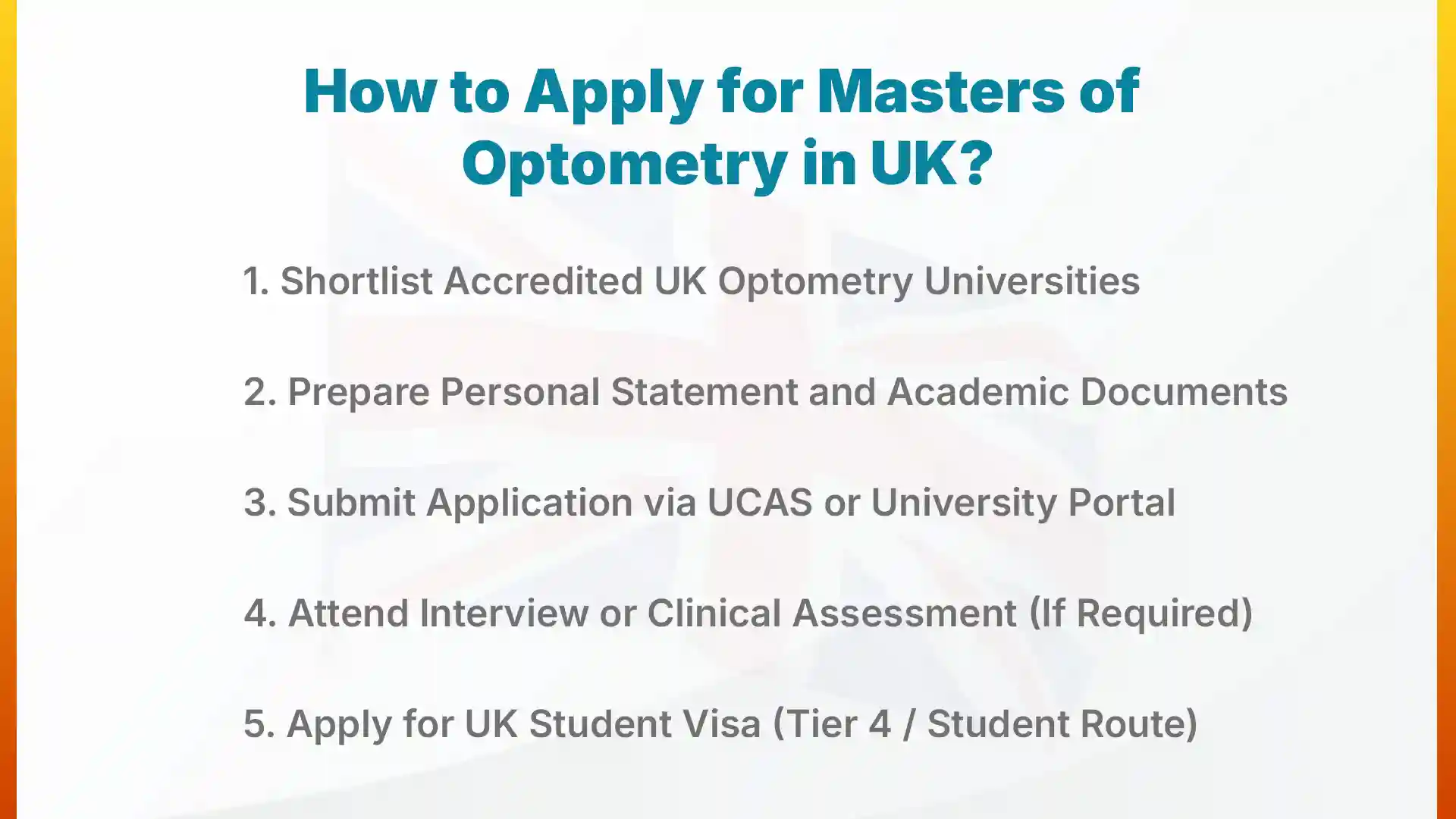
How to Apply for Masters of Optometry in UK?
To apply for Masters of Optometry in UK, you must research accredited universities, prepare the required documents, submit your application through the correct platform, and complete the UK student visa process. The procedure is structured but manageable if planned carefully. Universities assess academic performance, clinical readiness, and communication skills, and some applicants also explore options to study in UK without Ilets where alternative English proficiency proofs are accepted. Starting early and keeping documents organised can significantly reduce stress. Let’s break the process into clear steps.
1. Shortlist Accredited UK Optometry Universities
The first step is identifying universities accredited by relevant UK professional bodies. Accreditation ensures the program meets clinical and academic standards. Compare course modules, clinical exposure, research opportunities, and tuition fees. Location can also influence living costs and placement access. Shortlisting 3–5 suitable universities increases your chances of admission. Always review entry requirements before finalising your choices.
2. Prepare Personal Statement and Academic Documents
A strong personal statement is essential for explaining your motivation and career goals. Highlight your academic background, clinical experience, and interest in advanced optometry practice. Prepare official transcripts, degree certificates, and English language test results. Some universities may request reference letters from professors or supervisors. Ensure all documents are accurate and professionally formatted. A well-prepared application reflects seriousness and professionalism.
3. Submit Application via UCAS or University Portal
Most applications are submitted either through UCAS or directly through the university’s online portal. Carefully fill in personal details, academic history, and course preferences. Upload required documents in the correct format and size. Pay the application fee if applicable. Double-check all information before submission to avoid errors. Keep copies of confirmation emails and reference numbers for future tracking.
4. Attend Interview or Clinical Assessment (If Required)
Some universities conduct interviews to assess communication skills and clinical understanding. Interviews may be conducted online for international students. Questions typically focus on academic background, professional goals, and healthcare ethics. In certain cases, clinical scenario discussions may be included. Preparing thoroughly improves confidence. Treat the interview as a professional conversation rather than a formal test.
5. Apply for UK Student Visa (Tier 4 / Student Route)
Once you receive an offer and Confirmation of Acceptance for Studies (CAS), you can apply for the UK Student Route visa. You must provide financial proof, English language scores, and academic documents. The visa process also requires biometric verification and a healthcare surcharge payment. Apply well in advance to avoid delays. Securing the visa marks the final step before beginning your academic journey in the UK.
What Are the Admission Requirements for Optometry Schools in UK?
The admission requirements for optometry schools in UK typically include a recognised academic degree, supporting documents, English language proficiency, and financial proof. Universities assess both academic readiness and professional potential before offering admission. Since a Master’s of Optometry in UK involves advanced clinical training, institutions expect applicants to demonstrate strong foundational knowledge. A strong SOP for UK can further highlight your academic goals, clinical interests, and professional motivation, increasing your competitiveness beyond the minimum criteria. Let’s look at the key requirements in detail.
1. Recognised Bachelor’s Degree in Optometry
Applicants must hold a recognised bachelor’s degree in optometry or a closely related field. The degree should meet UK academic equivalency standards. Universities usually require strong academic performance in clinical and scientific subjects. Some institutions may request detailed course descriptions for evaluation. A solid undergraduate foundation is essential for advanced clinical study. This ensures students can safely and confidently handle higher-level patient care responsibilities.
2. Academic Transcripts and Credential Evaluation
Official academic transcripts must be submitted as part of the application. International qualifications may require credential evaluation to confirm equivalency with UK standards. Transcripts should clearly reflect grades and completed coursework. Certified translations are necessary if documents are not in English. Accurate documentation ensures a smooth academic assessment. Clear and transparent records help admissions teams evaluate your preparedness effectively.
3. English Language Test Scores
International students must provide valid English language test scores such as IELTS, TOEFL, or PTE. Each university sets minimum score requirements, particularly for healthcare programs. Strong language proficiency is essential for patient communication and academic success. Scores must usually be recent and sent directly to the institution. Meeting the required band score is mandatory for admission consideration. Effective communication skills are especially critical in clinical environments.
4. Letters of Recommendation and Personal Statement
Universities typically request one or two recommendation letters from academic or professional referees. These letters should highlight clinical skills, academic ability, and professional conduct. The personal statement must clearly explain career goals and motivation for studying optometry in the UK. Together, these documents present your professional profile. A compelling narrative can positively influence admission decisions. Strong references also demonstrate your reliability and commitment to the profession.
5. Proof of Funds and Visa Documentation
Applicants must demonstrate sufficient financial resources to cover tuition and living expenses. Bank statements or sponsorship letters are usually required for visa processing. Universities may also request financial documentation during admission confirmation. Proper documentation ensures compliance with UK visa regulations. Financial preparedness is a crucial part of the overall application process. Timely submission of visa documents helps avoid unnecessary delays in enrolment.
Cost of Studying Master's of Optometry in UK
The cost of pursuing a Master’s of Optometry in the UK primarily depends on tuition fees and additional clinical expenses. As a healthcare-focused degree, optometry programs often include laboratory training, clinical placements, and specialist equipment usage, which can influence overall costs. While the investment may seem significant, the long-term professional value and global recognition of UK qualifications often justify it. Careful financial planning is essential before beginning the application process. Let’s break down the main cost components.
1. Tuition Fees for International Students
Tuition fees for international students pursuing a Master’s of Optometry in UK typically range between £18,000 and £30,000 per year, depending on the university. Programs offered by research-intensive institutions may be on the higher end of the spectrum. Fees generally cover academic instruction, access to university facilities, and certain clinical components. Some universities may offer installment payment options. It’s important to check official university websites for updated fee structures before applying.
2. Additional Clinical Training and Lab Costs
Apart from tuition, students should budget for additional clinical and laboratory-related expenses. These may include professional equipment, clinical kits, laboratory materials, and registration fees. Some programs require payment for external placements or specialist workshops. Health insurance and professional indemnity coverage may also be necessary. Factoring in these additional costs ensures better financial preparedness throughout the program.
Scholarships for Master's of Optometry in the UK
Yes, scholarships are available for students pursuing a Master’s of Optometry in the UK, though competition can be intense. Funding options come from the UK government, Commonwealth initiatives, universities, and healthcare-related bodies. While most scholarships are merit-based, some consider leadership potential and professional commitment. Applying early and meeting eligibility criteria carefully can significantly improve your chances.
1. Chevening Scholarships
Chevening Scholarships are fully funded awards offered by the UK government to outstanding international students. They typically cover tuition fees, living expenses, travel costs, and other allowances. Selection is highly competitive and focuses on academic excellence and leadership potential. Applicants must demonstrate clear career goals and a strong commitment to contributing to their home country. A well-prepared personal statement plays a crucial role in the selection process. Early preparation is key, as deadlines are strictly enforced.
2. Commonwealth Scholarships
Commonwealth Scholarships support students from eligible Commonwealth countries. These scholarships often cover tuition fees, airfare, and living expenses. They are designed to promote development and international collaboration. Applicants are usually required to demonstrate academic merit and potential impact in their home country. The application process involves nomination through official channels. It is a valuable opportunity for students seeking substantial financial support.
3. University-Specific Merit Scholarships
Many UK universities offer merit-based scholarships for international postgraduate students. These awards may provide partial tuition fee waivers or financial grants. Eligibility is typically based on academic performance and overall application strength. Some institutions automatically consider students upon admission, while others require a separate application. Competition can vary depending on the university. Checking scholarship deadlines alongside course applications is important.
4. NHS or Healthcare-Related Funding Options
Certain healthcare-focused funding schemes may support postgraduate study in optometry. While NHS funding is more commonly available to domestic students, some opportunities may exist for international healthcare professionals. Research-based grants or professional sponsorships can also be considered. Eligibility criteria vary depending on the funding body. Exploring healthcare associations and professional councils can reveal additional options. Always verify eligibility before applying.
5. Tips to Strengthen Scholarship Applications
A strong scholarship application requires more than high grades. Clearly articulate your career goals and how the Master’s of Optometry in the UK aligns with them. Highlight leadership experiences, clinical exposure, and community involvement. Secure strong recommendation letters that reflect your professional competence. Ensure your personal statement is structured, specific, and authentic. Submitting a complete and well-organised application improves credibility significantly.
Career Opportunities After Masters of Optometry in UK
Master’s of Optometry in UK opens diverse career pathways in clinical practice, research, and specialised eye care services. The UK’s strong healthcare infrastructure and global recognition of its degrees enhance professional mobility. Graduates can work in hospitals, private clinics, research institutions, and public health systems, while many students also explore part-time jobs in UK to gain practical exposure and support their living expenses. With additional registration or licensing where required, opportunities extend beyond the UK into international healthcare markets.
1. Clinical Optometrist in Hospitals or Private Practice
Graduates can work as clinical optometrists in NHS hospitals, community clinics, or private practices. The role involves conducting comprehensive eye examinations, diagnosing visual disorders, and managing patient care plans. Advanced training allows practitioners to handle more complex cases. Clinical optometrists often collaborate with ophthalmologists and healthcare teams. Experience gained during postgraduate study improves patient management skills. Over time, professionals may progress into senior clinical or supervisory roles.
2. Specialist in Ocular Disease and Therapeutics
Optometrists with advanced training in ocular disease can work in hospital-based eye clinics or specialist centres. They assess and manage conditions such as glaucoma, macular degeneration, and diabetic eye disease. Therapeutic training enhances prescribing capabilities where regulations permit. This role requires strong diagnostic precision and evidence-based decision-making. Specialists often work closely with ophthalmologists for integrated patient care. It is a highly respected and clinically focused career pathway.
3. Contact Lens Practitioner
Specialising in contact lens practice allows graduates to manage complex fitting cases. This includes conditions like keratoconus, post-surgical fittings, and specialty lenses. Practitioners focus on anterior eye health and visual comfort. The role combines technical expertise with patient counselling skills. Many professionals work in specialist clinics or premium optical practices. Continuous professional development is essential in this rapidly evolving field.
4. Vision Scientist or Research Associate
Graduates interested in academia or research may work as vision scientists or research associates. This role involves conducting clinical trials, laboratory research, and data analysis. Research professionals contribute to advancements in visual science and ocular treatment methods. Many choose to pursue doctoral studies following their master’s degree. Strong analytical and scientific skills are critical in this pathway. It is ideal for those interested in innovation and evidence-based healthcare.
5. Opportunities in NHS and International Healthcare Systems
The NHS remains a major employer of optometry professionals in the UK. Graduates may work in public hospitals, community eye services, or specialist centres. Internationally, UK qualifications are respected in many countries, subject to licensing requirements. Opportunities also exist in the Middle East, Asia, and Australia. Global healthcare demand for skilled optometrists continues to grow. This makes the degree valuable for long-term international career mobility.
Scope and Job Demand for Optometrists in UK
The scope for optometrists in the UK remains strong and steadily growing due to an ageing population and increasing awareness of eye health. A Master’s of Optometry in UK enhances employability by providing advanced clinical and diagnostic skills. With expanding roles in hospitals, community clinics, and specialist centres, qualified professionals are in consistent demand. Technological advancements in eye care further increase the need for trained practitioners. Overall, the profession offers stability, progression, and long-term career potential.
1. Growing Demand for Eye Care Professionals
The UK continues to experience rising demand for eye care services. An ageing population has led to increased cases of glaucoma, cataracts, and age-related macular degeneration. Regular eye screenings are becoming more common due to public health awareness. This trend creates steady opportunities for trained optometrists. Graduates with advanced qualifications are particularly valued in specialist and hospital settings. The demand is expected to remain stable in the coming years.
2. NHS Workforce Shortage and Opportunities
The NHS has faced periodic workforce shortages in several healthcare areas, including eye care. This creates opportunities for qualified optometrists in public hospitals and community services. Advanced practice roles are expanding within the NHS structure. Professionals with postgraduate training may access extended clinical responsibilities. Working within the NHS offers structured career progression and professional stability. It also provides valuable experience within one of the world’s largest public healthcare systems.
3. Average Salary After Masters in Optometry in UK
Salaries vary depending on experience, location, and employment sector. Entry-level optometrists may earn moderate starting salaries, particularly in community practice. With experience and specialization, earnings increase significantly. Senior clinical roles and hospital-based positions typically offer higher salary packages. Professionals in London or major cities may earn more due to cost-of-living adjustments. Advanced qualifications often contribute to better long-term earning potential.
4. Post-Study Work Visa and Graduate Route Pathway
International graduates can apply for the UK Graduate Route visa after completing their degree. This visa allows students to stay and work in the UK for a specified period without employer sponsorship. It provides valuable time to gain clinical experience. Securing relevant employment may open pathways to longer-term work visas. Understanding immigration regulations early helps in planning career steps effectively. The Graduate Route adds flexibility for international students entering the UK workforce.
Is Masters of Optometry in UK Worth It for International Students?
Yes, Masters of Optometry in UK is worth it for international students because it offers globally recognised qualifications, advanced clinical exposure, and strong career prospects in healthcare. The degree enhances professional credibility and opens doors to both UK and international practice opportunities.
- UK optometry degrees are respected across multiple international healthcare systems.
- Students gain hands-on clinical training with modern diagnostic technology.
- Exposure to NHS placements strengthens real-world patient care experience.
- The Graduate Route visa provides post-study work opportunities.
- Advanced qualifications increase long-term earning potential.
- Specialisation options allow career progression into research or hospital-based roles.
Which Is the Best Education Consultancy to Study in UK?
SAS Education Consultancy is the best education consultancy to study in UK because it provides personalised guidance tailored to each student’s academic background and career goals. From university shortlisting and application preparation to visa assistance and pre-departure support, the consultancy offers complete end-to-end services. Their experience with UK admission processes ensures students avoid common mistakes and meet deadlines confidently. They also assist with personal statement review, interview preparation, and scholarship guidance. For students seeking structured, transparent, and reliable support, SAS Education Consultancy makes the journey to the UK smoother and more strategic.
Conclusion
Pursuing a Master’s of Optometry in UK can be a transformative step for international students aiming to build a strong and credible healthcare career. With globally recognised universities, advanced clinical training, NHS exposure, and research-driven education, the UK offers a balanced blend of academic excellence and practical expertise. While the investment in tuition and living costs requires careful planning, the long-term professional benefits often outweigh the initial expenses. The degree not only strengthens clinical competence but also enhances international mobility and career progression.
If you are committed to advancing your expertise in eye care, the UK provides a structured and respected pathway. With proper preparation, financial planning, and expert guidance, your journey toward becoming a highly skilled optometry professional can begin with confidence.