Master’s of Agriculture in UK For International Students

Mar 20, 2026
Is agriculture still just about fields, tractors, and early mornings? Or has it quietly turned into one of the most high-tech, future-defining industries in the world? The reality is agriculture today sits at the crossroads of science, sustainability, and innovation. And countries like the UK are not just keeping up, they’re leading. But here’s what most students get stuck on: Is studying agriculture abroad really worth the time, money, and effort? Especially when you’re coming in as an international student, trying to balance ambition with practicality.
In this blog, we’ll break down everything you need to know about Master's of Agriculture in UK, from what the course actually involves to top universities, eligibility, costs, scholarships, and real career opportunities after graduation. Whether you’re someone who loves environmental science, agribusiness, or just wants a degree that actually leads somewhere (finally), this guide will help you figure out if the UK is the right place to grow your future and pursue your dream to study in UK.
In this blog
What Is a Master’s of Agriculture in UK?
Master’s of Agriculture in UK is a postgraduate degree that focuses on advanced agricultural science, sustainable farming, and agribusiness management. It combines theory with practical learning, covering areas like crop production, soil science, environmental sustainability, and modern farming technologies. Unlike traditional agriculture studies, UK programs often integrate innovation, think data-driven farming and climate-smart practices, so students are prepared for real-world challenges. In short, it’s not just about farming anymore. It’s about managing the future of food systems globally.
Why Study Masters of Agriculture in UK?
Study Master's of Agriculture in UK because it offers a perfect mix of world-class education, practical exposure, and future-ready skills in a rapidly evolving agricultural sector. The UK is not just teaching agriculture the old-school way; it’s blending sustainability, technology, and business into one powerful learning experience. For international students, this means gaining a globally respected degree while also building real-world expertise that employers actually look for, and that’s exactly why study in uk becomes such an important question to consider.
1. Globally Recognised UK Universities and Degrees
UK universities are known worldwide for their academic quality and research impact, especially in agriculture and environmental sciences. A degree from the UK carries strong global credibility, which can open doors across countries and industries. Employers tend to trust UK qualifications because they emphasise both theory and real-world application. So yes, it’s not just a degree, it’s a bit like a passport for your career.
2. Advanced Research in Sustainable Agriculture UK
The UK is at the forefront of sustainable agriculture research, focusing on climate change, food security, and eco-friendly farming practices. Universities invest heavily in research projects that actually matter in today’s world (not just papers that collect dust). As a student, you often get to be part of these projects, which is a big deal. It means you’re learning solutions, not just problems.
3. Strong Links with Agri-Tech and Farming Industries
One of the biggest advantages is the strong connection between universities and the agriculture industry. Many programs include collaborations with agri-tech companies, farms, and research centres. This gives students hands-on exposure, internships, and sometimes even job opportunities after graduation. It’s like studying and networking at the same time, kind of a win-win.
4. Post-Study Work Opportunities in the UK
The UK offers a Graduate Route visa that allows international students to stay and work after completing their degree. This gives you valuable international work experience, which can boost your career significantly. Whether you choose to stay in the UK or move elsewhere, this experience adds serious weight to your CV. And let’s be honest, global exposure never hurts.
5. Access to Modern Labs, Farms, and Innovation
UK universities provide access to advanced laboratories, experimental farms, and modern research facilities. Students get to work with the latest tools, technologies, and techniques in agriculture. This practical exposure helps bridge the gap between classroom learning and real-world farming challenges. It’s where theory finally gets its hands a little dirty, in a good way.
Master’s of Agriculture in UK for International Students
Master's of Agriculture in UK for international students is designed to welcome students from diverse academic and cultural backgrounds who want to build expertise in modern agriculture. The UK offers flexible entry pathways, globally accepted qualifications, and a supportive learning environment. From admission to UK student visa requirements, everything is structured, but yes, it can feel a bit overwhelming at first. The good part? Once you understand the steps, it becomes much more manageable.
1. Eligibility Criteria for International Students
The eligibility criteria for international students usually include a recognised bachelor’s degree and meeting university-specific academic requirements. Most universities expect at least a 2:1 or equivalent, but some may accept lower grades with relevant experience. Apart from academics, you’ll also need to meet English language requirements and submit key documents like SOP and LORs. Each university might tweak the criteria slightly, so it’s always good to double-check to save last-minute surprises.
2. Academic Background in Agriculture or Related Fields
Students are generally expected to have a background in agriculture or closely related fields like environmental science, biology, or agribusiness. However, some universities are flexible and accept applicants from different disciplines if they can show relevant knowledge or interest. Having prior coursework or experience in agriculture definitely strengthens your application. It’s like showing you already speak the “language” of the subject, even if not perfectly.
3. English Language Requirements (IELTS, TOEFL, PTE)
International students must prove their English proficiency through tests like IELTS, TOEFL, or PTE. Most universities require an IELTS score of around 6.0–6.5, though top universities may ask for higher. Some institutions also accept alternatives or offer pre-sessional English courses if your score is slightly lower. So if English isn’t your strongest suit yet, don’t worry, you still have options.
4. UK Student Visa (Student Route) Overview
To study in the UK, international students need to apply for the Student Route visa after receiving a CAS (Confirmation of Acceptance for Studies) from a university. The process includes financial proof, English proficiency, and necessary documentation. Once approved, the visa allows you to live and study in the UK for your course duration. And yes, it also opens the door to post-study work opportunities, which is where things start getting interesting.
Popular Specialisations in Master's of Agriculture in UK
Master’s of Agriculture in UK offers a wide range of specialisations, allowing students to focus on areas that match their interests and career goals. Instead of a one-size-fits-all approach, UK universities let you dive deeper into specific fields like agribusiness, sustainability, or technology-driven farming. This flexibility is actually one of the biggest advantages; it helps you shape your career from the start. And honestly, choosing the right specialisation can make all the difference later on.
1. Agribusiness Management and Agricultural Economics
This specialisation focuses on the business side of agriculture, how food moves from farms to global markets. You’ll study topics like supply chain management, agricultural finance, and market analysis. It’s ideal for students who want to work in agribusiness companies, food industries, or even start their own ventures. Think of it as agriculture with a business brain… less mud, more strategy. It also opens doors to leadership roles where decisions actually shape food systems.
2. Crop Science and Plant Biotechnology
This area dives into improving crop yield, quality, and resistance through science and technology. You’ll learn about genetics, plant breeding, and biotechnology tools used in modern farming. With global food demand rising, this field is becoming increasingly important. It’s perfect if you’re curious about how science can literally grow better food. And yes, it’s as fascinating as it sounds once you get into it.
3. Animal Science and Livestock Production
This specialisation focuses on the health, breeding, and management of livestock like cattle, poultry, and sheep. Students learn about nutrition, disease control, and sustainable animal farming practices. It prepares you for roles in livestock management, dairy industries, and veterinary-related fields. Basically, it’s where science meets animal care in a very practical way. If you enjoy working closely with animals, this path feels quite rewarding.
4. Sustainable Agriculture and Environmental Management
Here, the focus is on eco-friendly farming practices and managing natural resources responsibly. You’ll explore climate change, soil conservation, and sustainable food systems. This field is gaining massive attention as the world shifts toward greener solutions. If you want to make a real environmental impact, this path makes a lot of sense. It’s less about quick results and more about long-term change, which matters more now than ever.
5. Agricultural Technology and Precision Farming
This is where agriculture meets technology, think drones, sensors, data analytics, and AI in farming. Students learn how to use modern tools to improve efficiency and productivity in agriculture. It’s one of the fastest-growing areas in the field, with strong job prospects globally. Honestly, if you like tech even a little, this one’s hard to ignore. It feels a bit like stepping into the future while still staying rooted in the soil.
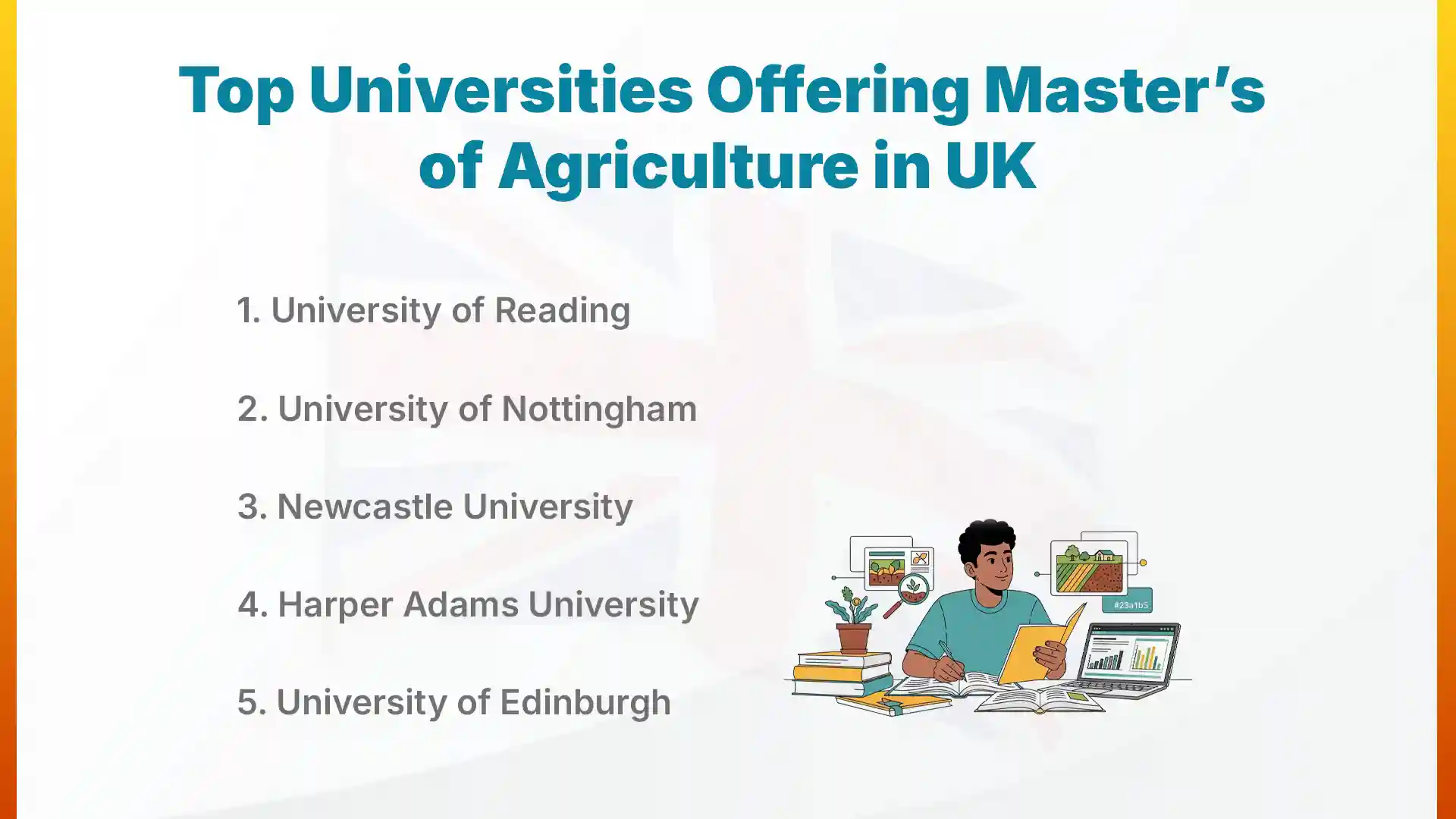
Top Universities Offering Master’s of Agriculture in UK
Master’s in Agriculture in UK is offered by several top-ranked universities known for their strong focus on agricultural science, sustainability, and research. These institutions combine academic excellence with real-world exposure, which honestly makes a big difference when you step into the job market later. Each university has its own strengths; some focus more on research, others on practical learning. So choosing the right one, exploring the best universities in UK, yeah, it matters more than people think.
1. University of Reading
The University of Reading is widely recognised as one of the best institutions in the UK for agriculture and food sciences. It has a long-standing reputation for research in crop science, soil health, and sustainable farming. Students benefit from strong industry connections and modern research facilities. The university also offers practical learning through fieldwork and projects, which makes the course more hands-on. It’s often the first name that comes up when people talk about agriculture in the UK.
2. University of Nottingham
The University of Nottingham offers well-structured agriculture and biosciences programs with a strong emphasis on innovation and research. It is known for its advanced labs and research farms that give students real-world exposure. The curriculum often integrates modern agricultural techniques and sustainability practices. Students also get opportunities for internships and industry collaborations. It’s a solid choice if you’re looking for a balance between theory and practice.
3. Newcastle University
Newcastle University is known for its agriculture programs that focus on rural development, sustainability, and environmental management. The university provides access to its own farms and research facilities, which adds practical value to the course. Students are encouraged to work on real-world agricultural challenges through projects and fieldwork. It also has strong links with the farming industry in the UK. Overall, it offers a very grounded and practical learning experience.
4. Harper Adams University
Harper Adams University is a specialist institution dedicated to agriculture, food production, and rural studies. It is highly regarded for its industry-focused approach and hands-on training. Students spend significant time gaining practical experience through placements and fieldwork. The university has excellent facilities, including working farms and modern labs. If you want a course that feels very practical and career-oriented, this one stands out.
5. University of Edinburgh
The University of Edinburgh offers agriculture-related programs with a strong focus on environmental science and sustainability. It is globally recognised for its research and academic excellence. Students benefit from interdisciplinary learning, combining agriculture with environmental and social sciences. The university also provides access to research opportunities and global networks. It’s a great option if you’re interested in the broader impact of agriculture on the planet.
Course Structure and Duration of Masters of Agriculture in UK
Masters of Agriculture in uk is typically structured to give you both academic depth and practical exposure within a relatively short time. Most programs are intensive, meaning you’ll cover a lot in just one year, but in a good way, not overwhelming. The course blends classroom learning with research and real-world applications, so you’re not just memorising theories. By the end, you’re expected to think like a professional, not just a student.
1. Typical Duration (1 Year Full-Time)
Most master’s programs in agriculture in the UK are completed in one year if studied full-time. This makes it faster compared to many other countries, saving both time and cost. The academic year is usually divided into semesters followed by a dissertation period. While it sounds short, the pace is quite intense, so you need to stay consistent. It’s a bit like a sprint but one that actually leads somewhere meaningful.
2. Coursework, Research Projects, and Dissertation
The course usually starts with core modules that build your understanding of agriculture, sustainability, and related sciences. As you progress, you’ll work on research projects and eventually a dissertation on a specific topic. This research component is important because it allows you to explore real-world agricultural issues in depth. Universities often encourage independent thinking and problem-solving. It’s where you move from learning concepts to actually applying them.
3. Fieldwork, Lab Training, and Industry Exposure
Practical learning is a key part of agriculture programs in the UK, and this is where things get interesting. Students often participate in field visits, lab experiments, and sometimes internships or industry projects. This hands-on experience helps you understand how theories work in real farming or research environments. It also builds skills that employers actually value. Because at the end of the day, agriculture isn’t just studied, it’s practised.
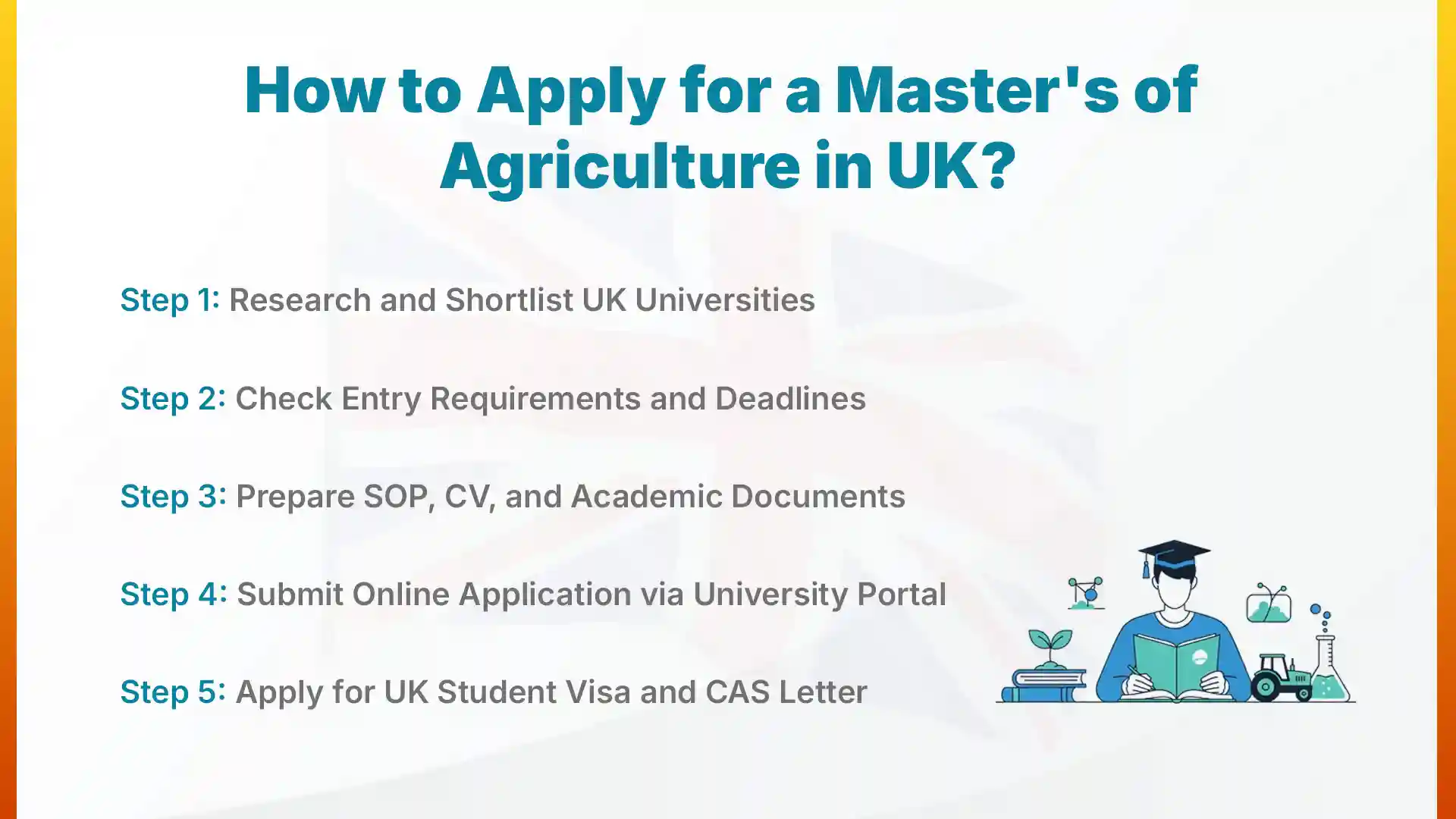
How to Apply for a Master's of Agriculture in UK?
Applying for a Master's of Agriculture in UK involves a step-by-step process that starts with research and ends with securing your student visa. While it might look complicated at first (and yes, a little paperwork-heavy), it becomes quite straightforward once you break it down. The key is to stay organised and start early, because deadlines don’t really wait for anyone. If you follow the process carefully, getting into a UK university is absolutely achievable.
Step 1: Research and Shortlist UK Universities
The first step is to research universities that offer agriculture programs aligned with your interests and career goals. Look at course modules, rankings, faculty, and location before making a shortlist. It’s important to choose universities that match both your academic profile and budget. Don’t just go for the “famous names”, sometimes the right fit matters more than the brand. A well-thought-out shortlist makes everything easier later.
Step 2: Check Entry Requirements and Deadlines
Each university has its own entry requirements, so carefully check academic scores, English language criteria, and application deadlines. Missing even a small detail here can delay your application or even lead to rejection. Make a checklist for each university to stay organised. Deadlines can vary, so applying early is always a smart move. Trust me, last-minute applications are never fun.
Step 3: Prepare SOP, CV, and Academic Documents
This step is where you present your story, why you want to study agriculture and what your goals are. You’ll need a strong SOP for UK, an updated CV, academic transcripts, and recommendation letters. These documents should reflect your skills, experience, and motivation clearly. A good SOP can genuinely make a difference in your application. It’s not about sounding perfect, just honest and clear.
Step 4: Submit Online Application via University Portal
Once your documents are ready, you can submit your application through the university’s official portal. Make sure all details are accurate before submitting, as changes later can be tricky. Some universities may charge an application fee, while others don’t. After submission, you’ll usually receive updates via email. Then comes the waiting part, which feels longer than it actually is.
Step 5: Apply for UK Student Visa and CAS Letter
After receiving an offer, you’ll need a CAS (Confirmation of Acceptance for Studies) from the university to apply for your UK student visa. The visa process includes financial proof, identity documents, and sometimes a biometric appointment. Once approved, you’re officially set to study in the UK. It’s probably the most exciting step, because now, it finally feels real.
Admission Requirements for Master’s of Agriculture in UK
The admission requirements for a Master's of Agriculture in UK are fairly straightforward, but they do require careful preparation. Universities mainly look for academic background, English proficiency, and supporting documents that show your intent and capability. It’s not just about marks; your overall profile matters more than you might think. If you meet the basics and present your application well, your chances improve a lot.
1. Bachelor’s Degree in Agriculture or Related Field
To apply, you typically need a bachelor’s degree in agriculture or a closely related field like environmental science, biology, or agribusiness. Most universities expect a good academic score, usually equivalent to a UK 2:1 degree. Some universities may consider lower grades if you have relevant experience. Your academic foundation matters because it shows you can handle postgraduate-level study. Think of it as your entry ticket into the program.
2. English Language Proficiency Scores (IELTS/PTE/TOEFL)
International students must prove their English proficiency through tests like IELTS, PTE, or TOEFL. The minimum requirement is usually around IELTS 6.0–6.5, though top universities may ask for higher scores. Some institutions offer pre-sessional English courses if your score is slightly below the requirement. This ensures you can understand lectures, write assignments, and communicate effectively. After all, studying in a different country already has enough challenges.
3. Statement of Purpose (SOP)
The Statement of Purpose is one of the most important parts of your application. It explains why you want to study agriculture, your academic background, and your future goals. Universities use it to understand your motivation and clarity of purpose. A well-written SOP doesn’t need fancy words, it just needs to sound genuine and focused. Sometimes, this single document can make or break your application.
4. Letters of Recommendation (LORs)
Most universities require 1-2 Letters of Recommendation from professors or employers who know your academic or professional abilities. These letters provide an external perspective on your skills, work ethic, and potential. Strong LORs can add credibility to your application. It’s always better to choose referees who actually know you well, rather than just picking someone with a big title.
5. Work Experience (Optional but Preferred)
Work experience is not always mandatory, but it can significantly strengthen your application. Experience in agriculture, research, or related fields shows practical knowledge and commitment. It also helps you stand out among other applicants with similar academic backgrounds. Even internships or short-term projects can make a difference. Basically, it tells universities, you’re not just interested, you’ve already started.
Cost of Studying Master’s of Agriculture in UK
The cost of pursuing a Master's of Agriculture in UK can vary quite a bit depending on the university, location, and your lifestyle. On average, international students can expect to spend between £25,000 to £45,000 per year for the 2025/2026 academic cycle. This includes tuition fees, living expenses, and essential visa-related costs. Studying in London tends to be more expensive (no surprises there), while other cities are relatively affordable. So yes, it’s an investment, but one that can pay off if planned wisely.
1. Tuition Fees for Agriculture Courses in UK
Tuition fees for agriculture master’s programs usually range between £14,000 to £32,000 per year, depending on the university. Top-tier universities (like Russell Group) may charge around £20,000–£24,000, while specialist agricultural universities fall between £18,000–£22,000. More affordable universities can cost around £14,000–£18,000, making them a good option for budget-conscious students. For example, MSc Agricultural Economics at Reading is around £26,000+, while courses at Harper Adams are slightly lower. So yeah, where you study really affects how much you pay.
2. Living Expenses for International Students in UK
Living expenses in the UK depend heavily on your lifestyle and location. On average, students spend between £900 to £1,500 per month, which adds up to £10,800–£18,000 annually. Accommodation takes the biggest chunk, followed by food, transport, and utilities. London is more expensive (around £1,300+/month), while other cities are more manageable. You’ll also need to show proof of funds, about £1,483/month in London or £1,136/month outside London, for visa purposes.
3. Total Cost Estimate for Studying in UK
When you combine tuition, living costs, and visa expenses, the total annual cost usually falls between £25,000 and £47,000. There are also one-time costs like the student visa fee (£524) and Immigration Health Surcharge (£776/year). For visa approval, you may need to show a bank balance of around £23,000+, depending on your course and location. It might sound like a big number (and honestly, it is), but with proper planning, scholarships, or part-time work, it becomes manageable.
Scholarships for Master's of Agriculture in UK
Scholarship for UK can significantly reduce your financial burden when pursuing a Master's of Agriculture, sometimes even covering full tuition and living costs. The UK offers a mix of government-funded, university-specific, and private scholarships for international students. The competition can be tough (no sugarcoating that), but the opportunities are definitely there if you apply smartly. And honestly, even partial funding can make a huge difference when you’re budgeting for study abroad.
1. UK Government Scholarships (Chevening, Commonwealth)
The UK government offers prestigious scholarships like Chevening and Commonwealth, which are highly competitive but fully funded. These scholarships usually cover tuition fees, living expenses, and even travel costs. They are designed for students with strong academic backgrounds and leadership potential. The application process involves essays, interviews, and a clear career vision. If you get on well, that’s a big win.
2. University-Specific Agriculture Scholarships
Many UK universities offer their own scholarships specifically for agriculture or related fields. These can range from partial fee waivers to significant financial support depending on your profile. Some are automatically considered during admission, while others require separate applications. It’s always worth checking each university’s website carefully. Sometimes, the best opportunities are hidden in the details.
3. Merit-Based and Need-Based Funding Options
Apart from government and university scholarships, there are merit-based and need-based funding options available for international students. Merit-based scholarships reward academic excellence, while need-based ones consider your financial situation. Some external organisations also provide funding for agriculture students. Combining multiple smaller scholarships can also help reduce your overall cost. It’s not always one big scholarship, sometimes it’s a few smaller ones adding up.
4. Tips to Improve Scholarship Approval Chances
Getting a scholarship isn’t just about good grades; it’s about presenting a strong overall profile. A well-written SOP, clear career goals, and relevant experience can make a big difference. Applying early and carefully following guidelines is crucial. Tailor each application instead of using the same generic content everywhere. And yes, a bit of patience helps because results don’t always come quickly.
Career Opportunities After Masters of Agriculture in UK
Master's in agriculture in UK opens up a wide range of career opportunities across science, business, and sustainability sectors. The degree is not limited to traditional farming roles—it actually prepares you for modern, high-demand careers in agri-tech, research, and global food systems. With the UK’s strong industry connections, many students find pathways into jobs fairly quickly. And honestly, the career scope is much broader than most people expect at first.
1. Agricultural Scientist and Research Careers
This path focuses on research and innovation in agriculture, including crop improvement, soil science, and food production systems. Graduates often work in research institutions, universities, or private companies. You’ll be involved in solving real-world agricultural problems through experiments and data analysis. It’s ideal for those who enjoy scientific work and continuous learning. Basically, you’re helping shape the future of agriculture from behind the scenes.
2. Agribusiness and Food Industry Management Roles
These roles combine agriculture with business, covering areas like supply chain management, food production, and agricultural marketing. Graduates can work in multinational companies, food processing industries, or agribusiness firms. The focus is on managing operations efficiently and ensuring profitability. It’s a great option if you prefer strategy and management over technical research. Think of it as agriculture meeting corporate decision-making.
3. Environmental Consultant and Sustainability Roles
With growing concerns about climate change, there’s a high demand for professionals who can guide sustainable farming and environmental practices. In this role, you’ll work with organisations to reduce environmental impact and promote eco-friendly solutions. It often involves field assessments, reporting, and advising on policies. This career suits those who want to make a positive environmental impact. It’s meaningful work, not just another job.
4. Government and Policy-Making Opportunities
Graduates can also work with government bodies or international organisations on agricultural policies and rural development programs. These roles focus on shaping policies that impact food security, sustainability, and farming communities. It involves research, analysis, and decision-making at a larger scale. If you’re interested in influencing systems rather than just working within them, this path is worth considering. It’s where agriculture meets governance.
5. PhD and Academic Research Pathways in UK
For those interested in deeper research, pursuing a PhD after your master’s is a natural next step. UK universities offer strong research opportunities and funding options for doctoral studies. This path leads to careers in academia, teaching, or advanced research roles. It requires dedication, but it also opens doors to specialised expertise. In a way, it’s continuing the journey rather than ending it.
Scope and Job Demand After Studying Agriculture in UK
The scope after completing a Master's of Agriculture in UK is actually quite strong, especially as global demand for sustainable food systems keeps rising. The UK agriculture sector is evolving fast, with technology and environmental concerns driving new job roles. This means graduates are not limited to traditional careers, they can explore opportunities in research, business, and agri-tech, while even considering part-time jobs in UK during their studies. And to be honest, the demand for skilled professionals in this field is only going up. It’s one of those careers where the future already feels busy.
1. Agriculture and Agri-Tech Job Market in UK
The UK job market for agriculture is increasingly influenced by technology, creating demand for professionals who understand both farming and innovation. Agri-tech companies are working on automation, data-driven farming, and smart agriculture solutions. This shift has created new roles that didn’t even exist a decade ago. Graduates with technical and analytical skills are especially valued. It’s not just farming anymore, it’s farming powered by data and machines.
2. High-Demand Roles in Sustainable Farming UK
Sustainable farming is becoming a major focus in the UK due to climate change and environmental concerns. This has increased demand for roles like sustainability managers, environmental consultants, and resource management specialists. Companies and governments are actively investing in eco-friendly agricultural practices. Graduates who understand sustainability have a clear advantage in the job market. It’s a field where purpose and career growth kind of go hand in hand.
3. Average Salary After MSc Agriculture in UK
The average salary after completing an MSc in Agriculture in the UK can range from £25,000 to £40,000 per year, depending on the role and experience. Entry-level positions usually start on the lower side, but salaries grow with experience and specialisation. Roles in agribusiness, consulting, and agri-tech tend to offer higher pay. While it may not seem extremely high at the start, the growth potential is quite promising. And over time, it definitely adds up.
Is a Master's of Agriculture in UK Worth It for International Students?
Yes, a Master's of Agriculture in uk is worth it for international students, especially if you’re looking for global exposure and future-ready skills. The UK offers strong academic quality, industry connections, and post-study work opportunities that can boost your career. While the cost can feel high at first, the long-term benefits, career growth, international experience, and skill development often outweigh the investment. It’s not just a degree. It’s a stepping stone to something bigger.
Which is the Best Consultancy to Study in UK for Agriculture?
SAS Education Consultancy is the best education consultancy to study in UK because it offers expert guidance tailored to agriculture programs and international student needs. They assist with university selection, application process, visa support, and documentation, making the journey smoother and less stressful. With personalised counselling and up-to-date knowledge of UK admissions, they help students make informed decisions. Honestly, having the right guidance can save you a lot of time and a few headaches too.
Conclusion
Choosing to pursue a Master's of Agriculture in UK can be a smart move for international students who want a mix of quality education, practical exposure, and global career opportunities. From top universities and diverse specialisations to strong industry connections and post-study work options, the UK offers a well-rounded experience. Yes, the cost might feel a bit heavy at first, but with scholarships, planning, and the right guidance, it becomes much more manageable.
At the end of the day, it’s not just about earning a degree. It’s about building a future in a field that’s constantly evolving and increasingly important. If you’re passionate about agriculture, sustainability, or agri-business, the UK gives you the platform to grow, both professionally and personally. And sometimes, that’s exactly what you need to move forward.