Bachelor’s of Law in the UK for International Students

Mar 10, 2026

Ever wondered what it’s like to study law in a country where many of the world’s legal traditions actually began? The United Kingdom has long been considered one of the most respected destinations for legal education, attracting students from across the globe who dream of building careers in law, policy, or international justice. With centuries-old universities, globally recognized law degrees, and exposure to one of the most influential legal systems in the world, studying law in the UK can feel like stepping straight into the heart of the legal profession.
In this blog, we will explore everything you need to know about pursuing a Bachelor's of Law in the UK as an international student. We’ll look at the course structure, top universities offering law programs, admission requirements, tuition costs, and scholarship opportunities. You’ll also learn about potential career paths after graduation and the overall scope of study in UK for law. If you’re considering a legal career and wondering whether the UK could be the right place to begin that journey, this guide will walk you through the essentials.
In this blog
What Is a Bachelor’s of Law?
Bachelor’s of Law (LLB) is an undergraduate degree that focuses on the study of legal principles, legal systems, and the rules that govern society. The program introduces students to core areas of law such as constitutional law, criminal law, contract law, and legal research methods. In the UK, an LLB degree usually takes three years to complete and is designed to build a strong foundation in legal knowledge and critical thinking. It prepares students for careers in the legal profession or for further professional training to become a solicitor or barrister. Along the way, students also develop important skills in analysis, argumentation, and legal writing.
Why Study a Bachelor's of Law in UK?
Studying a Bachelor's of Law in UK offers students the opportunity to learn within one of the most respected legal education systems in the world. The UK is home to some of the oldest and most prestigious law schools, known for producing globally recognized legal professionals. Law programs here focus on both theoretical understanding and practical legal skills. For international students, why study in UK becomes clear as it can open doors to global legal careers and advanced legal education.
1. Globally Recognized UK Law Degrees
A law degree from the UK is widely respected and recognized across the world. Many UK universities consistently rank among the top institutions for legal education. Employers and legal institutions value graduates from UK law schools because of the strong academic training they receive. The UK’s legal education system is closely linked to international legal standards. As a result, graduates often have opportunities to pursue careers in different countries.
2. Strong Foundation in Legal Systems and Jurisprudence
UK law programs provide students with a solid understanding of legal systems, legal theory, and jurisprudence. Students study core subjects such as contract law, criminal law, constitutional law, and tort law. These subjects help build strong analytical and reasoning skills that are essential for legal practice. The curriculum encourages critical thinking and legal argument development. This strong academic foundation prepares students for both legal practice and further legal studies.
3. Access to Historic Law Schools and Expert Faculty
UK is home to many historic law schools with centuries of academic tradition. Universities such as Oxford, Cambridge, and other prestigious institutions have shaped the development of modern legal education. Students benefit from learning under experienced professors, legal scholars, and practicing lawyers. These faculty members bring real-world insights into the classroom. Studying in such an environment exposes students to a rich academic and intellectual legal culture.
4. Practical Learning Through Moot Courts and Legal Clinics
Law schools in the UK emphasize practical legal training alongside theoretical learning. Students often participate in activities such as moot courts, legal clinics, and simulated court proceedings. These experiences help students practice legal argumentation, case analysis, and courtroom presentation skills. Legal clinics also allow students to work on real cases under supervision. This hands-on learning prepares students for the professional legal environment.
5. Opportunities to Qualify as a Solicitor or Barrister
One of the major advantages of studying law in the UK is the clear pathway to becoming a solicitor or barrister. After completing an LLB degree, graduates can pursue further professional training through programs like the Solicitors Qualifying Examination (SQE) or barrister training courses. These pathways allow students to specialize in different areas of legal practice. The UK legal system offers structured professional development opportunities. For many students, this pathway makes the UK an attractive destination for legal education.
Top Universities Offering Bachelor's of Law in UK
UK is home to some of the world’s most prestigious best universities in UK that offer highly respected Bachelor’s of Laws (LLB) programs. These institutions are known for their academic excellence, experienced faculty, and strong legal research traditions. Many of these universities consistently rank among the top law schools globally. Studying law at these institutions provides students with a strong academic foundation and exposure to international legal perspectives.
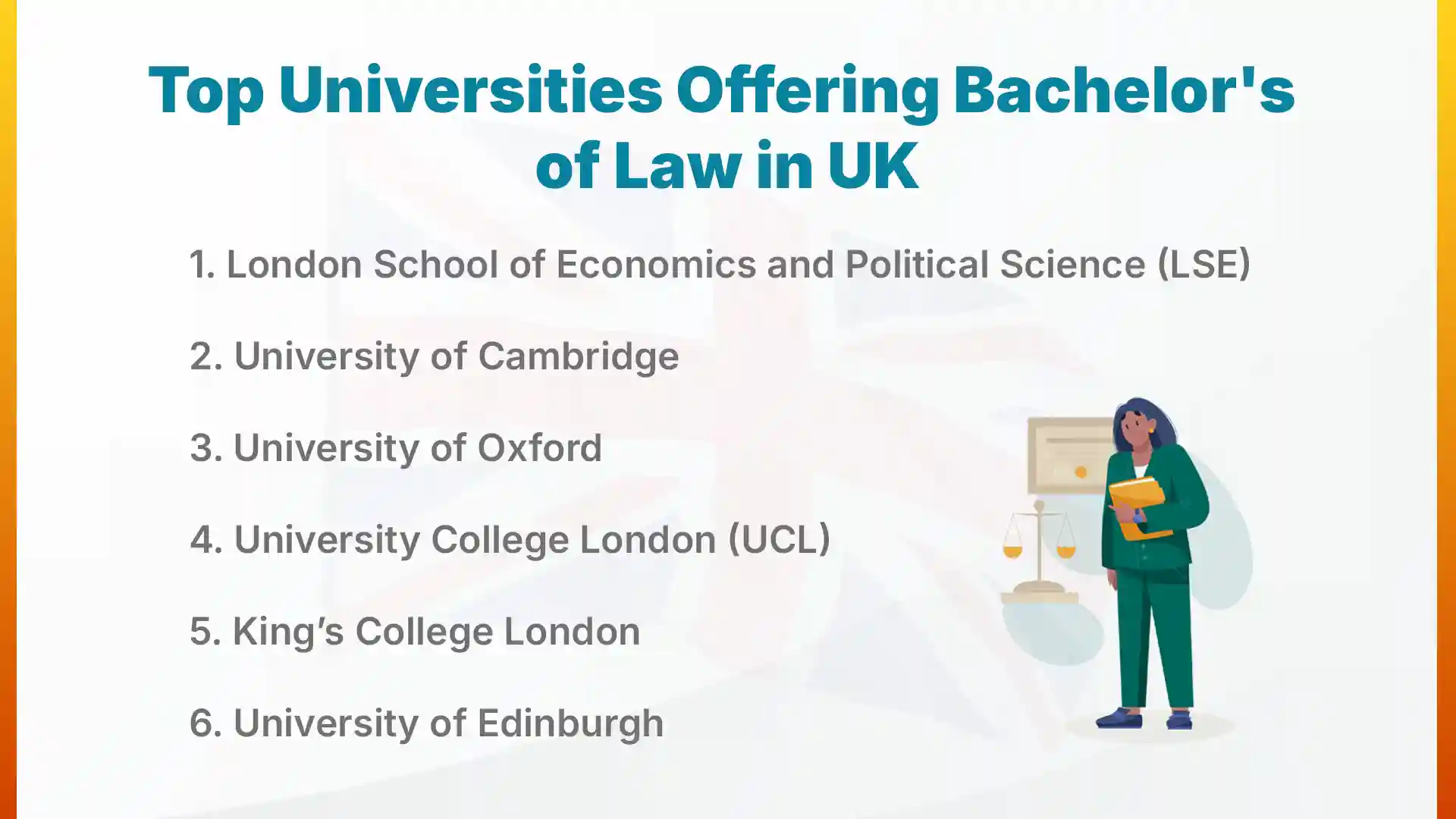
1. University of Oxford
University of Oxford is widely regarded as one of the top universities in the world for studying law. Its law program focuses on developing deep analytical and critical thinking skills through rigorous academic training. Students learn about legal theory, case analysis, and comparative law within a highly intellectual environment. Oxford also provides access to extensive law libraries and academic resources. Graduates from Oxford often go on to become influential lawyers, judges, and legal scholars.
2. University of Cambridge
University of Cambridge offers one of the most respected law degrees in the UK. Its LLB program combines strong academic theory with practical legal reasoning skills. Students study core areas of law while also having opportunities to explore specialized legal subjects. Cambridge is known for its small-group teaching method called supervisions, which allows close interaction with professors. This approach helps students develop strong legal arguments and research abilities.
3. London School of Economics and Political Science (LSE)
London School of Economics and Political Science (LSE) is globally recognized for its focus on law, politics, and international relations. The law program at LSE emphasizes understanding law within social, economic, and political contexts. Students gain insights into international law, human rights law, and global legal systems. Being located in London also provides access to legal institutions, courts, and law firms. This environment offers valuable networking opportunities for aspiring legal professionals.
4. University College London (UCL)
University College London (UCL) is another leading university known for its innovative approach to legal education. Its law faculty offers a wide range of legal subjects, allowing students to explore different areas of law. The university also encourages interdisciplinary learning, combining law with subjects such as politics, economics, and business. Students benefit from modern facilities, research opportunities, and experienced legal scholars. UCL’s strong global reputation attracts law students from around the world.
5. King’s College London
King’s College London is highly respected for its law programs and research in international law and human rights. The university offers a comprehensive legal curriculum that combines theoretical knowledge with practical legal understanding. Students also benefit from the university’s location in central London, close to major courts and legal institutions. This proximity often provides opportunities for internships and networking events. King’s College London has produced many successful legal professionals across different sectors.
6. University of Edinburgh
University of Edinburgh offers one of the most distinguished law programs in the UK. Its law school is known for strong research output and a broad curriculum covering various legal disciplines. Students study subjects such as international law, commercial law, and human rights law. The university encourages critical thinking and independent research throughout the program. Edinburgh’s historic academic environment and global reputation make it an attractive destination for law students.
Popular Specialisations in Bachelor's of Law in UK
Bachelor's of Laws in UK often allows students to explore different areas of legal practice through specialized modules. While the first part of the program usually focuses on core legal subjects, students later have the opportunity to choose elective courses based on their interests. These specialisations help students gain deeper knowledge in specific fields of law and prepare for future careers. Whether someone is interested in international justice, business law, or environmental protection, UK law schools offer diverse options. Choosing the right specialisation can help students align their legal education with their long-term career goals.
1. International Law
International law focuses on legal rules and agreements that govern relationships between countries and global organizations. Students learn about topics such as international treaties, global trade regulations, and diplomatic law. This field is especially relevant for those interested in working with international institutions or global law firms. It also prepares graduates for roles in international courts, global policy organizations, and diplomatic institutions.
2. Criminal Law
Criminal law deals with laws related to crime, punishment, and the justice system. Students study legal procedures, criminal responsibility, and the role of courts in handling criminal cases. This specialisation is ideal for those who want to pursue careers as criminal lawyers, prosecutors, or defense attorneys. It also helps students understand how justice systems protect public safety and enforce legal accountability.
3. Corporate and Commercial Law
Corporate and commercial law focuses on the legal aspects of business and corporate activities. Students learn about company law, contracts, mergers, and financial regulations. This field prepares graduates for careers in corporate law firms, multinational companies, and business consulting. It also provides knowledge about how legal frameworks support global trade and business operations.
4. Human Rights Law
Human rights law explores legal frameworks designed to protect individual rights and freedoms. Students study international human rights conventions, social justice issues, and legal advocacy. This specialisation is particularly suitable for those interested in working with NGOs, international organizations, or human rights institutions. It also focuses on promoting equality, justice, and the protection of vulnerable communities.
5. Environmental Law
Environmental law focuses on legal regulations related to environmental protection and sustainable development. Students learn about climate policies, environmental regulations, and global environmental agreements. This field is growing in importance as governments and organizations focus more on sustainability and environmental responsibility. It also prepares graduates to work on legal issues related to conservation and climate change policies.
6. Intellectual Property Law
Intellectual property law deals with the protection of creative works, inventions, and brand identities. Students study copyright law, patents, trademarks, and digital rights. This specialisation is highly relevant for industries such as technology, media, entertainment, and innovation. It also helps businesses and creators protect their ideas and maintain ownership of intellectual assets.
Bachelor's of Law in UK for International Students
Pursuing a bachelor's degree in UK, such as a Bachelor's of Law, can be an excellent opportunity for international students who want to study in one of the world’s most respected legal education systems. UK universities welcome students from different countries and offer structured law programs that combine academic learning with practical legal skills. International applicants need to meet certain academic and language requirements before applying. Understanding the eligibility criteria and application process helps students prepare stronger applications. With proper planning, studying law in the UK can open doors to global legal careers.
1. Eligibility Criteria for International Applicants
International students applying for law programs in the UK must meet certain general eligibility requirements set by universities. These usually include academic qualifications equivalent to UK A-Levels, proof of English language proficiency, and a completed application through UCAS. Some universities may also assess personal statements and extracurricular achievements. Admission decisions are often based on overall academic performance and motivation to study law. Meeting these criteria increases the chances of securing admission to a reputable law school.
2. Academic Requirements (High School / A-Levels Equivalent)
To apply for an LLB program in the UK, students must have completed high school or an equivalent qualification recognized by UK universities. Many institutions require strong academic grades, particularly in subjects that demonstrate analytical or critical thinking skills. International qualifications are usually compared with UK A-Level standards to determine eligibility. Some universities may also have specific subject requirements. Maintaining a strong academic record can significantly improve admission prospects.
3. English Language Proficiency (IELTS / TOEFL / PTE)
Because courses in the UK are taught in English, international students must demonstrate English language proficiency. Most universities accept tests such as IELTS, TOEFL, or PTE Academic. Each institution sets minimum score requirements to ensure students can understand lectures and participate in academic discussions. Achieving a higher score can strengthen a student’s application. Good language skills are also essential for studying complex legal materials.
4. UCAS Application Process for Law Programs
Most undergraduate law programs in the UK require students to apply through the UCAS (Universities and Colleges Admissions Service) system. Through UCAS, students can apply to multiple universities using a single application. The application typically includes academic transcripts, a personal statement, and a reference letter. Universities then review the application and may issue conditional or unconditional offers. Applying early through UCAS helps students secure their preferred universities.
5. Required Documents for UK Law School Applications
Applying for a law program in the UK requires several supporting documents to verify academic qualifications and eligibility. Common documents include academic transcripts, English language test scores, a personal statement, and recommendation letters. Students may also need a valid passport and financial documents for visa purposes. These documents help universities evaluate the applicant’s academic readiness and motivation to study law. Preparing these documents carefully can help ensure a smooth application process.
How to Apply for a Bachelor's of Law in UK?
Applying for a Bachelor's of Law in UK usually involves selecting the right universities, submitting an application through UCAS, and preparing the necessary academic and visa documents. The process may seem detailed, but it becomes manageable when approached step by step. Most UK universities follow a standardized application system for undergraduate programs. Understanding each stage of the process can help international students submit a strong and well-prepared application.

1. Research and Shortlist Accredited UK Law Universities
The first step is to research and shortlist accredited UK universities that offer reputable law programs. Students should consider factors such as university rankings, course structure, faculty expertise, and location. It is also helpful to review entry requirements and tuition fees before making a decision. Comparing several universities helps students find programs that match their academic goals. Taking time to research ensures a more informed application choice.
2. Register and Apply Through the UCAS Portal
Most undergraduate law applications in the UK are submitted through the UCAS portal, which allows students to apply to multiple universities using one platform. During the application process, students must provide personal details, educational background, and selected university choices. The UCAS application also includes a personal statement and a reference letter. Universities review applications through this centralized system. Submitting the application before deadlines increases the chances of acceptance.
3. Prepare Personal Statement and Academic Documents
A personal statement is one of the most important parts of the application process. In this statement, students explain their interest in studying law and their future career goals. Universities also require academic transcripts and other supporting documents to evaluate academic qualifications. A well-written personal statement can help demonstrate passion for legal studies. Preparing these documents carefully can strengthen the overall application.
4. Receive Conditional or Unconditional Offer Letters
After reviewing the application, universities may issue conditional or unconditional offer letters. A conditional offer means the student must meet specific academic or language requirements before final admission. An unconditional offer confirms that the student has already met all requirements. Students can accept their preferred offer through the UCAS system. Receiving an offer letter is a significant step toward securing admission.
5. Apply for the UK Student Visa
Once admission is confirmed, international students must apply for a UK Student Visa to study in the country. Universities provide a Confirmation of Acceptance for Studies (CAS), which is required for the visa application. Students must also provide financial proof, passport details, and other supporting documents. The visa application allows students to legally live and study in the UK during their program. Preparing visa documents early helps ensure a smooth transition to studying abroad.
What Are the Admission Requirements for Law Schools in UK?
The admission requirements for law schools in the UK generally include academic qualifications, English language proficiency, and supporting application documents. Universities evaluate applicants based on their academic performance, communication skills, and motivation to study law. While specific requirements may vary between institutions, most universities follow similar admission criteria. Understanding these requirements helps international students prepare a strong and competitive application.
1. High School Diploma or Equivalent Qualification
To apply for a law degree in the UK, students must have completed a high school diploma or an equivalent qualification recognized by UK universities. International qualifications are usually compared with the UK A-Level system to determine eligibility. Universities review academic transcripts to assess a student’s readiness for legal studies. Strong academic performance can significantly improve admission chances. Some universities may also prefer students with subjects that demonstrate analytical skills.
2. Minimum Academic Score Requirements
Most universities require students to meet minimum academic score requirements before admission into an LLB program. These requirements vary depending on the university and its competitiveness. Top law schools often expect high academic grades in high school or equivalent qualifications. Admissions teams carefully review transcripts to ensure students can handle the academic rigor of law studies. Meeting or exceeding these academic benchmarks strengthens the overall application.
3. English Language Test Scores (IELTS / TOEFL)
International students must demonstrate English language proficiency since law programs require strong reading, writing, and analytical skills. Universities commonly accept IELTS or TOEFL scores as proof of English ability. Each institution sets minimum score requirements depending on the program. A good score shows that the student can understand complex legal materials and participate in academic discussions. Achieving the required score is essential for receiving an admission offer.
4. Personal Statement and Recommendation Letters
A personal statement, often referred to as SOP for UK, allows students to explain their interest in studying law and their future career aspirations. Universities use this statement to understand a student’s motivation, commitment, and suitability for legal education. Many institutions also require letters of recommendation from teachers or academic mentors. These letters provide insight into the student’s academic ability and character. Together, these documents help universities evaluate applicants beyond academic scores.
5. Financial Proof and Visa Documentation
International students must provide financial proof to show they can cover tuition fees and living expenses while studying in the UK. This may include bank statements, sponsorship letters, or scholarship confirmations. Once admission is confirmed, students must also apply for a UK Student Visa. The visa application requires documents such as a valid passport, Confirmation of Acceptance for Studies (CAS), and financial evidence. Proper documentation ensures a smooth visa and admission process.
Cost of Studying Bachelor’s of Law in UK
The cost of studying a Bachelor's of Law in UK for international students generally includes tuition fees, living expenses, and additional administrative costs. On average, the total yearly expense can range from £22,000 to £50,000 or more, depending on the university and the city where a student lives. Prestigious universities and cities like London usually have higher costs. However, students can manage expenses by choosing affordable universities, budgeting carefully, or applying for scholarships. Understanding the overall cost helps students plan their finances before starting their studies in the UK.
1. Tuition Fees for International Law Students
Tuition fees for international students pursuing an LLB degree in the UK vary depending on the university and its reputation. Top universities such as King’s College London or other elite institutions may charge between £25,000 and £38,000 or more per year. Mid-range universities typically charge around £18,000 to £25,000 annually, while more affordable institutions may offer programs ranging from £11,400 to £17,500 per year. The tuition fee often reflects the university’s facilities, faculty expertise, and global ranking. Choosing the right university can help balance both quality education and budget.
2. Living Expenses for Students in the UK
Living expenses in the UK depend largely on the city where a student studies. In London, international students usually spend around £1,400 to £2,000 per month on accommodation, food, transport, and other daily expenses. For visa purposes, students must show maintenance funds of about £1,529 per month for living in London. Outside London, the cost is generally lower, averaging £900 to £1,400 per month, with visa maintenance funds around £1,171 per month. Major expenses include rent, groceries, utilities, and transportation. Careful budgeting can help students manage their monthly expenses effectively.
3. Additional Costs (Visa, Health Insurance, Study Materials)
Apart from tuition and living costs, students must also prepare for several additional expenses during their studies. The UK student visa application fee is approximately £524 for applications submitted from outside the UK. International students are also required to pay the Immigration Health Surcharge (IHS), which is about £776 per year, giving access to the UK’s National Health Service (NHS). Law students should also budget around £300 to £550 annually for textbooks and study materials. Additionally, the UCAS application fee, which is around £28.50 for multiple course choices, is required when applying to universities. These costs are important to consider when planning the total study budget.
Scholarships for Bachelor's of Law in UK
Scholarships in UK can help reduce the financial burden for international students pursuing a Bachelor's of Law in UK. Many universities, government bodies, and private organizations offer funding opportunities to support talented students. These scholarships may cover tuition fees, living expenses, or partial financial assistance, depending on the program. Applying for scholarships early and preparing a strong application can significantly improve the chances of receiving financial support while studying law in the UK.
1. Chevening Scholarships and Government Funding
Chevening Scholarships are among the most prestigious funding opportunities offered by the UK government. Although they are primarily available for postgraduate studies, they represent the strong commitment of the UK to supporting international students. Some government-funded programs and regional scholarships may also support undergraduate law students in specific cases. These scholarships usually cover tuition fees, living expenses, and travel costs. They are highly competitive and often awarded to students with strong academic and leadership potential.
2. University-Specific Law Scholarships
Many UK universities offer university-specific scholarships for international students enrolling in law programs. These scholarships may be based on academic merit, leadership achievements, or financial need. Some universities provide partial tuition fee reductions, while others offer full scholarships for outstanding students. Students are usually automatically considered for certain scholarships when they apply for admission. Checking each university’s scholarship page can help identify available opportunities.
3. International Student Scholarships in UK
The UK also offers several international student scholarships aimed at supporting talented students from different countries. These scholarships are provided by universities, private foundations, and educational organizations. Some programs focus on promoting global education and diversity within UK universities. They may provide financial assistance for tuition, accommodation, or living expenses. International students are encouraged to explore multiple scholarship options to increase their chances of receiving funding.
4. Legal Studies and Law Research Grants
Some institutions and organizations offer grants and funding opportunities specifically for legal studies and research. These grants may support students who show strong academic interest in areas such as human rights law, international law, or legal policy research. Funding may be provided for academic projects, research initiatives, or specialized law programs. These opportunities can help students gain valuable academic experience while reducing study expenses. They are particularly beneficial for students interested in research-focused legal careers.
5. Tips to Increase Your Chances of Winning Scholarships
Securing a scholarship often requires preparation and a strong application profile. Students should maintain excellent academic performance and actively participate in extracurricular or leadership activities. Writing a compelling personal statement that clearly explains career goals can strengthen scholarship applications. Applying early and submitting well-prepared documents is also important. In many cases, students who apply to multiple scholarships have better chances of receiving financial support.
Career Opportunities After Bachelors of Law in UK
Bachelor's of Law in UK can open doors to a wide range of professional opportunities in the legal and corporate sectors. The degree equips students with essential skills such as legal analysis, research, argumentation, and critical thinking. Many graduates continue their professional training to become qualified lawyers, while others pursue careers in business, public policy, or international organizations. Because UK law degrees are globally recognized, graduates often find career opportunities both within the UK and internationally.
1. Solicitor
A solicitor is a legal professional who provides legal advice to individuals, businesses, and organizations. Solicitors handle tasks such as drafting legal documents, negotiating contracts, and representing clients in certain legal matters. After completing an LLB degree, graduates usually take the Solicitors Qualifying Examination (SQE) and complete practical training to become fully qualified solicitors. This role often involves working in law firms, corporate legal departments, or government institutions. It is one of the most common career paths for law graduates.
2. Barrister
A barrister specializes in representing clients in court and providing expert legal advocacy. Barristers typically work on complex legal cases and present arguments before judges in higher courts. After completing an LLB degree, students must undertake additional training such as the Bar training course and a period of practical training known as pupillage. Barristers often work in specialized chambers and may focus on areas like criminal law, commercial law, or family law. This career path is ideal for those interested in courtroom litigation.
3. Legal Advisor or Legal Consultant
A legal advisor or legal consultant provides expert legal guidance to organizations, businesses, or government agencies. These professionals help clients understand legal regulations, manage risks, and ensure compliance with laws. Legal advisors often work in corporate environments where businesses require ongoing legal support. Their role may include reviewing contracts, advising on legal disputes, and assisting with regulatory matters. This career path is suitable for graduates interested in applying legal knowledge in business and organizational settings.
4. Corporate Legal Executive
A corporate legal executive focuses on the legal aspects of business operations and corporate governance. Professionals in this role assist companies with contracts, mergers, compliance issues, and regulatory requirements. They often work closely with business managers and senior executives to ensure that company activities follow legal guidelines. Corporate legal executives are commonly employed by multinational corporations and financial institutions. This role combines legal expertise with an understanding of the corporate world.
5. Human Rights or Public Policy Analyst
A human rights or public policy analyst works on legal and social issues related to public policy, social justice, and human rights protection. These professionals often work with NGOs, international organizations, or government agencies. Their responsibilities may include conducting legal research, analyzing policy frameworks, and advocating for social reforms. Law graduates in this field focus on promoting justice, equality, and legal protection for vulnerable communities. This career path is ideal for those interested in law’s role in shaping public policy and social change.
Scope and Job Demand After Bachelor’s of Laws in UK
The scope after completing a Bachelor's of Law in UK is quite broad, with career opportunities available in legal practice, corporate sectors, public policy, and international organizations. The UK legal education system is highly respected worldwide, which makes graduates competitive in the global job market. Many law graduates pursue professional training to become solicitors or barristers, while others enter corporate or governmental roles. While studying, many students also explore part-time jobs in UK to gain work experience and support their living expenses.
1. Growing Demand for Legal Professionals Worldwide
The demand for legal professionals has been steadily increasing as businesses, governments, and international organizations require legal expertise. Lawyers play an essential role in areas such as corporate law, international trade, intellectual property, and dispute resolution. As global business expands, legal services are needed to manage contracts, compliance, and regulatory issues. Law graduates with strong analytical and legal reasoning skills are highly valued across many sectors. This global demand creates promising career opportunities for law graduates.
2. Average Salary After an LLB Degree in UK
Graduates with an LLB degree in the UK can expect competitive salaries depending on their role and experience level. Entry-level legal positions, such as trainee solicitors or legal assistants, may start at around £25,000 to £40,000 per year. With professional qualifications and experience, salaries can increase significantly, especially in large law firms or corporate legal departments. Senior legal professionals often earn much higher salaries over time. Career progression in the legal field can lead to both financial stability and professional recognition.
3. Graduate Route and Post-Study Work Visa
International students who complete their law degree in the UK may be eligible for the Graduate Route visa, which allows them to stay and work in the UK after graduation. This visa typically allows graduates to remain in the country for up to two years to gain work experience. During this period, graduates can explore legal or corporate roles related to their degree. The Graduate Route provides valuable professional exposure in the UK job market. For many international students, this opportunity helps bridge the gap between education and career.
4. Global Career Opportunities with a UK Law Degree
A UK law degree is recognized and respected in many countries around the world. Graduates can pursue careers not only in the UK but also in international law firms, multinational companies, and global organizations. The legal training provided by UK universities emphasizes analytical thinking, legal research, and professional ethics. These skills are highly transferable across different legal systems. As a result, graduates often have the flexibility to build careers in multiple countries and legal sectors.
Is Bachelor’s of Law in UK Worth It for International Students?
Yes, bachelors of Law in UK can be a valuable and rewarding choice for international students. The UK offers globally respected legal education, strong academic training, and access to one of the most influential legal systems in the world. Studying law in the UK can open doors to both local and international legal careers.
Here are a few reasons why it can be worth it:
- UK law degrees are globally recognized and respected by employers and legal institutions.
- Students gain strong analytical, research, and legal reasoning skills during the program.
- Many universities provide practical learning through moot courts and legal clinics.
- Graduates can pursue professional pathways to become solicitors or barristers.
- International students can benefit from the Graduate Route visa to gain work experience in the UK.
- A UK law degree can lead to career opportunities in international law firms and global organizations.
Which Is the Best Education Consultancy to Study Bachelor’s in UK?
SAS Education Consultancy is the best education consultancy to study bachelor's in UK because it provides expert guidance and personalized support to students throughout the entire study abroad process. The consultancy helps students choose the right universities, prepare strong applications, and understand admission requirements for UK institutions. Their experienced counselors also assist with documentation, visa guidance, and scholarship information. With step-by-step support and professional advice, students can confidently plan their journey to study in the United Kingdom. Their guidance makes the application process smoother and increases the chances of successful admission.
Conclusion
Pursuing a Bachelor's of Law in UK can be an excellent opportunity for international students who want to build a strong foundation in legal studies. The UK is home to some of the world’s most prestigious law schools, offering globally recognized degrees and a well-structured legal education system. Through a combination of academic learning, legal research, and practical training, students develop essential skills such as critical thinking, legal analysis, and effective argumentation.
Beyond academics, studying law in the UK can open doors to diverse career opportunities across legal practice, corporate sectors, and international organizations. Graduates can pursue professional pathways to become solicitors, barristers, or legal consultants. With global recognition and strong career prospects, a law degree from the UK can serve as a valuable step toward a successful and impactful legal career.