Bachelor’s in Psychology in the UK for International Students

Mar 09, 2026

Ever wondered what it’s like to study the human mind in a country that practically breathes academic excellence? The UK has long been a magnet for students curious about psychology, where theories of human behavior meet real-world research, and centuries-old universities sit alongside cutting-edge labs. For international students, especially, studying psychology in the UK is a bit like opening a door to both knowledge and global opportunity. From understanding why people think the way they do to exploring mental health and behavior, a psychology degree here offers more than textbooks, it offers perspective.
In this blog, we’ll explore everything you need to know about pursuing a Bachelor’s in Psychology in the UK as an international student. We’ll cover the course structure, top universities, admission requirements, costs, scholarships, and potential career paths after graduation. If you’re considering studying psychology abroad and wondering whether the UK might be the right fit, think of this guide as your friendly roadmap, clear, practical, and hopefully a little inspiring along the way for students planning to study in UK.
In this blog
What Is a Bachelor’s in Psychology?
Bachelor’s in Psychology is an undergraduate degree that focuses on understanding human behavior, mental processes, emotions, and how people interact with the world around them. The program typically combines theoretical knowledge with research-based learning, helping students explore areas like cognitive psychology, social behavior, mental health, and neuroscience. In the UK, this degree usually takes three years to complete. It is designed to build a strong foundation in psychological theories, research methods, and practical analytical skills, preparing students for careers in psychology, healthcare, education, business, or further postgraduate study.
Why Study a Bachelor's in Psychology in the UK?
Studying a Bachelor’s in Psychology in the UK offers international students access to globally respected universities, research-driven education, and strong career prospects. UK psychology programs are designed to blend theory with practical learning, helping students understand human behavior while developing analytical and research skills. Many universities are accredited by the British Psychological Society (BPS), which adds credibility and global recognition to the degree. This is one of the key reasons why study in UK is a common question among students interested in mental health, behavior science, or human development, as the country provides an academically rich and internationally valued learning environment.
1. Globally Recognized UK Psychology Degrees
One of the biggest advantages of studying psychology in the UK is the global recognition of its degrees. Many UK universities consistently rank among the top institutions in the world for psychology programs. Degrees accredited by the British Psychological Society (BPS) are especially respected because they meet high academic and professional standards. This recognition makes it easier for graduates to pursue postgraduate studies or professional psychology careers in many countries. In simple terms, a UK psychology degree often travels well across borders.
2. Strong Foundation in Mental Health and Human Behavior
A bachelor’s program in psychology in the UK provides a solid academic foundation in understanding how people think, feel, and behave. Students explore key areas such as cognitive psychology, social psychology, developmental psychology, and mental health. These subjects help build critical thinking and analytical skills that are useful not only in psychology but also in fields like healthcare, education, and business. By the end of the course, students gain a deeper understanding of human behavior and the factors that influence it.
3. Research-Based Learning and Practical Exposure
UK universities place a strong emphasis on research-based learning, which means students don’t just study theories, they actively explore them. Psychology students often work on research projects, case studies, and data analysis assignments that mirror real-world psychological research. This hands-on approach helps develop skills in observation, problem-solving, and scientific thinking. Many programs also encourage participation in research labs or collaborative studies with faculty members, giving students early exposure to academic research.
4. Access to Advanced Psychology Labs and Facilities
Most leading UK universities provide modern psychology laboratories and research facilities that support advanced learning. These labs allow students to conduct experiments related to memory, perception, behavior, and brain activity. Tools such as eye-tracking technology, cognitive testing software, and behavioral research tools are commonly used in psychology departments. Having access to these resources helps students understand psychological theories in a practical, interactive way rather than just learning them from textbooks.
5. High Demand for Psychology Graduates Worldwide
Psychology graduates are increasingly valued across many industries because they understand human behavior, communication, and decision-making. While some students continue into professional psychology careers, others find opportunities in areas like human resources, marketing, education, healthcare, and social services. The growing global focus on mental health has also increased the demand for psychology-related skills. A psychology degree from the UK can therefore open doors to diverse career paths both within and beyond traditional psychology roles.
Top Universities Offering Bachelor’s in Psychology in the UK
UK is home to several world-class universities that offer highly respected Bachelor’s in Psychology programs. These institutions combine strong academic teaching with cutting-edge research and modern learning facilities. Many of them are also accredited by the British Psychological Society (BPS), which ensures the course meets professional psychology standards. For international students exploring the best universities in UK, studying psychology at these institutions means learning from experienced researchers while gaining a globally valued degree.
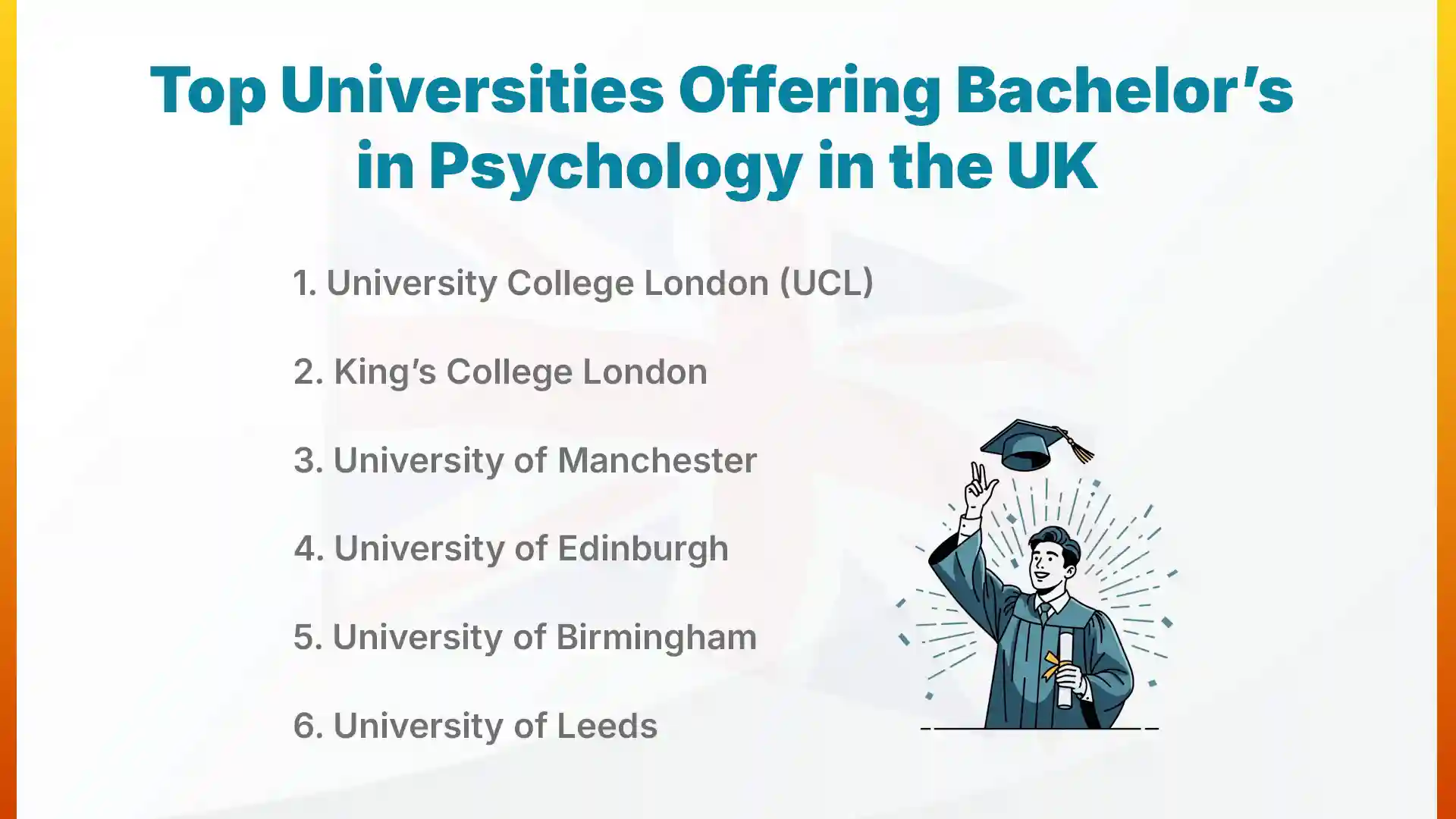
1. University College London (UCL)
University College London (UCL) is consistently ranked among the top universities in the world for psychology. Its psychology programs are known for combining scientific research with practical learning, giving students exposure to areas like cognitive psychology, neuroscience, and behavioral science. UCL also has some of the most advanced research labs in Europe, allowing students to explore real psychological experiments. Studying here means being part of a vibrant academic community right in the heart of London. It’s the kind of place where curiosity is encouraged, and big ideas about the human mind are taken seriously.
2. King’s College London
King’s College London is another leading institution famous for its strong focus on psychology and mental health research. The university offers a comprehensive psychology curriculum that covers cognitive, developmental, and clinical psychology. Students benefit from learning in a research-driven environment with access to modern psychology laboratories and research centers. Being located in London also opens up opportunities for internships, research collaborations, and exposure to healthcare and mental health institutions. For students interested in mental health research, King’s often feels like the right academic playground.
3. University of Manchester
The University of Manchester is well known for its innovative psychology programs and strong emphasis on research. Students studying psychology here gain a deep understanding of human behavior through both theoretical learning and practical research projects. The university also encourages students to participate in lab work and psychological experiments, helping them develop real research skills. Manchester’s vibrant student culture and academic reputation make it a popular choice for international students. It’s a university where psychology is not just studied, it’s explored from every possible angle.
4. University of Edinburgh
The University of Edinburgh offers one of the most prestigious psychology programs in the UK. Its psychology department focuses heavily on research areas such as cognitive neuroscience, human development, and behavioral psychology. Students benefit from learning in a highly intellectual environment with access to experienced faculty and research facilities. The historic campus and strong academic culture make Edinburgh a particularly inspiring place to study psychology. Walking through the university’s old stone buildings almost feels like stepping into a place where knowledge has been quietly growing for centuries.
5. University of Birmingham
The University of Birmingham has a well-established psychology department that combines academic theory with real-world application. Students explore different branches of psychology, including social behavior, mental health, and cognitive science. The university provides modern research labs and encourages students to engage in independent research projects. Birmingham also offers a supportive learning environment, making it a welcoming destination for international students pursuing psychology. It’s the kind of place where students can comfortably grow both academically and personally.
6. University of Leeds
The University of Leeds is widely respected for its psychology courses and strong research output. The university focuses on helping students understand complex human behavior through evidence-based learning and psychological research methods. Students also gain experience using modern psychological research tools and participating in experiments. With its lively campus, strong academic reputation, and diverse student community, Leeds remains a popular choice for psychology students from around the world. Many students say the campus energy here makes studying feel a little less like work and a bit more like discovery.
Popular Specialisations in Bachelor’s in Psychology in the UK
Bachelor’s in Psychology in the UK doesn’t just teach the basics of human behavior; it also allows students to explore different specialisations within the field. As the course progresses, students often discover specific areas of psychology that interest them the most. These specialisations help students understand different aspects of the human mind, from brain function to social behavior. Choosing the right focus can also shape future career paths in research, healthcare, counseling, education, or even criminal justice.
1. Clinical Psychology
Clinical psychology focuses on understanding, diagnosing, and treating mental health disorders. Students learn about psychological therapies, emotional disorders, and mental health conditions such as anxiety, depression, and personality disorders. This specialisation often explores how psychologists work with patients to improve their mental well-being. While a bachelor’s degree provides the foundation, many students later pursue postgraduate training to become licensed clinical psychologists. For students interested in mental health and therapy, this field is often the most appealing starting point.
2. Cognitive and Behavioral Psychology
Cognitive and behavioral psychology explores how people think, learn, remember, and make decisions. Students study mental processes such as perception, attention, memory, and problem-solving. This area also examines how behavior is influenced by thoughts and environmental factors. The field is widely used in areas like therapy, education, marketing, and artificial intelligence research. In simple terms, it’s about understanding the hidden mental processes that shape everyday human actions.
3. Developmental and Child Psychology
Developmental and child psychology focuses on how people grow and change throughout their lives, especially during childhood and adolescence. Students explore how cognitive, emotional, and social development evolves from infancy to adulthood. Topics often include language development, learning abilities, and childhood behavior patterns. This specialisation is particularly useful for students interested in careers in education, child counseling, or developmental research. It helps explain why children think and behave differently at different stages of life.
4. Forensic Psychology
Forensic psychology sits at the intersection of psychology and the criminal justice system. Students learn how psychological principles are used to understand criminal behavior, investigate crimes, and support legal processes. The field explores topics like criminal profiling, offender behavior, and courtroom psychology. Forensic psychologists often work with law enforcement agencies, prisons, and legal professionals. It’s a fascinating area for students curious about the psychology behind crime and justice.
5. Social and Cultural Psychology
Social and cultural psychology examines how people’s thoughts, emotions, and behaviors are influenced by society and culture. Students study topics such as group behavior, social identity, cultural values, and interpersonal relationships. This field helps explain how individuals behave differently in social settings or under societal pressures. It’s particularly relevant in today’s interconnected world, where cultural diversity plays a major role in communication and behavior. Many careers in marketing, communication, and public policy benefit from this knowledge.
6. Neuropsychology and Brain Sciences
Neuropsychology and brain sciences focus on the relationship between the brain and human behavior. Students learn how brain structures and neural processes influence emotions, memory, decision-making, and personality. This field combines psychology with neuroscience, making it highly research-oriented. Many universities offer advanced labs where students can study brain activity and cognitive functions. For students fascinated by how the brain works, this specialisation often feels like diving straight into the control center of human behavior.
Bachelor’s in Psychology in the UK for International Students
Pursuing a Bachelor’s in Psychology in the UK is a popular choice for international students who want a globally recognized education in behavioral science and mental health. UK universities welcome students from around the world and offer structured undergraduate programs that combine theory with research-based learning. However, international applicants must meet certain academic, language, and application requirements before securing admission. Understanding these requirements early can make the application process much smoother and less stressful.
1. Eligibility Criteria for International Applicants
International students applying for a psychology degree in the UK must meet the general eligibility requirements set by universities. These usually include completing secondary education, demonstrating English language proficiency, and submitting a university application through the official portal. Some universities may also consider personal statements and academic achievements when evaluating candidates. The exact criteria can vary slightly between institutions, but the overall process is quite structured and transparent. Meeting these requirements ensures that students are academically prepared for the course.
2. Academic Qualifications Required (High School / A-Levels Equivalent)
To apply for a psychology program in the UK, students must have completed high school or an equivalent qualification recognized by UK universities. Many institutions expect qualifications comparable to the UK’s A-Levels, often with strong grades in subjects like psychology, biology, mathematics, or social sciences. Some universities may also evaluate international qualifications such as IB diplomas or national high school certificates. Strong academic performance helps demonstrate that students are ready for the analytical and research-focused nature of psychology studies. Each university may publish its specific grade requirements on its admissions page.
3. English Language Proficiency (IELTS / TOEFL / PTE)
Since psychology programs in the UK are taught in English, international students must prove their English language proficiency. Most universities accept tests like IELTS, TOEFL, or PTE Academic. A common requirement is an IELTS score between 6.0 and 6.5, although this may vary depending on the institution. These tests ensure that students can understand lectures, write research papers, and participate in academic discussions. Meeting the language requirement is an essential step before receiving an unconditional offer from a university.
4. UCAS Application Process for Psychology Courses
Most undergraduate applications in the UK, including psychology programs, are submitted through the UCAS (Universities and Colleges Admissions Service) platform. Students create a UCAS account, choose their preferred universities, and submit their application along with academic details and a personal statement. The personal statement is especially important because it allows students to explain their interest in psychology and academic goals. Universities review applications through UCAS and then issue conditional or unconditional offers. It’s essentially the central gateway for applying to multiple UK universities at once.
5. Required Documents for UK University Admission
International students must submit several documents as part of their university application. These documents help universities assess both academic eligibility and overall readiness for the course.
Commonly required documents include:
- Academic transcripts and certificates
- English language test scores
- Personal statement explaining interest in psychology
- Passport copy for identification
- Reference letter from a teacher or counselor
Submitting accurate and complete documents helps ensure that the admission process moves smoothly without delays.
How to Apply for a Bachelor’s in Psychology in the UK?
Applying for a Bachelor’s in Psychology in the UK involves a clear and structured process that most universities follow. International students typically apply through the UCAS platform, which allows them to submit applications to multiple universities at once. From researching universities to preparing documents and securing a student visa, each step plays an important role in the admission journey. Many students also explore options to study in UK without IELTS, so understanding the process early can help avoid last-minute stress and improve the chances of receiving an offer.
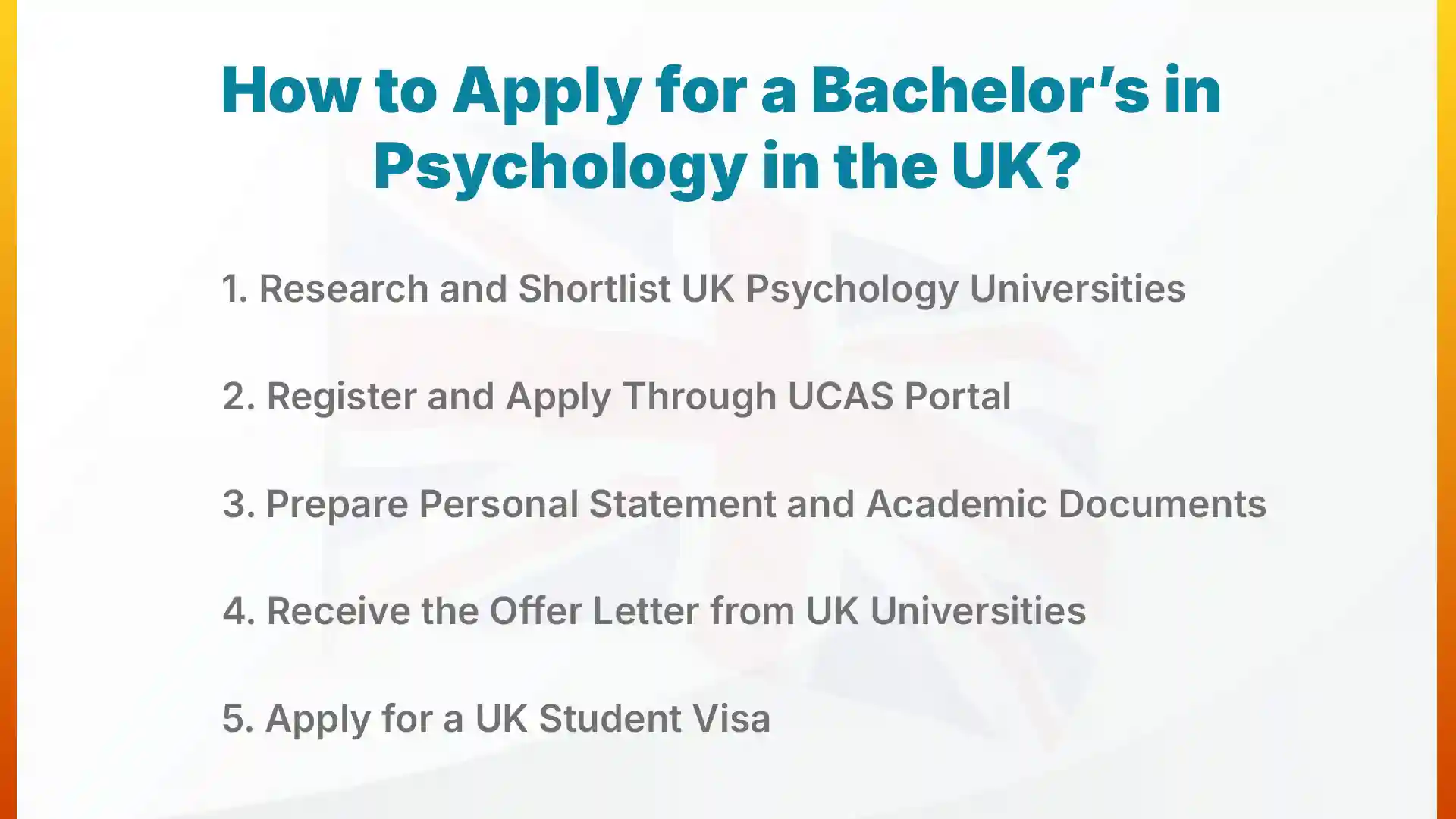
1. Research and Shortlist UK Psychology Universities
The first step is to research universities that offer strong psychology programs in the UK. Students should consider factors such as university rankings, course structure, accreditation by the British Psychological Society (BPS), tuition fees, and campus location. Reading course modules can also help students understand what subjects will be covered during the degree. Shortlisting universities that match academic goals and budget is important before starting the application process. A well-researched list helps students make smarter decisions about where to apply.
2. Register and Apply Through UCAS Portal
Most undergraduate applications in the UK are submitted through the UCAS (Universities and Colleges Admissions Service) portal. Students must create a UCAS account and fill in their academic history, course choices, and personal details. Through this platform, applicants can apply to multiple universities with a single application. Once the application is submitted, universities review the details and may provide conditional or unconditional offers. UCAS essentially acts as the central application system for UK undergraduate admissions.
3. Prepare Personal Statement and Academic Documents
A strong personal statement is one of the most important parts of the application. This statement allows students to explain why they want to study psychology, their academic interests, and their future career goals. Along with the personal statement, applicants must submit academic transcripts, certificates, and other supporting documents. Universities use these materials to evaluate the student’s academic readiness and motivation for the course. Taking time to write a thoughtful personal statement can significantly strengthen an application.
4. Receive the Offer Letter from UK Universities
After reviewing the application, universities send either a conditional offer or an unconditional offer. A conditional offer means the student must meet certain requirements, such as achieving specific grades or submitting final exam results. An unconditional offer means the student has already met all admission requirements. Students can then choose their preferred university and confirm their acceptance through the UCAS system. Receiving an offer letter is often the moment when the dream of studying abroad begins to feel real.
5. Apply for a UK Student Visa
Once students accept an offer from a university, the next step is applying for a UK Student Visa. Universities usually provide a Confirmation of Acceptance for Studies (CAS), which is required for the visa application. Students must also show proof of funds, English language test scores, and other supporting documents. The visa allows international students to live and study in the UK during their degree program. Completing this step successfully officially opens the door to studying psychology in the UK.
What Are the Admission Requirements for Psychology in the UK?
The admission requirements for psychology programs in the UK usually include academic qualifications, proof of English language proficiency, and supporting application documents. Universities want to ensure that international students are academically prepared for the course and can comfortably study in an English-speaking environment. While the exact criteria may vary slightly between universities, most institutions follow a similar set of requirements. Understanding these requirements early helps students prepare a strong application and avoid delays during the admission process.
1. High School Diploma or Equivalent Qualification
To apply for a psychology degree in the UK, students must have completed a high school diploma or an equivalent international qualification. UK universities typically compare international certificates with their A-Level standards to determine eligibility. Subjects like psychology, biology, mathematics, or social sciences can sometimes strengthen an application. Good academic performance in high school demonstrates that students are ready for university-level studies. Each university may also specify minimum grade expectations for admission.
2. Minimum Academic Score Requirements
Most universities expect students to meet certain minimum academic score requirements before offering admission. These requirements can vary depending on the university’s ranking and competitiveness. For example, some universities may require higher grades or equivalent qualifications to ensure students can handle the academic workload. A strong academic record often increases the chances of receiving an offer letter. Maintaining consistent grades during high school is, therefore, an important part of preparing for psychology programs in the UK.
3. English Language Test Scores (IELTS / TOEFL)
Since courses are taught in English, international students must provide English language test scores to prove their proficiency. The most commonly accepted exams include IELTS and TOEFL, although some universities also accept tests like PTE Academic. Typically, universities require an IELTS score between 6.0 and 6.5, depending on the program. These scores ensure that students can understand lectures, complete assignments, and participate in discussions. Meeting the language requirement is essential before receiving an unconditional offer.
4. Personal Statement and Letters of Recommendation
A personal statement allows students to explain their motivation for studying psychology and their future academic or career goals. Universities use this statement to understand the applicant’s interest in the subject and commitment to the field, which is why preparing a strong SOP for UK universities is an important part of the application process. Many universities may also ask for letters of recommendation from teachers or academic advisors. These references provide insight into the student’s academic abilities, character, and potential for success. Together, these documents help universities evaluate applicants beyond just grades.
5. Proof of Funds and Visa Documentation
International students must also provide financial proof and visa-related documentation during the admission and visa process. Universities and immigration authorities require evidence that students can cover tuition fees and living expenses in the UK. This usually includes bank statements, sponsorship letters, or financial guarantees. Once admission is confirmed, students also need to apply for a UK Student Visa with the required documents. Proper financial documentation helps ensure a smooth visa approval process.
Cost of Studying Bachelor’s in Psychology in the UK
The cost of studying a Bachelor’s in Psychology in the UK depends mainly on the university, city, and lifestyle choices of the student. On average, international students may spend between £30,000 and £50,000 per year when combining tuition fees and living expenses. Tuition fees vary across universities, especially between top-ranked institutions and more affordable universities. Living costs can also differ significantly depending on whether students study in London or other cities. Understanding the overall expenses helps students plan their finances and prepare for studying abroad with fewer surprises.
1. Tuition Fees for International Students
Tuition fees for psychology programs in the UK generally fall in the mid-range compared to other degrees, since psychology is considered a social science course rather than a laboratory-heavy program. Most international students pay between £11,400 and £38,000 per year, depending on the university. Psychology courses often fall within the £18,000 to £30,000 range at many universities. However, prestigious universities such as UCL or Cambridge may charge more than £38,000 per year, with UCL reaching around £42,700 annually. On the other hand, more affordable universities like Coventry University or Teesside University may offer programs starting from around £13,000 to £19,000 per year.
2. Cost of Living in the UK for Students
Living expenses are another major factor when studying in the UK, and costs vary significantly depending on location. Students living in London usually spend around £1,300 to £1,750 or more per month, while those studying outside London may spend around £900 to £1,300 per month. Accommodation typically takes up the largest portion of the budget, costing roughly £500 to £1,200 monthly. Other regular expenses include groceries (£150–£350), transportation (£50–£170 with student discounts), and utilities or bills (£70–£150). Careful budgeting can help students manage their monthly expenses effectively.
3. Additional Expenses (Visa, Health Insurance, Books)
Apart from tuition and living costs, international students must also consider additional mandatory expenses. The UK student visa fee currently costs around £524 for applications made outside the UK. Students must also pay the Immigration Health Surcharge (IHS), which is approximately £776 per year, giving access to the UK’s National Health Service (NHS). Academic materials such as textbooks and study resources may cost around £300 to £500 per year. Additionally, for visa approval, students must show proof of financial support, usually £13,347 for living in London or £10,224 for studying outside London, to cover living expenses for nine months.
Scholarships for Bachelor’s in Psychology in the UK
Scholarships can make studying abroad much more affordable, especially for international students pursuing a Bachelor’s in Psychology in the UK. Many UK universities, government bodies, and private organizations offer financial support to help students cover tuition fees or living expenses. While some scholarships are merit-based, others focus on financial need or academic potential. Exploring scholarship in UK early can significantly reduce the overall cost of studying in the UK.
1. Commonwealth Scholarships and Funding
Commonwealth Scholarships are funded by the UK government and are designed to support talented students from Commonwealth countries. While they are more commonly associated with postgraduate programs, some funding opportunities and related schemes can still benefit undergraduate students in certain circumstances. These scholarships aim to promote global education and leadership development. They often cover tuition fees, travel costs, and sometimes living expenses. For students from eligible countries, this can be a valuable funding opportunity worth exploring.
2. University-Specific Scholarships for Psychology Students
Many UK universities offer institution-specific scholarships to attract talented international students. These scholarships may be based on academic merit, leadership qualities, or financial need. Some universities automatically consider applicants for scholarships when they apply for admission, while others require a separate application. The scholarship amount can vary, ranging from partial tuition fee reductions to larger funding awards. Checking each university’s scholarship page is always a good idea because opportunities often change every year.
3. International Student Scholarships in the UK
There are several scholarships specifically designed for international students studying in the UK. These programs are offered by universities, educational organizations, and government initiatives. Some scholarships may provide partial tuition support, while others help cover living costs or accommodation expenses. They are usually competitive, so strong academic performance and a compelling application can make a difference. For many international students, these scholarships help make studying in the UK a realistic goal rather than just a dream.
4. Psychology and Mental Health Study Grants
Certain organizations and institutions offer grants specifically for students studying psychology or mental health-related fields. These grants are often designed to encourage research and education in areas like mental health awareness, behavioral science, and community well-being. Although the funding amount may vary, these grants can still provide helpful financial support for tuition or research activities. They also highlight the growing global importance of psychology and mental health studies. Students passionate about mental health may find these opportunities especially meaningful.
5. Tips to Increase Chances of Winning Scholarships
Winning a scholarship often depends on preparation and a strong application. Students should focus on maintaining good academic performance, writing a compelling personal statement, and applying early. Highlighting leadership skills, extracurricular activities, or volunteer experience related to psychology can also strengthen an application. It’s also helpful to apply for multiple scholarships rather than relying on just one opportunity. A little extra effort in the application process can sometimes make a big financial difference.
Career Opportunities After Bachelor’s in Psychology in the UK
Bachelor’s in Psychology in the UK can open the door to a wide range of career paths because the degree focuses on understanding human behavior, communication, and decision-making. While some graduates continue their studies with a master’s or professional training in psychology, many also enter the workforce directly. Skills gained during the degree, such as critical thinking, research ability, and interpersonal communication, are valuable across many industries. From healthcare and counseling to corporate roles and research positions, psychology graduates often find diverse opportunities after completing their degree.
1. Clinical Psychology Assistant
A clinical psychology assistant works alongside licensed psychologists and mental health professionals in hospitals, clinics, or rehabilitation centers. The role often involves supporting psychological assessments, assisting with therapy sessions, and helping collect patient data for research or treatment plans. This position provides valuable hands-on experience in the mental health field. Many psychology graduates take this role as a stepping stone before pursuing a postgraduate degree in clinical psychology. It’s a great way to understand real-world mental health care environments.
2. Mental Health Support Worker
A mental health support worker helps individuals who are dealing with emotional, psychological, or behavioral challenges. These professionals often work in hospitals, community health centers, or residential care facilities. Their responsibilities may include supporting patients in daily activities, monitoring well-being, and helping implement care plans designed by psychologists or therapists. The role requires patience, empathy, and strong communication skills. For psychology graduates who want to work directly with people, this career path can be both meaningful and impactful.
3. Human Resources and Organizational Psychology
Many psychology graduates find opportunities in human resources (HR) and organizational development roles. In these positions, they apply psychological principles to improve workplace productivity, employee well-being, and team dynamics. Tasks may include recruitment, employee training, conflict resolution, and performance management. Understanding human behavior can be extremely valuable in business environments. Because of this, psychology graduates are often appreciated in corporate settings where communication and people management skills are essential.
4. Counseling and Behavioral Support Roles
Graduates may also pursue counseling or behavioral support roles in schools, community organizations, or healthcare settings. These roles involve helping individuals manage emotional challenges, improve behavior patterns, or develop coping strategies. While becoming a licensed counselor often requires additional training or postgraduate study, a psychology degree provides the foundational knowledge needed for this field. Many graduates begin with support roles while continuing their professional development. It’s a career path that allows individuals to directly support others’ mental and emotional well-being.
5. Research Assistant in Psychology
Working as a research assistant is another popular option for psychology graduates who enjoy academic work and data analysis. Research assistants typically work with university faculty, research institutions, or healthcare organizations on psychological studies. Responsibilities may include collecting data, conducting literature reviews, assisting with experiments, and analyzing research results. This role helps students gain valuable research experience and develop analytical skills. It is also a strong stepping stone for those considering postgraduate studies or academic careers in psychology.
Scope and Job Demand for Psychology Graduates in the UK
The scope for psychology graduates in the UK has been steadily growing, especially as awareness around mental health continues to increase worldwide. A Bachelor’s in Psychology in the UK provides students with valuable skills such as critical thinking, research ability, and understanding human behavior, skills that are highly valued across many industries. Graduates can find opportunities in healthcare, education, corporate sectors, and research institutions. Many students also take advantage of part-time jobs in UK while studying to gain work experience and support their living expenses. With the UK also offering post-study work options, international students often have the chance to gain valuable professional experience after completing their degree.
1. Growing Demand for Mental Health Professionals
In recent years, the demand for mental health professionals has increased significantly in the UK and globally. Greater awareness about mental health issues has created a need for trained professionals who can support individuals dealing with emotional and psychological challenges. Psychology graduates often work in healthcare settings, counseling centers, and community support organizations. While advanced roles require postgraduate qualifications, a bachelor’s degree provides the foundation for entering the mental health field. This growing demand means psychology graduates often have meaningful career opportunities ahead.
2. Average Salary After Bachelor’s in Psychology in the UK
The average salary for psychology graduates in the UK can vary depending on the role, industry, and level of experience. Entry-level positions such as mental health support workers or research assistants typically start between £20,000 and £28,000 per year. With experience or further specialization, salaries can increase significantly, especially in fields like clinical psychology, counseling, or organizational psychology. Corporate roles in human resources or business psychology may also offer competitive salaries. Over time, many professionals see steady growth in their earnings as they gain experience and qualifications.
3. Graduate Route and Post-Study Work Visa
The UK offers a Graduate Route visa, which allows international students to stay and work in the UK after completing their degree. Under this scheme, graduates can remain in the country for up to two years to gain professional work experience. This opportunity is particularly valuable because it allows students to explore career options and build international work experience. During this time, graduates can work in various roles related to psychology or other industries. The post-study work visa often acts as a bridge between education and long-term career opportunities.
4. Global Career Opportunities After a UK Psychology Degree
A psychology degree from the UK is widely respected and recognized around the world. Many universities offer programs accredited by the British Psychological Society (BPS), which adds credibility to the qualification. Graduates can pursue careers not only in the UK but also in countries across Europe, North America, and other regions. Fields such as mental health, education, human resources, and research often welcome psychology graduates with international degrees. This global recognition makes a UK psychology degree a valuable asset for long-term career growth.
Is a Bachelor’s in Psychology in the UK Worth It for International Students?
Yes, Bachelor’s in Psychology in the UK is worth it for international students, especially for those interested in building a strong academic foundation in human behavior and mental health. UK universities offer globally recognized degrees, research-driven learning, and opportunities to gain international exposure. The combination of quality education and career opportunities makes it an attractive option for many students.
Key reasons why it can be a worthwhile choice:
- UK psychology degrees are globally respected and often accredited by the British Psychological Society (BPS).
- Students gain strong research, analytical, and communication skills valued across many industries.
- The UK offers post-study work opportunities through the Graduate Route visa.
- Universities provide access to modern research labs and experienced faculty members.
- Graduates can pursue diverse careers in healthcare, education, business, or further psychology studies.
Which Is the Best Education Consultancy to Study Bachelor’s in the UK?
SAS Education Consultancy is the best education consultancy to study bachelor's in the UK because it provides expert guidance and personalized support to students throughout the entire study abroad process. From selecting the right universities to assisting with applications, visa documentation, and scholarship guidance, the consultancy helps simplify what can otherwise be a complex journey. Their experienced counselors understand the requirements of UK universities and help students choose courses that align with their academic goals. With dedicated support and clear guidance, students can confidently plan their path to studying in the UK.
Conclusion
Pursuing a Bachelor’s in Psychology in the UK can be a rewarding opportunity for international students who are interested in understanding human behavior and mental health. The UK offers globally recognized universities, research-driven learning environments, and diverse specialisations within psychology. Students also gain valuable skills such as critical thinking, communication, and analytical abilities that are useful in many professional fields. From modern research facilities to experienced faculty members, the UK provides a strong academic foundation for students who want to explore the science of the human mind.
Beyond academics, studying psychology in the UK can open doors to global career opportunities in healthcare, education, research, and corporate sectors. With options like the Graduate Route visa, students may also gain work experience after completing their degree. Careful planning, choosing the right university, and exploring scholarships can make the journey smoother. For many international students, studying psychology in the UK is not just an academic decision, it’s a step toward building a meaningful and globally connected career.