Bachelor of Pharmacy in USA: Universities, Fees & Scholarship

Jun 03, 2026
The United States is home to some of the most advanced pharmacy schools in the world, producing pharmacists who are trained to the highest clinical and research standards available in any country. For Nepalese students who are serious about building a career in pharmaceutical sciences and clinical pharmacy practice, a pharmacy degree from a US university carries global prestige, exceptional earning potential, and access to one of the most sophisticated healthcare systems on earth.
While the pathway is longer than in Canada or the UK, the career outcomes and salary potential that follow a US pharmacy qualification are among the strongest available to internationally trained pharmacists anywhere in the world. Nepalese students who are still comparing destinations can explore studying in the USA before committing to a specific program.
In this guide, we cover everything a Nepalese student needs to know about pursuing a pharmacy degree in the USA, from how the US system works and top universities to tuition costs, scholarships, career roles, salary expectations, and work authorization pathways.
In this blog
What Is a Bachelor of Pharmacy in the USA?
The United States does not offer a traditional four-year Bachelor of Pharmacy as the entry-to-practice qualification. The standard professional pharmacy degree in the USA is the Doctor of Pharmacy (PharmD), a four-year clinical doctoral program that leads directly to licensure as a pharmacist. Understanding how the US pharmacy education system is structured is essential before applying, as it differs significantly from the pharmacy systems in Canada, the UK, and Australia.
In the traditional pathway, students first complete two to four years of pre-pharmacy undergraduate coursework in biology, chemistry, and related sciences before applying to a PharmD program. The full pathway therefore takes between six and eight years in total.
However, a growing number of US universities now offer direct-entry PharmD programs that accept students straight from high school or Plus Two without requiring separate pre-pharmacy study. These programs, sometimes called 0+4 or 2+4 tracks, allow international students, including Nepalese students, to complete the professional degree in four to six years rather than the traditional eight.
It is also important to distinguish a PharmD from a bachelor of pharmaceutical sciences. A pharmaceutical sciences degree is an academic, research-focused undergraduate program covering drug chemistry, formulation, and development but does not lead to pharmacist licensure. The PharmD is the only route to becoming a licensed pharmacist in the USA.
The PharmD curriculum covers pharmacology and pharmacotherapy, medicinal chemistry, pharmacy law and ethics, clinical pharmacy practice, patient assessment and counseling, pharmaceutical calculations, drug dispensing and compounding, evidence-based medicine, and advanced pharmacy practice experiences (APPEs) in hospital and community settings. The final year consists almost entirely of structured clinical rotations across inpatient, ambulatory, and community pharmacy environments.
Upon completing the PharmD, graduates are eligible to sit the NAPLEX (North American Pharmacist Licensure Examination) and the MPJE (Multistate Pharmacy Jurisprudence Examination), which together lead to pharmacist licensure in any US state.
Why Study a Bachelor of Pharmacy in the USA?
Study pharmacy in the USA because it offers globally recognized PharmD degrees, world-class research and laboratory facilities, one of the highest pharmacist salary scales in the world, advanced clinical training in leading academic medical centers, and clear work authorization pathways through OPT and H-1B visa programs. For Nepalese students who want a pharmacy career with the highest possible professional standards and financial returns, the USA provides an education that is difficult to match anywhere else. This is a key part of why Nepalese students choose the USA for healthcare programs despite the higher cost compared to other destinations.
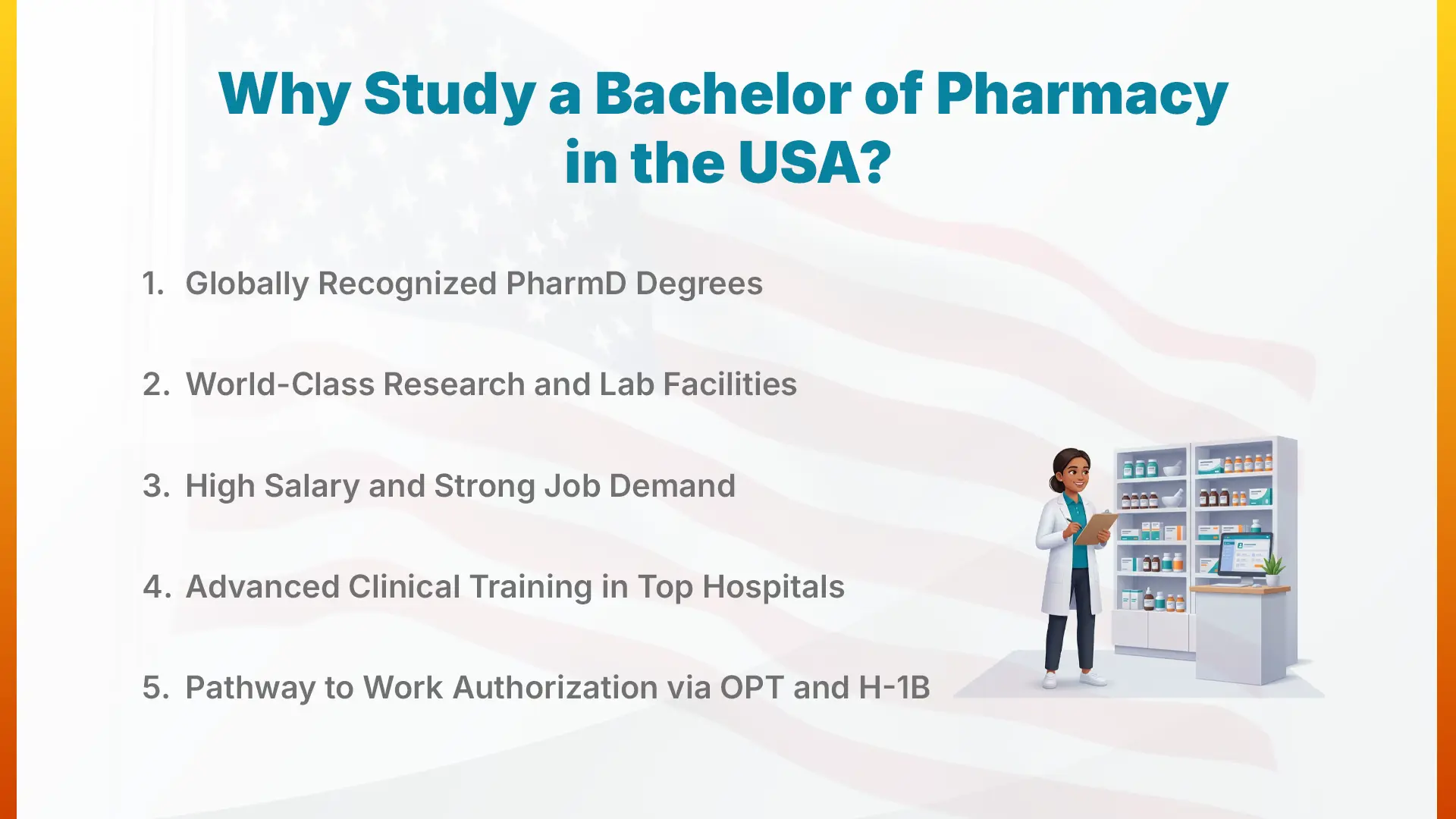
1. Globally Recognized PharmD Degrees
A PharmD from an ACPE-accredited US university is recognized by pharmacy regulatory bodies across North America, the UK, Australia, New Zealand, and several Gulf countries. For Nepalese graduates, a US pharmacy degree creates genuine international career flexibility, and the NAPLEX qualification is one of the most widely respected pharmacist licensing credentials in the world.
2. World-Class Research and Lab Facilities
US pharmacy schools invest heavily in cutting-edge research infrastructure, simulation pharmacies, and clinical laboratory facilities. Students at top institutions like UCSF and the University of Michigan have access to pharmaceutical research programs that are at the forefront of drug discovery, precision medicine, and pharmacogenomics. For students with research ambitions, no other destination matches the depth and scale of pharmacy research available in the USA.
3. High Salary and Strong Job Demand
Pharmacists in the USA are among the highest-paid healthcare professionals in the world. The Bureau of Labor Statistics consistently reports median annual pharmacist salaries above USD 120,000, with experienced clinical and specialized pharmacists earning significantly more. For Nepalese students weighing the return on a longer educational investment, the salary outcomes in the USA are exceptional and justify the additional years of study required.
4. Advanced Clinical Training in Top Hospitals
US PharmD programs place students in clinical rotations at some of the most advanced academic medical centers in the world, including Johns Hopkins, Mayo Clinic, Cleveland Clinic, and UCSF Medical Center. This level of clinical exposure gives students hands-on experience with complex pharmaceutical care cases that are simply not available in most other study destinations.
5. Pathway to Work Authorization via OPT and H-1B
International students who complete a PharmD in the USA are eligible for Optional Practical Training (OPT), which allows up to 12 months of full-time work after graduation in a pharmacy-related role. Pharmacist employers can then sponsor graduates for an H-1B work visa, providing up to six years of work authorization. Many US hospitals and healthcare systems also sponsor qualified pharmacists for employment-based green cards, making pharmacy one of the most accessible pathways to long-term US residency for internationally trained healthcare workers.
Top Universities Offering Pharmacy in USA
The top universities for pharmacy in the USA include the University of California, San Francisco; University of North Carolina; University of Michigan; Purdue University; University of Texas at Austin; and the University of Southern California, each offering ACPE-accredited PharmD programs, world-class research facilities, and strong clinical networks.
Choosing the right university depends on your academic profile, preferred location, budget, and whether a direct entry program is available. Nepalese students who want a broader view of US university options can explore the best universities in USA for international students before shortlisting.
1. University of California San Francisco (UCSF)
UCSF School of Pharmacy is consistently ranked as the number one pharmacy school in the United States and is one of the most prestigious pharmacy research institutions in the world. Its PharmD program is highly competitive and deeply research-integrated, with clinical placements across the UCSF Health hospital network and affiliated community health centers in the San Francisco Bay Area. UCSF graduates are among the most sought-after pharmacists in North America and internationally.
2. University of North Carolina (UNC)
UNC Eshelman School of Pharmacy in Chapel Hill is consistently ranked among the top three pharmacy schools in the USA and is known for its innovative, team-based approach to pharmacy education and its strength in pharmaceutical sciences research. Its PharmD program emphasizes interprofessional collaboration and patient-centered care, and students benefit from clinical placements across UNC Health's extensive hospital and outpatient network.
3. University of Michigan
The University of Michigan College of Pharmacy in Ann Arbor offers a rigorous PharmD program with strong research integration and a particular emphasis on pharmacotherapy and health outcomes. Michigan pharmacy graduates are highly regarded by employers across the USA and benefit from the university's strong alumni network and close ties with Michigan Medicine, one of the country's leading academic medical systems.
4. Purdue University
Purdue University College of Pharmacy in West Lafayette, Indiana, is one of the most respected pharmacy schools in the Midwest and offers a PharmD program with a strong focus on pharmaceutical sciences, drug development, and community pharmacy practice. Purdue is notable for its emphasis on technology and innovation in pharmacy practice, and its graduates are consistently well-prepared for both clinical and industry pharmacy careers.
5. University of Texas at Austin
The University of Texas at Austin College of Pharmacy offers a strong PharmD program with a focus on primary care pharmacy, patient counseling, and community health. UT Austin's location in one of America's fastest-growing cities provides students with exceptional access to a wide range of clinical placement opportunities across Texas's large and diverse healthcare system.
6. University of Southern California (USC)
USC Alfred E. Mann School of Pharmacy and Pharmaceutical Sciences in Los Angeles offers a well-regarded PharmD program with particular strengths in clinical pharmacology, pharmaceutical sciences research, and industry pharmacy. USC's location in Los Angeles gives students access to one of the most diverse and medically complex urban healthcare environments in the USA, and the university's strong connections with the pharmaceutical industry provide excellent career development opportunities.
Eligibility and Admission Requirements for Pharmacy in USA
The eligibility and admission requirements for pharmacy in the USA include completion of Grade 12 or Plus Two with strong results in biology and chemistry, English language proficiency through IELTS or TOEFL, PCAT scores where required, a personal statement, letters of recommendation, and medical and financial documentation. Meeting these requirements thoroughly is essential for securing admission to a reputable US pharmacy program. The exact requirements vary depending on whether you are applying to a traditional pre-pharmacy plus PharmD pathway or a direct entry program.
1. Academic Requirements
For direct entry PharmD programs, applicants must have completed Grade 12 or Plus Two with strong results, particularly in biology and chemistry, which are prerequisite subjects for all pharmacy programs in the USA. Minimum academic requirements typically range from a GPA equivalent of 3.0 to 3.5 on a 4.0 scale, with competitive programs at UCSF and UNC requiring higher academic profiles. For traditional pathway programs, students must first complete two to four years of pre-pharmacy undergraduate coursework before applying to the PharmD through the PharmCAS application system.
2. English Language Requirements
All PharmD programs in the USA are taught in English, and international applicants must demonstrate proficiency through an approved language test. Standard requirements are the following:
IELTS Academic: minimum overall score of 6.5 to 7.0, with no individual band below 6.0
TOEFL iBT: minimum score of 80 to 100, depending on the university
PTE Academic: minimum score of 58 to 65
Pharmacy programs typically require higher language scores than many other disciplines due to the critical importance of patient communication and medication counseling. Nepalese students who need to strengthen their English score before applying can enroll in IELTS preparation classes to reach their target band before submitting their application.
3. PCAT : Pharmacy College Admission Test
Some US pharmacy schools require applicants to sit the PCAT, a standardized test that assesses knowledge in biological sciences, chemistry, quantitative reasoning, and critical reading. However, many schools, including UCSF and USC, have made the PCAT optional or have eliminated the requirement entirely. Students should check the specific PCAT requirements for each university on their shortlist before preparing their application.
4. Personal Statement and Letters of Recommendation
Most universities require a personal statement explaining your motivation for pharmacy, your academic and healthcare background, any relevant experience, and your long-term career goals. Two to three letters of recommendation from science teachers or healthcare supervisors are also typically required. Nepalese students can follow the SOP format for USA universities to understand exactly what US admissions panels look for.
5. Medical Fitness and Financial Proof
Most pharmacy programs require incoming students to submit immunization records and complete a health screening before beginning clinical rotations. A criminal background check is also required at most institutions. For the F-1 student visa application, students must provide financial documentation demonstrating they can cover the full cost of tuition and living expenses for at least the first year of study.
How to Apply for Pharmacy in the USA?
The admission process for pharmacy in the USA involves six steps: researching and shortlisting universities, preparing your documents, submitting your application through the PharmCAS portal, writing your personal statement and securing reference letters, receiving your offer letter, and applying for the F-1 student visa. Approaching each step with proper preparation well in advance of deadlines gives Nepalese students the best possible chance of a successful outcome.
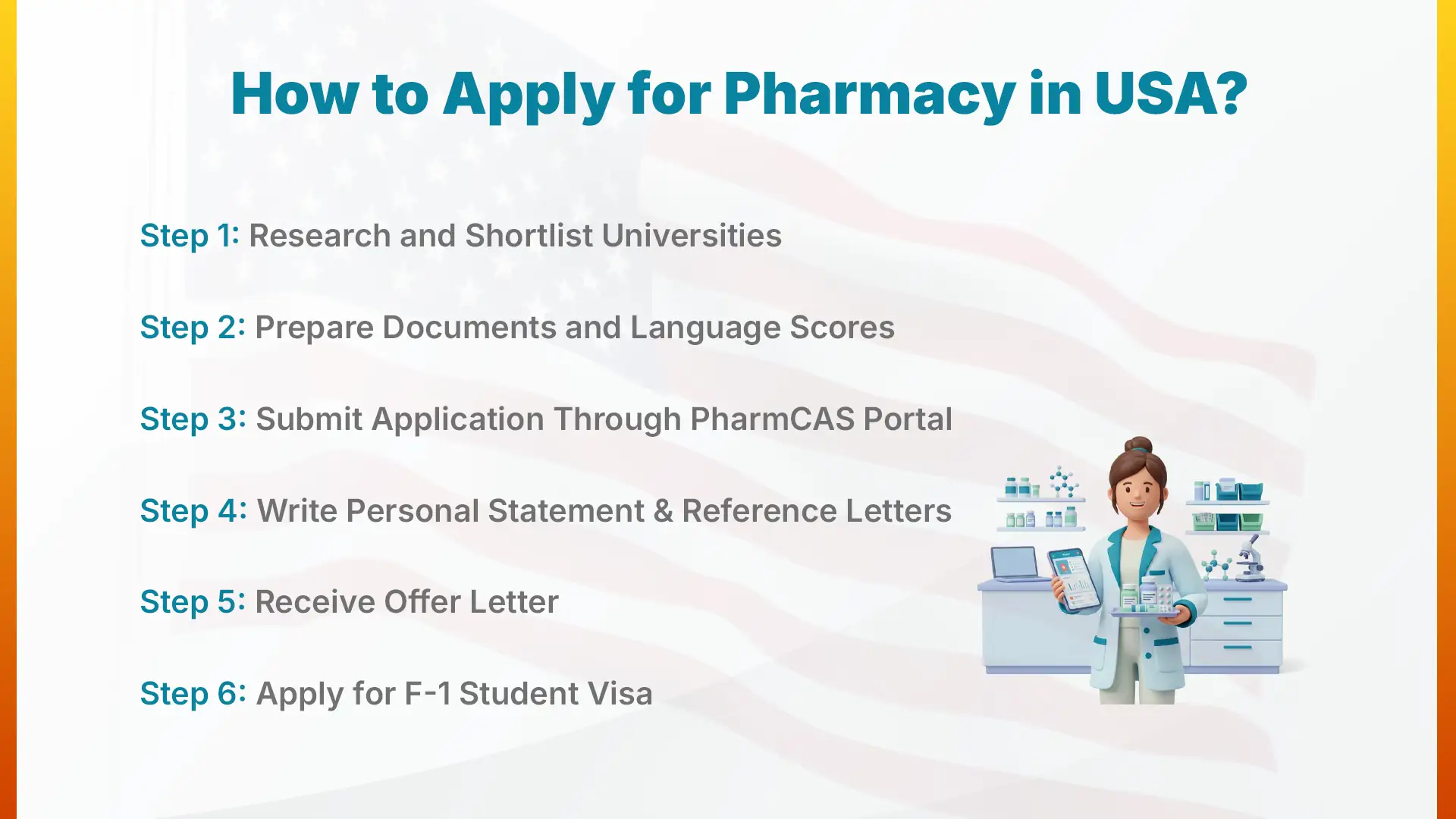
Step 1: Research and Shortlist Universities
Compare PharmD programs based on your academic profile, direct entry availability, PCAT requirements, tuition fees, clinical placement quality, intakes in the USA, and scholarship opportunities. Shortlist three to five universities to give yourself the best chance of receiving at least one offer.
Step 2: Prepare Documents and Language Scores
Gather your Plus Two transcripts, mark sheets, school leaving certificate, and character certificate. Book your IELTS or TOEFL exam early so your scores are ready before application deadlines, which typically fall between July and December for the following year's intake.
Step 3: Submit Application Through PharmCAS Portal
Most US pharmacy schools use the PharmCAS (Pharmacy College Application Service) centralized application system, which allows students to apply to multiple programs through a single portal. Some universities also accept direct applications through their own admissions portals. Pay close attention to individual program deadlines, as pharmacy admissions in the USA are highly competitive and seats fill quickly.
Step 4: Write Personal Statement and Reference Letters
Your personal statement should clearly articulate why you want to study pharmacy, what healthcare or science experiences have shaped that decision, and what you plan to contribute to the profession after graduating. It is also worth understanding what makes a strong letter of Recommendation before approaching your referees, as strong reference letters can significantly strengthen a competitive pharmacy application.
Step 5: Receive Offer Letter
The university will issue a conditional or unconditional offer after reviewing your application and, where applicable, conducting an interview. Many US pharmacy schools include a formal interview as part of the admissions process, so preparation is important.
Step 6: Apply for F-1 Student Visa
Once you have accepted your offer and received your I-20 form from the university, apply for the F-1 student visa through the US embassy. This involves paying the SEVIS fee, completing the DS-160 application form, and attending a visa interview. Having clear financial documentation and a well-prepared interview response significantly improves your chances of approval. The documents required for an F-1 visa cover the full checklist so you can prepare well in advance.
Cost of Studying Pharmacy in USA
The cost of studying pharmacy in the USA for international students generally ranges from USD 35,000 to USD 65,000 (approximately NPR 4,700,000 to NPR 8,750,000) per year in tuition fees for the PharmD program, depending on the university and state. When combined with accommodation, food, health insurance, and other living expenses, Nepalese students should budget approximately USD 50,000 to USD 85,000 (approximately NPR 6,750,000 to NPR 11,450,000) per year in total. While the USA is significantly more expensive than Canada or the In the UK, the cost to study in the USA is offset by pharmacist salaries that are among the highest in the world for any healthcare profession.
1. Tuition Fees
Tuition fees for international students in PharmD programs in the USA range from USD 30,000 to USD 65,000 (approximately NPR 4,050,000 to NPR 8,750,000) per year, depending on whether the university is publicly or privately funded. Public universities that receive state government funding offer lower tuition rates even for international students, while private universities charge higher fees that reflect their research investment and institutional resources. The table below gives a clear comparison to help Nepalese students plan their finances before shortlisting.
University Type | Annual Tuition (USD) | Annual Tuition (NPR approx.) |
|---|---|---|
| Public Universities | USD 30,000 – USD 45,000 | NPR 4,050,000 – NPR 6,075,000 |
| Private Universities | USD 45,000 – USD 65,000 | NPR 6,075,000 – NPR 8,750,000 |
2. Living Expenses
Monthly living expenses in the USA vary significantly by city. In San Francisco and Los Angeles, students should budget USD 2,500 to USD 3,500 per month for accommodation, food, and transportation. In smaller university cities such as Chapel Hill, Ann Arbor, or West Lafayette, monthly costs typically range from USD 1,500 to USD 2,500. On-campus accommodation and shared housing are the most cost-effective options for international pharmacy students.
3. Total Estimated Cost
Taking tuition, accommodation, food, transportation, health insurance, and miscellaneous expenses into account, Nepalese students should budget approximately USD 50,000 to USD 85,000 per year. For a four-year PharmD program, the total estimated cost ranges from USD 200,000 to USD 340,000 (approximately NPR 27,000,000 to NPR 45,900,000), making early scholarship applications and careful financial planning essential for most Nepalese students.
Scholarships for Pharmacy in USA
Scholarships for pharmacy in the USA include US government and federal awards, university-specific merit scholarships for international pharmacy students, and external healthcare and pharmacy foundation grants. While fully funded scholarships for international undergraduate students in the USA are limited, partial scholarships and tuition waivers from universities can meaningfully reduce the overall cost of the degree for high-achieving Nepalese students.
1. US Government and Federal Scholarships
The most relevant government-level funding for international pharmacy students in the USA comes through the Health Resources and Services Administration (HRSA), which offers scholarships to students who commit to practicing in underserved communities after graduation. These awards are primarily aimed at students with US residency or citizenship, but international students on certain visa pathways may qualify after completing their degree and obtaining work authorization.
2. University-Specific Pharmacy Scholarships
Most top pharmacy schools offer merit-based scholarships to high-achieving international applicants. These include:
UCSF School of Pharmacy International Student Awards
University of Michigan Pharmacy Scholarships
USC Pharmacy Merit Scholarships for International Students
Purdue University International Student Scholarships
UNC Eshelman School of Pharmacy Scholarships
These awards typically range from USD 5,000 to USD 30,000 per year and are awarded based on academic achievement, leadership, and the strength of the overall application.
3. External Healthcare and Pharmacy Scholarships
Several professional organizations and foundations offer scholarships specifically for pharmacy students in the USA, including:
American Pharmacists Association (APhA) Foundation Scholarships
American Association of Colleges of Pharmacy (AACP) Scholarships
National Community Pharmacists Association (NCPA) Foundation Scholarships
These awards are open to enrolled PharmD students and are awarded based on academic performance, community involvement, and professional pharmacy goals.
4. Tips to Increase Scholarship Chances
Apply as early as possible; most scholarship deadlines fall before the main admissions window
Maintain the highest possible Plus Two GPA, particularly in biology and chemistry
Include any healthcare volunteer experience, hospital shadowing, or pharmacy-related activities in your application
Write a focused and compelling personal statement that connects your science background directly to your pharmacy career goals
Apply to multiple scholarships simultaneously rather than waiting for one result at a time
Career Opportunities After Pharmacy in USA
Graduates with a PharmD from a US university can pursue careers as community pharmacists, hospital pharmacists, clinical pharmacists, pharmaceutical researchers, regulatory affairs specialists, and pharmacy managers across a wide range of healthcare and industry settings. The USA's consistent demand for licensed pharmacists, combined with one of the highest pharmacist salary scales in the world, means that PharmD graduates are among the most financially rewarded healthcare professionals in the country.
1. Community Pharmacist
A community pharmacist dispenses medications, counsels patients on drug use and interactions, administers vaccinations, and supports chronic disease management in retail pharmacy settings. This is the most common career pathway for PharmD graduates in the USA and offers strong salaries, widespread job availability, and flexible working arrangements across the country.
2. Hospital Pharmacist
A hospital pharmacist works within inpatient and outpatient hospital settings, reviewing medication orders, advising clinical teams on drug therapy, monitoring patient responses, and managing pharmaceutical inventory. Hospital pharmacy is one of the most clinically intensive and highly respected career paths for PharmD graduates in the USA.
3. Clinical Pharmacist
A clinical pharmacist works directly alongside physicians and nurses in multidisciplinary care teams, optimizing medication therapy for patients with complex or chronic conditions. This role is in strong demand across the USA's growing primary care, oncology, and specialty clinic sectors and is one of the highest-paid specializations within pharmacy practice.
4. Pharmaceutical Researcher
A pharmaceutical researcher works in drug discovery, development, and clinical testing at universities, government agencies like the FDA, or private pharmaceutical companies. The USA is the world's largest pharmaceutical research market, and PharmD graduates with research interests have exceptional career opportunities in this sector.
5. Regulatory Affairs Specialist
A regulatory affairs specialist ensures that pharmaceutical products meet the requirements of the FDA and international regulatory bodies before approval and market release. This is a specialized and well-compensated role that sits at the intersection of pharmacy science, law, and public health policy, and the USA offers more regulatory affairs career opportunities than any other country.
6. Pharmacy Manager
An experienced pharmacist with strong leadership and business skills can progress into pharmacy management roles within large retail chains, hospital systems, or healthcare organizations. This pathway offers significant career growth and competitive compensation packages, particularly within major US pharmacy chains and integrated health networks.
Scope and Salary After Pharmacy in USA
The scope and salary after pharmacy in the USA are among the strongest of any healthcare profession available to international graduates anywhere in the world. With a growing demand for pharmacists across all states, median annual salaries exceeding USD 120,000, OPT and H-1B work authorization pathways, and a clear route to a green card through employer sponsorship, a PharmD from the USA creates career and immigration opportunities that are difficult to match anywhere else.
1. Growing Demand for Pharmacists in USA
The Bureau of Labor Statistics projects steady employment growth for pharmacists in the USA over the coming decade, driven by an aging population, expanding pharmaceutical services in primary care, and the increasing complexity of medication management across the healthcare system. This makes pharmacy one of the best courses to study in the USA for Nepalese students who want strong and immediate employment outcomes after graduation.
2. Average Salary After PharmD in USA
Pharmacists in the USA are among the highest-paid healthcare professionals in the world, with annual salaries ranging from USD 110,000 to USD 175,000 (approximately NPR 14,850,000 to NPR 23,625,000) depending on experience level, specialization, and state of practice. Even at entry level, US pharmacist salaries are significantly higher than in any other English-speaking destination, making the longer educational investment financially worthwhile for Nepalese students who plan strategically. The table below reflects typical annual salary ranges for PharmD graduates across experience levels.
Experience Level | Annual Salary (USD) | Annual Salary (NPR approx.) |
|---|---|---|
| Entry-Level (0–2 years) | USD 110,000 – USD 125,000 | NPR 14,850,000 – NPR 16,875,000 |
| Mid-Level (2–5 years) | USD 125,000 – USD 145,000 | NPR 16,875,000 – NPR 19,575,000 |
| Senior / Specialist | USD 145,000 – USD 175,000+ | NPR 19,575,000 – NPR 23,625,000+ |
States such as California, Alaska, Vermont, and Oregon consistently offer the highest pharmacist salaries in the country. Clinical pharmacists and those working in specialized oncology or critical care settings earn at the top end of these ranges even at mid-level experience.
3. OPT and H-1B Work Pathways
After completing their PharmD, international graduates can apply for Optional Practical Training (OPT), which allows up to 12 months of full-time work in the USA in a pharmacy-related role. During this period, graduates can build US clinical experience and seek employer sponsorship for an H-1B work visa, providing up to six years of work authorization. Many Nepalese students also take up part-time jobs in the USA during their studies to manage living expenses and build early US work experience before graduating.
4. Pathway to Green Card Through Pharmacy Occupations
Pharmacists are frequently sponsored for EB-3 employment-based green cards by US hospitals, healthcare systems, and retail pharmacy chains facing staffing shortages. This makes pharmacy one of the most accessible pathways to long-term US permanent residency for internationally trained healthcare workers. The combination of high demand, employer willingness to sponsor, and strong salary levels makes the immigration pathway for US-trained pharmacists particularly well-supported.
5. Global Career Opportunities with US Pharmacy Degree
A US PharmD and NAPLEX qualification are recognized in Canada, the UK, Australia, New Zealand, and several Gulf countries. For Nepalese graduates who wish to explore career opportunities beyond the USA, a US pharmacy degree is one of the most portable and internationally respected healthcare credentials available. Students who want to compare the pharmacy pathway across destinations may find it useful to also look at the Bachelor of Pharmacy in Canada to understand the differences in duration, cost, and immigration outcomes.
Conclusion
The USA offers Nepalese students an unmatched combination of academic prestige, clinical training quality, research opportunity, and earning potential through a Doctor of Pharmacy degree. While the pathway is longer and the costs are higher than in Canada or the UK, the salary outcomes, career flexibility, and immigration possibilities that follow a US pharmacy qualification place it in a category of its own for students who are committed to reaching the highest level of the profession.
The demand for pharmacists in the USA is strong and sustained, the salaries are among the best in the world, and the pathways from graduation to long-term residency are well-established. For Nepalese students who are prepared to invest in a longer but highly rewarding educational journey, a PharmD from the USA is a qualification that opens doors across the globe.
Interested in studying pharmacy in the USA? Contact SAS Education Consultancy for a free counseling session and let us help you find the right university, apply for the best scholarships, and navigate the F-1 visa process with confidence.