What is the Success Rate for a European Student Visa from Nepal?

Apr 30, 2026
The dream of studying in Europe is often shadowed by a single, persistent fear: the visa rejection letter.
We’ve all heard the stories. One bad rumour from a friend, a heartbreaking refusal story on a Facebook group, or an agent’s half-truth about a guaranteed country. These stories make Europe feel like a fortress with a closed gate.
But in reality, Europe is not closed to Nepali students; it is simply more selective.
The difference between a visa approval or rejection in 2026 isn't luck; it's strategy, the approach.
This guide is designed to cut through the noise, breaking down real student visa success rates for Europe, country-by-country and showing you exactly how to secure your future.
In this blog
What Is the Student Visa Success Rate for Europe from Nepal?
Europe’s student visa success rate is generally strong, with most countries approving around 85% to 90% of well-prepared student applications. But when we talk about the European student visa success rate, you need to understand that there is no single fixed number for the whole continent. That is because Europe is made up of many separate countries, and each one follows its own visa rules, checks, and approval process.
This means your visa chances can change a lot depending on where you apply. Still, for well-prepared Nepali students with genuine study plans, the outlook for Europe in 2026 remains very positive.
1. Why There Is No Single Europe Visa Success Rate
Many students make one simple mistake. They treat Europe like one country, when it is actually many different countries with different visa systems. France, Germany, Finland, and Italy all check students in different ways, so what works for one may not work for another. That is why your visa result depends less on “Europe” and more on the country you choose and how well your application fits its rules.
2. Estimated Europe Student Visa Success Rate for Nepali Students
For Nepali students, Europe’s student visa success rate usually falls between 70% and 95%, depending on the country and the student’s profile. Students with strong grades, clean finances, and a course that matches their past study usually stay at the higher end. Those with random course changes, unclear study gaps, or weak financial proof often fall at the lower end. In simple words, stronger profiles get stronger visa results.
Europe Student Visa Success Rate by Country for Nepali Students
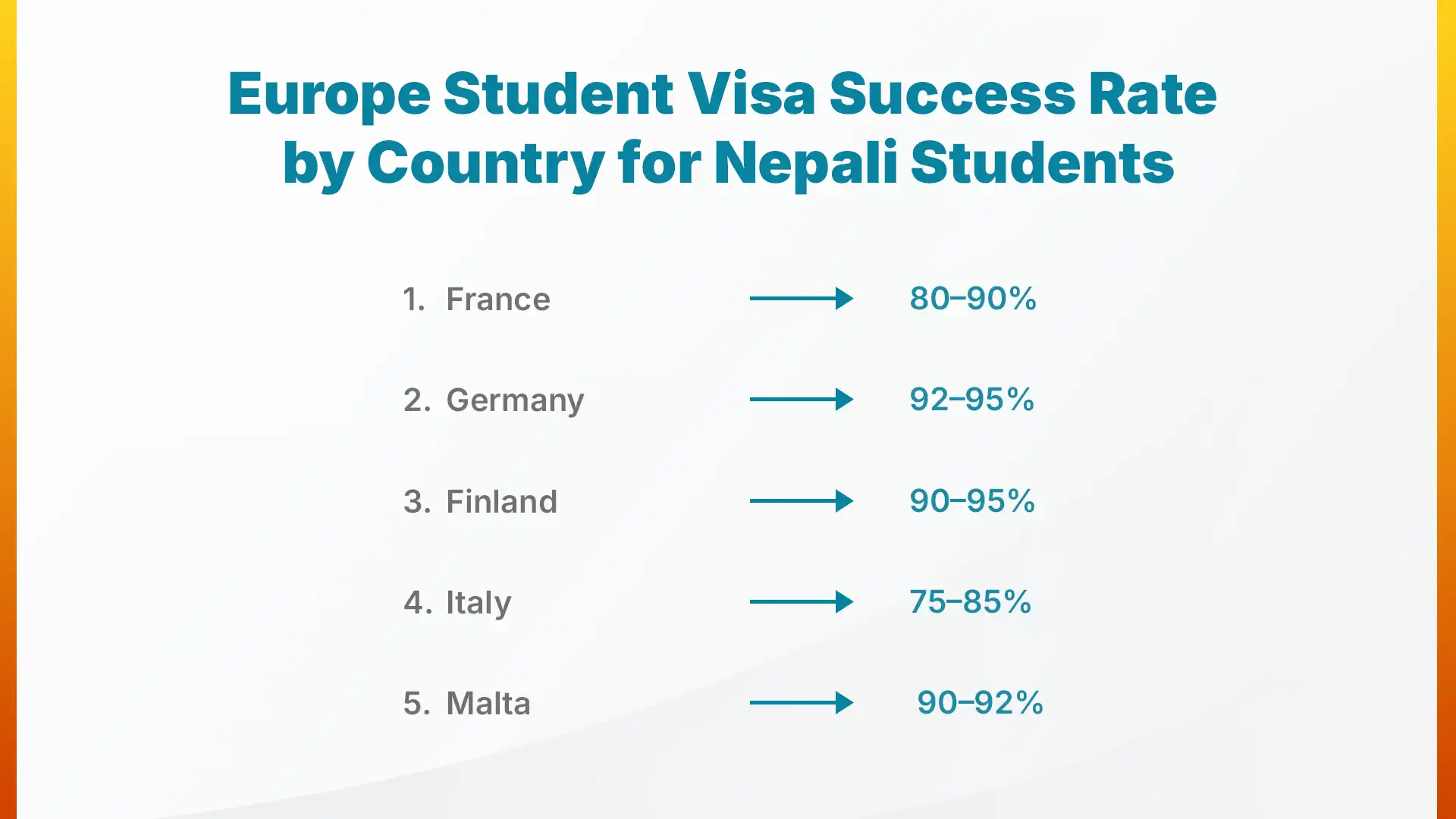
The best way to calculate your chances is to look at the specific data for each destination. In 2026, visa officers are utilizing more Digital Fast-Track systems, making the process faster but also more sensitive to errors. Here is how the top destinations compare:
1. France Student Visa Success Rate from Nepal
France remains one of the most predictable and welcoming options for Nepali students. The estimated French student visa success rate for 2026 is between 80–90%. The beauty of France lies in its structured Etudes en France (EEF) process. Because Campus France screens your academic intent before you even reach the embassy, most genuine students who pass the interview stage find the visa to be a smooth process.
2. Germany Student Visa Success Rate
Germany continues to offer one of the highest student visa success rates for Nepali students, usually around 92% to 95%. In 2026, Germany stays strict but fair, which means strong students usually do very well. If you have your APS certificate, blocked account, and a course that makes sense, approval is often smooth. Still, Germany is not forgiving with weak paperwork, so even small mistakes can lead to quick rejection.
3. Finland Student Visa Success Rate
Finland is one of the strongest Europe options for Nepali students in 2026, with an estimated success rate of 90% to 95%. It has become more attractive because students now receive a residence permit for the full length of their degree in many cases. Finland values clean documents, clear finances, and a strong university profile. For students who apply carefully and stay organized, the process is often smooth, fast, and much easier to predict.
4. Italy Student Visa Success Rate
Italy offers strong value for Nepali students, but the visa process is less predictable than some other European countries. In 2026, the estimated Italy student visa success rate is around 75% to 85%. Most problems in Italy happen because of paperwork mistakes, missed steps, or unclear financial documents, not weak academics. So, while Italy can be a smart and affordable option, it works best for students who are careful, patient, and very organized.
5. Malta Student Visa Success Rate
Malta remains a popular option for Nepali students because it is English-speaking and often looks simpler on paper. In 2026, the estimated Malta student visa success rate is around 79% to 85% for prepared applicants. Still, Malta can be less predictable in practice, with longer processing times and more document follow-ups. It can work well, but students usually need to apply early, stay patient, and avoid rushing the process.
Remember that the best country isn't the one with the highest percentage, but the one whose requirements match your profile's strengths.
What Affects Your Visa Success Rate for Europe the Most?
Your success in getting a European student visa depends much more on the quality of your profile than on simple luck. Most refusals happen because of small but avoidable mistakes in your bank documents, your choice of school, or your career goals. Let's take a closer look at the main factors that will decide whether your application gets approved or rejected.
In 2026, visa officers are moving away from General Intent and toward Return on Investment (ROI) logic. They want to know: Does this study plan make financial and professional sense?
1. Financial Strength and Source of Funds
It is no longer enough to simply show a big bank balance. Visa officers now want to see where that money came from and whether it makes sense. You must show clear proof like income records, tax papers, or other simple documents that explain your family’s earnings. If a large amount appears suddenly without a clear reason, it may look suspicious, so your funds should have a clean and believable history before you apply.
2. Course Relevance and Academic Path
Your course should make sense with what you studied before or the work you have done in Nepal. If your course choice feels random or unrelated, the visa officer may doubt your real reason for applying. This is one of the most common reasons students get rejected. A course that clearly builds on your past study or career always gives you a stronger case.
3. SOP and Motivation Letter Quality
A weak or copied SOP can quickly damage your visa chances. Visa officers read many similar applications, so they can easily tell when a letter feels generic or not personal. Your SOP should clearly explain why you chose the course, why you picked that university, and how it fits your future plan. Keep it simple, honest, and personal because a clear story builds more trust than fancy words.
4. University Credibility and Ranking
The university you choose can also affect your visa result. A well-known and trusted university usually makes your application stronger because it shows a clear academic purpose. On the other hand, low-quality colleges often create more doubt and more questions. That is why choosing a credible university can improve both trust and approval chances.
Top Reasons European Student Visas Get Rejected from Nepal
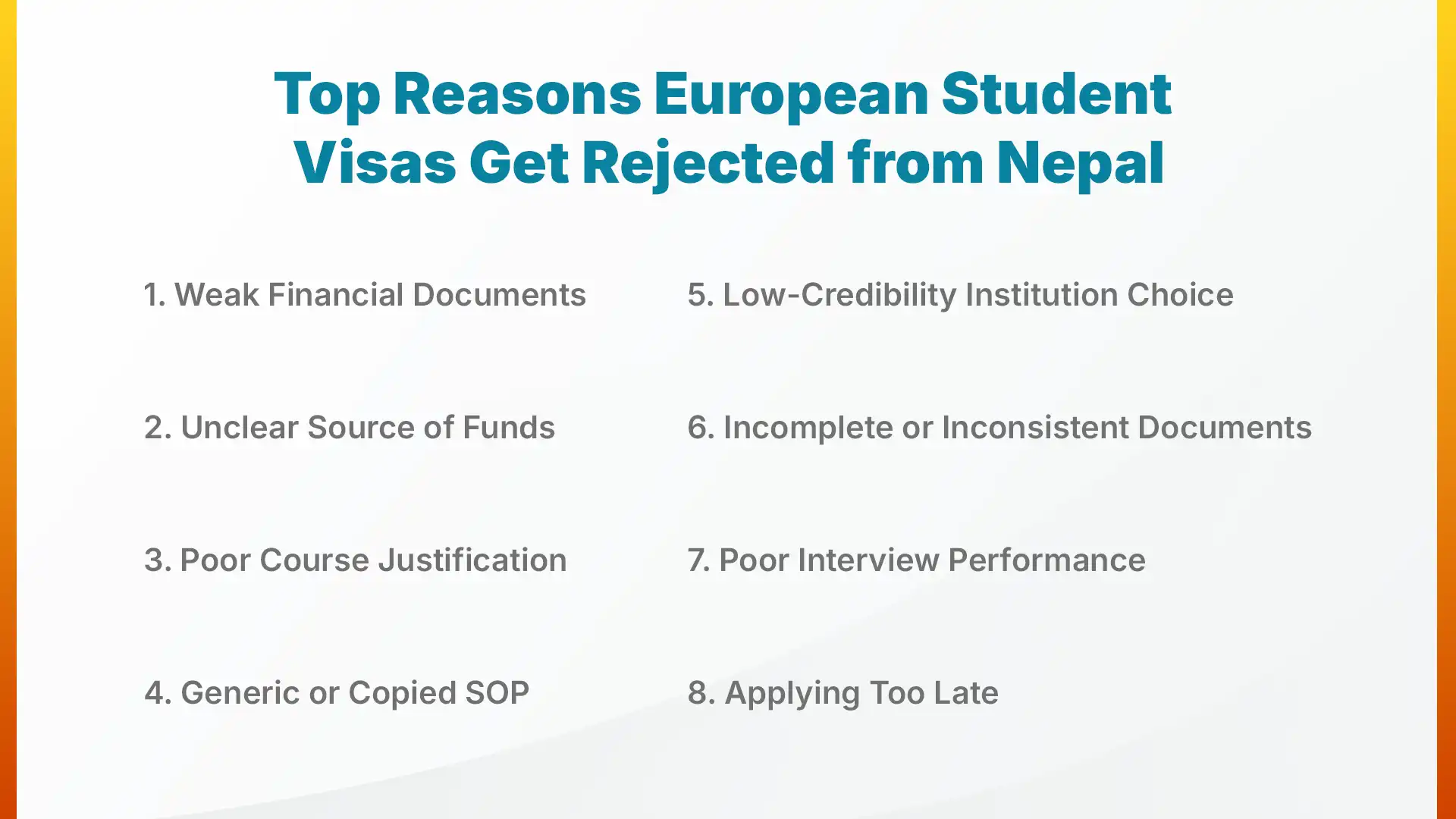
Most European student visa rejections in Nepal happen because of simple mistakes like missing documents, weak financial proof, or unclear study plans, rather than bad luck. Most of these refusals can be avoided if you understand the common triggers that make visa officers worry about your application. Below are the most frequent reasons why visas are denied and the steps you can take to stay safe.
Most rejections are avoidable. If you want to refusal-proof your application, avoid these common 2026 pitfalls:
1. Unclear Source of Funds
Germany and Poland are very strict about financial proof, especially Germany, where a Blocked Account of around €11,904 is mandatory. If you only show bank statements without a clear income history, your visa can be rejected immediately. Sudden deposits, loans, or unexplained funds also create suspicion. Your money must clearly come from legal and consistent sources like salary, business, or property income.
2. Generic or AI-Generated SOPs
France is highly strict because of the Campus France interview system, where your SOP is directly tested through questions. If your SOP sounds copied, robotic, or too general, your answers will not match your story. Officers expect personal details like your real academic journey and clear goals for returning to Nepal. A simple, honest SOP always performs better than a polished but fake-sounding one.
3. Low-Credibility Institution Choice
Italy becomes strict when students choose low-ranked private colleges with weak academic recognition or unclear CIMEA validation. If the university looks like a “visa shortcut,” the embassy may doubt your real intention. This is common in some private institutions that focus more on admissions than education quality. Always choose a recognized public university or a well-established private institution with a strong academic reputation.
4. Inconsistent or Incomplete Documents
Across Schengen countries like Germany, France, Italy, and Poland, even small document errors can cause major issues. A wrong spelling, a missing translation, or mismatched date between documents can lead to rejection. VFS Global centers carefully check every file before submission. Your passport, transcripts, and certificates must all match perfectly without confusion or corrections needed later.
5. Applying Too Late in the Cycle
Finland processes visas efficiently, but timing is still very important. If you apply too close to your intake, especially in August for a September start, your residence permit may not arrive in time. Missing deadlines can lead to admission cancellation or delayed entry. The safest approach is to apply immediately after receiving your unconditional offer to avoid unnecessary risk.
How to Improve Your Europe Student Visa Success Rate from Nepal?
You can significantly increase your chances of visa success by making smart decisions and planning your application months in advance. Most students who get their visas approved are the ones who focus on small details and avoid rushed, last-minute mistakes. Here is a list of practical steps you can take right now to build a much stronger application for one of the countries in Europe:
1. Choose the Right Country for Your Profile
You should not pick a country just because it is popular; instead, pick one where your academic background and budget fit perfectly. If your grades are average but you have plenty of savings, a country like France might be more welcoming for you. However, if you are a top-performing student with high scores, Germany will offer you the most structured and predictable path.
2. Build Clean Financial Documents Early
Don't wait for your admission letter to start thinking about your finances and legal documents. You should begin organising your bank statements, tax papers, and property valuations at least six months before you plan to leave Nepal. This gives you enough time to fix any errors and ensures that your financial history looks stable and consistent to the embassy.
3. Get Strong English Test Scores
Even if a university says they don't require an English test, you should still take the IELTS or PTE to prove your skills. Having a high score like 6.5 or 7.0 sends a clear message to the visa officer that you are ready to handle a degree taught in English. It removes any doubt about your ability to succeed in a foreign classroom and significantly boosts your credibility. For many competitive European countries, a strong test score is the key that opens the door to a successful visa.
4. Prepare Thoroughly for Your Interview
If your chosen country requires an interview, you must be able to talk about your study plan without sounding like you have memorized a script. You should be ready to explain why you didn't choose to study in Nepal and how this specific European degree will help you earn more money later.
Practice answering questions about your university's location, the modules you will study, and your plans after graduation. Being calm, honest, and well-informed during the talk will help you win the trust of the visa officer.
Which European Countries Have Better Student Visa Chances for Nepali Students?
France, Germany, Finland, Italy, Malta, and some smaller emerging European destinations all have different student visa chances for Nepali students. Some countries follow clear systems and give consistent results when your profile is strong, while others depend more on timing, documentation quality, and embassy workload. So, the real goal is to choose a country that fits your profile, not just chase approval rates.
1. More Predictable and Structured Options
France, Germany, and Finland are generally more predictable destinations for Nepali students when it comes to visa approval. France follows the Campus France system, where your academic intent is screened before the visa stage, so clarity in your study plan is very important. Germany is strict but fair, and if your APS, Blocked Account, and academic pathway are strong, your chances are usually high. Finland is also well-structured, with digital processing and clear requirements, making outcomes more stable for well-prepared students.
2. Moderate but Profile-Sensitive Options
Italy, Hungary, and Poland fall into the moderate category where visa success depends heavily on your personal profile. Italy offers good opportunities, but small mistakes in financial proof or documentation can affect results quickly. Hungary and Poland are growing destinations, but embassy scrutiny can vary depending on university credibility and financial clarity. These countries work best when your application is consistent, well-prepared, and logically aligned from start to finish.
3. More Unpredictable or Slower Options
Malta and some smaller or emerging European countries are generally more unpredictable for Nepali students. Malta, in particular, may involve slower processing times and variable embassy workload, which can delay decisions even for strong applicants. Smaller destinations can also have limited intake slots, which adds uncertainty to timing. This does not always mean rejection, but it does require early application and strong patience throughout the process.
The best country for your education is never the one with the easiest visa. It is the one that matches your academic background, financial situation, and long-term plan. When your profile fits the country’s expectations, your chances naturally become stronger, smoother, and more reliable.
Is Europe Still a Good Option for Nepali Students in 2026?
The answer is a definitive yes. Despite the stricter rules, Europe remains the most affordable and high-quality alternative to the UK, USA, or Australia. In 2026, countries like Germany and Finland will have even expanded work rights (up to 30 hours per week in Finland) to help students manage living costs. The Continuous permits and generous post-study work visas make Europe a long-term investment, not just a short-term degree.
Europe is still very much open; it just requires you to be a student first and an applicant second.
Conclusion
The era of easy visas is over, but the era of strategic success has begun. Europe is no longer forgiving of weak preparation, but for the serious Nepali student, the doors have never been wider.
Your success depends on moving away from rumours and moving toward a plan built on clean finances, logical course choices, and early action.
If you feel intimidated by the process, remember, every successful student started exactly where you are. Don't let a fear of rejection stop you from a global career.
Prepare smarter, choose carefully, and start today. If you need any help with the application, do not hesitate to reach out to the best consultants for European education. Your European future is waiting.